

MRSA PCR Test Sensitivity: How Accurate are Rapid Screening Results?
Imagine standing just days away from a major surgery, only to face the uncertainty of a pending or unclear screening result. It’s a common source of anxiety for patients across the UK who fear a last-minute cancellation. When your surgical team requires a clear result, the accuracy of your screening becomes the most important factor in your preparation. Recent clinical data from 2025 shows that mrsa pcr test sensitivity can reach as high as 100% for nasal swabs. This high level of precision means a negative result is exceptionally reliable, providing the certainty you need before your procedure.
We understand that medical terms like “sensitivity” can feel confusing when you’re just trying to complete a pre-op checklist. You want to know if you can trust the technology. In this guide, you’ll discover why molecular PCR testing is now the preferred choice for urgent screenings and how it compares to traditional culture methods. We’ll break down the latest clinical benchmarks in plain English and provide a clear path toward securing your pre-surgical clearance without the stress of unnecessary delays.
Key Takeaways
- Learn how high mrsa pcr test sensitivity ensures that even low levels of bacteria are detected, providing a reliable safety net for your health.
- Understand the clinical distinction between sensitivity and specificity to better interpret your screening’s accuracy and reliability.
- Discover why swabbing three key areas, the nose, groin, and axilla, is the most effective way to ensure no colonization is missed.
- Compare the 24-hour turnaround of molecular PCR tests with traditional culture methods to meet your urgent pre-surgery deadlines.
- Identify the external factors, such as recent antibiotic use, that can impact your results and learn how to prepare for a successful swab.
What is MRSA PCR Testing and Why Does Sensitivity Matter?
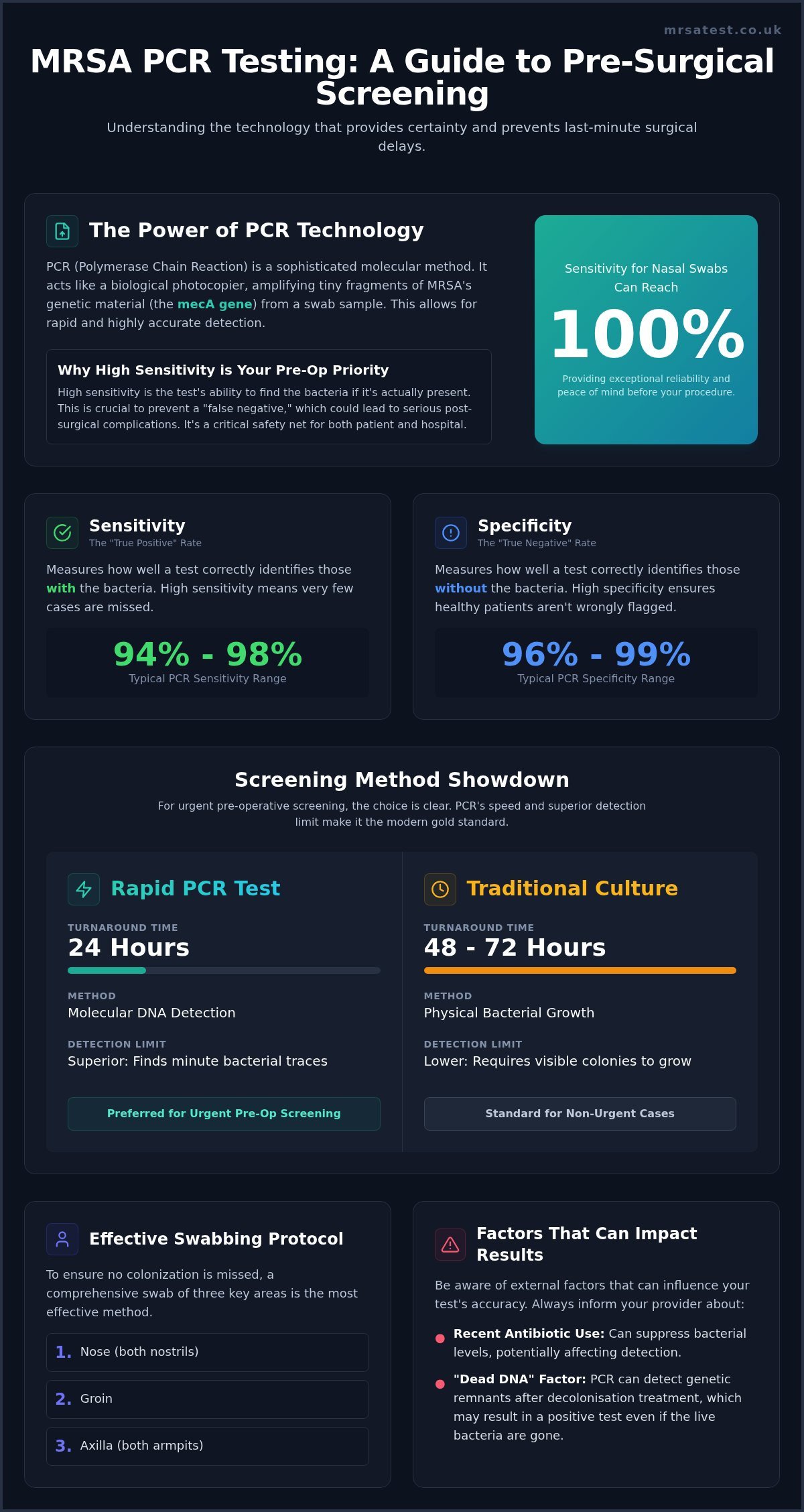
PCR stands for Polymerase Chain Reaction. It’s a sophisticated molecular method used by laboratories to detect the specific genetic material of a pathogen. When a lab screens for Methicillin-resistant Staphylococcus aureus (MRSA), the test specifically targets the mecA gene. This gene is the specific biological marker that grants the bacteria its resistance to standard antibiotics. Understanding mrsa pcr test sensitivity is vital because it represents the “true positive” rate. In plain English, sensitivity measures how well a test can find the bacteria if it’s actually present on your skin or in your nose. A test with high sensitivity is less likely to return a false negative, providing the clinical certainty required before an invasive procedure.
The Science of Molecular Detection
The PCR process works by amplifying tiny fragments of bacterial DNA. Think of it as a biological photocopier. Even if only a few bacterial cells are present on your swab, the lab can create millions of copies of the target DNA sequence until it’s clearly identifiable. This makes the method inherently faster than traditional culture techniques. While a culture requires 48 to 72 hours for bacteria to physically grow into visible colonies, PCR provides a definitive answer within a much shorter timeframe. There is also a distinction between detecting live bacteria and bacterial DNA. PCR identifies the genetic blueprint. This is a highly reliable way to determine if a patient is a carrier, as the DNA remains detectable even if the bacteria aren’t currently in an active growth phase.
Why Sensitivity is Your Pre-Op Priority
For anyone preparing for surgery, safety is the primary concern. Missing a colonisation, known as a false negative, can lead to serious post-surgical complications. If the bacteria aren’t detected, a patient might enter an operating theatre without the necessary decolonisation treatment. This increases the risk of surgical site infections and other hospital-acquired infections (HAIs). High mrsa pcr test sensitivity acts as a critical safety net for both the patient and the healthcare facility. It helps hospitals maintain “clean” environments by ensuring carriers are identified and treated before they can spread the bacteria. If you’re still learning about the basics of this condition, you can read more about what is MRSA to understand why these screening protocols are so strictly enforced across the UK.
Sensitivity vs. Specificity: How Accurate is the PCR Method?
When discussing medical diagnostics, accuracy is split into two distinct categories: sensitivity and specificity. Sensitivity is the test’s ability to correctly identify those with the bacteria. Recent market research from 2026 indicates that mrsa pcr test sensitivity levels typically range between 94% and 98%. This means the test is incredibly effective at “catching” the bacteria if it’s present on your body. Specificity, on the other hand, measures how well the test identifies those who are not carriers. PCR platforms maintain high specificity, usually between 96% and 99%, ensuring that healthy patients aren’t wrongly flagged as positive.
One unique aspect of molecular testing is the “Dead DNA” factor. Because PCR looks for genetic material rather than live, growing organisms, it can sometimes detect the remnants of bacteria that have already been killed by recent treatment. This can lead to a positive result even if you’ve successfully completed a decolonisation protocol. While this might seem like a drawback, it actually highlights the test’s power. It ensures that even the smallest trace of MRSA DNA is accounted for, providing a level of safety that traditional methods simply cannot match. If you need a reliable screening before a hospital admission, choosing a high-quality MRSA Rapid PCR Test can provide the clinical clarity you need.
PCR Sensitivity Comparison Table
Microbiologists often debate the “Gold Standard” of testing. While culture was the traditional choice for decades, PCR is now the preferred method for urgent pre-operative screening due to its superior limit of detection. It can find much smaller amounts of bacteria than a culture can.
| Feature | Rapid PCR Test | Traditional Culture |
|---|---|---|
| Result Speed | Within 24 hours | 48 to 72 hours |
| Sensitivity | 94% to 98% | 70% to 85% |
| Detection Limit | Very Low (Highly sensitive) | Moderate |
Understanding False Positives and Negatives
No medical test is 100% perfect, but PCR comes very close. A false negative occurs when the test says you’re clear, but you actually carry the bacteria. This is rare with a 99% sensitivity threshold, though it can happen if the swab technique is poor or if the colonisation is extremely low. False positives are equally uncommon. They usually occur due to the detection of non-viable (dead) DNA or cross-contamination. For surgical patients, the high negative predictive value (NPV) of PCR is the most important metric. It means a negative result is almost certainly correct, allowing you to proceed with your procedure with total confidence.
Factors That Can Influence Your MRSA Swab Accuracy
While the technology behind molecular testing is incredibly precise, the final result is heavily dependent on the quality of the sample provided. To achieve the highest possible mrsa pcr test sensitivity, the swabbing technique must be thorough. MRSA colonisation isn’t always uniform; the bacteria can reside in different warm, moist areas of the body. This is why sampling multiple sites is a clinical necessity. While some basic screenings only suggest a nasal swab, the established UK standard for pre-operative clearance typically requires samples from the nose, groin, and axilla (armpit) to ensure no bacterial reservoirs are missed.
External factors can also temporarily mask the presence of bacteria. Recent use of systemic antibiotics or the application of antiseptic washes, such as chlorhexidine, can lower the bacterial load on the skin surface. This doesn’t mean the MRSA is eradicated, but it may fall below the detection limit of the test. Similarly, “intermittent shedding” describes how bacteria are released from the skin in varying amounts over time. Using a laboratory-accredited service is vital here. Accredited facilities follow strict protocols to ensure that even low-level samples are processed with maximum reliability, providing a clear and trustworthy result.
Maximising Accuracy During At-Home Collection
To ensure your sample contains enough genetic material for analysis, it’s important to follow the provided instructions carefully. The “Nose, Groin, and Axilla” triple-site approach is the gold standard because it covers the most common areas of colonisation. When swabbing, use a firm but gentle rotating motion to collect sufficient material. Once you’ve finished, place the swab immediately into the transport tube. Our kits are designed to maintain DNA integrity during transit, so the laboratory receives a high-quality sample for molecular analysis.
Common Pitfalls in MRSA Screening
One frequent error is testing too soon after a previous infection or treatment. Testing immediately after a decolonisation protocol might lead to a positive result due to the detection of non-viable DNA. Conversely, testing while you’re still taking antibiotics can lead to a false negative because the medication suppresses the bacteria. Contamination of the swab by touching it against non-clinical surfaces can also lead to inconclusive results. For a detailed look at how to manage your screening timeline and avoid these issues, refer to our at-home test kits UK guide.
PCR vs. Culture: Which Screening Method Should You Choose?
Choosing between PCR and traditional culture is a common step in surgical preparation. While both tests are clinically valid, they serve different logistical needs. PCR is the preferred choice for urgent pre-operative clearance because it delivers results within 24 hours of laboratory receipt. In contrast, a traditional culture is often better suited for routine screenings where time is not a critical factor. For high-risk procedures like orthopaedic or cardiac surgeries, many UK hospitals now mandate a PCR result due to the superior mrsa pcr test sensitivity and the need for immediate, reliable data.
The logistical benefit of a 24-hour turnaround cannot be overstated for private surgery preparation. It provides a clear, documented status that meets the “Zero Tolerance” mandates for hospital-acquired infections. While a culture remains a useful tool for identifying specific antibiotic sensitivities in a diagnosed infection, the molecular speed of PCR has made it the modern standard for screening healthy carriers before they enter a clinical environment.
When Speed Equals Sensitivity
Speed is more than just a matter of convenience; it represents a clinical necessity. If a screening returns a positive result, you typically need a five-day decolonisation protocol before surgery can proceed. Waiting 48 to 72 hours for a culture result can close your clinical window and force a last-minute cancellation. By receiving results in just 24 hours, you gain the time needed to start treatment immediately and stay on track for your procedure. You can use our preparing for surgery checklist to ensure every part of your pre-op timeline is accounted for.
Cost-Effectiveness and Clinical Utility
While a culture test might have a lower upfront cost, the financial risk of a cancelled private surgery can be substantial. PCR technology justifies its cost by offering the highest available mrsa pcr test sensitivity, providing a definitive answer when you need it most. It removes the guesswork and the anxiety of a long wait. In private healthcare settings, where patient safety and efficiency are paramount, the peace of mind provided by rapid results is invaluable. A standard culture is perfectly sufficient for general health monitoring, but when a surgical date is on the line, the molecular approach is the gold standard. If you are working toward a strict surgical deadline, you can order your MRSA Rapid PCR Test today to ensure your results arrive in time.
Secure Your Pre-Op Clearance with mrsatest.co.uk
When your surgery date is approaching, you need a screening partner that understands the high stakes of clinical timelines. Our MRSA Rapid PCR Test– Nose/Groin/Axilla is designed to provide the highest level of diagnostic certainty available outside of a hospital ward. By utilizing the same molecular technology found in top-tier UK medical facilities, we ensure that your mrsa pcr test sensitivity remains at the peak of clinical standards. This precision allows you to meet hospital requirements with confidence, knowing that your results are backed by rigorous laboratory accreditation and expert oversight.
We’ve streamlined the entire process to remove the typical stress associated with pre-operative logistics. Our service is built on a foundation of speed and discretion. Every kit is dispatched from our UK hub and includes everything you need for a successful collection, including prepaid return shipping. Because our partner laboratories are located within the UK, we can offer a 24-hour turnaround time from the moment your sample reaches the lab. This efficiency has made us a trusted choice for thousands of patients who cannot afford a delay in their surgical journey.
The mrsatest.co.uk Difference
Quality starts with the tools you use. We provide clinical-grade swabs that are identical to those used by healthcare professionals in surgical theatres. These high-capacity swabs are essential for capturing enough genetic material to maintain maximum mrsa pcr test sensitivity. Once your sample is processed, your results are delivered directly to a secure, confidential portal. You won’t have to wait for a GP appointment or a letter in the post. If your result is positive, our team provides clear, calm guidance on the next steps, helping you understand the implications for your upcoming procedure without the jargon.
Ordering Your Kit Today
Securing your clearance is a simple, three-step process that fits around your schedule. There’s no need for an in-person appointment or a complex referral. We focus on getting you the answers you need as quickly as possible so you can focus on your recovery.
- Order: Request your kit online before 3 pm for next-day dispatch via our reliable UK courier network.
- Swab: Follow our clear, illustrated instructions to collect samples from your nose, groin, and axilla in the privacy of your home.
- Post: Use the included prepaid envelope to return your sample to our accredited laboratory for immediate molecular analysis.
Don’t let a missing test result stand between you and your health goals. By choosing a specialist service, you’re investing in the peace of mind that comes from professional-grade diagnostics. Order your MRSA Rapid PCR Test Kit now and take the final step toward a safe and successful surgery.
Preparing for a Safe and Successful Surgery
You now understand that high mrsa pcr test sensitivity is the key to a reliable pre-operative clearance. By choosing molecular detection over traditional culture methods, you gain a significant advantage in both speed and accuracy. This technology ensures that even low levels of bacteria are detected, allowing you to address any colonisation well before you reach the operating theatre. Remember that swabbing multiple sites, including the nose, groin, and axilla, remains the clinical standard for a truly thorough screening.
Securing your results shouldn’t be a source of stress during your surgical preparation. Our streamlined service provides professional-grade testing with the convenience of an at-home kit. You’ll receive results within 24 hours of lab receipt from our accredited UK laboratory partners, and we include free tracked 24 return shipping to ensure your sample is processed without delay.
Order Your Rapid MRSA PCR Test Kit for 24-Hour Results and move forward with the quiet confidence that your health is being managed by experts.
Frequently Asked Questions
How sensitive is a PCR test for MRSA?
PCR testing is highly precise, with clinical studies from late 2025 showing that mrsa pcr test sensitivity can reach levels between 94% and 98%. This high percentage means the test is exceptionally reliable at identifying the bacteria even when present in very small amounts. Because it detects the specific mecA gene in the bacterial DNA, it acts as a powerful safety net for patients who need definitive answers before undergoing an invasive medical procedure.
Can an MRSA PCR test give a false negative?
False negatives are rare with molecular testing, but they can occur under specific conditions. If the bacterial load on the skin is extremely low or if the swab doesn’t collect enough material from the nose, groin, or axilla, the test might miss the colonisation. Recent use of antiseptic washes or systemic antibiotics can also temporarily suppress the bacteria, making it harder for the laboratory equipment to detect the target genetic material.
Is PCR more accurate than a standard MRSA culture?
PCR is considered more accurate for screening because it has a lower limit of detection than a traditional culture. While a culture requires the bacteria to physically grow into visible colonies over 48 to 72 hours, PCR identifies the DNA blueprint immediately. This molecular approach ensures that even non-viable or slow-growing bacteria are accounted for, providing a more comprehensive view of your carrier status than older, growth-dependent methods.
Why do hospitals prefer PCR for pre-operative screening?
Hospitals prioritise PCR because its speed and mrsa pcr test sensitivity support critical infection control mandates. Rapid results allow surgical teams to make informed decisions within 24 hours, rather than waiting days for a culture to finish. This efficiency is vital for maintaining “clean” operating environments and preventing surgical site infections. Identifying carriers quickly ensures that necessary decolonisation treatments can begin immediately without delaying the scheduled surgery date.
Does a positive PCR test mean I have an active infection?
A positive result usually indicates colonisation, not necessarily an active infection. Colonisation means the bacteria are living on your skin or in your nose without causing illness. However, even without symptoms, being a carrier increases the risk of developing an infection after surgery. The test identifies the presence of MRSA DNA so that you can undergo a five-day decolonisation protocol to clear the bacteria before your procedure begins.
How long are MRSA PCR results valid for before surgery?
The validity period for a screening result is determined by your specific hospital’s policy rather than the test itself. Most UK surgical departments require a clear result from a test taken within two to four weeks of your admission date. It’s essential to check with your pre-assessment team to ensure your screening fits their required timeframe. Testing too early might mean you need to repeat the process before your operation.
Can I do the MRSA swab myself at home accurately?
Yes, you can collect an accurate sample at home by following the provided clinical instructions. The key is to ensure you swab all required sites, typically the nose, groin, and axilla, using a firm rotating motion. Our at-home kits use the same clinical-grade swabs found in professional medical settings. These swabs are designed to capture sufficient genetic material for high-sensitivity laboratory analysis, ensuring your self-collected sample is reliable.
What should I do if my PCR test comes back positive?
If your result is positive, you should contact your surgical team or pre-assessment clinic right away. They will typically prescribe a five-day decolonisation protocol, which involves using antiseptic body washes and nasal creams. It’s important to complete the full course as directed to clear the bacteria. Once the treatment is finished, your hospital may require a follow-up test to confirm you are clear before your surgery can proceed safely.