

Avoiding Surgery Delays in the UK: A Patient’s Guide to 2026
What if the only thing standing between you and your long-awaited surgery date wasn’t the NHS backlog, but a simple screening result you didn’t see coming? With 7.11 million cases currently on the elective treatment waiting list as of March 2026, the pressure to ensure your slot remains secure has never been higher. One of the most common reasons for a sudden cancellation is a positive MRSA screen, which requires a five-day decolonisation period before you can safely enter the operating theatre. Understanding exactly when to get mrsa test before surgery uk is the most effective way to prevent these avoidable clinical delays.
It’s natural to feel anxious about being a carrier without knowing it, especially when conflicting NHS timelines leave you feeling uncertain about your readiness. We understand that you want peace of mind that you are clinically fit for your procedure. This guide explains how to navigate current screening protocols and manage your own clinical timeline to avoid last-minute surprises. You’ll learn how to use rapid PCR and culture testing to build a strategy that ensures you’re ready to proceed the moment your hospital date arrives.
Key Takeaways
- Understand how current NHS supply shortages and clinical prioritisation protocols impact your surgery date in 2026.
- Learn exactly when to get mrsa test before surgery uk to ensure you have a sufficient “buffer zone” for any required decolonisation.
- Identify how MRSA screening acts as a hidden bottleneck and why early detection prevents last-minute, on-the-day cancellations.
- Use our structured 4-week pre-op checklist to manage your clinical readiness and administrative requirements with confidence.
- Compare the benefits of Rapid PCR and Standard Culture tests to choose the most efficient screening method for your specific timeline.
The State of UK Surgery Delays in 2026: Beyond the Waiting List
The UK’s elective surgery landscape in 2026 remains a complex environment for patients. While the NHS waiting list saw a slight decline to 7.11 million cases in March 2026, the path to the operating theatre isn’t always linear. Many patients assume that receiving a surgery date is the final hurdle. However, the “last-mile” risk of cancellation is increasingly common. Hospitals are currently managing a delicate balance between high patient volumes and unpredictable supply chain issues. This environment requires you to be more than just a name on a list; you must be a proactive participant in your own clinical readiness.
Clinical prioritisation is the framework hospitals use to decide who moves forward. If a slot becomes available due to a cancellation or a sudden influx of supplies, the surgical team will look for the patient who is most “theatre-ready.” This means having all administrative and clinical checks completed without error. A significant part of this readiness involves knowing when to get mrsa test before surgery uk to ensure your results are valid and clear. If you aren’t ready when the opportunity arises, your slot may be deferred to another candidate who is.
Understanding the 2026 Bone Cement Shortage
Patients awaiting hip and knee replacements face specific challenges this year. Manufacturing delays, particularly those linked to Heraeus Medical, have caused significant bone cement shortages across several NHS trusts. These materials are essential for securing joint prosthetics. When supplies are limited, hospitals implement emergency prioritisation protocols, often favouring urgent trauma cases over elective procedures. This creates a “window of opportunity” effect. When a shipment of cement arrives, hospitals work through the backlog at high speed. Staying surgery-ready during these periods is vital so you don’t miss these sudden openings.
Supply Delays vs. Clinical Delays
It’s important to distinguish between external supply issues and preventable clinical delays. You cannot control a national shortage of bone cement or surgical mesh. You can, however, control your own health status. A clinical delay occurs when a patient arrives for surgery but is turned away because of an unresolved health issue, such as an active infection or a positive screening result for Methicillin-resistant Staphylococcus aureus (MRSA). These cancellations are often the most frustrating because they are preventable with early screening.
Hospitals now place a heavy emphasis on patient-led readiness. This involves following a strict timeline for preparing for surgery to ensure no last-minute surprises occur. By identifying your MRSA status early, you create a buffer zone. If you are a carrier, you’ll have ample time for the standard five-day decolonisation treatment. Proactive testing ensures that when the hospital calls with a date, you can say yes with total clinical confidence.
The Hidden Bottleneck: How MRSA Screening Causes Last-Minute Cancellations
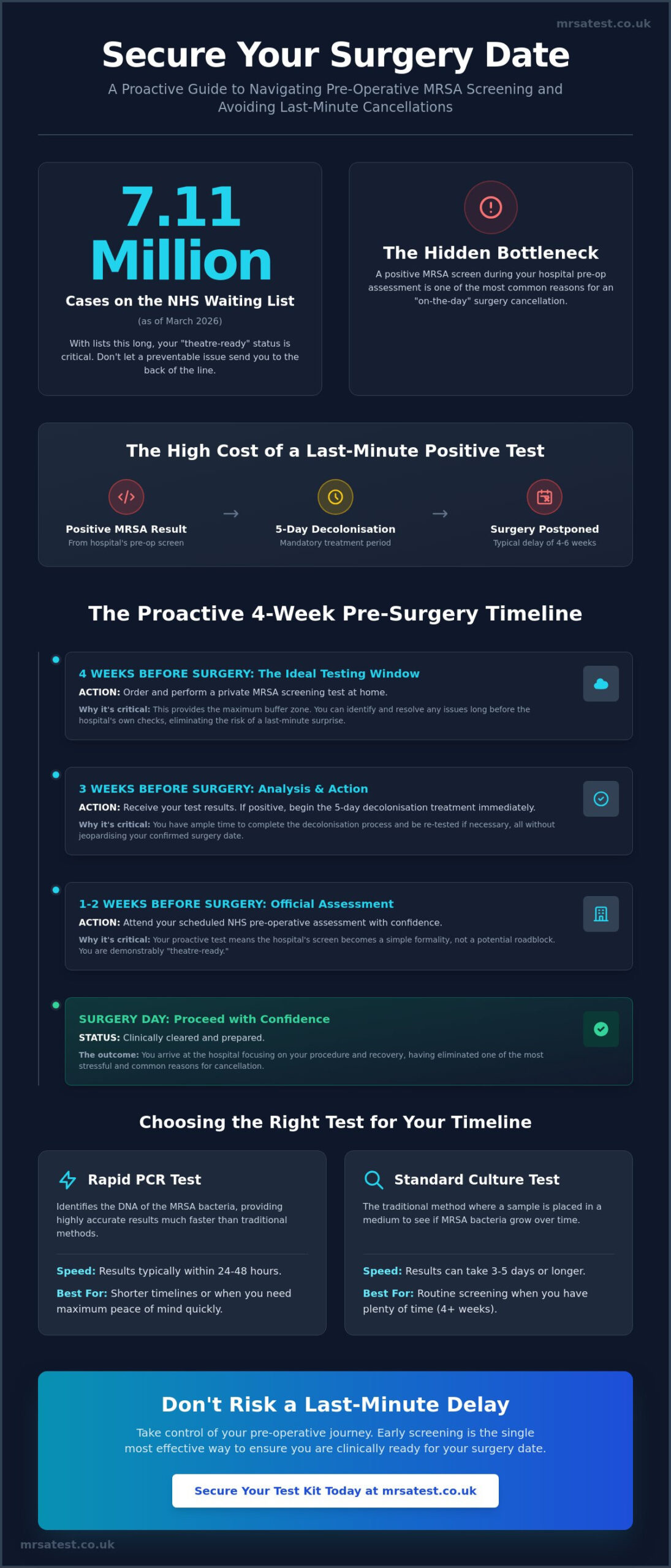
Imagine arriving at the hospital at 7:00 AM, fasting and prepared, only to be told your surgery is cancelled. This “on-the-day” nightmare is a reality for many elective patients in the UK. The culprit is often a positive MRSA result from a swab taken during a pre-operative assessment. While NHS guidance on MRSA screening suggests testing is routine, the timing often creates a hidden bottleneck. If you test positive, your procedure is immediately deferred. This leads to an immediate 4-6 week delay as the hospital must reschedule theatre time and verify you’re no longer a carrier.
The emotional cost of being turned away at the hospital gates is significant. You’ve likely arranged time off work, organised childcare, or prepared your home for recovery. Knowing exactly when to get mrsa test before surgery uk allows you to identify colonisation before the hospital’s own screening, giving you control over your timeline. By identifying a carrier status early, you avoid the frustration of a cancelled slot and the anxiety of re-entering the waiting list cycle.
MRSA and Hospital-Acquired Infections
Hospitals screen every elective patient because MRSA is a leading cause of post-surgical complications. If the bacteria enter an incision, they can cause deep-seated wound infections that are difficult to treat with standard antibiotics. You can read more about these risks in our guide on hospital-acquired infections. To protect ward safety and ensure patient recovery, surgeons will generally refuse to operate on colonised patients until they have completed a clear screening process. This is why understanding when to get mrsa test before surgery uk is a vital part of your clinical preparation.
The “Decolonisation Gap” Risk
A positive result isn’t just a clinical hurdle; it’s a logistical one. MRSA decolonisation is the process of removing bacteria from the skin and nose to prevent surgical site infections. This standard protocol typically takes five days of using antiseptic body washes and nasal ointments. However, you often need an additional few days for follow-up swabs to confirm the treatment was successful. This creates a 5-10 day window where surgery simply cannot proceed.
If your NHS screening happens only a few days before your operation, there simply isn’t enough time to bridge this “decolonisation gap.” Administrative errors, such as lost swabs or delayed laboratory results in high-volume settings, further increase the risk of a last-minute cancellation. Proactively choosing a private MRSA culture test several weeks in advance provides the safety net you need to ensure your surgery proceeds as planned.
Proactive vs. Reactive: Taking Control of Your Pre-Operative Health
In the current UK healthcare climate, relying solely on the hospital to identify potential issues is a reactive strategy that often leads to disappointment. We are seeing a significant shift toward “Patient-Led Readiness.” This approach empowers you to manage your own clinical data before you even attend a Pre-Operative Assessment (POA) clinic. By taking ownership of your screening, you ensure that your surgery date remains a certainty rather than a possibility. Private MRSA screening offers a level of speed and privacy that the high-volume NHS system cannot always match, providing a vital “buffer zone” for treatment if it’s needed.
Deciding when to get mrsa test before surgery uk is a critical part of this proactive plan. If you wait for your hospital appointment, you are essentially leaving your surgery date to chance. Taking a test privately allows you to interpret your own health data in a calm, non-clinical environment. If the result is negative, you can walk into your hospital assessment with total peace of mind. If it’s positive, you have the time to act discreetly and effectively without the pressure of a looming surgery date. This removal of the “unknowns” is often the most effective way to reduce pre-operative anxiety.
The Value of Early Detection
Why is three weeks the ideal timeframe? Knowing your status 21 days before your procedure is significantly safer than finding out 72 hours before. This early window allows for a stress-free decolonisation period. If you follow the official NHS guidance on MRSA screening and find you are a carrier, you will need time for treatment and potentially a follow-up test. By detecting the bacteria early, you can complete the necessary protocols and enter your hospital assessment already cleared, effectively bypassing the bottleneck that causes so many last-minute cancellations.
Choosing the Right Screening Method
Selecting the correct testing method depends entirely on your specific surgical timeline. You generally have two professional options:
- Standard Culture Tests: These are highly reliable and involve growing the bacteria in a lab. They typically take 48 to 72 hours for a result.
- Rapid PCR Tests: These utilize advanced molecular technology to identify bacterial DNA. They are much faster, often providing results within 24 hours.
The convenience of using at-home test kits in the UK has made this process more accessible than ever. It’s vital to ensure your private test is processed by an accredited laboratory. This ensures the results are clinically accurate and meet the high standards required for hospital acceptance. By choosing a professional service, you gain the clinical accuracy of a hospital lab with the convenience of a private setting.
Your 4-Week Pre-Op Checklist to Prevent Surgery Delays
The final 28 days before your procedure are the most critical for ensuring everything proceeds as planned. While the hospital manages the theatre schedule, you are the manager of your own clinical readiness. Taking a structured approach during this month eliminates the “last-mile” risks that lead to cancellations. By following a time-bound checklist, you can address potential issues while you still have a comfortable window to resolve them.
- Week 4: Administrative Audit. Confirm your transport and home support. Most UK hospitals require a responsible adult to collect you and stay for 24 hours post-surgery. Finalise your work leave and ensure your employer understands your recovery timeline.
- Week 3: Clinical Readiness. This is the ideal time for proactive screening. Determining when to get mrsa test before surgery uk is the cornerstone of this timeline. Testing now provides a safety net if a positive result occurs.
- Week 2: Physical Preparation. Focus on skin health and nutrition. Avoid shaving the surgical site, as small nicks can harbour bacteria. Monitor your skin for any new rashes, cuts, or sores that might require a GP’s attention before your admission.
- Week 1: Final Confirmation. You’ll likely receive a pre-op phone call. Review your medication list, especially if you take blood thinners or diabetic medication. Double-check your fasting instructions; “nil by mouth” usually starts at midnight.
- Day 0: Arrival. Pack a “ready-bag” with loose-fitting clothes, your current medications in their original packaging, and a copy of your private test results.
The Week 3 MRSA Safety Net
Week 3 is often called the “Goldilocks” zone for screening. It’s late enough for the results to be valid for your hospital admission, but early enough to provide a treatment window. If you wait until the hospital’s own assessment, you risk a cancellation if the results arrive too late. A positive MRSA result is not a diagnosis of illness, but a sign of “colonisation” requiring simple topical treatment. If your private screen returns a positive result, you have ample time to contact your GP for a decolonisation kit. This ensures you are clear before you even step foot in the hospital for your official assessment. To secure your surgery date with confidence, you can order your pre-operative MRSA kit today.
Administrative Red Flags
Clinical status is only one part of the puzzle. Administrative errors frequently cause delays in high-volume surgical departments. Ensure the hospital has received your latest blood test results from your GP or private provider. If these are missing on the day, your surgery cannot proceed. Additionally, check that your Pre-Operative Assessment (POA) is still valid. In many trusts, these assessments expire after three to six months. If your surgery was delayed previously, you might need a “top-up” assessment to remain on the active list. Staying ahead of these red flags keeps you at the front of the queue.
Securing Your Slot: How Private MRSA Screening Guarantees Readiness
Choosing a private screening partner allows you to navigate the complexities of the 2026 surgical landscape with quiet competence. mrsatest.co.uk is the UK’s trusted provider for patients who refuse to leave their recovery to chance. By managing your own diagnostics, you move from a state of pre-operative anxiety to a “Surgery Ready” status. Our service is designed to be discreet, fast, and clinically robust, ensuring that when you ask when to get mrsa test before surgery uk, you have a professional solution that fits your specific timeline.
We provide two primary types of screening kits to suit different clinical needs. Our MRSA Culture tests are the traditional standard, where samples are incubated to check for bacterial growth over 48 to 72 hours. For those with more imminent surgery dates, our MRSA Rapid PCR Test is the gold standard. This test uses molecular technology to identify bacterial DNA, providing a definitive result within just 24 hours of the lab receiving your sample. This speed is essential for patients who need immediate confirmation before their hospital admission.
Clinical Excellence and Accredited Labs
Quality and reliability are at the core of our service. We utilize a network of verified, UKAS-accredited laboratories to process every sample, ensuring the same level of accuracy you would expect from a hospital setting. The self-swab process is designed for simplicity and can be performed in the privacy of your home. Each kit includes clear, step-by-step instructions for collecting samples from the required sites, typically the nose and the groin or axilla (underarm). Once your results are processed, they provide the clear documentation you need for your own peace of mind and to demonstrate your clinical readiness to your surgical team.
Fast-Tracking Your Readiness
Our Rapid PCR test is particularly valuable if your surgery date has been brought forward or if you are filling a slot left by a previous cancellation. We support you through the entire screening journey with rapid delivery and streamlined procedures that minimize friction. You don’t have to wait for a hospital appointment to know your status; you can take action today to ensure your procedure remains on schedule. Don’t let a preventable clinical delay impact your health journey in 2026. You can order your confidential MRSA test kit today and take the final step toward securing your surgery date with total confidence.
Take Control of Your Surgical Timeline
The 2026 healthcare landscape requires a shift from passive waiting to active clinical readiness. By understanding the specific challenges of the current NHS backlog and supply shortages, you can ensure that your health status isn’t the reason for a last-minute postponement. Identifying your MRSA status early provides a vital buffer zone for treatment, effectively removing the most common bottleneck in the elective surgery process.
Deciding when to get mrsa test before surgery uk is the most important step in your final month of preparation. Our service provides the clinical accuracy and speed you need to proceed with confidence. We work with UKAS Accredited Laboratory Partners to deliver reliable results, with rapid 24-hour PCR results available for those on a tight schedule. Every kit includes discreet home delivery and prepaid return shipping to make the process as seamless as possible.
Don’t let a preventable clinical delay stand in the way of your recovery. Secure your surgery date with a private MRSA test kit today. You have worked hard to reach this stage of your health journey, and we are here to ensure your procedure moves forward exactly as planned.
Frequently Asked Questions
How long are surgery waiting lists in the UK for 2026?
As of March 2026, there are 7.11 million cases waiting for elective treatment in the UK, involving approximately 6.02 million individual patients. While the NHS met its target by seeing 65.3% of patients within 18 weeks, approximately 2.47 million people have been waiting longer than that timeframe. Around 94,000 patients have currently been waiting for over a year for their procedures.
What happens if I test positive for MRSA before my surgery?
If you test positive, your surgery will likely be deferred to prevent the risk of a serious surgical site infection. You’ll need to complete a five-day decolonisation programme using antiseptic washes and nasal ointments. Once treated, you’ll require clear follow-up swabs before the hospital can reschedule your procedure, which often results in a 4-6 week delay to the original date.
Can I perform an MRSA swab test on myself at home?
Yes, you can safely perform an MRSA swab test on yourself using a professional at-home kit. These kits provide clear instructions for swabbing the nose and groin areas. Taking a proactive approach and knowing when to get mrsa test before surgery uk helps you identify colonisation early and avoid the anxiety of a last-minute cancellation at the hospital gates.
Why is there a bone cement shortage in the UK in 2026?
The 2026 bone cement shortage is caused by manufacturing delays that have impacted major suppliers like Heraeus Medical. This shortage specifically affects orthopaedic procedures, such as hip and knee replacements, where the cement is used to fix prosthetics. Hospitals are currently using emergency prioritisation to manage stocks, often deferring elective cases to ensure urgent trauma patients can still receive treatment.
How long does a decolonisation programme take for MRSA?
A standard MRSA decolonisation programme typically takes five consecutive days to complete. During this time, you’ll use a special antimicrobial body wash and apply antibiotic ointment inside your nostrils. It’s important to follow the protocol exactly as prescribed and allow additional time for follow-up swabs to confirm the bacteria has been successfully cleared before your surgery date can be confirmed.
Will the hospital accept a private MRSA test result?
While hospitals usually conduct their own screening, private tests are an essential part of a patient-led readiness strategy. Knowing when to get mrsa test before surgery uk allows you to identify colonisation weeks before your hospital appointment. If you provide a negative private result, it offers peace of mind; if positive, it gives you the lead time needed to clear the bacteria before the hospital’s official check.
Does MRSA cause symptoms if I am just a carrier?
No, being an MRSA carrier, also known as being colonised, does not usually cause any symptoms or illness. The bacteria simply live on the skin or inside the nose without causing harm to the carrier. However, these bacteria pose a significant risk if they enter a surgical wound, which is why screening every elective patient is a standard safety requirement in UK hospitals.
What should I do if my surgery is cancelled due to shortages?
If a shortage causes a cancellation, your priority is to stay at the front of the queue by remaining clinically ready. Check with your hospital to see if your Pre-Operative Assessment is still valid, as these often expire after three to six months. Stay proactive by ensuring your MRSA status is clear, so you can accept a short-notice slot the moment supplies or theatre space become available.