
What if you didn’t have to wait for a hospital appointment or a GP’s approval to ensure your loved one is safe from a resistant infection? You likely feel a deep sense of responsibility to protect vulnerable relatives, especially if they’re preparing for surgery or moving into a care setting. It’s frustrating when you’re met with bureaucratic hurdles or told that proactive screening isn’t standard procedure for your specific situation. Understanding how to get an mrsa test for a family member shouldn’t be a source of stress when you’re already concerned about their health.
We understand that peace of mind comes from fast, accurate data. This guide will show you exactly how to secure a reliable test using the most efficient pathways available in the UK. We’ll explore the latest NHS eligibility criteria, explain how to navigate the GP system, and show you how private at-home PCR kits can provide laboratory-confirmed results with minimal delay. From understanding the difference between a culture and a rapid PCR test to receiving clear instructions on how to perform a swab at home, you’ll find everything you need to take control of your family’s safety.
Key Takeaways
- Compare NHS pathways with private options to find the most efficient and reliable testing route for your family’s specific needs.
- Identify the clinical differences between rapid PCR and traditional culture methods to ensure you select the most appropriate diagnostic path.
- Learn exactly how to get an mrsa test for a family member using discreet at-home kits that provide professional, laboratory-confirmed results.
- Master the correct swabbing technique for the nose, groin, and axilla to ensure sample accuracy and clinical reliability.
- Gain peace of mind before hospital procedures by securing fast results from verified, UKAS-accredited laboratory partners.
Understanding MRSA Screening Options for Your Relatives
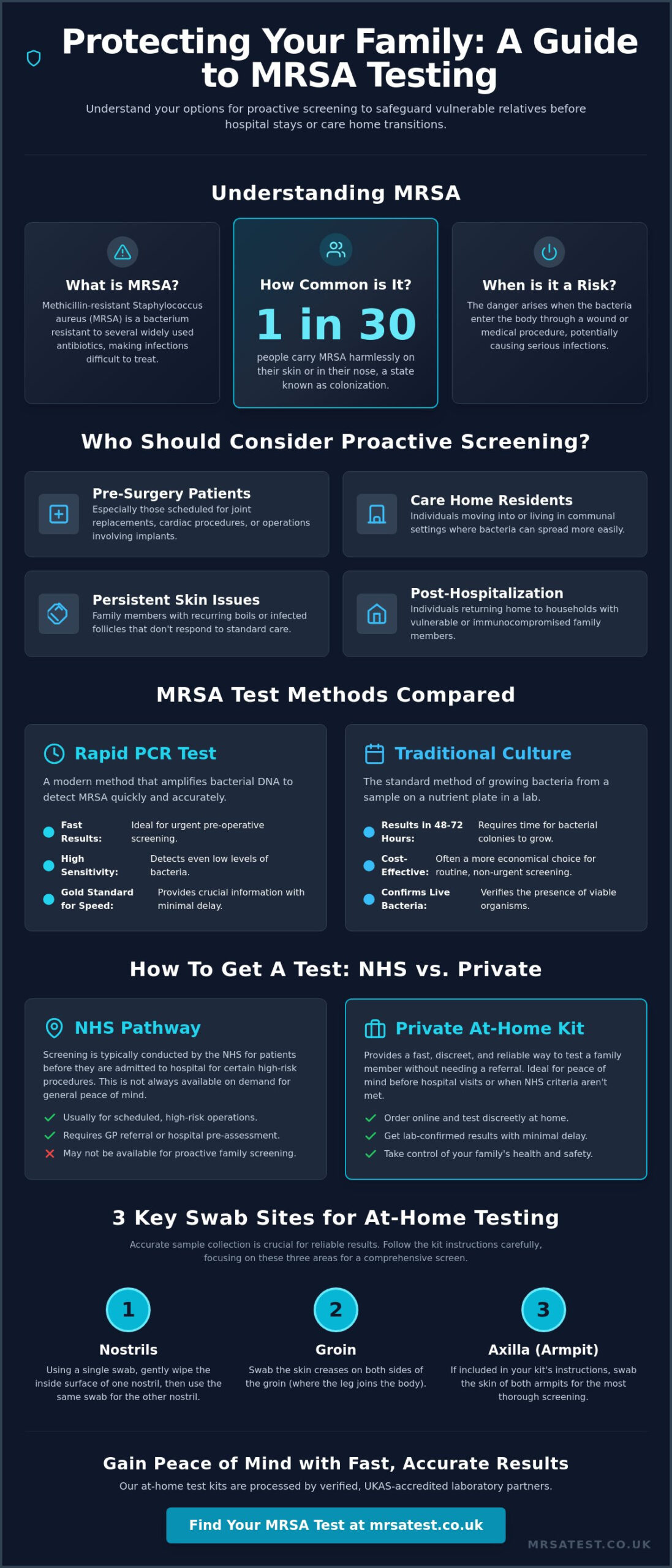
Methicillin-resistant Staphylococcus aureus (MRSA) is a common bacterium that lives harmlessly on the skin or in the nose of about 1 in 30 people. The challenge arises because this specific strain has developed resistance to several widely used antibiotics, making any resulting infections harder to treat than standard “staph” infections. For most healthy individuals, carrying the bacteria, known as colonization, causes no symptoms or illness. However, if these bacteria enter the body through a cut, wound, or medical procedure, they can cause serious infections in the blood, lungs, or bones.
Many people research how to get an mrsa test for a family member because they’re concerned about the transition from simple colonization to an active infection. While the NHS typically screens patients before they enter a hospital for high-risk procedures, there are many scenarios where a family might want to be proactive. Identifying whether a relative is a carrier allows for simple decolonization treatments, such as antiseptic body washes or nasal creams, before a minor issue becomes a major medical complication.
Why Proactive Testing Matters
Proactive screening is a vital tool for safeguarding the health of those you care for. It’s particularly important if you have elderly relatives or household members with weakened immune systems who are at a higher risk of complications from resistant bacteria. By identifying a carrier early, you can take steps to prevent the spread of the bacteria within your home. This is especially useful for breaking the cycle of recurring skin boils or abscesses that sometimes plague entire families. Screening also provides essential peace of mind before a hospital admission, ensuring that a surgical site remains as sterile as possible.
Who Should Be Tested?
If you’re wondering how to get an mrsa test for a family member, it helps to identify which relatives are in the highest risk categories. Not everyone requires a swab, but certain groups benefit significantly from knowing their MRSA status. You should consider testing for:
- Family members scheduled for major surgeries, particularly joint replacements, cardiac procedures, or any operation involving an implant.
- Relatives moving into or currently living in communal settings, such as care homes or assisted living facilities, where bacteria spread more easily.
- Household members experiencing persistent skin issues, like boils or infected hair follicles, that don’t respond to standard over-the-counter care.
- Individuals who have recently finished a stay in a hospital or healthcare facility and are returning to a home with vulnerable or immunocompromised residents.
How MRSA Testing Works: PCR vs. Culture Methods
The diagnostic process begins with a simple, painless swab collection. This involves using a sterile cotton tip to gently wipe specific areas of the skin where the bacteria are most likely to reside. Typically, these sites include the nostrils and the groin, though sometimes the armpits are included for a more comprehensive screen. Because the procedure is non-invasive, it’s a straightforward task to perform at home when you are arranging how to get an mrsa test for a family member. Once the samples reach a UKAS-accredited laboratory, scientists use one of two primary methods to identify the presence of the bacteria and its resistance to antibiotics.
According to NHS guidance on MRSA testing, the goal is to determine if the Staphylococcus aureus bacteria present are resistant to methicillin. This resistance is what classifies the strain as MRSA. Accuracy during this phase is vital. It relies heavily on the quality of the initial swab and the precision of the laboratory’s diagnostic equipment. High-quality labs look for specific markers of resistance, ensuring that the results you receive are clinically valid and ready for hospital review.
MRSA Culture Test: The Standard Approach
The culture method is the traditional way to identify bacterial growth. In the lab, the sample is placed on a special nutrient-rich agar plate and kept in a controlled, warm environment. Scientists monitor the plate over 48 to 72 hours to see if bacterial colonies develop. If growth occurs, further tests are conducted to check for antibiotic resistance. This method is often the most cost-effective choice for families who are conducting routine screening and aren’t facing an immediate hospital deadline. You can learn more about the technical differences in our detailed guide to MRSA Culture vs. PCR Test.
Rapid PCR Test: Speed and Precision
When time is a critical factor, the Rapid PCR (Polymerase Chain Reaction) test is the preferred diagnostic tool. Instead of waiting for bacteria to grow, this molecular test searches for specific DNA sequences unique to MRSA. This allows the laboratory to confirm results within 24 hours of receiving the sample. It’s often considered the gold standard for accuracy in modern diagnostics because it can detect even small amounts of the bacteria’s genetic material. This speed is essential for patients with imminent surgical procedures or those who need to confirm how to get an mrsa test for a family member quickly to meet care home requirements. If you require a fast turnaround, choosing a Rapid PCR kit ensures you have the necessary documentation without the long wait associated with traditional cultures.
NHS vs. Private MRSA Testing: Which Route is Right for Your Family?
Choosing between the public health service and a private provider depends on your relative’s specific situation and how quickly you need an answer. While the UK provides robust screening through the health service, access is strictly regulated. If you’re exploring how to get an mrsa test for a family member for reasons other than an immediate hospital admission, you may find the private route offers the flexibility and speed you need.
The NHS Pathway
The NHS provides MRSA screening primarily as a preventative measure for patients entering high-risk clinical environments. Eligibility is usually tied to a scheduled surgery or a move into a specialized care unit. According to NHS information on MRSA, this process typically involves attending a pre-operative assessment clinic where a healthcare professional performs the swabs. This ensures that the hospital can manage any potential infection risk before a patient enters a sterile operating theatre.
This route is highly effective for those already in the system, as results are shared directly with the surgical team. However, it isn’t designed for proactive household screening or for those who simply want to check a relative’s status for personal reassurance. If your family member doesn’t meet the specific clinical criteria for a state-funded swab, a GP may not be able to approve the test. This can leave families feeling stuck if they’re concerned about a carrier in the home but don’t have an upcoming medical procedure scheduled.
The Private Home Test Route
Private testing serves as a vital alternative for families who require more autonomy and faster results. You don’t need a GP referral or a hospital appointment to access these services. This is particularly helpful when you want to identify how to get an mrsa test for a family member who might be a carrier but doesn’t have an upcoming surgery. By bypassing the traditional referral system, you can secure laboratory-confirmed results on your own timeline.
One of the most significant advantages is the speed of the process. While hospital pathways can involve waiting for an available clinic slot, private kits are often dispatched for next-day delivery. You perform the swab in the comfort and privacy of your own home, which is often less stressful for elderly or anxious relatives. Once the lab receives the sample, results are typically delivered via secure email within 24 to 72 hours. This discretion ensures that health data is managed privately, allowing you to take action or seek decolonization treatment without waiting for traditional bureaucratic cycles.
A Step-by-Step Guide to Swabbing a Family Member at Home
Once you’ve decided how to get an mrsa test for a family member and your kit arrives, the collection process is straightforward and entirely painless. Preparation is the first step toward ensuring a high-quality sample. Start by washing your hands thoroughly with soap and water to prevent cross-contamination. Find a quiet, well-lit area where your relative feels comfortable and relaxed. Explain that the swab is non-invasive and will only take a few moments to complete. Having all your kit components laid out on a clean surface before you begin will help the process feel managed and professional.
The accuracy of your results depends on collecting enough biological material from the correct sites. Most comprehensive screens require samples from three key areas: the nostrils, the groin, and the axilla (armpit). These are the locations where Staphylococcus aureus is most likely to colonize. To collect the sample, remove the sterile swab from its packaging, being careful not to touch the tip. Gently insert the cotton end into the nostril and rotate it slowly five times against the inside wall. Repeat this process for the other nostril, the skin folds of the groin, and the armpit as directed by your specific kit instructions.
After the collection is complete, place the swab into the provided transport tube and seal it tightly. It’s essential to label the tube clearly with the requested details to ensure the laboratory can process it without delay. Place the tube into the secure packaging and use the prepaid return envelope to send it to our accredited laboratory partners. If you’re ready to begin the process, you can order your MRSA testing kit today for rapid, laboratory-confirmed results.
Swabbing Children and Infants
Testing a child requires a gentle, patient approach to reduce any potential anxiety. You can make the process feel like a “game” by explaining that you’re just using a giant cotton bud to look for “sleepy bugs.” It’s vital to ensure the swab doesn’t go too deep into the nasal passage; a shallow rotation is all that’s required for an accurate sample. Keeping the child calm and still for just thirty seconds will ensure the swab makes sufficient contact with the skin.
Assisting Elderly or Vulnerable Relatives
When assisting elderly family members, be particularly mindful of skin sensitivity. The skin in the groin and axilla areas can be fragile, so use a very light touch during the rotation. If your relative has cognitive impairment, explain each step in simple, reassuring terms as you do it. Maintaining their privacy and dignity throughout the collection is paramount, especially when swabbing the groin area. A calm, clinical approach helps the relative feel supported and safe during this brief diagnostic procedure.
Choosing a Reliable Private MRSA Test for Peace of Mind
Selecting a diagnostic provider is the final, most critical step in understanding how to get an mrsa test for a family member. It’s not enough to simply acquire a swab; the clinical integrity of the laboratory processing that sample determines the reliability of your results. When you’re evaluating private options, your first priority should be verifying that the provider works with UKAS-accredited laboratory partners. This accreditation is the gold standard in the UK, ensuring that the facility meets rigorous national standards for technical competence and the validity of its diagnostic procedures. Without this, you cannot be certain that a negative result is truly accurate.
Beyond clinical credentials, the logistics of the service are vital for your peace of mind. A reliable provider should offer tracked, fast shipping to ensure the kit reaches you quickly and the sample returns to the lab without degradation. Once the analysis is complete, the results should be delivered in a clear, easy-to-read report. These reports are designed to be intuitive for you while containing the technical data your GP or surgical team requires. Before you finalize your choice, use this checklist to ensure the service meets your family’s needs:
- Accreditation: Does the lab hold UKAS certification for microbiology testing?
- Site Coverage: Does the kit include swabs for all required sites, such as the nose, groin, and axilla?
- Speed: Is there a clear commitment to 24-hour or 48-hour turnaround times?
- Confidentiality: Are results delivered through a secure, encrypted portal or email?
- Support: Is there a professional point of contact if you have questions about the process?
Why Accuracy and Speed Matter
In clinical diagnostics, accuracy is paramount. Low-quality kits or unverified laboratories increase the risk of a “false negative,” which occurs when the test fails to detect the bacteria even though it’s present. This can lead to a false sense of security and potentially cause complications during medical procedures. Speed is equally important, particularly when you’re managing tight surgical deadlines. A 24-hour PCR result can be the difference between a surgery proceeding as planned or being delayed. For a broader look at managing these requirements, you can refer to our Pre-Op Health Checklist, which helps you organize all the necessary logistics before a hospital admission.
Securing Your Family Kit Today
The process of protecting your loved ones should be as seamless as possible. Our online ordering system is designed for efficiency, with kits dispatched in discreet packaging to respect your privacy. We focus on providing a professional service that removes the stress from medical screening, allowing you to focus on your relative’s care. If you’re still unsure about how to get an mrsa test for a family member or need help interpreting a result, our team is available to provide the professional support you need. You can order a confidential MRSA test kit for your family member here to ensure they have the laboratory-confirmed clearance required for their next steps in care.
Ensuring Your Family’s Safety with Reliable Testing
Protecting a relative from resistant bacteria involves more than just observation; it requires definitive, laboratory-confirmed data. You’ve learned that while the NHS provides essential pre-operative screening, private testing offers a faster, more flexible route for proactive household safety. By choosing high-precision methods like PCR, you can bypass traditional waiting times and secure results that are both clinically valid and easy to share with medical professionals.
Understanding how to get an mrsa test for a family member is the first step in breaking the cycle of infection and ensuring a safe environment for those most at risk. You can Order a Professional MRSA Test Kit for Your Family Member to access UKAS-accredited laboratory testing with results delivered in as little as 24 hours through our rapid PCR service. Every kit includes discreet packaging and prepaid return shipping to make the diagnostic process as manageable as possible. Taking this proactive step provides the clarity you need to move forward with confidence in your family’s healthcare journey.
Frequently Asked Questions
Can I test my child for MRSA at home?
Yes, you can test a child at home using a standard diagnostic kit. The process is non-invasive and involves a simple skin swab that is entirely painless. When you’re learning how to get an mrsa test for a family member who is young, the key is to remain calm and explain the process as a quick, ticklish wipe. This ensures you collect a valid sample without causing any distress to the child.
How long does it take to get MRSA test results for a family member?
Turnaround times depend on the laboratory method you select. A Rapid PCR test typically provides results within 24 hours of the laboratory receiving the sample. Traditional culture methods require more time for bacteria to grow, usually taking between 48 and 72 hours. These timelines are designed to help you plan effectively for upcoming hospital admissions or care home moves without unnecessary delays.
Will my GP accept the results of a private MRSA test?
Most UK healthcare providers and GPs accept private results if they come from a UKAS-accredited laboratory. These facilities follow the same rigorous clinical standards as the NHS. When you provide laboratory-confirmed results, it can often satisfy pre-operative requirements. We always recommend confirming with your specific surgical team to ensure the private report meets their internal documentation standards before your appointment.
What should I do if my family member tests positive for MRSA?
If a relative tests positive, you should contact their GP to discuss decolonization treatment. This usually involves a prescribed course of antiseptic body wash and nasal ointment used over five to ten days. It’s also helpful to increase household hygiene, such as frequent hand washing and regular laundering of towels and bedding. These steps help prevent the bacteria from spreading to other vulnerable people in your home.
Is the MRSA swab painful for elderly relatives?
The swabbing process is entirely painless and non-invasive for elderly relatives. It only involves a gentle rotation of a soft cotton tip against the skin surface or just inside the nostril. There are no needles or uncomfortable procedures involved. For those with fragile skin, you can perform the swab very lightly while still collecting enough biological material for a valid and accurate laboratory analysis.
Do I need to test everyone in the house if one person has MRSA?
Testing the whole household isn’t always mandatory, but it’s often beneficial if you have vulnerable residents or recurring infections. If one person is colonized, others may carry the bacteria without showing any symptoms. Screening everyone helps identify all carriers so that the entire household can undergo decolonization at the same time. This is the most effective way to break the cycle of transmission.
Can I buy an MRSA test kit over the counter in the UK?
MRSA test kits aren’t typically available in high street pharmacies or over the counter. Instead, they are ordered through specialized online diagnostic services. This ensures that the samples are sent directly to a professional laboratory for clinical analysis rather than being a simple instant test. Ordering online allows for discreet delivery and ensures you receive a professional report that is clinically recognized.
What is the difference between a nose/groin swab and a nose/groin/axilla swab?
A nose and groin swab is the standard screening protocol used by many healthcare providers. Adding the axilla, or armpit, provides a more comprehensive screen by checking an additional area where the bacteria often live. Choosing a three-site test increases the likelihood of detecting colonization. This provides a more complete picture when you are determining how to get an mrsa test for a family member with maximum accuracy.