

Vitality Health Surgery Prep: A Guide to MRSA Screening & Requirements (2026)
Imagine arriving at the hospital, bags packed and mind prepared, only to be told your procedure is cancelled because a simple swab result is missing or outdated. It’s a distressing scenario, yet one that occurs frequently when the logistics of pre-operative care become unclear. Most private patients feel a natural anxiety about these clinical hurdles, especially when balancing tight schedules and the desire for a swift recovery.
We understand that you want your procedure to go ahead without a hitch. This guide helps you master your vitality health surgery prep by clarifying Vitality Health requirements and ensuring your MRSA screening is completed accurately and on time. By taking a proactive approach, you can eliminate the uncertainty of whether the hospital or the patient handles the swabs.
In the following sections, we’ll outline the essential 2 to 4 week screening window and explain the difference between rapid PCR and standard culture methods. You’ll gain a clear understanding of the pre-op timeline and the clinical standards required for your results to be accepted. This knowledge provides the confidence you need for a smooth, stress-free path to your scheduled surgery date.
Key Takeaways
- Understand why insurance pre-authorisation is only the first step and how to manage the clinical requirements that follow.
- Master your vitality health surgery prep by identifying the strict 2 to 4 week MRSA screening window required by most private UK hospitals.
- Learn the difference between rapid PCR and standard culture tests to ensure your results are available well before your scheduled admission.
- Discover how at-home screening kits provide a discreet, professional alternative to in-clinic appointments without compromising on clinical integrity.
- Gain confidence that your results meet the highest standards by using UKAS-accredited laboratory testing accepted by private consultants.
Navigating Your Vitality Health Surgery Prep Journey
Securing insurance approval feels like the final hurdle, but it’s actually the start of a critical clinical phase. Your vitality health surgery prep involves more than just a confirmation email from your provider; it requires a coordinated effort between you, your consultant, and the hospital’s infection control team. While Vitality manages the financial framework, the responsibility for meeting clinical standards often rests with the patient. This transition from financial authorisation to surgical readiness is where many patients feel the most pressure.
The pre-operative assessment serves as the bridge between these two stages. In private healthcare, this assessment isn’t just a formality. It is a detailed review of your medical history and current health status. Your consultant will specify certain clinical requirements, such as blood pressure targets or specific infection screenings, that must be met before you are cleared for the operating theatre. Understanding these expectations early prevents the anxiety of last minute delays.
Understanding Vitality’s Pre-Authorisation Process
Before you can focus on the medical details, the financial foundation must be solid. Use the Vitality Fee Finder tool to confirm that your chosen specialist and anaesthetist are fully covered within your policy’s limits. It is vital to discuss pre-operative costs early. Some screenings are included in the hospital’s package, while others might be considered separate diagnostic tests. Once authorised, keep your claim number accessible. The hospital will require this unique reference to link your clinical records with your insurance profile, ensuring a seamless admission process without administrative friction.
The Checklist for Private Surgical Readiness
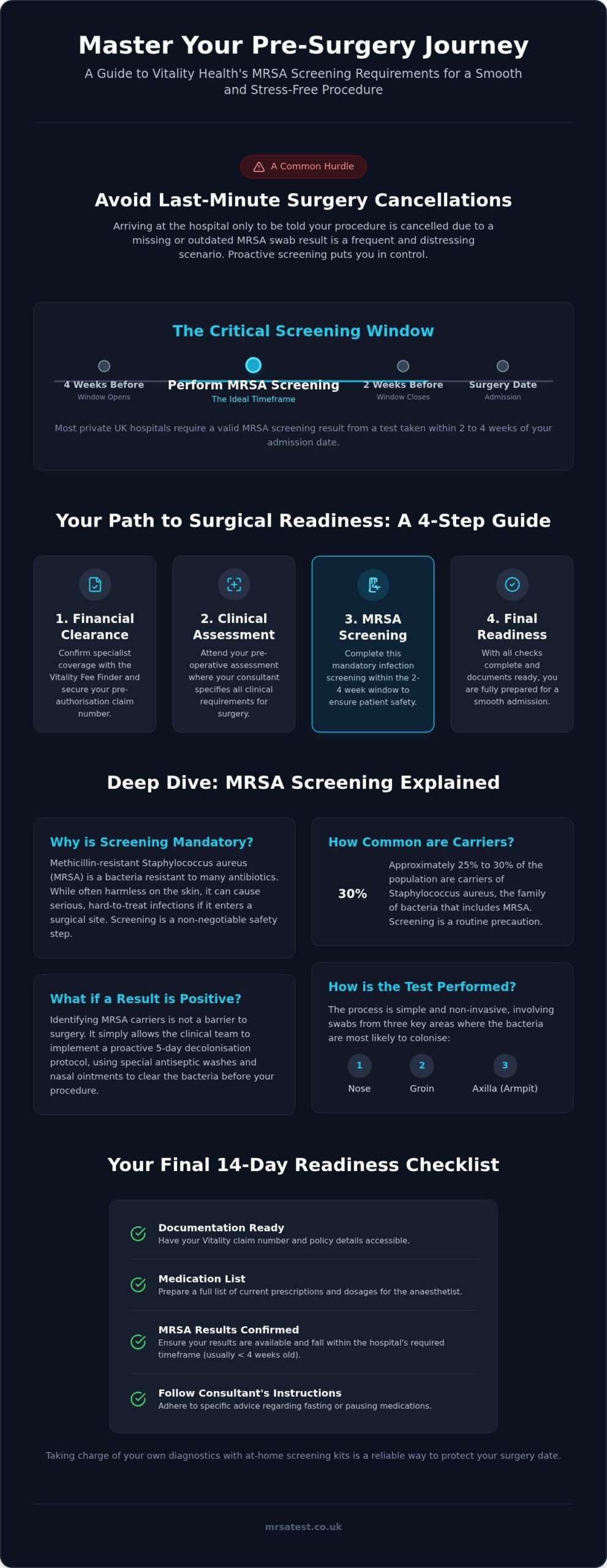
Effective preparing for surgery demands a dual focus on your physical health and the logistical requirements of the private facility. A central part of this readiness is screening for Methicillin-resistant Staphylococcus aureus (MRSA). This bacterium can lead to serious complications if it enters a surgical site, making early detection a priority for patient safety.
Your 14 day timeline is the most active window for preparation. During this period, you should gather essential documents and complete necessary tests. Having everything ready ensures you aren’t scrambling the day before your procedure.
- Documentation: Have your Vitality claim number and policy details printed or saved on your phone.
- Medication: Create a full list of current prescriptions and dosages to share with the anaesthetist.
- Screening: Ensure your MRSA results are available and meet the hospital’s specific timeframe, usually within 4 weeks of surgery.
- Instructions: Follow consultant specific advice regarding fasting or the temporary cessation of certain medications.
Many patients assume the hospital will handle every swab during their visit, but private healthcare often expects you to provide proof of a clear screening before your arrival. Missing this window can lead to last minute cancellations. Taking charge of your own diagnostics is a reliable way to protect your surgery date.
Why MRSA Screening is Mandatory for Private Surgery
Methicillin-resistant Staphylococcus aureus (MRSA) is a type of bacteria that has developed resistance to several widely used antibiotics. While it often lives harmlessly on the skin or in the nose of healthy individuals, it becomes a serious clinical concern during invasive procedures. Research indicates that approximately 25 to 30% of the population are carriers of Staphylococcus aureus, which serves as a common reservoir for MRSA. As part of your vitality health surgery prep, identifying whether you are a carrier is a non-negotiable step for patient safety.
The screening process is straightforward and non-invasive. Clinical staff or at-home kits use swabs to collect samples from the nose, groin, and axilla (armpit). These specific areas are known “reservoirs” where the bacteria are most likely to colonise. By identifying carriers before they enter the hospital, medical teams can initiate a 5 day decolonisation protocol using antiseptic washes and nasal ointments. This proactive approach is a cornerstone of NHS guidelines on MRSA screening, which most private facilities also adopt as their minimum safety standard.
Protecting Your Health and the Hospital Environment
Private hospitals maintain strict zero-tolerance policies regarding MRSA to protect their sterile environments and reputation for safety. If a patient is colonised with MRSA, they face a significantly higher risk of developing surgical site infections (SSIs). These infections can lead to wound breakdown, sepsis, or the failure of prosthetic implants. Beyond the risk to the individual, hospital-acquired infections can spread quickly in a clinical setting, potentially endangering other vulnerable patients. Ensuring you are clear of the bacteria before admission protects your recovery timeline and prevents the need for extended hospital stays or additional corrective surgeries.
Rapid PCR vs. Culture: Meeting Tight Deadlines
Timing is the most common cause of stress during surgical preparation. Traditional culture methods involve placing the sample in a nutrient-rich environment and waiting for bacteria to grow, which typically takes 48 to 72 hours. In contrast, the rapid PCR method is a molecular detection tool used to identify bacterial DNA, providing results much faster than traditional methods. Most UK private hospitals accept both, but PCR is increasingly the “gold standard” for patients with imminent surgery dates because it delivers results within 24 hours.
If your procedure is scheduled for next week, waiting three days for a culture result might be too risky. Choosing a rapid PCR screening kit ensures your results are verified by an accredited lab and ready for your pre-op assessment without the stress of a last minute delay. This efficiency is particularly valuable for Vitality members who need to coordinate their clinical clearance with insurance authorisation windows.
Comparing NHS vs. Private Pre-Op Screening Timelines
One of the most significant challenges in your vitality health surgery prep is managing the logistical “hand-off” between your insurance approval and the clinical requirements of the hospital. While the NHS provides MRSA screening before you go into hospital at no direct cost, the scheduling often lacks the flexibility required for private healthcare. Hospital-led pre-op clinics frequently operate on rigid schedules; if your appointment is delayed, you risk missing the vital 2 to 4 week window for results to be processed and verified before your admission date.
Taking control of your own screening timeline offers a distinct advantage. By choosing a private mrsa test, you eliminate the need to wait for a clinic slot. You can perform the swab at home exactly when it suits your schedule, ensuring the results are ready well in advance. This peace of mind allows you to focus on your physical recovery rather than chasing hospital administrators for an appointment time. It’s a strategic move to protect your surgery date from administrative delays.
The Risk of Last-Minute Cancellations
Discovering a positive MRSA result just days before your procedure is a distressing experience. If a screen identifies colonisation, you must undergo a standard decolonisation protocol. This process typically requires 5 days of antiseptic body washes and nasal ointments. If this isn’t completed before your scheduled date, the surgery will likely be postponed. The 5-day protocol is non-negotiable for infection control teams. Having results 10 to 14 days before your surgery provides the necessary lead time to complete treatment if required. This buffer avoids the emotional distress and potential financial complications of a postponed procedure.
Ensuring Your Results Meet Vitality Standards
For your results to be accepted by Vitality-recognised facilities, the testing must meet strict clinical benchmarks. The laboratory must hold UKAS accreditation, which serves as a guarantee of technical competence and accuracy. When your results arrive, you’ll receive a professional certificate. You should present this to your surgical team during your pre-op assessment or upload it to your patient portal. Most private hospitals now prefer digital submissions, which can be shared instantly via secure patient dashboards. Integrating these results into your digital health records is a final, vital step in your vitality health surgery prep. It ensures that every member of your care team has clear, verified proof of your screening status.
How to Complete Your Pre-Surgery Swabs at Home
Busy private healthcare patients often struggle to find time for additional hospital appointments. Completing your vitality health surgery prep from home eliminates the need for unnecessary travel and clinical waiting rooms. Our kits provide every tool required to maintain clinical integrity in a non-clinical environment. Each kit includes sterile swabs, transport tubes containing preservative media, and clear, illustrated instructions. By following the provided steps, you ensure that your samples are just as reliable as those taken by a nurse in a specialist clinic.
Maintaining a sterile environment during collection is simpler than many patients expect. The key is to handle the equipment with clean hands and avoid touching the swab tips to any household surfaces. This professional approach ensures that the laboratory receives a clean sample, reducing the risk of an “inconclusive” result that could delay your procedure. Taking control of this process allows you to fit your clinical requirements around your professional and personal life.
Step-by-Step Guide to Self-Collection
Accurate collection is vital for a valid lab result that your consultant will accept. You will need to swab three primary areas: the inside of both nostrils, the groin creases on both sides, and both axillae (armpits). These areas are the most common reservoirs for bacterial colonisation.
- Nose: Moisten the swab if instructed, then gently rotate it inside the front of each nostril for five seconds.
- Groin: Rub the swab firmly along the skin fold where the leg meets the torso on both the left and right sides.
- Axilla: Ensure the swab makes firm contact with the skin in the centre of the armpit, repeating the process for both arms.
To prevent cross-contamination, do not allow the swab tip to touch your clothes or the outside of the transport tube. Once you have finished swabbing the site, place the swab immediately into the tube and snap the handle at the indicated break line. Secure the cap tightly to prevent the preservative liquid from leaking during transit.
Managing Logistics: Posting Samples to the Lab
Speed is essential for accurate molecular diagnostics. We include prepaid, tracked UK delivery with every order to ensure your samples reach the lab without delay. We recommend posting your samples between Monday and Thursday. Avoid posting on Friday afternoons or Saturdays. Samples that sit in the postal system over the weekend may experience degraded viability, which can impact the accuracy of a culture test.
You can track your kit’s journey using the provided reference number. This gives you full visibility of when the samples arrive at our UKAS-accredited facility. Once the lab receives the package, the 24-hour countdown for PCR results begins. You can order your MRSA at-home testing kit today to ensure your samples are processed well ahead of your hospital admission date. This streamlined logistical path is the most efficient way to finalise your vitality health surgery prep.
Securing Your Surgery Date with MRSAtest.co.uk
Choosing a professional diagnostic partner is the final, most impactful step in your vitality health surgery prep. While the logistical and financial authorisations provide the framework for your care, the clinical results ensure the safety of your procedure. Our service is designed to bridge the gap between clinical necessity and personal convenience, providing a seamless path from your living room to the operating theatre. We understand that for private patients, time is a premium commodity that shouldn’t be wasted in hospital waiting rooms.
The guarantee of clinical accuracy is at the heart of our operations. Every sample is processed by UKAS-accredited laboratory partners, ensuring that your results meet the highest technical standards required by UK consultants. We maintain strict adherence to data privacy regulations, ensuring your medical information remains discreet and secure. By choosing a specialist provider, you gain the quiet competence of experts who manage the entire diagnostic process, leaving you free to focus on your upcoming recovery.
Why Private Patients Choose Our Accredited Kits
Trust is built on transparency and support. We believe that understanding MRSA is the first step in alleviating the anxiety often associated with pre-operative screening. Our kits don’t just provide the tools for collection; they offer a comprehensive support system for the private patient journey. From the moment you receive your professionally packaged kit to the delivery of your digital certificate, the process is managed with clinical precision.
Our commitment to reliable reporting means your consultant receives exactly what they need to sign off on your admission. We provide clear, easy to read diagnostic reports that can be integrated directly into your private health records. This professional documentation serves as a powerful trust signal to your surgical team, confirming that you’ve been screened using methods that meet or exceed standard hospital protocols. We support you through every stage, ensuring no clinical detail is overlooked.
Fast-Track Your Results for Imminent Procedures
If your surgery date is approaching quickly, the standard culture method might not provide the necessary lead time. For imminent procedures, we recommend selecting the Rapid PCR option. This molecular detection tool identifies bacterial DNA with incredible speed, allowing for 24-hour peace of mind once the sample reaches our lab. It’s the “gold standard” for those who need to finalise their vitality health surgery prep without the stress of a last minute cancellation.
Don’t let administrative bottlenecks or slow hospital clinics jeopardise your procedure. Staying ahead of your surgical schedule requires proactive planning and efficient solutions. You can Order your pre-op MRSA test kit now to secure your timeline. Once your clear results are in hand, you can enter the hospital with the confidence that you’ve met every clinical requirement, ensuring a smooth and safe transition into your surgery and subsequent recovery.
Finalising Your Clinical Readiness
Mastering your vitality health surgery prep is about moving from administrative approval to clinical certainty. By choosing to manage your own MRSA screening, you bypass the potential bottlenecks of hospital-led clinics and secure a clear path to your procedure. This proactive approach ensures that every clinical requirement is met with precision and documented through a verified laboratory. It’s the most effective way to eliminate the anxiety of missing your surgical window due to timing issues or missing paperwork.
Our service provides the professional reliability you need during this critical pre-operative period. With a focus on speed and technical accuracy, our UKAS-accredited laboratory testing is trusted by private patients across the UK for its clinical integrity. Whether you require standard culture results or rapid 24-hour PCR detection, we support your journey with discreet at-home collection kits that fit into your busy schedule. This ensures your results are ready for your consultant’s final review.
Secure your surgery date with a fast, private MRSA test kit today. Taking this simple, expert-led step provides the peace of mind you deserve; it allows you to focus fully on a successful operation and a swift, healthy recovery.
Frequently Asked Questions
Does Vitality Health pay for my pre-op MRSA test?
Vitality Health usually covers the cost of pre-operative screenings when they are performed as part of an authorised hospital admission or pre-op assessment. You should check your specific claim details or use the Fee Finder tool to confirm your policy coverage. Many patients choose to self-fund a private test for greater flexibility and to avoid the logistical hurdles of attending an extra hospital-led clinic appointment.
How far in advance of my surgery should I take the MRSA test?
Most private hospitals require MRSA screening to take place between 2 and 4 weeks before your scheduled surgery date. This timeframe ensures the result is current while allowing enough time for a 5-day decolonisation treatment if you test positive. Taking the test too early may result in the hospital requesting a repeat swab closer to your admission date to maintain clinical safety.
Can I use an at-home MRSA test for a private hospital admission?
Yes, you can use an at-home MRSA test for a private hospital admission provided the laboratory processing the sample is UKAS-accredited. Private consultants and infection control teams accept these results because they meet the same technical standards as hospital labs. This is a common part of a modern vitality health surgery prep, offering a discreet and professional alternative to in-person appointments without compromising on accuracy.
What is the difference between a PCR and a culture MRSA test for surgery?
A PCR test is a molecular detection tool that identifies bacterial DNA, providing results within 24 hours. A culture test involves growing the bacteria in a lab, which typically takes 48 to 72 hours. While both are clinically accurate, the rapid PCR method is often preferred for time-sensitive surgical schedules where a fast turnaround is essential for securing your clinical clearance and surgery date.
What happens if I test positive for MRSA before my Vitality surgery?
If you test positive, you will need to undergo a standard 5-day decolonisation protocol using antiseptic body washes and nasal ointments. Once this routine is finished, your surgical team will decide if a repeat screen is necessary before admission. Most procedures can go ahead as planned once the treatment is completed, provided the protocol is started early enough before your scheduled surgery date.
Which body sites need to be swabbed for a pre-op MRSA screen?
The standard screening protocol involves swabbing three primary reservoirs: the inside of both nostrils, the groin creases, and the axillae (armpits). These specific areas are where the bacteria are most likely to colonise. Collecting samples from all three sites ensures a comprehensive screen that meets the safety requirements of UK private hospitals and protects the sterile environment of the operating theatre.
How long do the MRSA test results take to come back?
The turnaround time depends on the testing method you choose. Rapid PCR results are typically available within 24 hours of the sample reaching the laboratory. Standard culture tests take longer, usually between 1 and 3 working days. Factor in tracked postal times when planning your vitality health surgery prep to ensure your certificate arrives well before your pre-op assessment. This speed is essential for meeting tight deadlines.
Is the at-home MRSA test kit easy to use for beginners?
The kits are designed for simple and effective self-collection. Each package includes sterile swabs and clear, illustrated instructions to guide you through the swabbing process. By following the step-by-step guide, you can collect high-quality samples that maintain clinical integrity. The process is non-invasive and takes only a few minutes to complete in the privacy of your own home, making it accessible for everyone.