

MRSA Test for Surgery Next Week: How to Get Fast, Reliable Results in Time
Imagine receiving your final pre-operative instructions only to realize you still need a negative MRSA clearance certificate, and your procedure is just days away. The realization that you need an mrsa test for surgery next week can be incredibly stressful, especially when standard hospital waiting lists are long. You are likely worried that a simple swab delay might push back a surgery you have waited months to undergo. It’s a common fear, but a tight deadline doesn’t have to mean a cancelled appointment.
We understand that navigating hospital requirements and the technical differences between PCR and culture tests feels overwhelming when you are already preparing for surgery. You deserve a testing process that is efficient, discreet, and reliable. This article explains how to secure a lab-certified negative result within 24 to 48 hours, providing the peace of mind you need to move forward. We will walk you through the benefits of rapid PCR technology, provide simple instructions for at-home self-swabbing, and show you how to get your results in time to meet even the strictest surgical deadlines.
Key Takeaways
- Understand why hospitals require MRSA screening to prevent surgical site infections (SSIs) and ensure a safe recovery.
- Learn the critical differences between traditional culture tests and rapid PCR technology, which identifies bacterial DNA in a fraction of the time.
- Discover the correct technique for self-swabbing the nose, groin, and axilla to guarantee the most accurate diagnostic results.
- Find out how to secure a lab-certified clearance certificate even if you need an mrsa test for surgery next week.
- See how professional laboratory reports can be delivered directly to your pre-operative team to keep your surgical schedule on track.
Why Hospitals Require an MRSA Test Before Surgery
Hospitals prioritize patient safety by screening for Methicillin-resistant Staphylococcus aureus (MRSA), a specific type of bacterium that has developed resistance to several widely used antibiotics. Most people carry various bacteria on their skin or in their noses without ever feeling ill. This state is known as “colonisation.” While these bacteria are harmless on the surface of the skin, they become a significant threat during invasive procedures. If your clinical team has requested an mrsa test for surgery next week, it’s because they need to confirm you aren’t carrying this resistant strain into a sterile operating environment.
The Risk of Surgical Site Infections (SSIs)
A surgical site infection (SSI) occurs when bacteria enter the body through the incision made during an operation. Because MRSA doesn’t respond to standard penicillin-based treatments, an infection can be exceptionally difficult to manage. It often leads to prolonged hospital stays, additional courses of intravenous antibiotics, or even secondary surgeries to clean the wound. Screening protects you from these complications while also protecting other vulnerable patients on the ward. Identifying colonisation “next week” is a critical window. It provides just enough time for a standard five-day decolonisation protocol. This treatment usually involves a specific antibacterial body wash and a nasal cream to clear the bacteria before your scheduled admission date.
Hospital Protocols for Pre-Operative Screening
NHS and private hospital protocols mandate screening for any “elective” or planned procedures that carry a higher risk of infection. This is particularly true for surgeries involving the insertion of prosthetic material or metalwork, such as hip and knee replacements, heart valve repairs, or spinal fixations. High-risk specialties like neurosurgery, vascular surgery, and cardiothoracic surgery maintain strict clearance requirements for every patient.
If you arrive for your procedure without a valid MRSA certificate, the hospital may postpone or even cancel your surgery to avoid the risk of a ward outbreak. Most hospitals consider a negative result valid for three to six months, though this can vary based on local trust policies. When hospital waiting lists are long or administrative errors occur, securing a private mrsa test for surgery next week is a proactive way to ensure your surgery proceeds as planned. It removes the uncertainty of waiting for hospital labs and gives you documented proof of your negative status well before you reach the admissions desk.
PCR vs. Culture: Choosing the Right Test for a Tight Timeline
When you’re told you need an mrsa test for surgery next week, the specific laboratory method used to process your sample is critical. Most patients aren’t aware that there are two distinct ways to identify the presence of MRSA. The traditional culture method and the modern rapid PCR test offer very different timelines. If your hospital requires a negative clearance certificate before admission, choosing the slower option could lead to a last-minute cancellation of your procedure.
Standard Culture Testing (The 3-Day Wait)
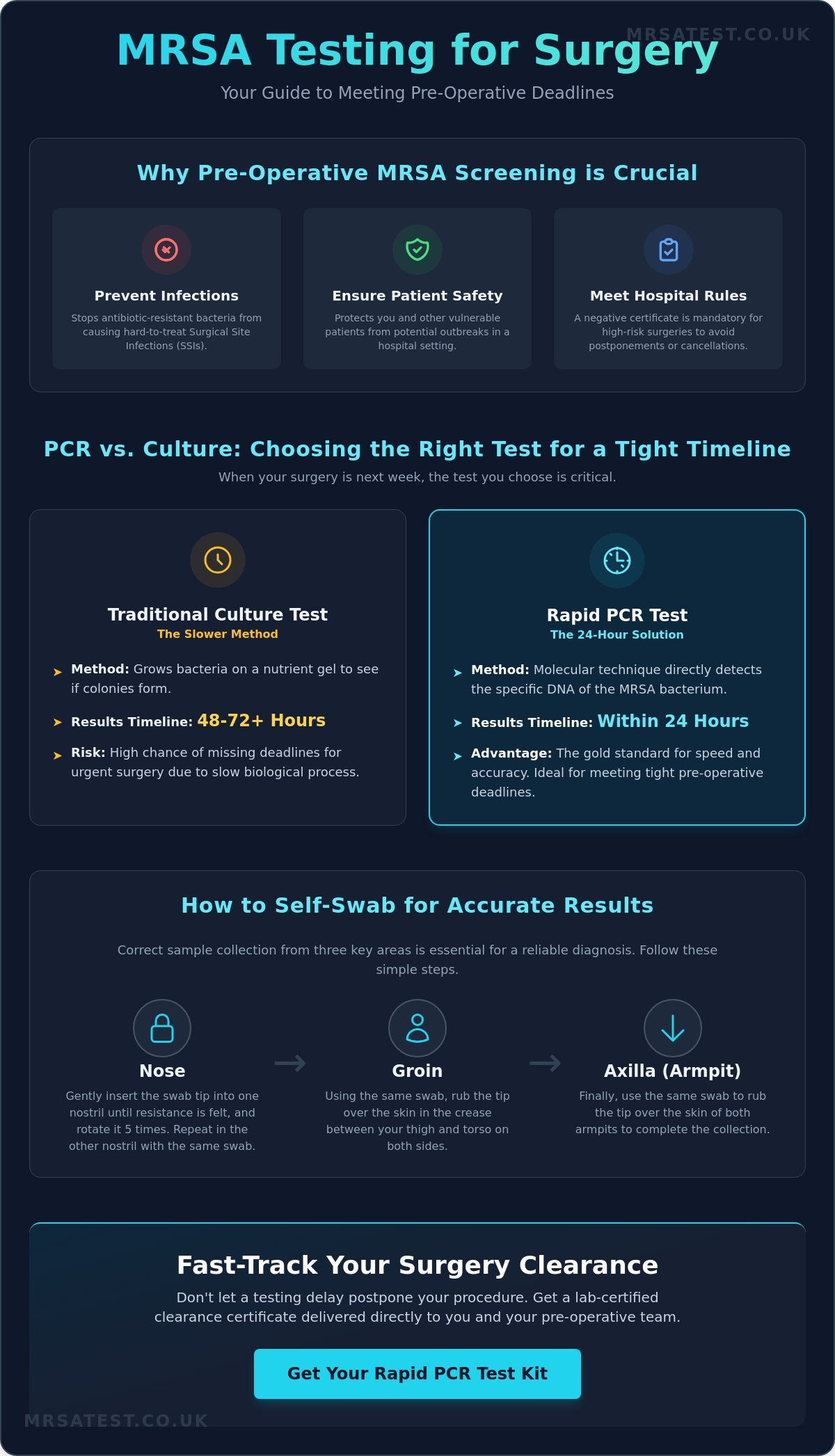
The culture test is the traditional approach to screening. In this process, a laboratory technician places your swab sample onto a specialized nutrient gel to see if bacteria grow. It’s a biological process that simply can’t be rushed. It usually takes between 48 and 72 hours for bacterial colonies to become visible enough for identification. If the sample shows “borderline” growth, the lab might need to incubate it for an additional day to be certain of the result. This method is often unsuitable for patients who have surgery scheduled in less than five days, as any delay in postage or lab processing will miss the hospital’s deadline.
Rapid PCR Testing (The 24-Hour Solution)
Rapid PCR (Polymerase Chain Reaction) testing is a molecular technique that bypasses the need for bacterial growth. Instead of waiting for colonies to form, the lab uses advanced equipment to detect the specific DNA of the MRSA bacterium directly from the swab. This method is considered the gold standard for speed and accuracy in pre-operative screening. Results are typically available within 24 hours of the laboratory receiving your kit. This rapid turnaround provides the official clearance required for an mrsa test for surgery next week, giving you the documentation you need without the anxiety of a long wait.
According to NHS guidance on MRSA testing, the goal of screening is to identify colonisation so that treatment can begin before you enter a sterile operating theatre. PCR technology makes this possible even on a tight schedule. While a culture test looks for live bacteria, PCR looks for the genetic signature, making it a highly sensitive and reliable diagnostic tool. If you’re worried about missing your surgical window, you might consider our MRSA Rapid PCR Test to ensure your results are ready when you are.
Private MRSA Testing: A Reliable Alternative for Surgery Clearance
Waiting for a hospital-led screening appointment can be a source of significant anxiety when your surgical date is fixed. If you’ve been told you need an mrsa test for surgery next week, relying on the standard NHS backlog might feel like a gamble you can’t afford to take. Private testing offers a streamlined alternative, providing the speed and guaranteed timelines necessary to meet strict clinical deadlines. By utilizing UKAS-accredited laboratories, you ensure that your results carry the same medical weight as those performed within a hospital setting, allowing your pre-operative team to proceed with confidence.
Ensuring Your Result is Accepted by the Hospital
For a private test to be valid, it must meet the specific documentation standards required by surgical teams. Most hospitals follow strict hospital-acquired infections protocols to maintain ward safety. Your laboratory report should clearly state your full name, the date the sample was taken, and the diagnostic method used, such as a Rapid PCR. Research into the clinical effectiveness of MRSA screening confirms that high-sensitivity tests are essential for preventing post-operative complications. We recommend informing your surgeon or pre-op nurse that you are using an independent, accredited service. Most consultants welcome proactive screening as it reduces the risk of last-minute theatre cancellations.
The Convenience of At-Home Screening
The days leading up to a procedure are often filled with appointments and logistical planning. Managing your mrsa test for surgery next week from the comfort of home can significantly reduce your stress levels. Integrating this step into your preparing for surgery phase allows you to avoid unnecessary hospital visits and potential exposure to other illnesses. Modern at home test kits uk are designed for simplicity and professional accuracy. The process is straightforward: you order the kit online, perform the self-swab following the included instructions, and return the sample via priority post. Once the lab receives your swab, your results are processed rapidly, often within 24 hours, and emailed directly to you for immediate forwarding to your clinical team.
Step-by-Step: How to Self-Swab for Accurate Results
Performing a self-swab at home is a straightforward process, but precision is vital to ensure your results are accepted by your clinical team. If you’ve ordered an mrsa test for surgery next week, you need the sample to be perfect on the first attempt to avoid any administrative delays. Start by washing your hands thoroughly with soap and water. Clear a clean, dry area to lay out your testing kit components. This simple preparation prevents environmental contaminants from affecting the laboratory analysis and ensures your sample remains pure.
The “swab and rotate” technique is the most effective way to collect a viable sample. You aren’t just touching the surface; you need to apply gentle pressure and rotate the swab head several times against the skin or mucous membrane. This action ensures you pick up enough skin cells and bacteria for the lab to analyze. Common mistakes, such as barely touching the skin or failing to rotate the swab, often lead to “insufficient” results. In a time-sensitive situation, an invalid sample is the last thing you need.
Swabbing the Nose, Groin, and Axilla
For the nasal swab, insert the tip about 1 to 2cm into the nostril and rotate it firmly against the inside wall five times. Repeat this in the other nostril using the same swab. For the groin and axilla (armpit), focus on the skin folds where bacteria are most likely to colonize. Ensure the swab makes firm, consistent contact with the skin. Using multiple sites significantly increases the sensitivity of the mrsa and screening process, providing a more comprehensive profile of your colonisation status.
Packaging and Returning Your Sample
Once you’ve completed the swabs, place them immediately into the transport tube containing the stabilization medium. This medium keeps the sample stable and prevents it from drying out during transit. Secure the cap tightly and clearly label the tube with your full name and date of birth. This step is essential so the lab can match your sample to your pre-operative records accurately. Use the provided prepaid tracked 24-hour return envelope to send your kit back. This ensures the lab receives your sample as quickly as possible, keeping your mrsa test for surgery next week on schedule.
Ready to secure your clearance? Order your MRSA Rapid PCR Test kit today to ensure your surgery proceeds without delay.
Fast-Track Your Surgery with mrsatest.co.uk
Securing an mrsa test for surgery next week shouldn’t be a source of stress. At mrsatest.co.uk, we specialize in providing the rapid, lab-certified results required by hospitals across the UK. We understand that your surgical date is a priority. That’s why we’ve streamlined our entire diagnostic process to focus on efficiency and clinical accuracy. Thousands of patients trust our service because we provide clear, professional laboratory reports that are ready to be forwarded directly to pre-operative teams. Our pricing is transparent and all-inclusive, covering the kit, priority return postage, and the laboratory analysis without any hidden fees.
Our service is designed to bridge the gap between hospital requirements and your busy schedule. We provide a range of options to suit your specific needs, including:
- MRSA Rapid PCR Test– Nose/Groin/Axilla
- MRSA Rapid PCR Test– Nose/Groin
- MRSA Culture – Nose/Groin/Axilla
- MRSA Culture – Nose/Groin
Our Rapid PCR Testing Process
Our logistics are built for speed. If you place your order before 2pm, we dispatch your kit the same day via first-class mail. Once you’ve performed your self-swab and returned it using our tracked 24-hour service, our partner laboratories begin the analysis immediately. You won’t have to wait days for a letter in the post. Instead, your results are delivered securely via email the moment the analysis is complete. This rapid turnaround is essential when you need an mrsa test for surgery next week. If you have questions about your report, our support team is available to provide clarity on the technical details of your results.
Next Steps if Your Result is Positive
Receiving a positive result isn’t a “fail” or an automatic end to your surgical plans. It’s simply a prompt for proactive care. If MRSA is detected, it means you’re colonized, and a standard decolonisation programme can often still save your surgery date. This typically involves a five-day course of antibacterial body washes and nasal creams to clear the bacteria from your skin. You should provide your laboratory report to your GP immediately so they can prescribe the necessary treatment. By identifying the bacteria now, you’re taking the necessary steps to ensure your procedure is as safe as possible and that your recovery remains on track.
Secure Your Surgical Date with Confidence
Preparing for an operation is a significant milestone, and managing the final logistics shouldn’t feel like a race against time. By choosing rapid PCR technology over traditional culture methods, you eliminate the uncertainty of a multi-day wait. Private screening allows you to bypass potential hospital backlogs, ensuring you have a lab-certified clearance certificate ready for your pre-operative assessment. Securing an mrsa test for surgery next week is a proactive way to protect your health and your schedule.
Our service provides the peace of mind you need through a UKAS Accredited Laboratory and discreet & secure home testing. We understand the urgency of your procedure, which is why 24-hour PCR results are available to keep your admission on track. Don’t let a missing certificate lead to a last-minute cancellation. Take control of your pre-op requirements today.
Order Your Rapid PCR MRSA Test Kit for Next-Day Results
You’ve worked hard to prepare for this procedure. We’re here to ensure the final clinical steps are simple, fast, and stress-free. You’re in safe hands.
Frequently Asked Questions
Will my hospital accept a private MRSA test result?
Most hospitals accept results from private laboratories as long as they’re UKAS-accredited and follow standard diagnostic protocols. Your laboratory report must include your full name, the date of the sample, and the specific testing method used. It’s always a good idea to confirm with your pre-operative team that they’ll accept an external certificate to ensure your admission goes smoothly.
How long does a PCR MRSA test take to give results?
A PCR test provides results much faster than traditional methods, typically within 24 hours of the laboratory receiving your swab. Because this method identifies bacterial DNA directly, it bypasses the multi-day incubation period required for a culture. This rapid turnaround is particularly helpful if you’ve realized you need an mrsa test for surgery next week and can’t wait for hospital processing.
Can I do an MRSA swab myself at home?
Yes, self-swabbing at home is a reliable way to collect samples for pre-surgical screening. Our kits provide all the necessary components and clear instructions to guide you through the process. By following the “swab and rotate” technique in the required areas, you can collect a high-quality sample that provides professional-grade accuracy without the need for a clinical appointment.
What happens if my MRSA test comes back positive before surgery?
A positive result doesn’t usually mean your surgery is cancelled. Instead, it indicates that you’re colonized with the bacteria and need a decolonisation treatment. This standard protocol involves using an antibacterial body wash and nasal cream for five days. Once you complete this treatment, your risk of infection is significantly reduced, and your surgical team will typically proceed with your scheduled procedure.
Is a PCR test more accurate than a culture test for MRSA?
PCR testing is considered the gold standard for rapid screening because of its high sensitivity. While culture tests are reliable, they depend on growing live bacteria, which can take up to three days. PCR identifies the genetic signature of MRSA immediately, reducing the risk of a false negative result. This makes it a dependable choice for patients who need absolute certainty on a tight deadline.
Do I need to swab my nose and my groin for a surgery test?
Yes, swabbing the nose and groin is the standard requirement for most surgical clearances. These areas are the most common sites for MRSA colonisation. Some protocols also include the axilla (armpit) to ensure the highest possible detection rate. Using multiple sites increases the sensitivity of the test, giving your surgical team the most accurate picture of your health status before you enter the operating theatre.
How many days before surgery should I take the MRSA test?
We recommend taking your test at least one week before your scheduled procedure. This timeline ensures that your results are ready for your pre-op assessment. If you find yourself needing an mrsa test for surgery next week, the rapid PCR method is essential. It provides enough time for you to receive your results and complete a five-day decolonisation treatment if the test returns a positive result.
What is the difference between MRSA colonisation and an infection?
MRSA colonisation means the bacteria are present on your skin or in your nose but aren’t causing any harm or symptoms. You can be a carrier without knowing it. An infection occurs only if the bacteria enter your body through a wound or incision. Screening’s designed to find colonisation so it can be treated before it has the chance to cause a serious post-operative infection.