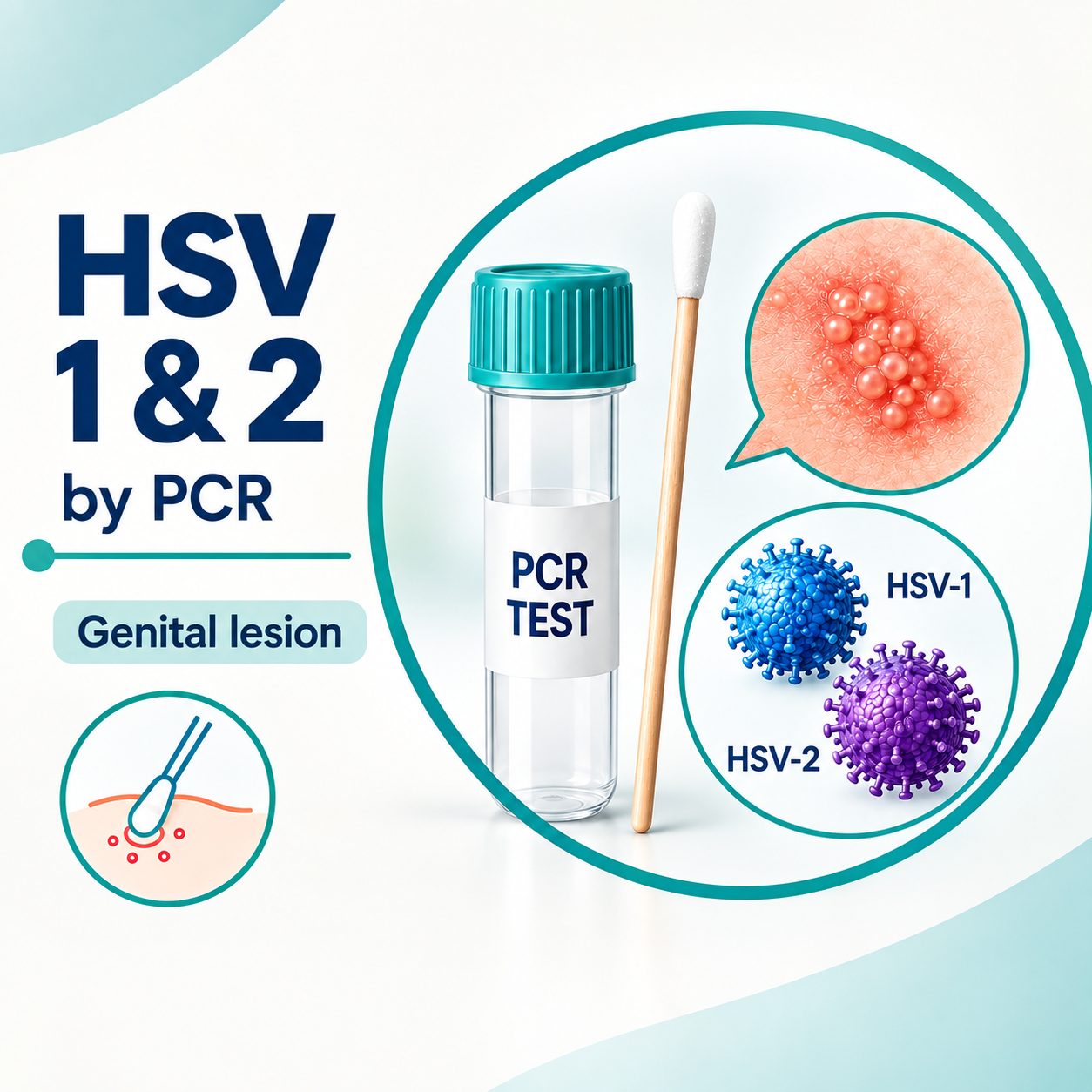
If you suspect that you have genital herpes, test the lesion directly.
The PCR test for
HSV-1 and HSV-2 using a swab from a genital lesion is a laboratory test which is intended for the detection and differentiation of Herpes Simplex Virus Type 1 (HSV-1) and
Herpes Simplex Virus Type 2 (HSV-2) in the case of an active genital lesion.
PCR can directly detect the genetic material of HSV in the sample provided. Molecular testing is very sensitive when it comes to
detecting HSV in genital ulcers and other mucocutaneous lesions.
The test should be used in cases where there is an
active blister, sore or ulcer.
Important note: Should you not currently have a visible genital lesion, then this lesion-swab test might not be the right one.
A healthcare professional could recommend whether or not another kind of assessment or testing would be appropriate.
Key benefits
Detects HSV-1 & HSV-2
There are tests available for
Herpes Simplex Virus Type 1 and Type 2.
PCR-based testing
It directly detects the genetic material of HSV from a sample of the lesion.
Differentiates the virus type
The outcome shows which of
HSV-1 or HSV-2 was detected.
Designed for active lesions
Appropriate in the case where there is a genital blister, sore or ulcer.
Laboratory analysed
The samples are analysed by means of PCR testing in a laboratory.
Confidential
The results are given to you in a confidential manner in keeping with the procedures of your testing provider.
How the test works
- Collect your sample
Take the sterile swab that has been supplied and use it to obtain a sample from the lesion that is active, making sure to follow the collection instructions which are included with your kit.
- Prepare your sample
Put the swab into the specimen transport tube which is provided and follow the instructions to prepare it for return.
- Laboratory testing
The sample is analysed by means of PCR in order to detect the genetic material of HSV-1 and HSV-2.
- Receive your result
The laboratory report will show if
HSV-1 or HSV-2 has been detected in the sample that was submitted.
[ORDER YOUR TEST]
What kind of thing does this test detect?
The test detects two types of herpes simplex virus:
HSV-1
HSV-1 is usually linked with oral herpes but can also lead to
genital herpes, for example as a result of oral-genital contact.
HSV-2
HSV-2 is a frequent cause of genital herpes and is more often linked with recurrent genital infections.
Genital infections can be caused by both HSV-1 and HSV-2.
At what point should I use this test?
This test is intended for people who currently have an
active genital lesion, such as:
- A blister
- A sore
- An ulcer
- A suspected herpes lesion
- A new genital lesion
- A recurrent genital lesion
For testing to be carried out there must be an appropriate lesion to swab; the NHS states that herpes testing at sexual health services usually involves taking a swab from a visible blister or sore.
For the best opportunity for detection
Wherever possible, samples should be taken when the lesion is still
active rather than after it has completely healed, since HSV detection becomes more difficult as the lesion heals.
Symptoms that may occur with genital herpes
Genital herpes can cause:
- Small genital blisters
- Open sores or ulcers
- Tingling
- Burning
- Itching
- Genital irritation
- Pain when urinating
- Discomfort around the affected area
It is possible for certain individuals to have mild symptoms or to show no symptoms at all.
It doesn’t have to be herpes that causes a genital lesion; other infections and non-infectious conditions can also lead to genital ulcers or sores, which is why a clinical evaluation might be suitable—especially if the symptoms are unusual or last for a long time. The BASHH guidance states that both HSV and other possible causes should be taken into account when assessing genital ulceration.
What’s included?
Your test kit contains:
| Sterile swab |
For collecting the lesion sample |
| Specimen tube |
For transporting the collected sample |
| Collection instructions |
Step-by-step sampling guidance |
| Return packaging |
For returning the sample |
| Laboratory PCR analysis |
Testing for HSV-1 and HSV-2 |
| Results report |
Your confidential laboratory result |
Important: The kit should only be described as being suitable for self-collection or
home sampling if the particular collection method has been validated and approved for your laboratory service.
Understanding your results
HSV-1 not detected / HSV-2 not detected
In the sample that was submitted, no genetic material of HSV-1 or HSV-2 was found.
A negative result does
not entirely rule out the possibility of HSV infection, especially in the case of an older lesion or one which is healing, or when there is not enough viral material in the sample.
HSV-1 detected
The genetic material of HSV-1 was found in the lesion sample that was submitted.
HSV-2 detected
The genetic material of HSV-2 was found in the lesion sample that was submitted.
When interpreting a result you should take your symptoms and clinical history into account. If you still have lesions that are unexplained or persistent, you should get medical advice.
HSV-1 vs HSV-2
| Can cause genital herpes |
✓ |
✓ |
| Can cause oral herpes |
✓ |
✓ |
| Can be sexually transmitted |
✓ |
✓ |
| Can cause recurrent infection |
✓ |
✓ |
| Detected by this test |
✓ |
✓ |
The kind of HSV identified may be of importance for prognosis and for clinical management; genital infection due to HSV-2 is more often linked with recurrent genital disease than is genital infection due to HSV-1.
PCR testing vs other herpes tests
Lesion PCR
The test checks for
HSV genetic material in a sample taken from the lesion.
It is intended for use in cases where a genital lesion is present and can be taken as a sample.
Blood antibody testing
Instead of testing the lesion directly, blood tests check for HSV antibodies.
They can be considered in certain circumstances even if there are no lesions, but they address a different clinical question.
Viral culture
Viral culture can be used to test lesions as well, but molecular testing is usually more sensitive. The sensitivity of culture decreases as the lesions start to heal.
Frequently Asked Questions
May I carry out this test even if I don’t have any symptoms?
The product is intended for use in testing an
active genital lesion.
When there is no visible blister, sore or ulcer, then this test might not be suitable. You should discuss your symptoms with a healthcare professional and find out if another type of testing would be appropriate.
At what time should I take the sample?
The lesion should be present when the sample is collected, adhering to the collection instructions that come with the kit.
As a lesion heals, detecting HSV can become more difficult.
Can a negative result entirely exclude herpes?
No.
A negative result indicates that HSV-1 or HSV-2 was not found in the sample that was submitted, but it does not entirely rule out the possibility of infection, especially if the lesion is old or is in the process of healing or if the sample contains too little viral material.
Can the test show me the time at which I picked up herpes?
No.
The test is able to find out if genetic material from HSV-1 or HSV-2 is present in the sample, but it cannot tell when the infection was obtained or from whom it was acquired. The NHS specifically states that herpes testing cannot show for how long a person has had the condition or who they got it from.
Does having HSV-1 mean that I have oral herpes?
Not necessarily.
HSV-1 is capable of causing infections of the mouth and the genital area; when HSV-1 is found in a genital lesion it means that genetic material of HSV-1 was detected at that location.
Is genital herpes curable?
At the moment there is no treatment available which can get rid of HSV from the body. Although antiviral treatment can assist with managing the symptoms and outbreaks.
Does this test also detect other sexually transmitted infections?
No.
The test is specifically for
HSV-1 and HSV-2.
Other infections may cause genital sores or ulcers. In some cases, further STI testing or a clinical evaluation might be suitable depending on your symptoms and circumstances.
What if I have a genital sore but the test comes out negative?
If the lesion continues, comes back, gets worse, or is still unexplained, you should consult a healthcare professional.
Genital ulcers might be caused by something other than HSV, and a negative result for HSV doesn’t mean that all possible causes have been excluded.
May I take the test while I am pregnant?
Instead of just using a home testing service, if you are pregnant and have a new or suspected genital herpes lesion you should obtain medical advice.
The BASHH and RCOG have particular guidance in relation to HSV during pregnancy and the neonatal period.
Why choose Repose Healthcare?
Our aim at Repose Healthcare is to make laboratory testing simple, private and accessible.
The PCR test for HSV-1 and HSV-2 offers targeted laboratory analysis of an existing genital lesion and is intended to determine whether genetic material from HSV-1 or HSV-2 has been
detected.
Private testing
Laboratory analysis
Clear results in 1-3 working days.
Important information
This test is meant to aid in the investigation of a possible HSV infection and
does not take the place of a medical evaluation or advice.
Genital blisters, sores or ulcers may be caused by things other than herpes. When you have genital lesions that are unexplained, persistent, severe or getting worse, you should obtain medical advice.
The NHS says that you should go to a sexual health clinic if you have symptoms of genital herpes, so that a doctor can examine the lesion and take the right kind of swab.
Seek prompt medical advice if:
- You are pregnant and have suspected genital herpes
- You have severe or rapidly worsening symptoms
- You have extensive or unusual lesions
- You are concerned about another STI
- You have significant difficulty passing urine
- Symptoms persist despite a negative result