
A positive MRSA result is not a surgical roadblock; it is a clinical roadmap for your safety. You might feel embarrassed or fear that being a carrier means an immediate cancellation. However, modern protocols treat MRSA as a manageable factor rather than a crisis. Understanding what to tell my surgeon about my mrsa result is the first step in transforming this discovery into a proactive safety plan that protects your recovery.
We know that navigating pre-operative requirements can feel overwhelming. You’ll learn exactly how to communicate your status to your surgical team to ensure a smooth and safe procedure. This guide covers the 5 to 10 day decolonisation protocols, explains why your screening is valid for up to six months under May 2025 UK standards, and provides a clear script for your next appointment. You can approach your surgery with confidence, knowing that transparency is your best tool for a healthy outcome.
Key Takeaways
- Understand the clinical difference between being an MRSA carrier and having an active infection so you can discuss your health accurately.
- Learn exactly what to tell my surgeon about my mrsa result using a structured disclosure method that prioritises safety and prevents last-minute delays.
- Discover why a positive screen rarely leads to a cancellation and how decolonisation protocols prepare you for a successful procedure.
- Find out how to present private, UKAS-accredited results to your hospital team to streamline your pre-operative assessment.
- See how rapid PCR screening provides the fast answers you need when your surgery date is approaching quickly.
Decoding Your MRSA Test Result Before the Consultation
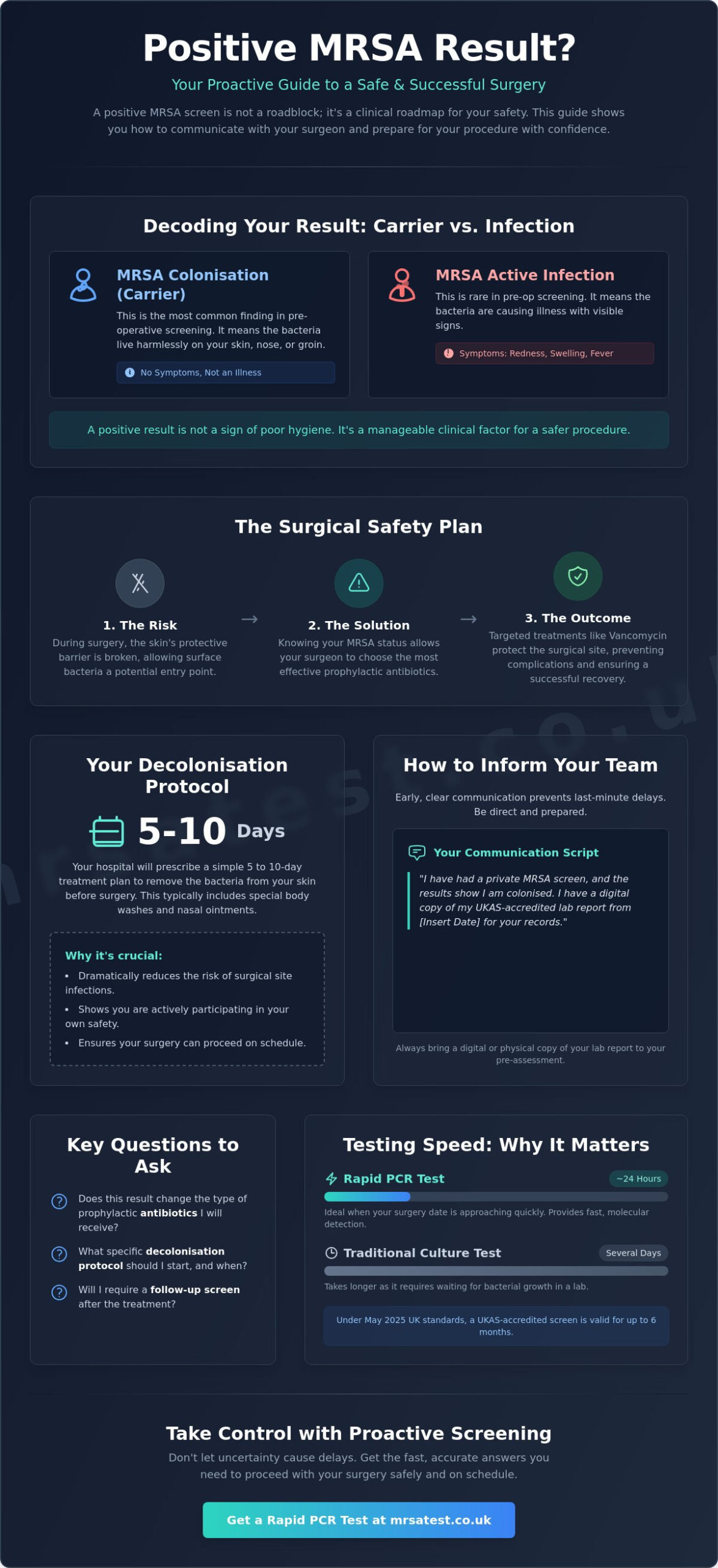
Seeing a “Positive” result on a lab report can feel daunting. Before you decide what to tell my surgeon about my mrsa result, remember that this document is a tool for safety, not a judgment. It provides the specific clinical data required to tailor your surgical care. Surgeons rely on this information to select the most effective prophylactic antibiotics. By knowing your status, they can choose specific treatments like vancomycin instead of standard options, ensuring the surgical site remains protected from resistant strains. This proactive approach is standard practice in UK hospitals to prevent post-operative complications.
Colonisation vs. Active Infection
The word “positive” usually refers to colonisation in a pre-operative context. This means you’re “carrying” the bacteria on your skin, in your nose, or in your groin without feeling ill or showing symptoms. An active infection involves visible signs like redness, swelling, or fever. Most patients identified during screening are healthy carriers who’ve lived with the bacteria unknowingly. Even asymptomatic carriage needs attention before an operation. When the skin’s barrier is broken during surgery, those harmless surface bacteria can enter the body and cause complications if they aren’t managed beforehand.
Reading Your Lab Report
Your report will likely list “Staphylococcus aureus,” which is a common bacterium. When the lab identifies “Methicillin Resistance,” it simply means certain standard antibiotics won’t work. Understanding MRSA as a manageable clinical factor helps remove the unhelpful stigma of “superbugs.” It’s a biological reality, not a sign of poor hygiene. In fact, many people carry these bacteria despite rigorous personal cleanliness. Your report will also specify the swab sites, typically the nose and groin, which helps the surgical team understand exactly where the bacteria are present.
The testing method used also dictates how quickly you can act. An MRSA PCR rapid test provides molecular detection in 24 hours, which is vital if your surgery date is fast approaching. Traditional culture tests take longer, often several days, to confirm bacterial growth. Knowing what to tell my surgeon about my mrsa result includes sharing which sites were swabbed and the specific type of test performed. This transparency helps your team start the necessary 5 to 10 day decolonisation protocol early. Using a UKAS-accredited laboratory ensures your results are accurate and ready for clinical use, which is the best way to keep your surgery on schedule without unnecessary delays.
How to Discuss Your MRSA Status with Your Surgical Team
Transparency is the most effective tool for ensuring your surgery stays on schedule. While it might feel tempting to wait for the hospital to conduct their own tests, early disclosure is the best way to prevent last-minute cancellations. Knowing exactly what to tell my surgeon about my mrsa result removes the guesswork for your medical team and allows them to implement safety protocols immediately. Under the standardised UK guidance updated in May 2025, an MRSA screen is typically valid for at least three months, meaning your proactive test result is highly relevant to your upcoming procedure.
Your Communication Script
You don’t need to be a medical expert to have this conversation. When you meet your surgeon or pre-assessment nurse, be direct and factual. You might say: “I have had a private MRSA screen, and the results show I am colonised. I have a digital copy of my UKAS-accredited lab report from [Insert Date] for your records.” This approach shows you’re prepared and prioritising patient safety. It’s helpful to reference resources like Staph Screening Before Surgery to understand why this disclosure is so vital for your recovery. Always bring a physical or digital copy of your report, as surgeons need to see the specific swab sites and the date the sample was processed.
If you’re still waiting for a confirmed status and your surgery is less than two weeks away, consider an MRSA Rapid PCR Test to get answers within 24 hours. Having this data in hand before your pre-op appointment can save days of administrative back-and-forth.
Questions to Ask Your Surgeon
Once you have shared your status, use the opportunity to clarify the next steps. This keeps you in control of your care plan and reduces anxiety. Consider asking the following questions:
- “Does this result change the type of prophylactic antibiotics I will receive during the operation?”
- “What specific 5 to 10 day decolonisation protocol do you recommend I start today?”
- “Will I need a follow-up screen to confirm the decolonisation was successful before my admission date?”
- “Does being a carrier change my post-operative wound care instructions?”
Most pre-assessment nurses are very experienced in managing MRSA colonisation. They’ll appreciate your honesty because it allows them to book a side room if necessary or adjust the theatre list to maintain infection control standards. By being open about what to tell my surgeon about my mrsa result, you’re not just reporting a lab value; you’re actively participating in a safer surgical outcome.
Will a Positive MRSA Result Cancel My Surgery?
The assumption that a positive MRSA result leads to an automatic cancellation is one of the most common myths in pre-operative care. In reality, the vast majority of surgeries proceed as planned. While a positive result is a clinical priority, it’s rarely a reason to stop a necessary procedure. Instead, it triggers a specific safety protocol designed to protect you and other patients. When considering what to tell my surgeon about my mrsa result, remember that your transparency allows the hospital to schedule your treatment window effectively rather than causing a last-minute delay.
The timing of your surgery often dictates the response. For emergency admissions, NHS protocols ensure you’re admitted to a side room and started on treatment immediately; the operation typically goes ahead without delay. For elective procedures, your surgeon may choose to postpone the date by 5 to 10 days to allow for a full decolonisation cycle. This is a standard safety measure, not a cancellation. If you’ve already completed a decolonisation protocol within the last three months, your surgeon may decide no further delay is necessary, provided your documentation is clear.
The Decolonisation Process
Decolonisation is a straightforward routine that “clears the path” for a safe operation. It typically involves using antiseptic body washes, such as Chlorhexidine, and specific nasal creams for five consecutive days. This process significantly reduces the bacterial load on your skin and in your nostrils, lowering the risk of a surgical site infection. To stay organised, it’s helpful to follow a structured preparing for surgery checklist. This ensures you complete every step of the protocol before your admission date, giving your surgical team full confidence in your readiness.
What Happens on the Day of Surgery?
On the day of your procedure, you might notice some minor adjustments to your care. It’s common for patients with MRSA colonisation to be placed at the end of the surgical list. This isn’t a reflection of your health status; it’s a logistical step that allows the theatre team to perform a terminal clean of the operating room without delaying subsequent patients. You may also be cared for in a private room or a specific bay using barrier nursing techniques. Your quality of care remains identical to every other patient. Visitors are still welcome, though they’ll be asked to follow strict hand hygiene protocols to maintain the hospital’s safety standards.
Presenting Private MRSA Results to the NHS or Private Hospital
Patients often choose private screening to gain early peace of mind or to bypass the logistical delays of hospital-led testing. When you have a result in hand, the next step is ensuring it’s seamlessly integrated into your medical records. Knowing what to tell my surgeon about my mrsa result involves more than just a conversation; it requires presenting a validated, clinical document that the hospital can trust. By providing this information at least two weeks before your procedure, you give the surgical team ample time to update your care plan without rushing.
Most hospitals welcome proactive screening because it reduces the risk of last-minute theatre cancellations. However, the quality of the documentation is vital. A printout or digital PDF from a UKAS-accredited facility provides the “quiet competence” your surgical team expects. It shows you’ve taken your preparation seriously and are prioritising the safety of the entire surgical ward. If you’re still deciding on a provider, you can order a UKAS-accredited MRSA test today to ensure your results meet these high clinical standards.
The Validation Checklist
For a private result to be accepted by an NHS or private hospital, it must meet specific clinical standards. Hospitals aren’t being difficult; they’re following strict infection control protocols. Before your appointment, verify the following details on your report:
- UKAS Accreditation: The report must show a UKAS-accredited laboratory number. This proves the facility meets national quality standards for molecular detection.
- Personal Identifiers: Your full name and date of birth must be clearly visible and match your hospital record exactly.
- Swab Sites: The report should specify where the samples were taken. Standard UK guidance updated in May 2025 focuses on the nose and groin as the primary sites for elective surgery screening.
Communicating with the Pre-Assessment Lead
Don’t wait until the morning of your surgery to present your findings. As soon as you receive your results, contact the pre-assessment department or the surgical secretary. Modern at-home test kits in the UK provide a professional result that is often faster than standard hospital routes. You can usually email the PDF directly to the department, allowing them to upload it to your electronic patient file immediately. This early action is the best way to clarify what to tell my surgeon about my mrsa result before you even step into the consultation room.
If a hospital initially hesitates to accept an external result, politely remind them that the test was performed by a UKAS-accredited facility using PCR or culture methods. Most trusts will accept these results if they are less than three months old. If they insist on a re-test, your private result still serves as an early warning. It allows you to begin decolonisation while waiting for the hospital’s confirmation, ensuring you stay on track for your scheduled date.
Taking Control: Rapid Screening and Next Steps
Taking control of your surgical timeline is the most effective way to eliminate pre-operative anxiety. While hospital protocols are robust, they often move at a pace that doesn’t account for your personal schedule or your need for peace of mind. By choosing an MRSA Rapid PCR Test Kit, you gain molecular detection in 24 hours, giving you a significant head start. This early insight means you won’t be left wondering what to tell my surgeon about my mrsa result at the final hour. Instead, you’ll arrive at your pre-assessment with a clear plan already in motion.
Discretion is a core benefit of modern screening. Testing for MRSA from the comfort of your own home removes the stress of additional hospital visits and allows you to manage your health privately. Our 100% UK-Based partner laboratory ensures that your data is handled with the highest level of confidentiality. When you have your results early, you can address any colonisation issues before they become a logistical problem for the hospital theatre team.
Why Proactive Testing Matters
Bypassing the standard “waiting game” in the NHS allows you to manage your health with quiet competence. Many patients find that hospital-acquired infections (HAIs) are far more manageable when the surgical team has prior knowledge of a patient’s colonisation status. It’s about prevention rather than reaction. Knowing your status at least 14 days before your procedure is the gold standard for surgical preparation. This window is crucial; it provides the necessary time for a full 5 to 10 day decolonisation cycle, ensuring you’re clinically ready for theatre without the stress of a last-minute postponement.
Your Pre-Op Action Plan
To ensure your surgery proceeds safely, follow this simple three-step strategy to stay ahead of the curve:
- Order your kit early: Aim to test at least two weeks before your admission date to allow for shipping and any necessary treatment.
- Sample and Return: Use the simple at-home swabs and return them to our UKAS-accredited facility for fast processing.
- Communicate the Facts: Once you receive your results within 24 to 72 hours, contact your surgical secretary or pre-assessment lead.
When you’re prepared, the conversation regarding what to tell my surgeon about my mrsa result becomes a simple, professional exchange of facts. You can confidently explain that you’ve already identified your status through an accredited facility and are ready to follow their recommended safety protocol. Knowledge is the best tool for a complication-free recovery. By taking these proactive steps, you’re not just a patient; you’re an active partner in your own surgical safety.
Secure Your Surgical Timeline with Confidence
Transparency is your most effective tool for a safe and successful recovery. By understanding that MRSA colonisation is a manageable clinical factor rather than a reason for cancellation, you can approach your pre-op consultation with quiet competence. Providing your medical team with a UKAS-accredited report ensures they have the data needed to select the correct prophylactic antibiotics and maintain hospital safety standards. Under the standardised guidance issued in May 2025, your screening remains a valid part of your patient file for at least three months.
Knowing what to tell my surgeon about my mrsa result allows you to bypass the anxiety of the unknown and focus on your health. Our 100% UK-based service provides the discretion and speed you need when an operation date is approaching. You can order your fast-tracked pre-surgery MRSA test kit today to receive accurate results within 24 hours of lab receipt. This proactive step ensures you have the facts in hand to lead the conversation with your surgical team. You’re now fully equipped to move forward with your procedure, knowing that your safety and recovery are the top priorities.
Frequently Asked Questions
Will my surgery be cancelled if I test positive for MRSA?
Your surgery won’t be automatically cancelled if you test positive for MRSA. Instead, it is typically postponed for 5 to 10 days to allow for a decolonisation protocol. This safety measure ensures that the bacterial load on your skin is reduced before the procedure. For urgent operations, hospitals often proceed immediately while managing the risk in a side room with enhanced barrier nursing and specific antibiotics.
Do I have to tell my surgeon if I did a private MRSA test?
Yes, you should disclose any private test results to your surgical team as early as possible. Transparency is the most effective way to prevent last-minute theatre delays. When deciding what to tell my surgeon about my mrsa result, simply present your UKAS-accredited report. This allows the hospital to update your electronic patient file and confirm that your results meet the standardised UK guidance updated in May 2025.
What is the standard decolonisation treatment before surgery?
The standard treatment involves a 5-day cycle of decolonisation. This protocol typically includes a 4% Chlorhexidine body wash and a specific nasal ointment applied three times daily. These products work together to eliminate MRSA from common carriage sites like the nose and skin surface. Following this routine exactly as prescribed “clears the path” for a safe surgical entry and reduces the risk of post-operative infection.
How long does it take to clear MRSA before I can have my operation?
Most patients are considered ready for surgery after completing a 5-day decolonisation treatment. While some hospitals may require a follow-up screen to confirm the bacteria are gone, many proceed once the protocol is finished. Your initial screen is valid for at least three months under current UK clinical standards. This validity can often be extended to six months if you haven’t been hospitalised in the interim.
Can I get MRSA from the hospital if my pre-op test was negative?
It’s possible to acquire MRSA in a hospital environment even if your pre-operative screen was negative. However, the incidence of MRSA in the UK has decreased significantly since enhanced mandatory surveillance began in 2014. Screening remains the most effective tool to differentiate between bacteria you were already carrying and a new hospital-acquired infection. This data helps your team provide the most accurate post-operative care.
Is a PCR MRSA test better than a culture test for surgery prep?
An MRSA PCR rapid test is often superior for surgical preparation because it provides molecular detection in 24 hours. While traditional culture tests are accurate, they require several days for bacterial growth. If your surgery is scheduled within the next 14 days, the speed of a PCR result allows you to start decolonisation immediately. This prevents the administrative friction that often leads to elective surgery delays.
What happens if I test positive for MRSA on the day of my surgery?
If you test positive on the day of surgery, the hospital will likely move your procedure to the end of the theatre list. This isn’t a cancellation; it’s a logistical step that allows for a terminal clean of the operating room after your case is finished. You may also be cared for in a private side room to maintain infection control. Your quality of care and the surgical procedure itself remain identical to any other patient.
Can my family catch MRSA from me while I wait for surgery?
Healthy family members, including children and pregnant women, are generally not at risk from someone carrying MRSA. The bacteria live harmlessly on the skin of roughly 3% of the population. While you wait for your surgery, you don’t need to isolate at home. Simple hand hygiene and avoiding the shared use of towels or razors are sufficient to prevent the spread of the bacteria to others in your household.