
MRSA PCR vs. Culture Test: Which Screening Method Is Right for You?
Imagine your surgery is scheduled for next week, but your hospital admission depends on a clear MRSA screen you haven’t yet secured. The pressure of a looming deadline, combined with the fear of hospital-acquired infections, can make an already stressful time feel unmanageable. When you’re weighing the options of an mrsa pcr vs culture test, you need clear facts rather than complex medical jargon to make an informed decision. It’s natural to feel anxious about potential delays, but choosing the right diagnostic tool provides the professional reassurance you need to move forward.
This article explains the critical differences in speed, accuracy, and cost between these two primary screening methods. We’ll show you why a rapid PCR test is often the essential choice for urgent pre-operative requirements, while a standard culture test remains a reliable, cost-effective option for routine screening. By the end of this guide, you’ll have the confidence to choose a discreet, accredited testing kit that ensures your procedure stays on track. We’ll provide a clear overview of turnaround times and laboratory precision so you can secure your results with total peace of mind.
Key Takeaways
- Discover the fundamental science behind MRSA screening, including how molecular DNA detection differs from traditional microbiological growth.
- Compare the turnaround times of an mrsa pcr vs culture test to ensure your results arrive before your scheduled hospital admission.
- Evaluate the accuracy and sensitivity of each method to understand why certain tests are less likely to yield a false negative.
- Identify which screening option matches your hospital’s specific requirements, balancing the need for speed with cost-effective routine testing.
- Learn how to complete a professional, accredited MRSA screen from home using a discreet and streamlined self-collection process.
Understanding MRSA PCR vs. Culture Tests
Safe surgical outcomes begin long before you enter the operating theatre. One of the most critical steps in this preparation is screening for Methicillin-resistant Staphylococcus aureus (MRSA). This specific strain of bacteria has developed a resilience to common antibiotics, making it difficult to treat if it enters the bloodstream or a surgical wound. Because of this, hospitals across the UK mandate screening to protect both the individual patient and the wider clinical environment. When you’re deciding between an mrsa pcr vs culture test, you’re choosing between two distinct laboratory technologies that offer different advantages in terms of speed and detection methods.
The rise of at-home testing has streamlined this process significantly. By using a professional self-collection kit, you can complete your required screening in a private setting. This reduces the logistical burden on healthcare facilities and allows you to manage your pre-operative timeline with greater control. Whether you choose a rapid molecular method or a traditional microbiological growth test, the goal remains the same: ensuring you’re clear for your procedure.
Why Screening for MRSA is Mandatory for Surgery
Hospitals are highly controlled environments, yet they’re also places where vulnerable patients are at risk of hospital-acquired infections (HAIs). Screening allows clinicians to distinguish between “colonisation” and “infection.” Many people carry MRSA on their skin or in their nose without ever feeling ill; this is colonisation. However, during surgery, the skin’s natural barrier is broken. If the bacteria are present, they can migrate into the body and cause a serious infection. Identifying your status early is a vital part of preparing for surgery. It ensures that if you’re carrying the bacteria, you can undergo a simple decolonisation treatment before your operation date.
The Evolution of MRSA Diagnostics
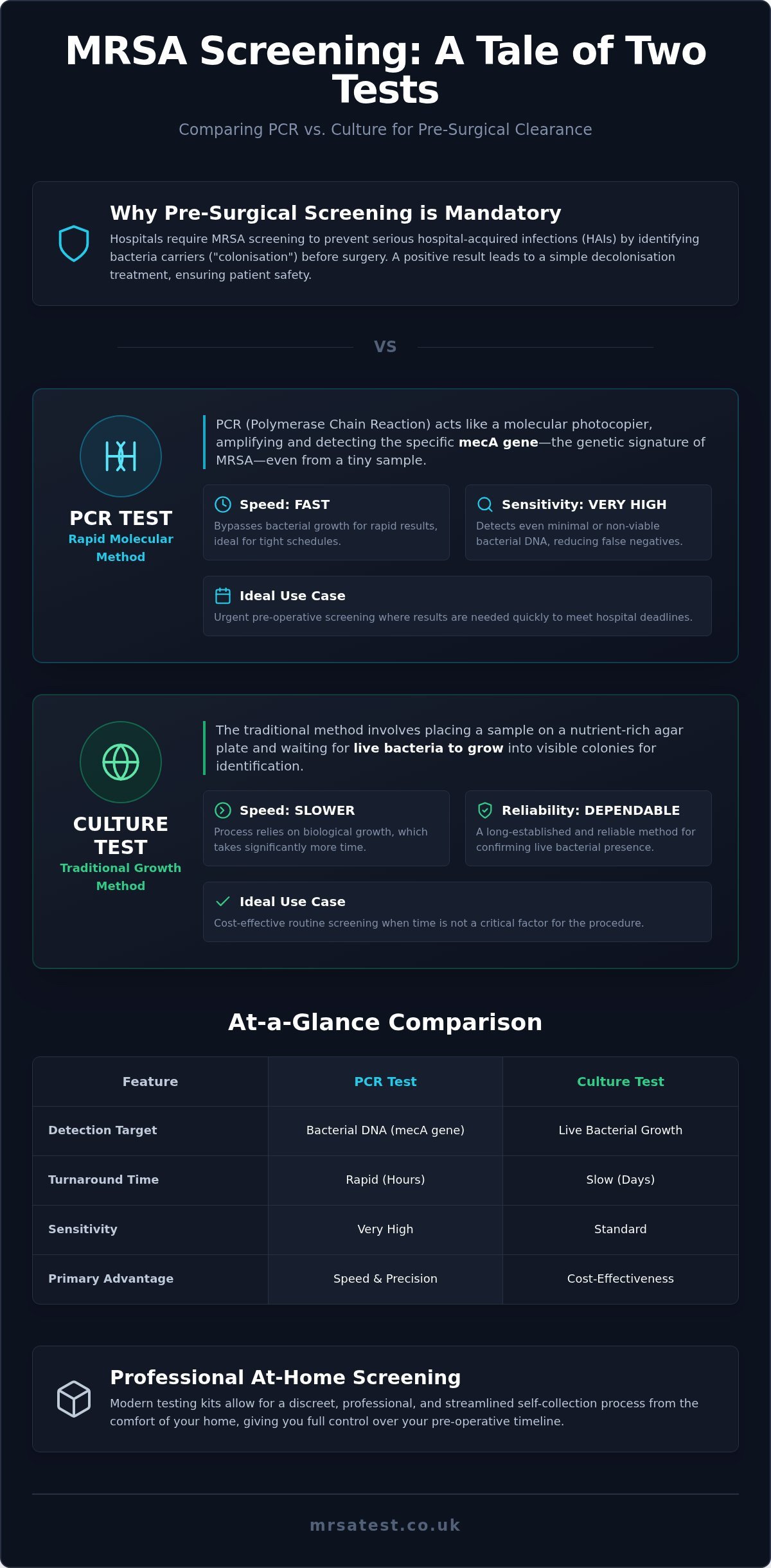
For decades, the standard approach was the culture method. This involves placing a sample on a nutrient-rich agar plate and waiting for any bacteria to grow. While reliable, it’s a slow process that relies on biological growth. In recent years, the landscape has shifted with the rise of rapid molecular diagnostics. Modern PCR technology allows labs to bypass the waiting period for bacterial growth by identifying the unique DNA signatures of the bacteria instead. Today, patients have a choice. You can opt for the traditional culture or the faster PCR method, depending on your hospital’s specific requirements and how quickly you need your results confirmed. Understanding the technical nuances of an mrsa pcr vs culture test helps you select the kit that best fits your surgical schedule.
The Science of Detection: DNA vs. Live Growth
Understanding the technical differences between an mrsa pcr vs culture test starts with what the laboratory is searching for in your sample. While both methods are highly effective, they operate on different scientific principles. One method looks for the genetic blueprint of the bacteria, while the other looks for the living organism itself. This distinction is vital because it affects how quickly you receive your results and how sensitive the test is to low levels of bacteria on your skin.
How PCR Identifies the mecA Gene
PCR, or Polymerase Chain Reaction, focuses on molecular detection. It specifically targets the mecA gene, which is the genetic signature that grants Staphylococcus aureus its resistance to methicillin and other common antibiotics. You can think of PCR as a molecular photocopier for bacterial DNA. Even if only a tiny amount of genetic material is present on your swab, the PCR process replicates that DNA millions of times until it’s easily identifiable by laboratory equipment.
This high level of sensitivity is why PCR is often preferred for urgent pre-surgery screening. Because it detects genetic markers rather than relying on bacterial growth, it can identify the presence of MRSA even if the bacteria are no longer “viable” or capable of replicating. According to a study comparing PCR and culture, molecular methods frequently show higher sensitivity rates, making them an excellent choice for patients who need a definitive answer quickly. If you’re working against a tight hospital deadline, choosing a professional PCR screening kit can provide the rapid clarity you need.
The Microbiological Culture Process
The traditional culture method takes a more biological approach. In the lab, your sample is placed on a nutrient-rich agar plate designed to encourage bacterial growth. The plate is then kept in a controlled incubator for a set period. Scientists monitor the plate to see if any colonies form. If growth occurs, they use visual inspections and chemical tests to confirm if the bacteria are indeed MRSA.
The primary advantage of a culture is that it confirms “viability.” It proves that the bacteria are alive and capable of causing an active colonisation. While this process is thorough, it’s naturally limited by the speed of biology; you simply can’t force bacteria to grow faster than their natural rate. This is why cultures take longer than PCR tests. However, for routine screenings where time isn’t the primary concern, the culture method remains a dependable and widely respected diagnostic standard.
Comparing Speed, Sensitivity, and Reliability
Choosing between an mrsa pcr vs culture test often comes down to a balance of time and precision. While the previous section explored the biological differences, the practical implications for your surgical timeline are even more significant. PCR technology offers a rapid assessment, whereas culture methods provide a detailed view of living bacteria. Understanding how these metrics affect your preparation can help alleviate the anxiety of a looming hospital deadline.
Turnaround Times: Meeting Your Surgery Deadline
Time is the most critical factor when preparing for a procedure. A standard culture test typically requires 48 to 72 hours because the laboratory must wait for biological growth to occur. In contrast, results for a PCR kit are often delivered within 24 hours of the lab receiving your sample. This difference can be the deciding factor if your hospital requires proof of a negative screen only days before admission. It’s a common scenario where a delay in testing could lead to a postponed surgery.
The logistical process is designed for maximum efficiency. Once you post your self-collected swab using the prepaid return shipping, it’s processed by an accredited UK laboratory. For those on a tight schedule, the MRSA test using PCR technology is the only viable option to prevent last-minute cancellations. This speed doesn’t compromise quality; it simply uses advanced molecular tools to bypass the slow pace of traditional microbiology.
Diagnostic Sensitivity and Accuracy
Sensitivity refers to a test’s ability to correctly identify individuals who are colonised with MRSA. PCR is widely recognised for its superior sensitivity. It can detect minute fragments of bacterial DNA that a culture might miss, especially if the sample volume is low. Research comparing PCR and culture for MRSA detection suggests that molecular methods are particularly effective when a patient has recently used antibiotics. Antibiotics can inhibit live bacterial growth on an agar plate, potentially leading to a false negative in a culture test, whereas PCR remains accurate.
There’s a common debate regarding “false positives” in PCR testing. Because PCR detects DNA rather than live organisms, it can occasionally pick up genetic material from dead bacteria. While some clinicians argue this leads to over-treatment, most surgical teams prefer the high sensitivity of an mrsa pcr vs culture test to ensure maximum safety in the operating room. The higher price of PCR reflects the advanced technology and the rapid turnaround that traditional methods can’t match. If you’re looking for the most rigorous screening to ensure a safe environment for your recovery, the molecular approach offers the highest level of reassurance.
Which MRSA Test Should You Choose?
Deciding between an mrsa pcr vs culture test requires looking at your specific circumstances. Most patients find that their choice is dictated by two primary factors: their hospital’s instructions and their remaining time before admission. It’s vital to select the test that aligns with clinical requirements while offering you the fastest route to a confirmed result. Choosing the wrong method can lead to unnecessary stress or even a cancelled procedure.
The Pre-Surgery Decision Matrix
Start by reviewing your hospital pre-op letter. Some surgical departments specifically request a “Rapid PCR” due to its high sensitivity, while others may accept a standard culture. If the letter doesn’t specify, you should calculate your remaining time carefully. You need to account for kit delivery, return postage, and lab processing to ensure you meet your deadline.
- Step 1: Identify if your hospital requires 2 swab sites (Nose and Groin) or 3 sites (Nose, Groin, and Axilla/Armpit).
- Step 2: Calculate your “buffer” time. Account for at least 48 hours for the kit to move through the postal system before it reaches the lab.
- Step 3: Choose the PCR method if your surgery is scheduled within the next 5 to 7 days. This ensures your results are ready well before you arrive at the clinic.
Screening for Peace of Mind
Not every test is driven by an urgent surgical deadline. If you’re conducting a routine screen or monitoring common skin infections, a culture test is a highly reliable and budget-friendly option. This method provides the clinical confirmation you need to inform your GP or healthcare provider about your status. It’s an excellent choice for those who want a professional assessment without the added cost of rapid molecular technology. Choosing the right mrsa pcr vs culture test depends on whether you’re prioritising speed or routine surveillance.
Whether you need the speed of PCR or the traditional thoroughness of a culture, selecting an accredited UK laboratory ensures your data is handled with discretion. We provide a simple, managed process that prioritises your peace of mind and safety. You can browse our full range of MRSA screening kits to find the right match for your upcoming procedure or personal health goals.
Professional At-Home Screening with mrsatest.co.uk
mrsatest.co.uk bridges the gap between high-level clinical accuracy and the convenience of your own home. While hospital-based screening often involves long waiting lists or inconvenient travel, our service allows you to take full control of your pre-operative health logistics. You don’t have to worry about the technical complexities of an mrsa pcr vs culture test when the entire process is managed by medical experts. We provide clear, factual guidance and professional-grade collection materials to ensure your sample remains valid and your results are precise.
Accredited Labs and Reliable Results
Accreditation is the most significant factor to consider when evaluating at home test kits uk. We partner exclusively with UK-based, accredited laboratory facilities to process every sample we receive. This commitment to quality ensures that your screening meets the same rigorous standards as a hospital-led test. We also prioritize sample integrity during transit; every kit includes specialized transport packaging and prepaid return shipping to protect the swab until it reaches the lab. Once the analysis is complete, you’ll receive a professional laboratory report. This document provides the clinical evidence required by surgical teams, offering you the reassurance that you’re medically cleared for your procedure.
Simple Steps to Complete Your Test
Completing your MRSA screen is a straightforward and painless process designed for the layperson. Each kit contains sterile swabs and clear, step-by-step instructions for sampling the required sites, typically the nose and groin. After you’ve collected your samples, you’ll activate your kit through our secure online portal. This activation step is vital for tracking your sample and ensuring your results are delivered confidentially. Whether you’ve chosen an mrsa pcr vs culture test, the streamlined workflow remains the same, minimizing friction and reducing the anxiety often associated with medical diagnostics.
Our commitment to discretion means your personal data is handled according to strict privacy regulations. Results are delivered through a secure digital platform, allowing you to share them with your healthcare provider at your own discretion. This professional approach prioritizes your peace of mind and ensures that your surgical schedule remains on track. Order your confidential MRSA test kit online today to access rapid, reliable screening from a trusted UK laboratory.
Securing Your Health for a Successful Procedure
Choosing between an mrsa pcr vs culture test doesn’t have to be a source of pre-operative stress. You now understand that PCR technology offers the rapid, 24-hour turnaround required for tight surgical deadlines, while traditional culture testing provides a dependable method for routine health monitoring. Both options deliver the clinical clarity needed to ensure you’re colonisation-free before entering a hospital environment. By selecting a test that aligns with your specific timeline and hospital requirements, you can focus on your recovery instead of logistical delays.
Our service connects you with a UK Accredited Laboratory to ensure every result is professional and precise. We prioritize your privacy with discreet, plain packaging and secure digital delivery. Don’t let screening requirements hold up your medical journey. You can Order Your Private MRSA Test Kit for Pre-Surgery Screening today and receive results within 24 hours of laboratory receipt for PCR kits. Taking this proactive step gives you the confidence and peace of mind you deserve for a safe and successful procedure.
Frequently Asked Questions
Is a PCR test more accurate than a culture test for MRSA?
PCR tests are generally considered more sensitive than culture tests because they detect bacterial DNA directly. This molecular method can identify the presence of MRSA even in very small quantities that might be missed by traditional growth methods. While both are highly reliable, the increased sensitivity of a PCR screen significantly reduces the risk of a false negative result. This makes it an excellent choice for patients who require absolute certainty before surgery.
How long does it take to get MRSA culture results?
A standard MRSA culture test typically takes between 48 and 72 hours to produce a definitive result once the laboratory receives your sample. This timeframe is necessary because the process relies on biological growth. Scientists must allow enough time for any bacteria present on the swab to multiply on a nutrient-rich agar plate. If you’re working against a tight deadline, the 24-hour turnaround of a rapid PCR test is often more suitable.
Can a PCR test give a false positive for MRSA?
It’s possible for a PCR test to return a positive result even if the bacteria are no longer viable or alive. This happens because the test identifies specific genetic markers, such as the mecA gene, which can persist after the bacteria have died. While this is technically a false positive for an active colonisation, most clinical teams view this high level of detection as a safer approach for pre-surgery screening to minimize infection risks.
Why is the MRSA PCR test more expensive than the culture test?
The price difference between an mrsa pcr vs culture test reflects the advanced molecular technology used in the laboratory. PCR requires specialized equipment and expensive chemical reagents to amplify and identify bacterial DNA. Additionally, the premium cost covers the rapid processing required to deliver results within 24 hours. While the culture test is a more budget-friendly option, it relies on slower, traditional microbiological methods that take several days to complete in the lab.
Which test do NHS hospitals usually require before surgery?
NHS hospital requirements vary significantly between different trusts and specific surgical departments. While traditional culture tests have been the standard for years, many hospitals now utilize or request rapid PCR screening to streamline their admission processes. You should always check your official pre-operative letter for specific instructions. Both methods provided by our accredited laboratory partners are widely accepted across the UK healthcare system for identifying MRSA colonisation status before a procedure.
Do I need to swab my nose, groin, and armpits for both tests?
The number of sites you need to swab depends on the specific protocol requested by your hospital. We offer kits for both Nose/Groin and Nose/Groin/Axilla (armpits) to ensure you can meet these requirements. Most standard screenings focus on the nose and groin as primary colonisation sites. However, if your pre-op instructions mention triple swabbing, you’ll need the kit that includes the axilla to ensure your screening is considered complete by the surgical team.
Can I use an at-home MRSA test for my pre-operative assessment?
Yes, you can use a professional at-home kit for your pre-operative assessment. Our service bridges the gap by providing the same level of accuracy found in a hospital setting through our UK-based, accredited laboratory partners. Once your sample is processed, you’ll receive a formal lab report that you can present to your surgical team. This is a convenient and discreet way to manage your health logistics without needing an in-person appointment or long wait.
What happens if my MRSA test result is positive?
If your result is positive, it means you’re currently colonised with MRSA, but it doesn’t necessarily mean you’re ill. You should present your laboratory report to your GP or surgical team immediately. They’ll typically prescribe a simple decolonisation treatment, which usually involves antiseptic body washes and antibiotic nasal creams. Completing this protocol before your surgery date is essential for reducing the risk of infection and ensuring your procedure can go ahead safely as planned.