Faecal Elastase Test – Pancreatic Function Test
Assess Pancreatic Digestive Function from Home
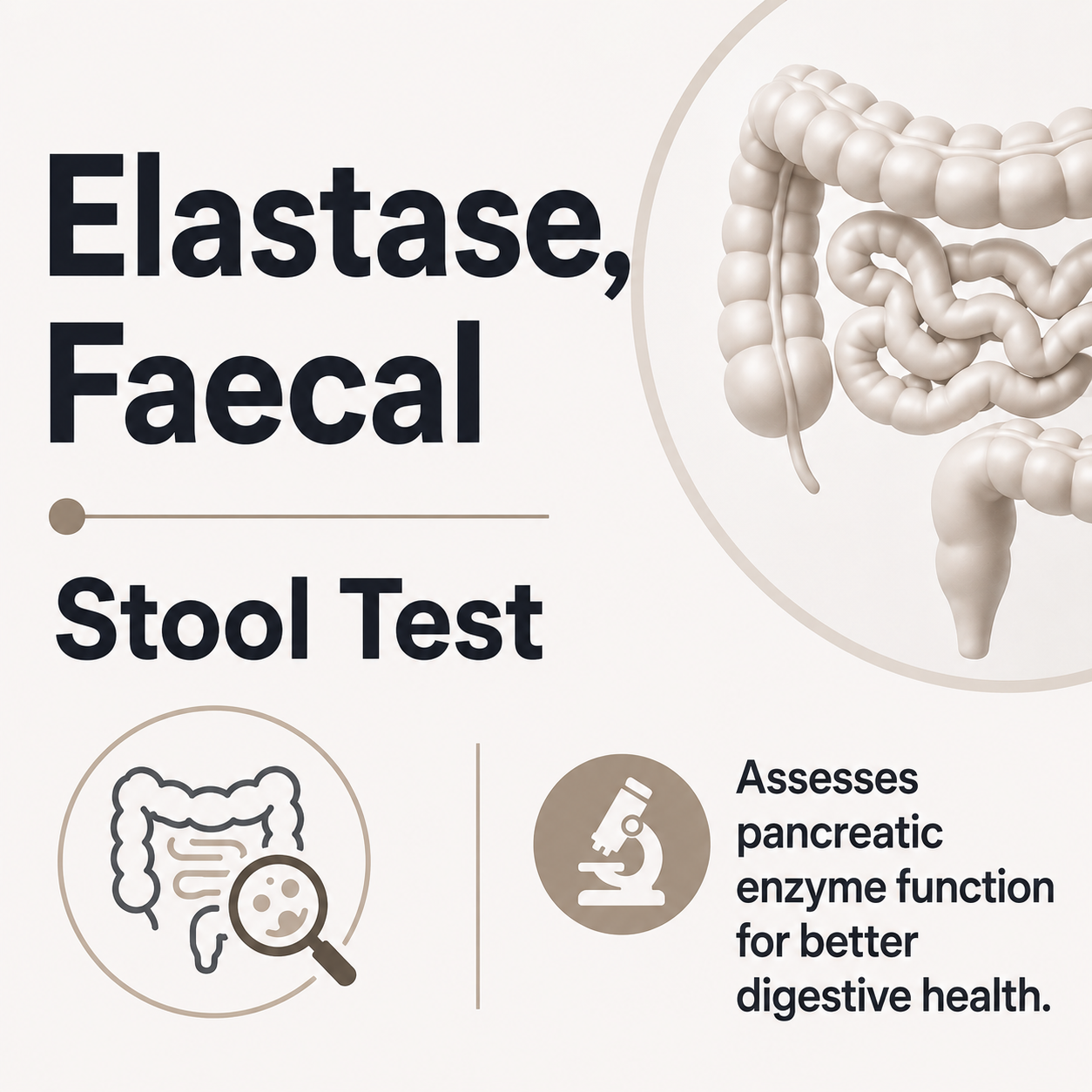
The Faecal Elastase Test is a simple, non-invasive stool test that checks for pancreatic elastase-1, an enzyme linked to how your pancreas helps with digestion.
Pancreatic elastase is released into your digestive tract and stays stable as it moves through your system. This makes it a helpful marker for checking how well your pancreas works.
Low faecal elastase levels can be linked to Exocrine Pancreatic Insufficiency (EPI), which means the pancreas is not making or releasing enough digestive enzymes. EPI can affect how your body digests and absorbs nutrients, and may cause symptoms like diarrhoea, bloating, stomach discomfort, greasy stools, and unexplained weight loss.
Our home test, analysed in a laboratory, gives you an easy way to learn about your pancreatic digestive function. You can then talk about your results with a healthcare professional if needed.
What Is Faecal Elastase?
Faecal elastase is a digestive enzyme produced by the pancreas and released into the intestine.
Unlike many other digestive enzymes, pancreatic elastase stays stable as it moves through your digestive system. By measuring how much is in your stool sample, we can get helpful information about how your pancreas is working.
A faecal elastase test does not check the overall health of your pancreas or diagnose a specific disease. It only shows how well your pancreas makes digestive enzymes.
Why Is Pancreatic Function Important?
The pancreas helps with digestion by making enzymes that break down food, so your body can absorb nutrients.
If your pancreas makes fewer enzymes, it can affect digestion and how well you absorb nutrients. This can cause symptoms like:
- Persistent or chronic diarrhoea
- Loose, oily or greasy stools
- Floating or difficult-to-flush stools
- Bloating and excessive gas
- Abdominal discomfort
- Unexplained weight loss
- Difficulty digesting fatty foods
- Nutritional deficiencies
- Fatigue associated with poor nutrient absorption
These symptoms can have many different causes, so they are not always due to pancreatic insufficiency.
Who Might Consider a Faecal Elastase Test?
You might consider a faecal elastase test if you have ongoing symptoms or if there are concerns about your pancreas not working properly.
Talk to your healthcare professional about testing if you have:
- Persistent digestive symptoms
- Chronic or recurrent diarrhoea
- Frequent bloating or abdominal discomfort
- Oily, greasy or difficult-to-flush stools
- Unexplained weight loss
- Concerns about nutrient absorption
- Nutritional deficiencies without an obvious explanation
Faecal elastase testing can also help when pancreatic insufficiency is suspected in people with certain medical conditions, such as:
- Chronic pancreatitis
- A history of pancreatic disease or surgery
- Cystic fibrosis
- Diabetes
- Certain gastrointestinal conditions
Having one of these conditions does not always mean you have pancreatic insufficiency. Your healthcare professional can help decide if testing is right for you.
What Does the Test Measure?
The test measures:
Pancreatic Elastase-1 in a stool sample
The amount of elastase found in your sample can show how well your pancreas is working.
Understanding Your Result
Results are commonly interpreted using ranges such as:
| Faecal Elastase Result |
General Interpretation |
|
>200 µg/g |
Generally considered within the normal range |
|
100–200 µg/g |
May indicate reduced pancreatic exocrine function and may require further assessment |
|
<100 µg/g |
More strongly suggestive of significant pancreatic exocrine insufficiency |
These ranges are just a general guide. Always consider your lab’s reference range and your personal situation when looking at your results.
A low result alone does not show the exact cause. Your healthcare professional will look at your symptoms, medical history, and other tests to help find the reason.
What Is Exocrine Pancreatic Insufficiency (EPI)?
Exocrine Pancreatic Insufficiency (EPI) happens when the pancreas does not make or release enough digestive enzymes to properly digest food.
Reduced digestive enzyme activity can particularly affect the digestion and absorption of fats and may contribute to:
- Greasy or oily stools
- Diarrhoea
- Bloating and abdominal discomfort
- Unintentional weight loss
- Nutritional deficiencies
- Fat-soluble vitamin deficiencies
EPI can be caused by several things, such as pancreatic disease, surgery on the pancreas, cystic fibrosis, or other medical conditions.
If EPI is suspected, your healthcare professional may suggest more tests and, if needed, treatment like pancreatic enzyme replacement therapy (PERT).
Benefits of a Faecal Elastase Test
Non-Invasive Stool Test
You do not need a blood test. This test only needs a stool sample you collect at home.
Convenient Home Collection
You can collect your sample at home, in private, using the materials that come with your test kit.
Useful Marker of Pancreatic Exocrine Function
Faecal elastase is a well-known lab marker for checking how much enzyme your pancreas makes.
Laboratory Analysed
A laboratory analyses your sample and provides your results in a report.
Supports Further Discussion
Your results can give you more information to discuss with your GP or healthcare professional, especially if you still have digestive symptoms.
How the Testing Process Works
Step 1 – Order Your Test
You can order your Faecal Elastase Test securely from Repose Healthcare.
Step 2 – Collect Your Sample
Use the instructions in your kit to collect the stool sample at home.
Step 3 – Return Your Sample
Pack your sample as instructed and send it back to the laboratory using the return packaging provided.
Step 4 – Laboratory Analysis
The laboratory processes your sample and checks it for pancreatic elastase-1.
Step 5 – Receive Your Results
After testing is finished, you will get your laboratory report securely, based on the service included with your test.
Be sure to follow the instructions in your test kit, as sample requirements, storage, and return steps may be different for each kit.
Do I Need to Prepare for the Test?
You usually do not need a blood sample or to fast for faecal elastase testing.
Always follow the sample collection and preparation instructions in your test kit. If you take medication or have a pancreatic or digestive condition, ask your healthcare professional if you are unsure about anything that could affect your test.
Do not stop prescribed medication unless advised to do so by a qualified healthcare professional.
Frequently Asked Questions
How reliable is a faecal elastase test?
Faecal elastase is a trusted lab marker for checking pancreatic exocrine function, especially when pancreatic enzyme insufficiency is suspected.
However, this test should not be used alone to make a diagnosis. Your results should be looked at together with your symptoms, medical history, and other clinical information.
What does a low faecal elastase result mean?
A low result may mean your pancreas is not working as well as it should. The lower the result, the more likely pancreatic insufficiency is, especially if you have ongoing symptoms.
A healthcare professional can help decide if you need more tests.
Can this test diagnose pancreatic cancer?
No.
A faecal elastase test checks how well your pancreas works, but it cannot diagnose or rule out pancreatic cancer, pancreatitis, or other pancreatic diseases.
If you have ongoing or worrying symptoms, talk to a healthcare professional instead of relying only on this test.
Can I take medication before the test?
Medication needs can be different for each person. Follow your test kit instructions and ask your healthcare professional if you are not sure.
Do not stop prescribed medication without medical advice.
Is the test suitable for children?
Faecal elastase testing can be done for children if pancreatic insufficiency is suspected. However, always talk to a healthcare professional first, especially if the child has ongoing symptoms, poor growth, or unexplained weight loss.
What happens if my result is low?
If your result is low, discuss it with a healthcare professional. They may suggest more tests or assessments based on your symptoms and medical history.
Does a normal result rule out all pancreatic problems?
No.
A normal faecal elastase result does not rule out all pancreatic or digestive problems. Always consider your symptoms and medical history too.
Why Choose Repose Healthcare?
At Repose Healthcare, we make lab testing easier by offering home sample collection and secure lab analysis.
Our Faecal Elastase Test offers:
- Convenient home stool collection
- Laboratory analysis
- Secure access to results
- Clear sample collection instructions
- Discreet and confidential service
- UK-based customer support
We want to help you get useful health information easily, while making sure your lab results are explained clearly and responsibly.
Test Summary
| Feature |
Details |
|
Test |
Faecal Elastase Test |
|
Sample type |
Stool |
|
Marker measured |
Pancreatic Elastase-1 |
|
Purpose |
Assessment of pancreatic exocrine function |
|
Collection |
Home stool collection |
|
Laboratory analysis |
Yes |
|
Fasting required |
Generally not required |
|
Results |
Laboratory report |
|
Suitable for |
Adults where assessment of pancreatic exocrine function is appropriate |
|
Clinical use |
May support investigation of suspected pancreatic exocrine insufficiency |
Important Medical Disclaimer
This Faecal Elastase Test is intended to provide information about pancreatic exocrine function and is not intended to diagnose, exclude or rule out pancreatic insufficiency, pancreatitis, pancreatic cancer or any other medical condition.
A low faecal elastase result may have several possible explanations and should be interpreted in combination with your symptoms, medical history and other relevant investigations. A result within the normal range does not guarantee that there is no pancreatic or gastrointestinal disease.
This test should not replace a consultation with your GP or another qualified healthcare professional, particularly if you have persistent, unexplained or worsening symptoms.
Do not start, stop or change medication or treatment based solely on the result of this test. If you receive an abnormal result, discuss it with a healthcare professional who can advise whether further investigation is appropriate.
If you have severe or worsening abdominal pain, repeated vomiting, significant weakness or fainting, fever, jaundice, difficulty breathing, blood in your stool, or you feel seriously unwell, seek urgent medical attention rather than relying on a home test.
This test is a supplemental source of health information and is not a substitute for professional medical advice, diagnosis or treatment.