

MRSA Test for Healthcare Workers UK: A Guide to Occupational Screening
Imagine you’ve just secured a competitive placement at a leading NHS trust, only to find your start date is stalled because you cannot book a timely screening appointment with your local GP. It’s a stressful situation that many medical professionals face, especially when your career progression depends on meeting strict occupational health protocols. You want to ensure patient safety and maintain your work eligibility, but the fear of a positive result or the confusion between testing methods often makes the process feel more daunting than it needs to be.
We understand that you need clear, reliable information to move forward with confidence. This guide explains everything you need to know about the mrsa test for healthcare workers uk, from the technical differences between a 24-hour PCR rapid test and a traditional culture screen to the simple steps for effective decolonisation. We will outline how to obtain fast, UKAS-accredited results from the comfort of your own home, allowing you to secure your placement without the typical wait times or unnecessary administrative hurdles. You’ll gain a full understanding of the screening requirements and the fastest paths to valid certification.
Key Takeaways
- Understand why MRSA screening is a mandatory requirement for clinical staff and how it helps maintain patient safety in UK healthcare settings.
- Learn about the “Triple Swab” protocol and why sampling multiple sites, including the nose and groin, is essential for diagnostic accuracy.
- Compare traditional culture methods with rapid PCR testing to ensure you meet your occupational health deadlines for urgent placements.
- Discover how to access a discreet mrsa test for healthcare workers uk to verify your status from the comfort of home before your official NHS screening.
- Find out how to manage a positive result through professional decolonisation protocols that ensure your long-term eligibility for work.
Why is an MRSA Test for Healthcare Workers in the UK Mandatory?
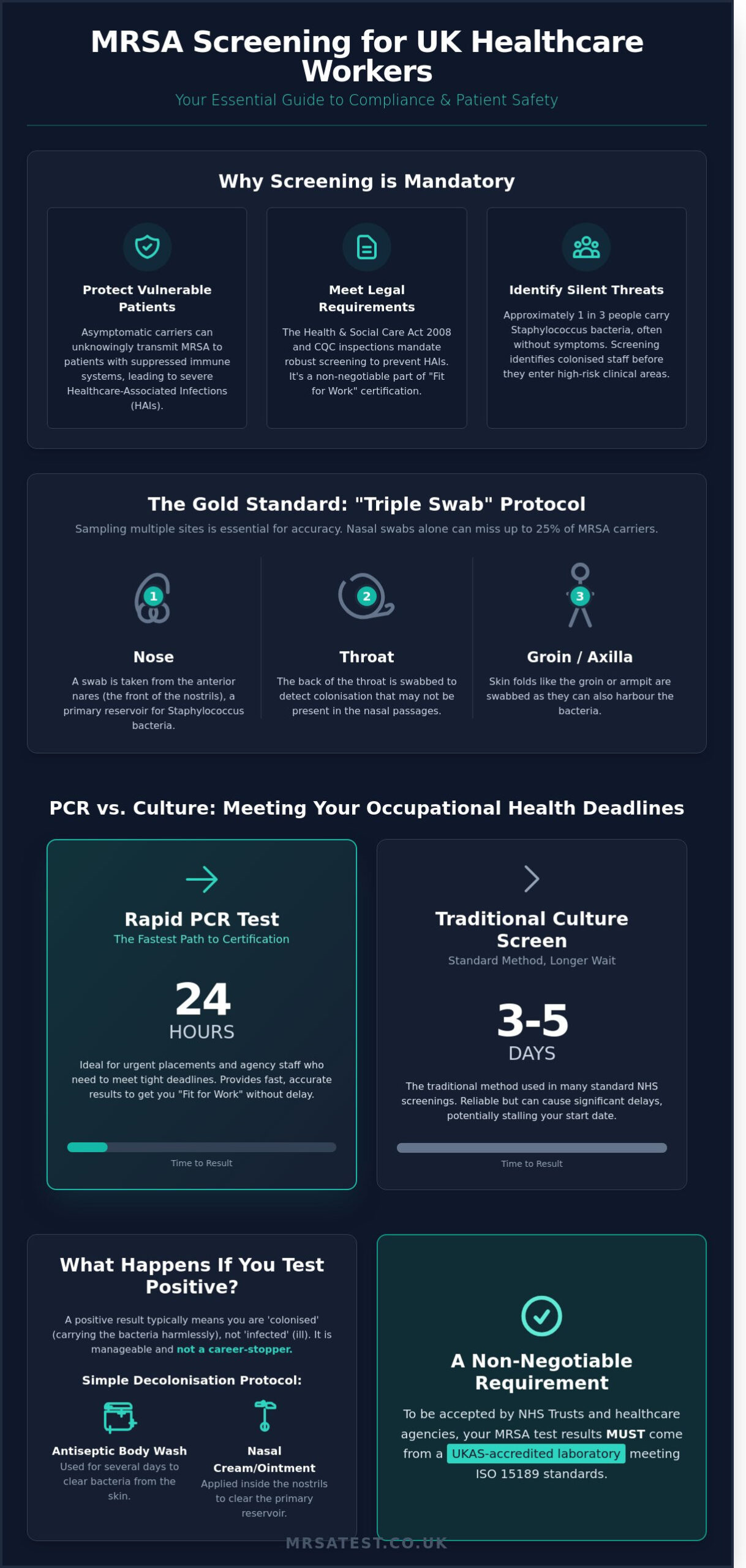
Protecting patients starts with understanding your own health status. In the UK, MRSA (Methicillin-resistant Staphylococcus aureus) remains a primary concern for infection control teams because it’s resistant to several widely used antibiotics. This resistance makes infections harder to treat and increases the risk of serious complications for those in clinical care. For this reason, an mrsa test for healthcare workers uk is a standard requirement for anyone entering a frontline clinical environment.
The legal framework for this requirement is the Health and Social Care Act 2008. This legislation mandates that healthcare providers maintain a clean and safe environment to prevent Healthcare-Associated Infections (HAIs), a responsibility that covers everything from staff screening to sourcing reliable medical equipment from distributors like Cables and Sensors. It’s a statutory obligation. If a trust or private clinic fails to implement robust screening, they risk failing CQC (Care Quality Commission) inspections. For the individual worker, it’s about clinical safety. There is a vital distinction between “infection,” where the bacteria cause illness, and “colonisation,” where the bacteria live harmlessly on the skin. Most healthcare staff who test positive are colonised, meaning they feel perfectly healthy but can still pass the bacteria to vulnerable patients.
The Risk of Asymptomatic Carriage
Data from the NHS suggests that approximately 1 in 3 people carry some form of Staphylococcus bacteria at any given time. Most don’t know they have it. In high-turnover environments like Intensive Care Units (ICUs) or neonatal wards, this asymptomatic carriage is a silent threat. Healthcare workers move between patients constantly, making them potential vectors for transmission. For a patient with a surgical wound or a suppressed immune system, a simple transfer of bacteria can lead to sepsis or pneumonia. Regular screening ensures that carriers are identified and offered simple “decolonisation” treatments, such as antiseptic body washes and nasal creams, before they enter high-risk zones.
In these critical care settings, maintaining not only staff hygiene but also equipment integrity is paramount. For instance, ensuring the accuracy of patient monitors with quality replacement spo2 sensors is just as important as infection control for overall patient safety.
Agency and NHS Trust Requirements
If you’re looking to join a nursing agency or start a new role in an NHS Trust, you’ll find that a negative mrsa test for healthcare workers uk is often a non-negotiable prerequisite. Agencies require this as part of their “Fit for Work” certification to ensure they’re supplying safe staff to hospitals. Most trusts require a fresh screen every 12 months, though this can be more frequent for staff in renal or orthopaedic departments.
- Permanent Staff: Usually screened during pre-employment and then at intervals determined by local trust policy.
- Agency/Locum Staff: Must typically provide a negative result from a UKAS-accredited laboratory before their first shift.
- 2026 Standards: The UK’s 5-year action plan on antimicrobial resistance (2024-2029) suggests that by 2026, screening protocols will become even more standardised across all regions to combat evolving bacterial strains.
Staying compliant doesn’t have to be difficult. Using a professional, UK-based service ensures your results are accurate and accepted by your employer. It’s a simple step that maintains professional standards and, most importantly, keeps your patients safe.
Standard Screening Protocols: Swab Sites and Procedures
Standard screening for MRSA in the UK follows a rigorous “Triple Swab” protocol. This method ensures that clinicians don’t miss colonisation in different areas of the body. When you perform an mrsa test for healthcare workers uk, you’ll typically receive three separate swabs. These target the nose, the throat, and the skin folds of the groin or axilla. Relying on a single site often leads to false negatives; clinical data indicates that nasal swabs alone can miss up to 25% of carriers. By sampling multiple sites, the accuracy of the screen increases significantly, providing a clearer picture of your colonisation status.
Using a UKAS-accredited laboratory is essential for any healthcare professional. These facilities meet ISO 15189 standards, which means the results are legally and clinically valid for occupational health departments. Most NHS trusts and private clinics won’t accept results from non-accredited labs because they lack the necessary quality controls. Choosing an accredited service ensures your data is handled securely and your results are reliable enough to satisfy workplace safety requirements.
Common Swab Locations Explained
Nasal swabs focus on the anterior nares, which are the very front parts of the nostrils. This area is the primary reservoir where Staphylococcus aureus bacteria reside. You don’t need to push the swab deep into the nasal cavity; a gentle rotation around the inner rim is usually sufficient to collect a viable sample.
The groin and axilla are equally important because MRSA thrives in warm, moist environments. These skin colonisation sites are frequent sources of transmission in hospital settings. If you have active skin lesions, eczema, or chronic wounds, these must also be sampled. Bacteria often concentrate in broken skin, making these sites a high priority for an accurate mrsa test for healthcare workers uk. If you’re managing your own compliance, choosing a discreet MRSA home test kit ensures you meet these professional standards without needing a GP appointment.
Ensuring Sample Integrity
To get a valid result, you must use the correct collection technique. You should rotate each swab firmly against the skin or mucosa for at least 5 seconds. This ensures enough biological material is transferred to the swab tip for the lab to process. If the swab is too dry, it might not pick up enough bacteria, leading to an “inconclusive” result that requires a retest.
- Avoid Contamination: Don’t let the swab tip touch any surfaces like clothing or worktops before or after sampling.
- Transport Medium: Ensure the swab is placed immediately into the provided tube containing transport gel or liquid.
- Timely Dispatch: Most UK laboratories require samples to arrive within 48 hours of collection to maintain the viability of the bacteria.
Common mistakes that lead to invalid tests include failing to label the tubes correctly or using the same swab for multiple body sites. Each location requires its own dedicated swab to avoid cross-contamination. Following the instructions precisely ensures your sample remains stable during transit to the UKAS-accredited partner laboratory.
PCR vs. Culture Testing: Meeting Occupational Health Deadlines
When you’re applying for a new role within the NHS or a private clinic, timing is everything. Occupational health teams require proof of clearance before you step onto the ward to ensure patient safety. The choice between a PCR and a culture test usually comes down to how quickly you need to start your new position. While both methods are highly accurate, they serve different needs based on your specific deadline. Rapid PCR offers a fast turnaround for urgent starts, while culture tests provide a more traditional, budget-friendly route for routine screening.
Rapid PCR: Results in 24 Hours
Rapid PCR is the fastest way to secure your clearance. This method uses molecular detection to identify MRSA DNA directly from your swabs. You’ll typically receive your results within 24 hours of the laboratory receiving your sample. It’s the ideal mrsa test for healthcare workers uk who have secured a last-minute agency shift or a locum placement starting within the week. PCR is highly sensitive; it detects even minute amounts of genetic material, providing a definitive answer without the wait. Because these tests require advanced equipment in a UKAS-accredited facility, they carry a higher price point, but the speed is often essential for meeting strict recruitment deadlines.
- Speed: Results processed in as little as 24 hours.
- Accuracy: High sensitivity for detecting colonisation.
- Best for: Urgent agency placements and contract renewals.
Standard Culture Testing
Standard culture testing involves placing your samples in a controlled environment to see if bacteria grow over several days. This process takes longer because the laboratory must wait for the colonies to become visible under a microscope, which naturally extends the timeline. You should expect a 48 to 72-hour wait for these results once the lab receives your kit. If you’re performing a routine annual check or your start date is several weeks away, this is a reliable and cost-effective option. Prices for culture tests are often £20 to £30 lower than rapid PCR alternatives, making them a sensible choice for staff on a budget who aren’t in a rush.
Choosing the right mrsa test for healthcare workers uk depends entirely on your calendar. If your induction is in three days, the PCR route is the only way to ensure your paperwork is ready. If you’re simply updating your clinical record for a future role, the culture test provides the same level of professional certification at a lower cost. Always check with your specific Trust or agency first, as some high-risk environments may specify which testing method they prefer for their staff onboarding process.
What Happens if You Test Positive? Decolonisation and Work
Receiving a positive result from an mrsa test for healthcare workers uk doesn’t mean your clinical career is over. It’s a manageable situation that many professionals face at some point in their careers. Colonisation simply means the bacteria are present on your skin or in your nose without causing an active infection. UK healthcare trusts view this as a routine health and safety matter, not a disciplinary one. The focus remains on patient safety and your own well-being.
The Decolonisation Process
The standard treatment to remove MRSA from your body, known as decolonisation, usually lasts five days. You’ll typically use a 2% mupirocin nasal ointment three times a day and a 4% chlorhexidine body wash once daily. To ensure the treatment works, you must be thorough. Apply the cream to the inner surface of each nostril using a cotton bud. During your daily wash, pay close attention to your armpits, groin, and feet, as these are common areas for the bacteria to reside.
- Wash your hair with the antiseptic solution at least twice during the five-day cycle.
- Change your clothing, towels, and bed linen every day to prevent re-contamination.
- Lather the body wash for at least 30 seconds before rinsing to ensure it’s effective.
High-temperature laundering is vital during this period. Ensure all fabrics are washed at 60°C to kill any lingering bacteria. Following these steps precisely increases the likelihood of a successful first decolonisation cycle. UK Health Security Agency (UKHSA) data suggests these protocols are highly effective for the majority of individuals on their first attempt, provided they’re followed to the letter.
Returning to Clinical Practice
You can’t return to the ward or clinical duties immediately after finishing your treatment. NHS guidelines generally require a clearance period to ensure the colonisation hasn’t returned. This involves taking “three clear sets” of swabs from your nose, throat, and any skin lesions or skin folds. These tests are usually taken at least 48 hours after treatment ends; then they’re repeated at weekly intervals. Once you have three consecutive negative results, you’re usually cleared to return to full duties.
Keep a detailed record of your results and maintain open communication with your Occupational Health department. They’re there to support your transition back to work and ensure patient safety isn’t compromised. When you’re ready to confirm you’re clear, repeating an mrsa test for healthcare workers uk provides the documented proof your trust requires to update your records. If you’ve tested positive through a private screening, you can share these results with your employer to fast-track your decolonisation programme and get back to work sooner.
Fast and Confidential At-Home MRSA Testing for Staff
For many NHS and private sector staff, a mandatory mrsa test for healthcare workers uk can be a source of significant stress. While workplace screening is a vital safety measure, the prospect of an unexpected positive result often causes anxiety about shift patterns, patient safety, and professional standing. Proactive, private testing allows you to understand your colonisation status before you ever step into an official screening environment. This gives you the control to manage your health and seek advice on decolonisation protocols in a private, supportive setting.
Our service provides a clinical solution that fits into the demanding schedule of a nurse, doctor, or care assistant. We understand that shift workers don’t always have the time to visit a GP or occupational health clinic for preliminary checks. By choosing an at-home kit, you bypass the need for appointments and waiting rooms. Your samples are processed by 100% UK-based partner laboratories that are UKAS-accredited. This ensures that every report meets the same high standards required by the health service, providing you with reliable data you can trust.
Privacy and Professionalism
Discretion is at the heart of what we do. We ship every kit in plain, unbranded packaging that fits through a standard letterbox. You won’t have to worry about neighbours or colleagues knowing the contents of your mail. Once the lab completes your analysis, we deliver your results through a secure digital portal. This confidential approach reduces the pressure associated with workplace screening. It’s about giving you peace of mind so you can focus on your patients without the weight of the unknown. Knowing your status early allows you to take proactive steps if a positive result occurs, ensuring you remain compliant with UK healthcare regulations.
Ordering Your Kit Online
Getting started is a simple, three-step process designed for efficiency. First, select your preferred testing method online. We offer both standard culture tests and an MRSA PCR rapid test option for molecular detection in 24 hours. Once your kit arrives, follow the clear instructions to collect your swabs from the comfort of your own home. Every kit includes a prepaid Royal Mail Tracked 24 return envelope, so you can post your samples back to our UK laboratory at no extra cost. You’ll receive a notification as soon as your professional lab report is ready for viewing.
Don’t leave your screening status to chance. Order your professional MRSA test kit today and take a proactive step towards protecting your career and your patients.
- Trusted: All samples processed in UKAS-accredited UK facilities.
- Safe: Secure digital delivery of sensitive medical data.
- Fast: Rapid PCR options available for results within 24 hours of lab receipt.
- Confidential: Plain packaging ensures your privacy is protected at all times.
Secure Your Occupational Health Clearance Today
Meeting mandatory NHS and private healthcare requirements doesn’t need to be a source of anxiety. Understanding the protocols for nasal, throat, and groin swabs ensures you’re fully prepared for your clinical role. Obtaining a professional mrsa test for healthcare workers uk is a vital step in safeguarding patient health and maintaining your professional registration. Our service simplifies this process by providing results from UKAS-accredited UK laboratories, ensuring your documentation meets every clinical standard required by occupational health departments.
If you’re facing a tight recruitment deadline, our rapid PCR option provides molecular detection results in just 24 hours. We offer a 100% confidential and discreet service, delivering everything you need to your door. You’ll avoid the wait times of traditional clinics while receiving the same high level of clinical accuracy. Take control of your compliance today so you can focus on your career and your patients.
Order your UKAS-accredited MRSA test kit for healthcare workers
Frequently Asked Questions
Do I need an MRSA test to work as a nurse in the UK?
Yes, you’ll likely need an MRSA test to work as a nurse or healthcare professional in the UK. Most NHS Trusts and private providers require screening as part of their pre-employment health checks to comply with the Health and Social Care Act 2008. This policy helps prevent the spread of infection to vulnerable patients. If you’re joining an agency, they’ll often ask for a valid mrsa test for healthcare workers uk before placing you on a ward.
How long does an MRSA test result take for healthcare workers?
Results typically take between 24 and 72 hours depending on the laboratory method used for your sample. A standard culture test requires 48 to 72 hours for the bacteria to grow and be identified by technicians. If you choose a PCR rapid test, which uses molecular detection to find bacterial DNA, you can often receive your results within 24 hours. Fast turnaround times are essential for staff who need to start a new role quickly.
Can I work if I am an MRSA carrier but have no symptoms?
You can usually continue working if you’re an MRSA carrier, provided you follow the decolonisation protocol set by your Occupational Health department. Being colonised means the bacteria live on your skin without causing illness, which applies to about 3% of the population. Your employer will typically allow you to work in non-high-risk areas while you complete a five-day treatment of antiseptic body wash and nasal cream to clear the bacteria.
What is the difference between a PCR and a culture MRSA test?
The main difference is the detection method and the speed of the results. A culture test involves placing your sample in a nutrient-rich environment to see if bacteria grow over 2 to 3 days. In contrast, a PCR rapid test is a molecular method that searches for the specific DNA of the MRSA bacteria. PCR is significantly faster, providing a definitive answer in just 24 hours; it’s the ideal choice for urgent employment clearances.
Will my GP provide an MRSA test for my new job?
Most UK GPs won’t provide an MRSA test for employment purposes because it’s considered an occupational health requirement rather than a clinical necessity. NHS guidelines state that GPs should focus on diagnostic testing for symptomatic patients. You’ll usually need to arrange your mrsa test for healthcare workers uk through your employer’s Occupational Health department or a private UKAS-accredited laboratory service to ensure you meet your confirmed start date without delays.
How many swabs are required for a standard healthcare worker screen?
A standard healthcare screen typically requires three separate swabs to ensure an accurate and reliable result. These samples are usually taken from the nostrils, the throat, and the groin or armpit area. Taking swabs from multiple sites increases the chance of detecting colonisation, as the bacteria often thrive in warm, moist areas of the body. Following the instructions carefully ensures your samples are valid for professional laboratory analysis and certification.
How long does the MRSA decolonisation process take for staff?
The standard decolonisation process for healthcare staff takes exactly five days to complete. This regimen involves using a 2% chlorhexidine body wash once daily and applying a prescribed antibiotic nasal ointment, such as Mupirocin, three times a day. After finishing the five-day course, you’ll wait two days before being re-tested. You usually need three sets of negative swabs, taken at weekly intervals, to be considered fully clear by most NHS Trust policies.
Is an at-home MRSA test kit as accurate as a hospital test?
Yes, a high-quality at-home kit is just as accurate as a hospital test when processed by a UKAS-accredited facility. These kits use the same clinical-grade swabs and laboratory techniques found in NHS settings. You can collect your samples from the comfort of your own home and send them to a trusted UK partner laboratory. This provides a discreet and confidential way to get the professional results you need for your healthcare career without visiting a clinic.