Pre-Employment MRSA Screening: A Guide for Healthcare Professionals
Could a microscopic bacterium you don’t even know you’re carrying be the only thing standing between you and your new clinical role? For many healthcare workers, the requirement for pre-employment mrsa screening feels like an unexpected hurdle that triggers unnecessary anxiety about job security. It’s perfectly natural to feel concerned when a routine Occupational Health check mentions bacterial testing, especially when you’re eager to start your new position in a busy NHS trust or private clinic.
We’re here to provide clarity and peace of mind during this transition. You’ll learn exactly why UK employers require these tests and how the screening process works, including the difference between active infection and simple colonisation, which is just the presence of bacteria on the skin without any symptoms. We’ll also outline a clear action plan for managing your results, ensuring you can satisfy your new employer’s health standards quickly. This guide provides a straightforward path to securing your “fit to work” status without the stress of long GP waiting lists or confusing medical jargon.
Key Takeaways
- Understand why pre-employment mrsa screening is a mandatory safety requirement for healthcare workers and how it helps maintain a sterile clinical environment.
- Clear up the confusion between MRSA colonisation and active infection to better understand your results and what they mean for your health.
- Familiarise yourself with the standard UK “triple swab” protocol and the specific areas of the body that require sampling for a valid result.
- Learn about the straightforward five-day decolonisation programme used to manage positive results, allowing you to start your new role with confidence.
- Discover how discreet, at-home testing options can help you bypass lengthy NHS queues and accelerate your professional onboarding.
What is Pre-Employment MRSA Screening and Why is it Required?
Pre-employment MRSA screening is a standard safety check for healthcare professionals entering the UK clinical workforce. It’s a proactive measure designed to identify individuals carrying the bacteria before they start their roles. Methicillin-resistant Staphylococcus aureus (MRSA) is a strain of bacteria that has evolved to survive several common antibiotics. In hospital environments, this resistance makes it a significant threat to patient safety. Screening ensures that staff don’t unknowingly introduce the bacteria into sterile environments or transmit it to those most at risk.
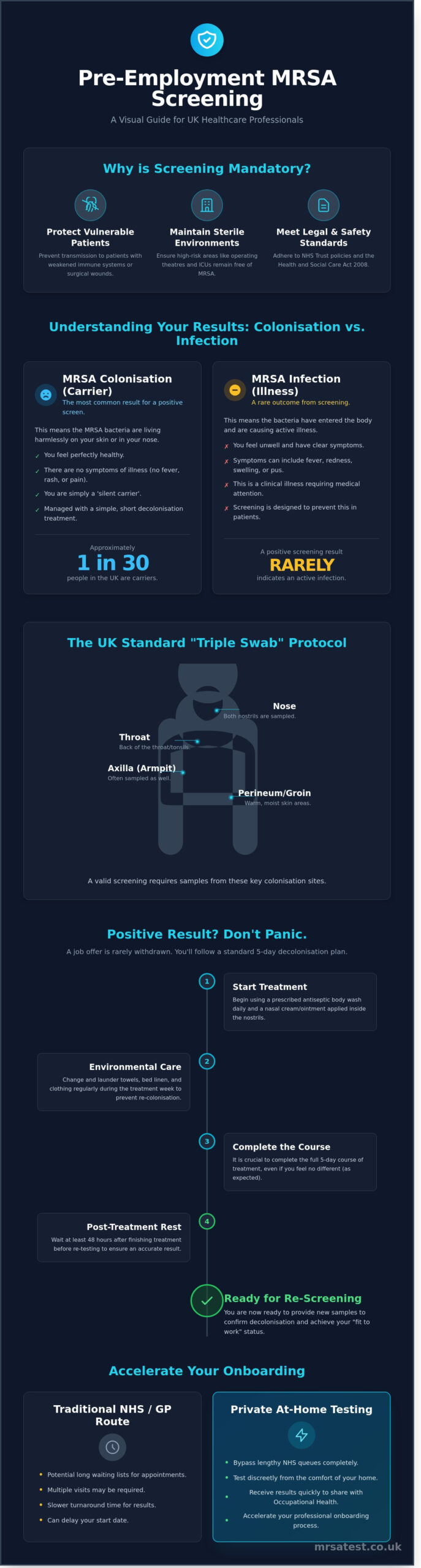
UK employers in the healthcare and care sectors mandate these tests to maintain high infection control standards. Protecting vulnerable patients from healthcare-associated infections is the primary goal, a principle that applies across all clinical settings, from major surgical wards to a specialized Aesthetics clinic Enderby. When a person is colonised with MRSA, they don’t feel ill, but they can easily pass the bacteria to patients with surgical wounds or weakened immune systems. By implementing pre-employment mrsa screening, hospitals and clinics create a safer environment for everyone involved. It’s a simple process that provides peace of mind for both the employer and the new recruit.
Who Needs to be Screened?
Not every role requires the same level of scrutiny, but most positions involving patient proximity will. Clinical staff with direct patient contact, such as doctors, nurses, and dentists, are always prioritised. This also extends to support staff working in high-risk areas like operating theatres, intensive care units, or renal wards. Care home workers and students on clinical placements must also undergo testing. Data suggests that approximately 3% of the UK population carries MRSA, making these checks essential for new starters in sensitive roles.
The Legal and Safety Framework
Adherence to NHS Trust policies and private healthcare standards is mandatory for all providers. The Occupational Health Department plays a central role in managing staff health and ensuring compliance with these regulations. MRSA is a bacterium resistant to common antibiotics like flucloxacillin, so detecting it early allows for simple decolonisation treatments before work begins. Using pre-employment mrsa screening helps organisations meet their legal obligations under the Health and Social Care Act 2008. This ensures that patient care remains the top priority while protecting the safety of the healthcare facility.
Colonisation vs. Infection: Understanding Your Results
Receiving a positive result during your pre-employment mrsa screening often causes unnecessary anxiety. It is vital to distinguish between being “colonised” and having an active infection. Colonisation means the bacteria live on your skin or inside your nose without causing any illness or symptoms. You aren’t “ill” in the traditional sense; you’re simply a carrier. Statistics suggest that approximately 1 in 30 people carry MRSA on their bodies at any given time without ever knowing it.
The Healthcare Infection Society MRSA Guidelines provide evidence-based frameworks for managing these results, ensuring staff and patient safety remain the priority. Clinical environments require this screening because a healthy carrier can inadvertently pass the bacteria to vulnerable patients. While the bacteria are harmless to you, they can cause serious issues if they enter a patient’s surgical wound or bloodstream. Understanding this distinction helps you view the screening as a standard safety protocol rather than a personal health crisis.
How MRSA Lives on the Body
MRSA typically colonises warm, moist areas of the body. The most common sites include the nostrils, the back of the throat, and skin folds such as the armpits or groin. In these locations, the bacteria exist in a state of “silent carriage.” You won’t feel a fever or see a rash. However, the transition from carrier to a source of transmission happens easily through skin-to-skin contact or contaminated surfaces. Our guide on what is MRSA explains the risks of silent carriage and how it differs from symptomatic illness. Screening identifies these hidden reservoirs so they can be managed before you start your new role.
Implications for Your Job Offer
A positive result rarely leads to a withdrawn job offer. Instead, it triggers a standard “decolonisation” procedure. This usually involves using a special antiseptic body wash and antibiotic nasal cream for five days. Once you complete this simple cycle, most Trusts or private clinics will clear you for work. Your results are handled with the highest level of discretion. Under the Data Protection Act 2018, your employer must keep your medical information confidential; only the Occupational Health team typically sees the specifics. If you want to proactively manage your status, you can order a confidential home test kit to check your status before your official appointment. This allows you to start any necessary decolonisation early and ensures your start date remains on track.
The Screening Process: How and Where Samples are Taken
The pre-employment mrsa screening process is a standardised procedure designed to identify asymptomatic carriage. In the UK, Occupational Health departments generally follow national guidelines that recommend a double or triple swab protocol. This ensures that the most common colonisation sites are thoroughly checked before a staff member begins their role in a clinical environment. Most screenings are completed within a few minutes, and the process is entirely non-invasive.
Clinicians use sterile swabs, which look like long cotton buds, to collect samples from specific areas of the body. These swabs are then placed in a transport medium, a special gel or liquid that keeps any bacteria alive while the sample travels to a UKAS-accredited laboratory. Using a trusted, accredited facility ensures that the results are accurate and meet the high standards required by the NHS and private healthcare providers.
Common Swab Sites Explained
Nasal swabs are the foundation of every screen. The anterior nares, or the front of the nostrils, are the primary reservoir for MRSA. Clinical data indicates that approximately 33% of the population carry Staphylococcus aureus in their nose, making this the most critical site to test. The process involves gently rotating a moist swab inside each nostril for about five seconds.
Groin and axilla (armpit) swabs are also mandatory in a comprehensive screen. These areas are warm and moist, providing the perfect environment for bacteria to thrive and colonise the skin. If you have any active skin lesions, such as eczema, psoriasis, or healing surgical wounds, these must be swabbed too. Broken skin is significantly more likely to harbour MRSA than healthy, intact skin, so identifying carriage in these areas is vital for patient safety.
PCR vs. Culture Testing
When you undergo pre-employment mrsa screening, your samples will be processed using one of two primary methods. Culture testing is the traditional approach. Scientists place your sample on a nutrient-rich agar plate and wait for bacterial colonies to grow. This method typically takes 48 to 72 hours to provide a definitive result. It’s the standard choice for many UK Occupational Health departments because it’s cost-effective and highly reliable for routine checks.
- PCR (Polymerase Chain Reaction): This is a rapid molecular test that identifies the DNA of the MRSA bacteria. It provides results in as little as 24 hours, making it the preferred choice for urgent staff starts or “fast-track” onboarding.
- Culture Testing: While slower, this method allows the lab to perform sensitivity testing, which determines which antibiotics would be most effective if treatment is needed.
Most UK providers now offer both options. While culture testing remains the baseline for many, the 24-hour turnaround of a PCR test is increasingly popular for those who need to start their new position without delay. Regardless of the method, the goal is to provide a clear, confidential report that confirms you’re safe to work in a clinical setting.
The rapid advancement from traditional culture testing to molecular methods like PCR highlights the broader trend of technological innovation within the medical field. For healthcare professionals interested in the cutting edge of research and development, it’s a fascinating time. While diagnostics are one area, other fields like neurotechnology are also seeing major breakthroughs. For those curious about high-performance neural interfaces used in R&D, you can check out MindRove.
What Happens if You Test Positive for MRSA?
Receiving a positive result during your pre-employment mrsa screening doesn’t mean you have an active illness or that your job offer is automatically withdrawn. It simply indicates you’re “colonised,” meaning the bacteria live on your skin or in your nostrils without causing you harm. To protect vulnerable patients, you must undergo a decolonisation programme. This is a standard 5-day clinical routine designed to clear the bacteria from your body before you begin your clinical duties.
Success depends entirely on strict adherence to the treatment plan. If you skip a single application, the bacteria may persist; this leads to a failed re-test and avoidable delays in your start date. Most NHS trusts and private providers require a confirmed clear result to maintain a safe environment for everyone.
The Decolonisation Protocol
The standard protocol involves a combination of topical treatments used over five consecutive days. You’ll typically be prescribed an antiseptic body wash containing 4% Chlorhexidine (CHG) or Octenidine. You must use this daily as a liquid soap for your skin and hair to reduce the bacterial load on your body’s surface.
- Mupirocin 2% Nasal Ointment: You apply this to the inside of each nostril three times a day to eliminate the primary reservoir where MRSA often hides.
- Daily Hygiene: It’s vital to change your towels, clothes, and bed linen every day during the 5-day period.
- High-Temperature Washing: Laundering these items at 60°C ensures any shed bacteria are effectively destroyed.
Returning to Work and Prevention
Once you finish the 5-day course, you’ll wait a minimum of 48 hours before undergoing re-screening. Most UK healthcare facilities require three consecutive sets of negative swabs, usually taken 48 to 72 hours apart, before you’re cleared for duty. This rigorous process is a cornerstone in preventing a hospital-acquired infection from reaching high-risk wards or surgical theatres.
Prevention remains an ongoing responsibility. You might be required to undergo annual screenings or periodic “spot checks” if you work in high-dependency units or neonatal care. Maintaining excellent hand hygiene and following local infection control policies are your best tools for staying clear. If you’re concerned about your status after treatment, you can order a discreet MRSA home test kit to check your clearance privately before your official occupational health review.
Fast-Tracking Your Onboarding with Private Home Testing
Securing a GP appointment for a routine swab can be a significant hurdle. With the NHS facing record backlogs, waiting 7 to 14 days for a screening appointment is now common. For a healthcare professional starting a new role, this delay can push back a start date by several weeks. Private testing removes this bottleneck. It allows you to take control of your pre-employment mrsa screening timeline. Knowing your status before your official Occupational Health assessment gives you the chance to seek decolonisation treatment privately if needed. This prevents the stress of a failed health check during your first week on the job.
By choosing a private route, you bypass the administrative delays often associated with primary care. This ensures your career progression remains on track. Many trusts and private hospitals accept external laboratory reports as long as they meet specific clinical standards. Taking this proactive step demonstrates professional diligence and a commitment to patient safety before you even step onto the ward.
The Benefits of At-Home Screening
Taking a swab at home means you don’t have to request time off from your current job or sit in a crowded waiting room. The process is entirely confidential. Your kit arrives in plain packaging, and results are delivered securely to your digital device. If you’re on a tight deadline, you can use a rapid PCR MRSA test. This molecular detection method identifies MRSA DNA and provides results within 24 hours of the laboratory receiving your sample. It’s significantly faster than traditional culture methods, which typically require 48 to 72 hours for incubation.
- No need for GP referrals or long waiting lists.
- Complete privacy with results sent only to you.
- Avoids the risk of local clinic delays.
Choosing a Trusted UK Provider
Not all tests are equal. To ensure your results are valid for pre-employment mrsa screening, you must use a UKAS-accredited laboratory. At mrsatest.co.uk, we support healthcare professionals by providing clinical-grade testing that meets strict UK standards. Our 100% UK-based service ensures your samples are processed quickly without international transit delays. Our process is designed for efficiency:
- Order your kit: Select the test you need and receive it via discreet next-day delivery.
- Sample collection: Follow the clear, step-by-step instructions to collect your swabs in the comfort of your home.
- Return the sample: Use the included pre-paid tracked envelope to send your sample to our accredited partner lab.
- Receive your certificate: Access your professional laboratory report via a secure portal, ready to present to your new employer.
Our service provides the quiet competence you expect from a medical professional. We focus on accuracy and speed, ensuring you can start your new role with confidence and peace of mind.
Streamline Your Path to Clinical Practice
Completing your pre-employment mrsa screening doesn’t have to be a source of stress or a cause for career delay. Understanding the distinction between colonisation and infection helps you manage your results with professional confidence. Most UK healthcare providers require these tests to maintain safety standards, so securing your clearance quickly is essential for starting your new role on schedule.
We provide a clinical solution that fits around your busy life. Our kits use UKAS-accredited laboratory results to ensure every test meets the rigorous standards required by NHS trusts and private hospitals. If you’re on a tight deadline, our 24-hour PCR rapid test option provides molecular detection that helps you meet onboarding requirements without the wait. You’ll receive everything needed for a discreet at-home collection, allowing you to bypass clinic waiting rooms and manage your health privately. Our service is already trusted by healthcare professionals across the UK to deliver the accurate documentation needed for professional registration.
Order Your Private MRSA Screening Kit Today
Take the next step in your career with the peace of mind that comes from professional, reliable testing.
Frequently Asked Questions
Is MRSA screening mandatory for all NHS jobs?
Pre-employment MRSA screening isn’t mandatory for every NHS position. It’s specifically required for staff working in high-risk clinical areas as defined by the 2014 Department of Health guidelines. This includes roles in intensive care, cardiothoracic surgery, and neonatal units. If you’re applying for a non-clinical or low-risk administrative role, your Occupational Health assessment usually won’t include a mandatory swab.
How long does pre-employment MRSA screening take?
You can expect your results within 24 to 72 hours depending on the testing method used. A PCR (Polymerase Chain Reaction) test provides molecular detection within 24 hours, while a traditional culture test takes up to 3 days to allow for bacterial growth. Most UKAS-accredited laboratories process these samples quickly to ensure your recruitment timeline remains on track and your start date isn’t delayed.
Can I start work while waiting for my MRSA results?
You generally cannot begin clinical duties in high-risk wards until your clearance is confirmed. Most NHS Trusts require a negative result before they’ll issue a final start date for patient-facing roles. This policy protects vulnerable patients from potential healthcare-associated infections. If your role is non-clinical, your employer might allow you to start induction training while the laboratory processes your swabs.
What if I am already colonised with MRSA before I apply?
Being colonised with MRSA doesn’t disqualify you from employment. Approximately 3% of the UK population carries the bacteria on their skin without knowing it. If you test positive during your pre-employment MRSA screening, you’ll simply undergo a five-day decolonisation protocol using antiseptic body wash and nasal ointment. Once you complete the treatment and provide clear follow-up swabs, you’re safe to begin your new healthcare role.
Do I have to pay for my own MRSA screen for a new job?
Most NHS Trusts and private hospitals cover the cost of your screening as part of their standard recruitment process. However, if you’re a locum or agency worker, you’re often asked to provide your own clearance certificate. Private screening kits for Occupational Health typically cost between £40 and £90, depending on whether you choose a rapid PCR or a standard culture test.
Will a positive MRSA result show up on my permanent medical record?
Your results are kept in a confidential Occupational Health file which is separate from your general GP medical record. While the screening outcome is shared with the recruitment team to confirm your fitness for work, it’s handled under strict UK data protection laws. This ensures your clinical status remains private and only accessible to the medical professionals managing your employment clearance.
How often do healthcare workers need to be re-screened for MRSA?
There isn’t a national requirement for annual re-screening for all healthcare staff. You’ll usually only need a new screen if you move to a high-risk department or if there’s an active outbreak on your ward. Some specialist units, like bone marrow transplant centres, might require staff to undergo screening every 6 to 12 months to maintain a sterile environment for immunocompromised patients.
Can I use an at-home MRSA test for my Occupational Health clearance?
You can use an at-home test kit as long as it’s processed by a UKAS-accredited laboratory. Our service provides a professional-grade MRSA Culture Test that meets the standards required by most UK healthcare employers. It’s a discreet and simple way to test for MRSA from the comfort of your own home before you start your new position, ensuring you’re fully prepared for your first day.