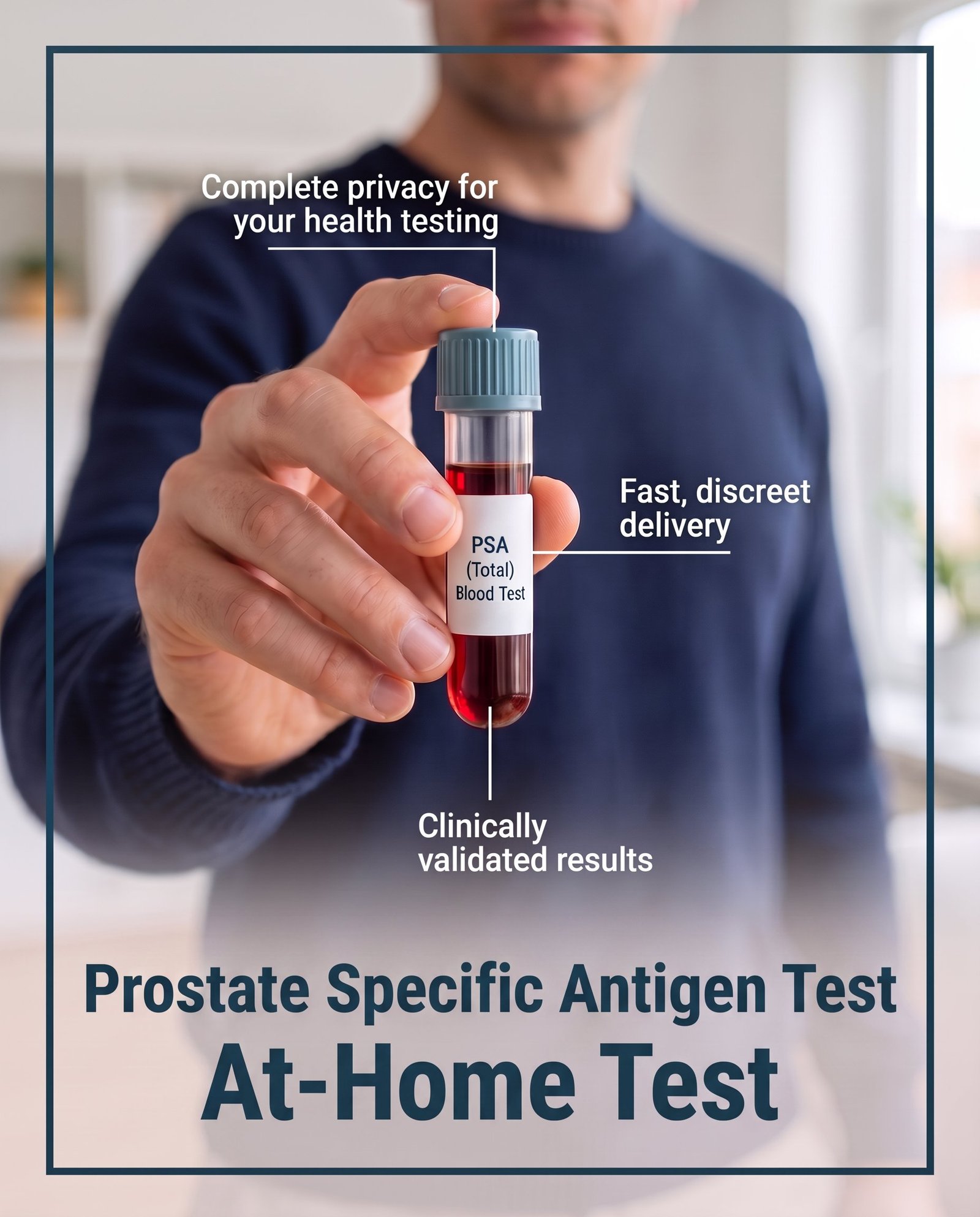
Prostate Specific Antigen (PSA) Blood Test: Check Your Prostate Health at Home
Easy PSA Testing You Can Do at Home
The PSA Blood Test from Repose Healthcare checks the total PSA level in your blood.
PSA is a protein made by prostate cells. Normally, only a small amount is found in your blood, but levels can go up for several reasons, such as benign prostate enlargement (BPH), prostatitis, urinary infection, or prostate cancer.
A PSA test can give helpful information about your prostate health and may show if you need more medical checks. However, a high PSA does not always mean you have prostate cancer, and a normal PSA does not fully rule it out.
With our home testing service, you can collect your blood sample in private and send it to a lab for analysis. Your results will be shared with you securely.
What Is a PSA Test?
Prostate Specific Antigen (PSA) is a protein mainly made by cells in the prostate.
The amount of PSA in your blood can tell you about your prostate. PSA levels often go up as men age and can also rise if the prostate is enlarged, inflamed, or affected by other issues.
PSA testing is one way to check prostate health. It may be recommended if you have symptoms, certain risk factors, or concerns about prostate cancer.
It’s important to know that PSA is not only linked to prostate cancer. A high result should be looked at in context and may mean more tests are needed.
What Does This PSA Test Measure?
This test measures:
Total Prostate Specific Antigen (Total PSA)
Your result will be shown in µg/L (ng/mL) and compared to the lab’s reference range.
PSA levels change naturally as you get older. UK guidelines use age-based thresholds in some cases, but these are not strict cut-offs for cancer or a diagnosis.
As a general guide, doctors often use these age-related thresholds:
| Age |
PSA level requiring clinical consideration* |
|
40–49 years |
≥2.5 µg/L |
|
50–59 years |
≥3.5 µg/L |
|
60–69 years |
≥4.5 µg/L |
|
70–79 years |
≥6.5 µg/L |
These thresholds are based on age and used in certain clinical situations. They are not strict normal or abnormal limits for everyone. Always consider your lab’s reference range and your own risk factors.
A PSA result higher than expected does not always mean cancer. Your GP may suggest repeating the test or doing more checks based on your result, symptoms, and personal risk.
Why Take a PSA Test?
A PSA test may be appropriate if you:
- Want information about your prostate health
- Are concerned about your risk of prostate cancer
- Have a family history of prostate cancer
- Have been advised to monitor your PSA
- Have symptoms that may be associated with a prostate condition
- Have previously been treated for a prostate condition or prostate cancer
Symptoms that may warrant medical assessment include:
- Needing to urinate more frequently
- Difficulty starting or maintaining urine flow
- A weak or interrupted urine stream
- Feeling that your bladder has not fully emptied
- Needing to urinate frequently during the night
- Blood in the urine or semen
- Problems getting or maintaining an erection
These symptoms are not specific to prostate cancer and can also occur with benign prostate enlargement and other prostate or urinary conditions.
Who Should Consider PSA Testing?
There is no single age at which everyone should automatically have a PSA test.
Men and anyone with a prostate who are concerned about their prostate cancer risk can discuss PSA testing with their GP. Age, family history, ethnicity, symptoms and other risk factors may all be relevant when deciding whether testing is appropriate.
You may wish to discuss PSA testing with your healthcare professional if you:
- Are aged 50 or over
- Have a close family history of prostate cancer
- Are concerned about your individual prostate cancer risk
- Have urinary or other symptoms affecting your prostate or urinary system
- Have previously had an elevated PSA result
- Are undergoing monitoring following prostate treatment
A home PSA test is meant to add to, not replace, advice from your doctor.
What Can Raise PSA Levels?
A raised PSA does not always mean you have cancer. PSA can increase because of:
- Benign prostatic hyperplasia (BPH)
- Prostatitis or prostate inflammation
- Urinary tract infection
- Prostate cancer
- Recent ejaculation
- Vigorous exercise, particularly cycling
- Recent prostate procedures or examinations
- Urinary retention or catheterisation
Some medicines can also change PSA levels. For example, finasteride and dutasteride can lower PSA, so let your healthcare professional know if you take these when looking at your result.
Preparing for Your PSA Test
Getting ready for your test matters because some activities can temporarily change your PSA levels.
For 48 hours before collecting your sample, NHS guidance advises avoiding:
- Ejaculation
- Vigorous exercise
- Cycling
- Anal sex
If you have a urinary infection, talk to your GP about when to take a PSA test. NHS guidance says to wait 4 to 6 weeks after the infection has cleared before testing.
You can generally eat and drink normally before a PSA blood test.
If you take medicine for prostate problems, especially finasteride or dutasteride, make sure this is taken into account when looking at your result. Do not stop taking prescribed medication unless advised to do so by your healthcare professional.
Understanding Your PSA Results
Lower PSA
A PSA level in the expected range can be reassuring, but it does not fully rule out prostate cancer or other prostate issues.
PSA results should be looked at alongside your age, symptoms, family history, and other risk factors.
Raised PSA
A high PSA can happen for many reasons and does not always mean prostate cancer is present.
Depending on your situation, your healthcare professional may suggest:
- Repeating the PSA test
- A clinical examination
- Urine testing
- Further blood tests
- An MRI scan
- Referral to a urology specialist
- Other investigations where appropriate
NHS guidance says that if your PSA is high, you may be offered another test. If it stays high, further checks like an MRI or biopsy may be needed.
Why One PSA Result Is Not Enough
PSA levels can change over time and may be affected by temporary factors.
Because of this, a single result should not be used alone to diagnose or judge your cancer risk.
Does a PSA Test Diagnose Prostate Cancer?
No.
A PSA test cannot confirm if you have prostate cancer.
A high PSA can be caused by prostate cancer, but it can also happen due to benign prostate enlargement, prostatitis, urinary infection, or other reasons.
If your PSA is high, you may need more tests to find out why. This could include repeating the PSA test, having an MRI, or sometimes a prostate biopsy.
How the PSA Home Test Works
1. Order Your Test
Order your PSA Blood Test online and get the collection kit delivered discreetly to your address.
2. Prepare for Testing
Follow the preparation instructions in your kit and avoid activities that could temporarily raise your PSA before you collect your sample.
3. Collect Your Sample
Use the sample collection equipment provided to take your blood sample at home, following the instructions closely. Package your sample according to the supplied instructions and return it to the laboratory using the provided return packaging.
5. Laboratory Analysis
Your sample is analysed for total PSA.
6. Receive Your Results
Once testing is complete, your laboratory report will be made available securely according to the service provided.
Always follow the instructions that come with your test kit, including how to collect, store, and return your sample.
Benefits of an At-Home PSA Test
Convenient Home Collection
Take your blood sample at home in private, without needing to visit a clinic.
Total PSA Measurement
The test checks the total amount of prostate-specific antigen in your blood.
Laboratory Analysis
Your sample is tested in a lab, and you’ll get your results in a lab report.
Private and Discreet
Your test kit is delivered discreetly, and your results are handled securely.
Useful Prostate Health Information
Your PSA result gives you extra information to talk about with your GP or healthcare professional.
Why Choose Repose Healthcare?
At Repose Healthcare, we make lab testing easier by offering convenient home sample collection and secure lab analysis.
Our PSA testing service offers:
- Convenient home sample collection
- Laboratory analysis
- Secure access to results
- Clear sample collection instructions
- Discreet and confidential service
- Accessible prostate health information from home
- UK-based customer support
We aim to make testing simple and to present your results clearly and responsibly, in the right clinical context.
Test Summary
| Feature |
Details |
|
Test |
Prostate Specific Antigen (PSA) Blood Test |
|
Sample type |
Blood |
|
Marker measured |
Total PSA |
|
Purpose |
Assessment of prostate-specific antigen levels |
|
Collection |
Home collection |
|
Laboratory analysis |
Yes |
|
Preparation |
Avoid ejaculation, cycling and vigorous exercise for 48 hours; follow kit instructions |
|
Results |
Laboratory report |
|
Suitable for |
Adults with a prostate where PSA testing is appropriate |
|
Important limitation |
PSA cannot diagnose or exclude prostate cancer |
Frequently Asked Questions
What does a PSA blood test measure?
A PSA test measures the concentration of prostate-specific antigen in your blood.
PSA is produced by prostate cells and is normally present in the bloodstream in small amounts.
Is a high PSA result always cancer?
No.
A raised PSA can occur because of benign prostate enlargement, prostatitis, urinary infection and other factors as well as prostate cancer.
Does a normal PSA rule out prostate cancer?
No.
Some prostate cancers can occur without a significantly raised PSA. A PSA result should therefore be considered alongside your symptoms, age, family history and other risk factors.
At what age should I have a PSA test?
There is no universal age at which everyone should automatically have PSA testing.
Men and anyone with a prostate who are concerned about prostate cancer can discuss the benefits and limitations of testing with their GP. Age and individual risk factors will help determine whether testing is appropriate.
Should I fast before a PSA test?
No. You can generally eat and drink normally before a PSA test.
However, certain activities can temporarily affect PSA. NHS guidance recommends avoiding ejaculation, vigorous exercise, cycling and anal sex for 48 hours before testing.
Can cycling affect PSA?
Yes.
Vigorous exercise, particularly cycling, can temporarily affect PSA levels. Avoid cycling and other vigorous exercise for 48 hours before testing.
Can ejaculation affect PSA?
Yes.
Recent ejaculation can temporarily increase PSA. NHS guidance recommends avoiding ejaculation for 48 hours before testing.
What happens if my PSA is high?
A high PSA result does not automatically mean cancer.
Your GP or another healthcare professional may recommend repeating the test or carrying out further investigations depending on your individual circumstances. These may include MRI or referral to a urology specialist.
Can I take a PSA test if I have a urinary infection?
A urinary infection can raise PSA and affect the reliability of the result. NHS guidance recommends waiting 4 to 6 weeks after the infection has cleared before having a PSA test.
Can medication affect PSA?
Yes. Some medicines can affect PSA levels. In particular, finasteride and dutasteride can substantially lower PSA, which needs to be taken into account when interpreting the result.
Tell your healthcare professional about any medication you take and do not stop prescribed treatment without medical advice.
Important Medical Disclaimer
The Prostate Specific Antigen (PSA) Blood Test provides information about the level of total PSA in your blood. It is not intended to diagnose or exclude prostate cancer, benign prostate enlargement, prostatitis or any other prostate condition.
PSA is a non-specific marker. A raised result can occur for many reasons, including prostate cancer, benign prostate enlargement, prostate inflammation, urinary infection, recent ejaculation and vigorous exercise. A normal PSA result does not completely rule out prostate cancer.
PSA testing has limitations and can sometimes result in further investigations that ultimately do not identify cancer. The decision to have PSA testing should take into account the potential benefits and limitations of the test.
Your result should be interpreted alongside your age, symptoms, family history, medical history, medications and other relevant clinical information.
If you receive an elevated or unexpected result, contact your GP or another qualified healthcare professional for appropriate follow-up. Further testing may be required.
Do not start, stop or change medication or treatment based solely on the result of this test.
If you have urinary symptoms, blood in your urine or semen, unexplained weight loss, persistent pain or other concerning symptoms, seek medical advice rather than relying solely on a home PSA test.
This test is intended to provide additional health information and is not a substitute for professional medical advice, diagnosis or treatment.