

Blog
MRSA Test: The Complete Guide to Screening, Results, and Home Testing in 2026
Your surgery is scheduled, your consultant has requested an MRSA test, and now you’re facing a frustrating wait for an NHS appointment that could push everything back. It’s a situation thousands of patients encounter every year, and the anxiety it creates is completely understandable.
Waiting on a system that wasn’t designed for your timeline isn’t your only option. Most people don’t realise that a fully accredited, lab-certified MRSA test can be completed from home, with results returned in as little as 24 hours, without a single clinic visit. The confusion around testing methods, result formats, and what a positive finding actually means only adds to the stress, but it doesn’t have to.
This guide cuts through that uncertainty. You’ll learn exactly how MRSA screening works, what the difference is between PCR and culture testing, how to interpret your results, and how private home-collection kits can get you a lab-certified report your consultant will accept, on your schedule, not the system’s. Whether you’re preparing for an upcoming procedure or simply want clarity fast, you’re in the right place.
Key Takeaways
- An MRSA test detects whether you are carrying resistant bacteria on your skin — even with no symptoms — and a positive result can delay or cancel elective surgery if not addressed promptly.
- PCR and Culture are two distinct testing methods with very different turnaround times; understanding which one your consultant requires could save you days of unnecessary waiting.
- Home collection kits allow you to swab the correct clinical sites yourself, but knowing exactly where to swab — and why those sites matter — is essential for an accurate, accepted result.
- Not all private providers are equal; using a UKAS accredited laboratory ensures your report carries the clinical credibility that hospitals and surgical teams will recognise.
- Fast, discreet, lab-certified screening is available without a clinic visit — this guide explains every step, from choosing the right test to understanding what your results mean.
What is an MRSA Test? Understanding the Screening Process
MRSA, or Methicillin-resistant Staphylococcus aureus, is a specific strain of staph bacteria that has developed genetic resistance to a broad class of common antibiotics, making it significantly harder to treat than ordinary bacterial infections. An MRSA test is a clinical screening tool used to detect whether this resistant bacteria is present on your skin, inside your nasal passages, or within a wound, often before you’ve noticed any symptoms at all.
That last point matters enormously. Unlike many conditions that announce themselves clearly, MRSA can exist on the body in complete silence. Understanding the distinction between two very different states, colonisation and active infection, is the key to understanding why screening is requested before surgery in the first place.
Colonisation vs. Infection: What the Test Looks For
Colonisation means the bacteria is living on or in your body without causing harm. Your immune system isn’t fighting it, and you feel entirely well. Millions of people carry Staphylococcus aureus on their skin at any given time without ever developing an infection. The problem arises when a surgical incision creates a direct route for those bacteria to bypass the skin’s natural defences and enter deeper tissue or the bloodstream. At that point, what was harmless carriage can become a serious post-operative infection. The MRSA test identifies asymptomatic carriers precisely to prevent this scenario, protecting both the individual patient and others in a clinical environment.
The Science of Antibiotic Resistance
Standard antibiotics like penicillin and amoxicillin work by targeting a specific structure in bacterial cell walls. MRSA carries a genetic mutation, specifically the mecA gene, that alters this target site, rendering those drugs ineffective. This is why MRSA is frequently described as a “superbug.” Treating an MRSA infection requires clinicians to reach for alternative, often more intensive antibiotics, sometimes called last-resort treatments, which carry their own considerations around tolerability and side effects.
This is where specialised laboratory diagnostics become essential. Identifying resistant strains isn’t something a standard clinical observation can achieve; it requires controlled laboratory analysis to confirm both the presence of the bacteria and its resistance profile. That confirmed result then directly informs the clinical team’s treatment decisions, ensuring the right antibiotic is chosen from the outset rather than discovered through trial and error.
Screening before a procedure removes the guesswork entirely. A clear, lab-certified result gives your surgical team the information they need to proceed safely or to arrange appropriate decolonisation treatment in advance.
MRSA Screening: Pre-Op Readiness & Infection Control
MRSA screening isn’t optional for most hospital admissions in the UK. Whether you’re entering an NHS trust or a private surgical facility, your care team will require confirmed screening results before you’re cleared to proceed. This applies to elective procedures ranging from hip and knee replacements to cardiac interventions and bowel surgery. The reasoning is straightforward: a surgical incision creates a direct pathway for bacteria already present on the skin to reach deeper tissue, and a resistant strain in that environment is a serious complication that’s far easier to prevent than treat.
Pre-Surgery Requirements in the UK
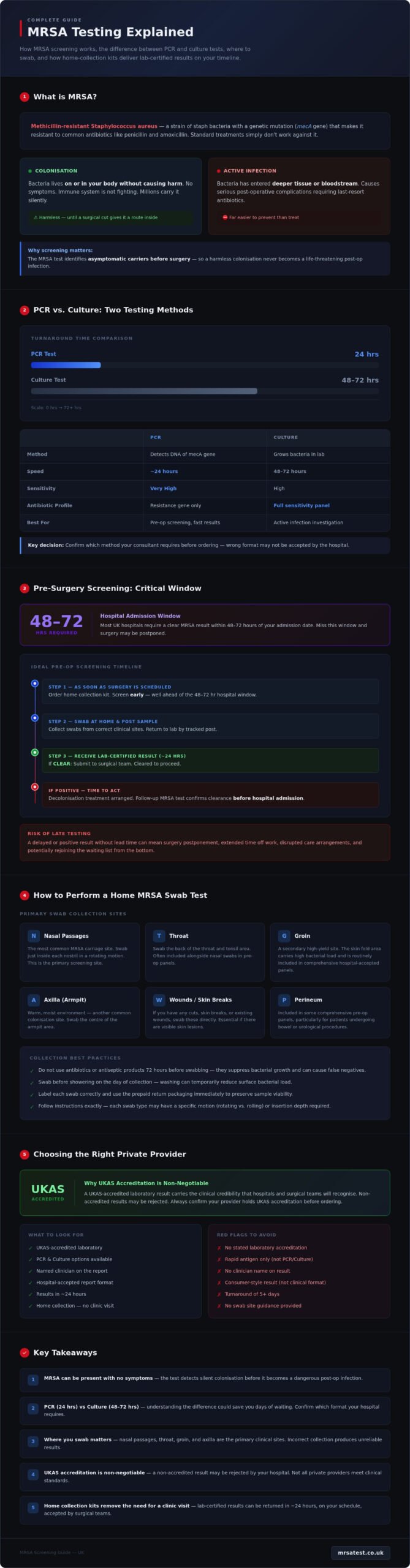
Most hospitals require a clear result within 48 to 72 hours of your admission date. That narrow window creates a real logistical problem for patients relying on NHS appointment availability. If your result isn’t returned in time, or if it comes back positive without enough lead time for decolonisation treatment, your surgery may be postponed. Last-minute cancellations carry consequences beyond inconvenience: extended time off work, disrupted care arrangements, and in some cases, a return to the bottom of a waiting list. The emotional toll of that outcome, particularly for patients who’ve waited months, is significant.
Private MRSA testing offers a practical solution at two distinct stages. First, it allows you to screen early and confirm your status well ahead of the admission window, giving you time to act if the result requires it. Second, once a decolonisation protocol has been completed, a follow-up MRSA test can confirm clearance before you attend hospital, so your surgical team has documented evidence that the treatment worked. This is something NHS pathways rarely accommodate quickly. If you’re preparing for an upcoming procedure, the Preparing for Surgery Checklist covers the full range of pre-op steps worth working through in advance.
Protecting Vulnerable Households
Screening isn’t only relevant to the person going into surgery. People living with elderly relatives, immunocompromised family members, or individuals recovering from a procedure at home have good reason to understand their own carrier status. MRSA can transfer through close physical contact, shared towels, or shared bathroom surfaces, and a household member who carries the bacteria without symptoms could inadvertently put a vulnerable person at risk.
High-contact professions carry their own considerations. Healthcare workers, sports coaches, gym staff, and physiotherapists all operate in environments where skin-to-skin contact or shared equipment creates transmission risk. Screening in these contexts isn’t about fear; it’s about responsible practice.
- Elderly or immunocompromised household members: Regular screening for close contacts reduces the risk of transmission in home care settings.
- Healthcare and care home workers: Occupational exposure makes periodic screening a sensible precaution, particularly following any clinical incident.
- Sports and gym environments: Shared equipment and close physical contact create conditions where asymptomatic carriage can spread quickly.
The good news is that testing doesn’t require a GP referral or a clinic appointment. At-home test kits in the UK allow anyone to collect samples from the correct clinical sites, return them via prepaid post, and receive a lab-certified result without leaving the house. For anyone managing a busy schedule or caring for a dependent at home, that convenience isn’t a luxury; it’s what makes proactive screening realistic.
MRSA PCR vs. Culture Tests: Comparing Speed, Accuracy, and Cost
Two fundamentally different technologies sit behind MRSA screening, and choosing between them isn’t just a technical decision. It’s a practical one that depends on your timeline, your reason for testing, and what you need the result to tell you. Understanding how each method works makes that choice straightforward.
Rapid PCR: The Gold Standard for Urgent Results
PCR, or Polymerase Chain Reaction, doesn’t look for the bacteria itself. It looks for the bacteria’s genetic fingerprint. Specifically, it detects the mecA gene, the genetic mutation responsible for antibiotic resistance in MRSA. The laboratory amplifies tiny fragments of DNA from your swab sample until they’re detectable, producing a result with high sensitivity and specificity. There’s no waiting to see whether anything grows.
That molecular approach is why PCR results are available within 24 hours of the lab receiving your sample. For anyone with surgery scheduled within the next 48 hours, that turnaround is the difference between a confirmed result arriving in time and a last-minute postponement. If your consultant has given you a narrow pre-admission window, the Rapid PCR Test Kit is the appropriate choice. It’s the method most surgical teams expect for urgent pre-operative clearance, precisely because it delivers a definitive, lab-certified answer quickly.
- Turnaround: Results within 24 hours of lab receipt
- What it detects: The mecA gene, confirming antibiotic-resistant MRSA
- Best for: Urgent pre-surgery screening, time-sensitive admissions
- Sensitivity: High; no incubation period means no risk of slow-growing colonies being missed
Standard Culture: The Traditional Diagnostic Method
Culture testing takes a different route. Your swab sample is applied to a growth medium in a controlled laboratory environment and incubated, typically for 48 to 72 hours. If MRSA is present, colonies form and become identifiable. It’s a well-established method with decades of clinical use behind it.
One distinct advantage of culture is that it can reveal antibiotic sensitivity patterns beyond simply confirming MRSA presence. That information is most useful in a treatment context, where a clinician needs to know which specific antibiotics will be effective. For patients who aren’t working to a tight surgical deadline, and who want a cost-effective option for general household or occupational screening, a culture-based MRSA test is a practical and reliable choice.
- Turnaround: 48 to 72 hours from lab receipt
- What it detects: Live bacterial colonies, plus antibiotic sensitivity data
- Best for: Non-urgent screening, follow-up testing, occupational or household peace of mind
- Cost: Generally more affordable than PCR
The decision comes down to urgency. If your procedure is imminent, PCR gives you the speed and certainty a surgical team requires. If you’re screening proactively, without a fixed deadline, culture delivers reliable results at a lower price point. Both methods use accredited laboratory analysis; neither requires a clinic visit.
How to Perform a Home MRSA Swab Test: A Step-by-Step Guide
Correct Swabbing Technique for Accurate Results
Three sites matter most for a reliable mrsa test: the nose, the groin, and the axilla (armpit). These areas are where MRSA colonises most commonly, and missing any one of them reduces the sensitivity of your screen.
Nose: Tilt your head back slightly. Insert the swab tip just inside one nostril, approximately one to two centimetres. Rotate the swab firmly against the inner wall for five to ten seconds, applying gentle pressure to ensure good mucosal contact. Repeat in the second nostril using the same swab before placing it into its transport tube.
Groin: Swab the skin fold where your inner thigh meets your body. Press the swab tip against the skin and roll it firmly in a circular motion for five seconds, covering as much surface area as possible. This is a high-carriage site; don’t rush it.
Axilla: Apply the swab directly into the armpit hollow, again rolling and pressing against the skin for five seconds. Avoid using deodorant or antiperspirant on the site for at least two hours before collection, as residue can interfere with the sample.
The single most common mistake is touching the swab tip with your fingers before or during collection. Skin contact from your hands introduces foreign bacteria and can compromise the result. Handle each swab only by its plastic stem. If you accidentally touch the tip, discard it and use a replacement if one is included, or contact the provider before posting.
Returning Your Sample to the Lab
Once all swabs are sealed in their transport tubes, place them in the prepaid, tracked return envelope included with your kit and post it the same day you collect. The transport medium inside each tube keeps your sample stable throughout the journey to the UK laboratory, but same-day posting avoids any unnecessary delay.
From the moment the lab receives your sample, PCR results are returned within 24 hours and culture results within 48 to 72 hours. Your report is delivered securely by email or through a private online portal, with no paperwork sent to your home address. The result is formatted as a lab-certified document suitable for sharing directly with your surgical team or consultant.
Ready to collect your sample? Order your home MRSA test kit and receive everything you need to screen accurately from home, with a lab-certified result returned on your schedule.
Choosing mrsatest.co.uk for Fast, Accredited MRSA Screening in the UK
There’s a meaningful difference between a general diagnostic provider that happens to offer MRSA screening alongside dozens of other tests, and a service built exclusively around this single area of diagnostics. mrsatest.co.uk exists for one purpose: to give patients, surgical teams, and households in the UK access to fast, accurate, and clinically credible MRSA results without the friction of a clinic appointment. That focus matters when your surgery timeline is tight and there’s no room for ambiguity.
UK-Based Laboratory Excellence
Every sample collected through mrsatest.co.uk is processed by UKAS accredited laboratory partners based in the UK. UKAS accreditation, issued by the United Kingdom Accreditation Service, is the formal recognition that a laboratory meets internationally defined standards for technical competence and quality management. It’s the benchmark NHS trusts and private surgical facilities use when evaluating whether a result is clinically trustworthy. A report from an accredited UK laboratory carries that credibility automatically.
Keeping the entire process domestic also eliminates the delays and chain-of-custody uncertainties that come with routing samples through international facilities. Your swab travels directly to a UK lab, is analysed under accredited conditions, and your result is returned securely by email or through a private online portal. No paperwork arrives at your home address. Your data is handled in accordance with UK data protection regulations, and your personal health information remains entirely confidential.
For anyone uncomfortable with the idea of swabbing the groin or axilla in a clinical setting, home collection removes that barrier entirely. You collect in your own space, at a time that suits you, with no waiting room and no third party present.
Support and Next Steps After Your Result
Your lab report will state one of two findings: Detected or Not Detected. A Not Detected result means no MRSA was identified at the sites tested. You can share that certified report directly with your consultant or surgical team as confirmation of your pre-operative status.
A Detected result doesn’t mean your surgery is cancelled. It means your clinical team needs to know. Contact your consultant promptly and share the report; they will typically arrange a decolonisation protocol, usually involving a nasal ointment and antiseptic body wash, before rescheduling your procedure. A follow-up MRSA test after completing that treatment confirms clearance and gives your surgical team the documented evidence they need to proceed safely.
- Not Detected: Share your certified report with your consultant and proceed as planned.
- Detected: Inform your surgical team immediately; decolonisation treatment is straightforward and effective in most cases.
- Post-treatment: A follow-up test confirms clearance before your admission date.
If you want to understand more about what a positive result means clinically, including how MRSA is treated and what decolonisation involves, the What is MRSA guide covers the full picture. Knowledge removes uncertainty. And when your procedure is on the line, certainty is exactly what you need.
Your Next Step Towards a Safer Procedure
Uncertainty before surgery is stressful enough without adding avoidable delays to the mix. An mrsa test gives your surgical team the confirmed information they need to proceed safely, and getting one no longer requires a clinic visit, a GP referral, or a wait that puts your procedure at risk.
The key points are simple: PCR delivers lab-certified results within 24 hours for urgent pre-operative timelines, home collection covers all the clinically relevant sites discreetly and accurately, and UKAS accredited laboratory analysis means your report carries the credibility your consultant will recognise. Every step of the process is designed to work around your schedule, not the other way around.
Don’t let a missing result be the reason your surgery gets postponed. Order your private MRSA test kit online today and receive everything you need for accurate, discreet home collection with tracked return and fast results. You’ve done the research. Taking the next step is straightforward.
Frequently Asked Questions About MRSA Testing
How long does an MRSA test take to give results?
It depends on the testing method. A Rapid PCR test returns results within 24 hours of the laboratory receiving your sample. A culture test takes longer, typically 48 to 72 hours, because the sample must be incubated to allow any bacterial colonies to grow and become identifiable. If your surgery is imminent, PCR is the appropriate choice purely on the basis of speed.
Is the MRSA swab test painful?
No. The swabbing process is uncomfortable at most, not painful. The nasal swab involves inserting a soft tip just inside each nostril and rotating it gently against the inner wall for a few seconds. The groin and axilla swabs involve rolling the swab against skin folds. There’s no needle, no puncture, and no procedure that requires any preparation for discomfort.
What happens if I test positive for MRSA before my surgery?
A positive result doesn’t automatically mean your surgery is cancelled. You should contact your consultant promptly and share your certified lab report. In most cases, they’ll arrange a decolonisation protocol, typically a nasal ointment applied twice daily alongside an antiseptic body wash, over several days. A follow-up mrsa test after completing treatment confirms whether the bacteria has cleared, allowing your surgical team to proceed with documented evidence of clearance.
Can I do an MRSA test at home instead of at the hospital?
Yes. Home collection kits allow you to swab the clinically relevant sites yourself, return your sample via prepaid post, and receive a lab-certified result by secure email. The result is formatted as a formal report that consultants and surgical teams recognise. For anyone managing a tight pre-operative timeline or wanting to avoid a separate clinic visit, home testing is a practical and fully credible alternative.
Where do you have to swab for an MRSA test?
The three primary sites are the nose, the groin, and the axilla (armpit). These are the areas where MRSA most commonly colonises the body without causing symptoms. Some test kits cover all three sites; others cover just the nose and groin. If you’re screening before surgery, choosing a kit that includes all three sites gives your result the broadest clinical coverage and reduces the chance of a missed detection.
How accurate are at-home MRSA test kits?
Accuracy depends on two things: the laboratory method used and how correctly the sample is collected. When processed by a UKAS accredited laboratory, both PCR and culture methods deliver clinically reliable results. The most common source of inaccuracy isn’t the lab analysis; it’s sample collection errors, such as touching the swab tip or skipping a site. Following the included instructions carefully makes a significant difference to result quality.
Do I need to see a GP to get an MRSA test?
No GP referral is required. You can order a home collection kit directly, collect your own samples, and receive a lab-certified result without any clinical appointment. This is particularly useful if your consultant has requested screening but NHS appointment availability doesn’t fit your surgical timeline. The certified report you receive is suitable for sharing directly with your surgical team or any other healthcare professional involved in your care.
What is the difference between an MRSA PCR test and a culture test?
A PCR test detects the genetic fingerprint of MRSA, specifically the mecA gene, directly from your swab sample without any incubation period. This makes it faster and highly sensitive. A culture test grows the bacteria in a controlled laboratory environment over 48 to 72 hours, which takes longer but can also reveal which antibiotics the bacteria responds to. For urgent pre-operative screening, PCR is the preferred method; for non-urgent or follow-up testing, culture is a reliable and cost-effective option.
