
MRSA Infection Rates UK 2026: Latest Statistics and Patient Safety Trends
Did you know that hospital-onset MRSA cases increased by 29.2% in March 2026 compared to the same month last year? While it’s easy to assume these infections are a problem of the past, the latest figures from the UK Health Security Agency show that the landscape is changing. It’s natural to feel a sense of worry or distrust regarding hospital cleanliness when you’re preparing for a procedure. You want to focus on your recovery, not on the fear of unexpected complications or confusing medical reports.
We’re here to help you understand the current mrsa infection rates uk 2026 and what they actually mean for your health. This article breaks down the latest trends, including the significant rise in community-acquired cases, into clear and manageable information. You’ll learn how to move beyond the statistics to create a personal safety plan, ensuring you have the peace of mind that comes from proactive screening before you enter a clinical setting.
Key Takeaways
- Understand the clinical distinction between MRSA colonisation and bacteraemia to accurately assess your risk before a scheduled procedure.
- Navigate the latest mrsa infection rates uk 2026 to see how regional trends in cities like London and Birmingham might influence your local healthcare experience.
- Identify the direct link between carrying MRSA and the risk of post-operative complications, helping you take proactive steps for a smoother recovery.
- Gain clarity on how to find and interpret NHS Trust performance data to ensure you’re making informed decisions about your hospital choice.
- Learn the logistical advantages of using a private MRSA Rapid PCR or Culture test to secure your surgical schedule without waiting for hospital-led screening.
MRSA Infection Rates in the UK: The 2026 Statistical Landscape
The UK Health Security Agency (UKHSA) released its latest mandatory surveillance data on May 6, 2026. These figures offer a detailed look at how Methicillin-resistant Staphylococcus aureus (MRSA) is behaving within our healthcare system. When we discuss the mrsa infection rates uk 2026, it’s vital to distinguish between colonisation and bacteraemia. Colonisation means the bacteria are present on your skin or in your nose without causing illness. Bacteraemia is a more serious state where the bacteria have entered the bloodstream. While many people carry the bacteria harmlessly, the transition from colonisation to infection is what clinical teams work hard to prevent.
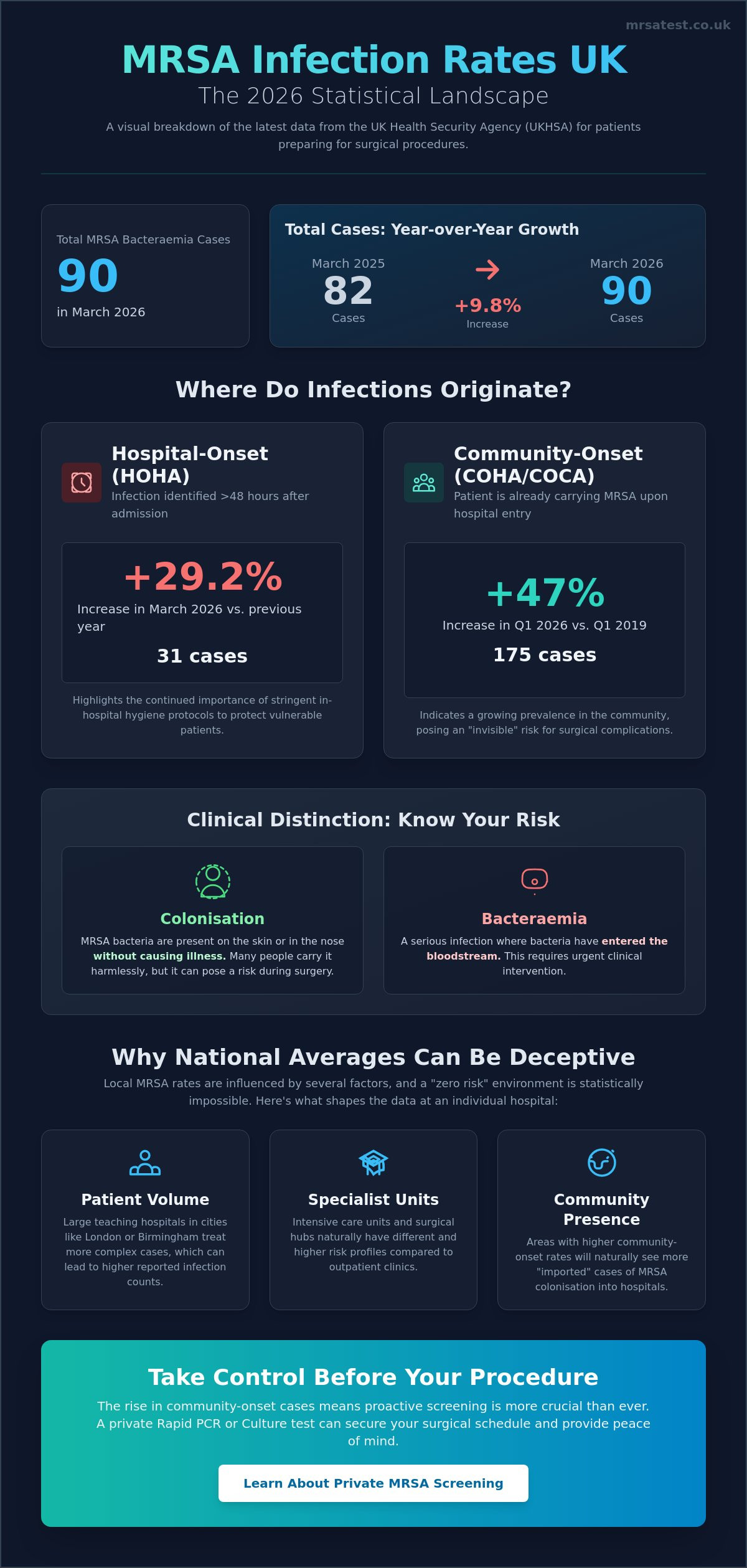
Recent data shows that total MRSA bacteraemia cases reached 90 in March 2026. This is a 9.8% increase from the 82 cases reported in March 2025. When we look at the broader picture, the first quarter of 2026 saw 175 community-acquired cases. This represents a 47% increase compared to the 119 cases recorded during the same period in 2019. These shifts indicate that while hospital protocols remain strict, the bacteria are becoming more prevalent in community settings.
Understanding the 2026 Data Trends
The slight fluctuations in early 2026 cases highlight the ongoing challenge of infection control. The NHS operates under a “zero tolerance” policy for avoidable infections, meaning every case is investigated to improve future safety. This policy ensures that reporting remains transparent and rigorous. For clarity, MRSA bacteraemia is defined as a bloodstream infection requiring urgent clinical intervention. While the numbers have risen slightly compared to the previous year, they remain significantly lower than the peaks seen two decades ago, proving that modern hygiene standards are effective.
Why National Averages Can Be Deceptive
National statistics provide a helpful overview, but they don’t always reflect the reality of an individual hospital ward. Several factors influence local data:
- Patient Volume: Large teaching hospitals in cities like London or Birmingham often treat more complex cases, which can lead to higher reported counts.
- Specialist Units: Intensive care or surgical hubs naturally have different risk profiles than outpatient clinics.
- Community Presence: Areas with higher community-onset rates will see more “imported” cases into the hospital environment.
It’s important to understand that a “zero risk” environment is statistically impossible in any clinical setting. Bacteria are a natural part of our environment. The goal of mandatory reporting isn’t just to count cases, but to maintain the high standards that keep patients safe. By tracking these trends, hospitals can adapt their cleaning and screening protocols in real-time. This proactive approach is exactly why the UK remains a global leader in healthcare-associated infection management.
Hospital-Onset vs. Community-Onset: Where Do Risks Persist?
Understanding where an infection originates is a key part of managing your health before surgery. In the context of mrsa infection rates uk 2026, medical professionals categorise cases based on when and where they’re detected. Hospital-Onset Healthcare-Associated (HOHA) infections are those identified more than 48 hours after a patient is admitted. In March 2026, there were 31 HOHA cases reported, representing a 29.2% increase from the previous year. This rise highlights why hospitals remain vigilant about hygiene protocols to protect vulnerable patients.
However, “community-acquired” doesn’t always mean you caught the bacteria in a public space like a gym or shop. It often refers to patients who are already carrying the bacteria on their skin, known as colonisation, when they enter the hospital. These cases are classified as Community-Onset Healthcare-Associated (COHA) or Community-Associated (COCA) infections. According to the official annual MRSA statistics, these community-detected cases now make up a significant portion of the national total, acting as an “invisible” factor in surgical complications.
The Shift Toward Community-Onset MRSA
Recent data suggests a clear trend. Between January and March 2026, 175 people contracted MRSA in the community. This is a 47% increase compared to the 119 cases recorded during the same period in 2019. Why is this happening? One factor is the long-term impact of antibiotic prescribing habits, which can allow resistant strains to circulate more widely outside of clinical settings. If you’re concerned about your carrier status, you can find more detail in our complete guide to MRSA symptoms and risks.
Comparing Infection Sources
To help you visualise the current landscape, here is how the different categories compared in March 2026:
| Category | Definition | March 2026 Cases |
|---|---|---|
| HOHA | Hospital-Onset Healthcare-Associated | 31 |
| COHA | Community-Onset Healthcare-Associated | 13 |
| COCA | Community-Onset Community-Associated | 46 |
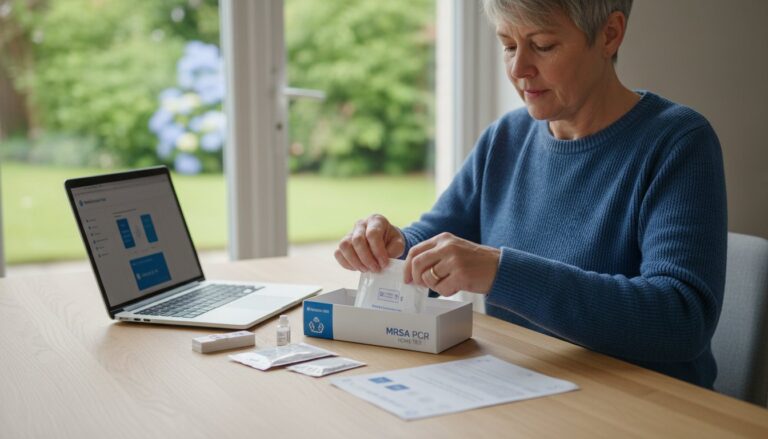
Pre-operative screening is specifically designed to identify community carriers before they undergo surgery. If a person is found to be colonised, they can undergo a “decolonisation” protocol. This usually involves using special antibacterial body washes and nasal creams to clear the bacteria before the procedure. This simple step significantly reduces the risk of the bacteria entering a surgical wound. For those who want to be proactive, an at-home MRSA screening kit provides a convenient way to check your status before your hospital admission date.
Why MRSA Surveillance Matters for Surgical Patients
National surveillance data, such as the mrsa infection rates uk 2026 provided by the UKHSA, is often viewed through the lens of public health policy. For a patient awaiting a procedure, the importance of this data is far more personal. If you’re colonised with MRSA, the risk of a surgical site infection (SSI) increases significantly. When the skin barrier is breached during surgery, bacteria that were sitting harmlessly on the surface can enter the body. This isn’t just a clinical statistic; it’s a direct threat to your recovery timeline.
The Risk to Elective Surgery Patients
Elective surgery patients, particularly those undergoing orthopaedic or cardiothoracic procedures, face specific risks. These operations often involve the use of implants, such as joint replacements or heart valves, where an infection can be devastating. Even “minor” surgeries aren’t exempt from concern. Any breach of the skin provides an opportunity for bacteria to take hold if they’re present on your body. You can find more advice on managing these risks in our guide on preparing for surgery and pre-op logistics.
Antimicrobial Resistance (AMR) in 2026
The challenge of treating MRSA continues to evolve as resistance patterns change. MRSA remains resistant to common penicillins, making pre-op detection vital. Because these bacteria don’t respond to the standard antibiotics usually given as a precaution during surgery, an undetected carrier is at a much higher disadvantage. Screening allows for the use of targeted decolonisation protocols, such as antiseptic washes, which are far more effective than trying to manage a resistant infection after it has already developed. By identifying the presence of MRSA before you enter the operating theatre, you and your clinical team can take the necessary steps to keep your recovery on track.
Interpreting Regional Variations and NHS Trust Performance
National averages often mask the local reality of healthcare. When you examine the mrsa infection rates uk 2026, you’ll notice that numbers vary significantly between regions. For example, high-density urban areas like London or Birmingham frequently report higher case counts. This isn’t necessarily a sign of poor hygiene. Instead, it often reflects a higher volume of patients, more complex surgical cases, and more rigorous screening protocols. Larger teaching hospitals often manage “higher acuity” patients; those who are more seriously ill and therefore more susceptible to infections.
To get a true sense of safety, you should look at “rates per 100,000 bed days” rather than simple case counts. A hospital with ten cases might actually be safer than one with five if it treats significantly more people. You can use this data to advocate for your own care. Don’t be afraid to ask your surgical team about the specific infection rates on their ward. Understanding these metrics helps you move from feeling anxious to feeling informed and empowered before your procedure.
Regional Hotspots vs. Reporting Accuracy
A “hotspot” on a map doesn’t always indicate a “dirty” hospital. In many cases, higher rates are a result of better detection. Hospitals that screen every patient upon admission will naturally find more carriers than those with more relaxed protocols. You can access the UKHSA data dashboard to look up your specific provider and see how they compare to the national average. This transparency is a key part of the UK’s commitment to patient safety. If you’re concerned about how these statistics affect your upcoming stay, you might find our patient’s guide to hospital-acquired infections helpful for understanding the broader risks.
Private Healthcare and MRSA Standards
Many patients wonder if private UK hospitals offer lower MRSA rates than the NHS. While private facilities often have fewer patients and private rooms, which can help control spread, they’re held to the same strict reporting standards. In 2026, many private clinics actually require independent MRSA certification before they’ll even schedule your admission. This means you may need to provide proof of a negative result from a verified laboratory. This requirement ensures that the clinical environment remains as sterile as possible for everyone. If your clinic requires an independent result, you can order a private MRSA Culture or PCR test to ensure your paperwork is ready well in advance of your surgery date.
Proactive Prevention: Moving from Statistics to Personal Safety
While the national mrsa infection rates uk 2026 provide a useful benchmark for public health, they don’t account for your specific health status before a procedure. Many patients wait for their hospital-led pre-operative assessment to be screened for MRSA. However, this often happens only a few days before the scheduled surgery. If you’re found to be a carrier at this late stage, your operation might be postponed to allow for treatment. This delay can be stressful and disruptive to your recovery plans.
Taking a proactive approach by using a private MRSA test allows you to manage your health on your own timeline. If your results indicate that you’re carrying the bacteria, you’ll have ample time to complete a decolonisation protocol. This typically involves a five-day course of specialized antibacterial body washes and nasal ointments. Clearing the bacteria before you arrive at the hospital significantly reduces the risk of the bacteria entering a surgical site, providing you with an extra layer of security and peace of mind.
Taking Control of Your Pre-Op Screening
Modern diagnostic technology has made screening faster and more accessible than ever. When choosing a test, it’s helpful to understand the difference between a traditional culture and a PCR test. A culture involves growing the bacteria in a lab, which can take several days. In contrast, a Rapid PCR test identifies the genetic material of the bacteria, often providing results much sooner. To ensure your results are accepted by clinical professionals, always use a service that partners with accredited UK laboratories. Once you receive your laboratory report, you can present it to your NHS or private consultant to fast-track your clearance process.
- Speed: PCR testing offers a significant time advantage for urgent surgical schedules.
- Accuracy: Results from verified labs provide clinical-grade reliability.
- Clarity: Detailed reports help your surgical team make informed decisions about your care.
The Future of Patient-Led Infection Control
In 2026, at-home testing has become a standard tool for proactive patients who value discretion and convenience. You don’t need to visit a clinic or sit in a waiting room to understand your risk profile. By performing a simple swab in the privacy of your own home, you can obtain the same high-quality diagnostic information used in hospitals. This shift toward patient-led screening reflects a broader trend in UK healthcare where individuals take more responsibility for their pre-operative preparation. It’s a simple, well-managed process that ensures you’re supported by experts without the need for unnecessary travel. Don’t leave your surgical safety to chance; order your confidential MRSA test kit today to ensure you’re fully prepared for your upcoming procedure.
Taking Control of Your Surgical Safety
Analysing the mrsa infection rates uk 2026 reveals a complex picture of healthcare safety. While hospital standards remain high, the increase in community-acquired cases suggests that the risk profile for surgical patients is shifting. Relying solely on the timing of hospital-led screenings can lead to unnecessary stress or last-minute delays in your procedure. By understanding these trends, you’re better equipped to advocate for your own health and ensure your recovery stays on track.
Personal safety doesn’t have to be complicated. You can manage your pre-operative preparation with confidence by choosing professional screening that fits your schedule. Our process utilizes verified UK-accredited laboratories to provide clinical accuracy in a private setting. Whether you need a fast 24-hour PCR option or a traditional culture, the system is designed for your convenience and speed.
Secure your pre-op peace of mind with a private MRSA test kit. Each kit features discreet, at-home collection with a prepaid return included. Taking this small step today ensures you enter the hospital with the security and reliability you deserve. We’re here to support you through a simple, expert-led process for a safer surgical journey.
Frequently Asked Questions
What are the current MRSA infection rates in UK hospitals for 2026?
In March 2026, the UK reported 90 total cases of MRSA bacteraemia. This represents a 9.8% increase compared to the same period in 2025. Of these, 31 were hospital-onset cases, while the remaining 59 were detected in the community. These figures are part of the accredited official statistics published by the UK Health Security Agency (UKHSA) to monitor patient safety across all NHS Trusts.
Is MRSA still a major threat during surgery in the UK?
MRSA remains a significant clinical focus because it’s resistant to common antibiotics like penicillins. While the total number of cases is lower than in previous decades, the 29.2% rise in hospital-onset cases in early 2026 highlights an ongoing risk. For surgical patients, the threat primarily occurs when the bacteria enter a wound, making pre-operative screening a vital step for a safe recovery.
How can I find the MRSA rates for my local NHS Trust?
You can access specific performance data through the UK Health Security Agency (UKHSA) data dashboard. This platform provides monthly updates on healthcare-associated infections for every NHS Trust. When reviewing the mrsa infection rates uk 2026, it’s helpful to look for the “rate per 100,000 bed days.” This metric offers a more accurate comparison of safety levels than simple case counts.
Does a high MRSA rate in a hospital mean it is unsafe?
A higher case count doesn’t automatically mean a hospital is less clean or unsafe. Specialist hospitals or those in high-density areas like London often treat more complex, high-risk patients. Additionally, hospitals with rigorous screening protocols may detect more carriers, which can lead to higher reported numbers. It’s often a sign of a proactive approach to infection control and transparent reporting.
Can I be tested for MRSA privately before my surgery?
Yes, you can choose to have a private MRSA test before your hospital admission. We offer MRSA Rapid PCR and Culture tests that you can perform in the privacy of your home. These tests use swabs from the nose, groin, and axilla to check for the presence of the bacteria. This allows you to understand your status and take action well before your surgical date.
What happens if I test positive for MRSA before my operation?
If a test identifies the presence of MRSA, you’ll typically undergo a decolonisation protocol. This is a simple process involving special antibacterial body washes and nasal creams used over several days. The goal is to clear the bacteria from your skin and nose before your operation. Once completed, it significantly reduces the risk of developing a post-operative infection during your recovery.
How often are UK MRSA statistics updated?
The UK Health Security Agency (UKHSA) publishes these statistics on a monthly basis. The most recent data, covering up to March 2026, was released on May 6, 2026. This frequent reporting ensures that healthcare providers and the public have access to the most current information. It allows for rapid responses to any emerging trends or clusters of infections within the healthcare system.
Why do MRSA rates vary so much between different regions of the UK?
Regional variations in mrsa infection rates uk 2026 are often driven by population density and patient demographics. Urban centers with larger, more diverse populations often show different trends than rural areas. The type of healthcare facilities in a region also matters. Areas with multiple large teaching hospitals or specialist surgical hubs will naturally report different figures based on the complexity of the patients they treat.