

Blog
MRSA Infection Rates in UK Hospitals: 2026 Statistics and Patient Trends

Jun
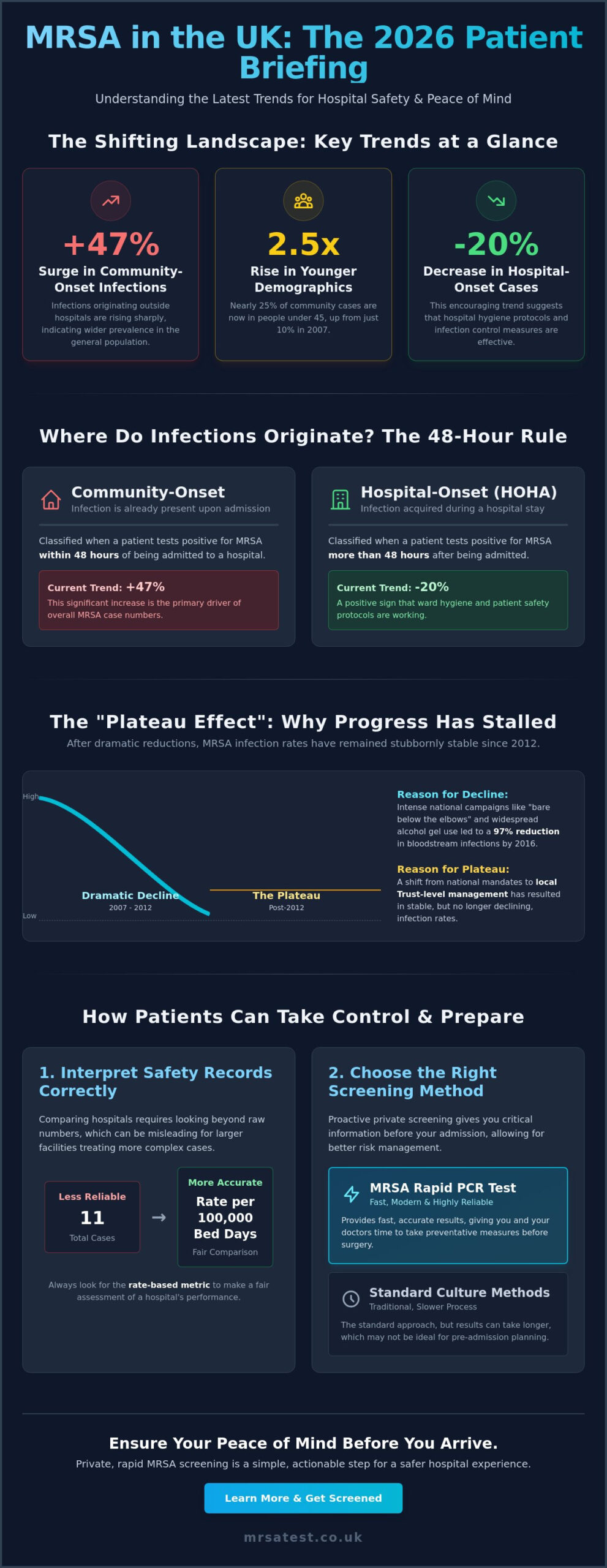
Did you know that nearly a quarter of community-onset MRSA cases now involve people under the age of 45? This is a sharp rise from 2007, when that demographic represented just 10% of infections. While many patients focus solely on the ward environment, the latest mrsa infection rates uk hospitals report are heavily impacted by trends starting outside the clinic. Recent UK Health Security Agency data released in June 2026 shows that while hospital-onset cases saw a 20% decrease in early 2025, community-associated infections surged by more than 47%.
It’s completely understandable to feel concerned about antibiotic-resistant bacteria or confused by complex government statistics when preparing for surgery. This article will help you make sense of the latest UK hospital MRSA data and show you how proactive screening can protect you during your next admission. We’ll break down the 2026 patient trends, clarify the risks of different infection types, and explain how a private PCR test provides a fast, reliable way to manage your health with confidence. By understanding the current landscape, you can take simple, actionable steps to ensure your safety and peace of mind.
Key Takeaways
- Review the most recent 2026 data on mrsa infection rates uk hospitals to distinguish between risks acquired in clinical settings versus those originating in the community.
- Understand why the decline in superbug cases has plateaued and why younger demographics are now seeing a significant rise in community-associated infections.
- Learn how to interpret hospital trust safety records and prepare effectively for surgery by identifying if you fall into a high-risk category.
- Compare the clinical benefits of MRSA Rapid PCR testing against standard Culture methods to determine which screening process best fits your timeline and needs.
- Discover actionable steps to manage your own infection risk privately, ensuring peace of mind before you even step foot in a hospital ward.
Current MRSA Infection Rates in UK Hospitals (2024-2026)
The UK Health Security Agency (UKHSA) provides the most reliable snapshot of how safe our clinical environments really are. Understanding mrsa infection rates uk hospitals starts with the primary metric used by health officials: MRSA bacteraemia. This term refers to Methicillin-resistant Staphylococcus aureus (MRSA) when it enters the bloodstream. Because these infections are the most serious and difficult to treat, they serve as a critical benchmark for hospital hygiene and patient safety protocols.
As of June 2026, the latest annual figures show a complex picture. While we are far from the “superbug” peaks of the early 2000s, progress has plateaued. In January 2025, the UK reported 94 cases of MRSA bacteraemia, representing a 6.8% increase compared to the previous year. However, it’s vital to distinguish between where an infection is caught. Official data splits these into “trust-assigned” (hospital-onset) and “community-assigned” cases. Interestingly, while community cases rose, hospital-onset cases actually fell by 20% in that same period. This suggest that while ward protocols are improving, the bacteria is becoming more prevalent in the general population.
How the UKHSA Tracks Hospital-Acquired Infections
Every NHS Trust has a legal obligation to report every case of MRSA bacteraemia. The UKHSA uses a 48-hour window to determine the “location of onset.” If a patient tests positive after being in the hospital for more than two days, it’s usually classified as hospital-onset healthcare-associated (HOHA). This rigorous tracking helps clinical teams identify if specific wards or procedures need better hygiene protocols. By 2026, these reports have become more transparent, allowing patients to see exactly how their local trust is performing.
Regional Variations in MRSA Statistics
Not all hospitals face the same challenges. You might notice that a large teaching hospital in a major city reports higher case numbers than a small rural facility. This is often due to the complexity of the patients they treat. To make a fair comparison, experts look at the “rate per 100,000 bed days” rather than just the raw number of cases. For example, Oxford University Hospitals reported 11 total cases for the 2025/2026 fiscal year, but only 6 were apportioned to the trust itself. This distinction helps patients understand if a high number is due to the hospital’s size or an actual lapse in infection control. Understanding these mrsa infection rates uk hospitals helps you make informed decisions about where you receive care.
Understanding the Trends: Why Have Superbug Reductions Levelled Off?
The National Institute for Health and Care Research (NIHR) has identified a clear plateau in the decline of superbug cases across the country. Between 2007 and 2012, the UK witnessed a dramatic drop in infections, but since that period, the numbers have remained stubbornly stable. This stagnation in mrsa infection rates uk hospitals reflects a fundamental shift in healthcare strategy. We have moved away from the high-pressure national mandates of the early 2000s toward a model of local Trust-level management. While this allows hospitals to tailor their hygiene protocols to their specific patient needs, it has also led to a more fragmented landscape where progress is often incremental rather than revolutionary.
It is a clinical reality that a zero-risk environment is impossible in acute healthcare settings. Hospitals are high-traffic hubs where vulnerable patients, staff, and visitors constantly interact. Bacteria like MRSA are opportunistic; they colonise the skin and wait for a break in the protective barrier, such as a surgical incision or a catheter site. You can examine the long-term trajectory of these challenges through the Official UK Government MRSA infection data, which tracks how the “plateau effect” has persisted despite ongoing hygiene efforts.
The Impact of National Infection Control Campaigns
The mid-2000s marked a transformative era for the NHS. National drives achieved a remarkable 97% reduction in MRSA bloodstream infections by 2016. Policies like “bare below the elbows” and the introduction of alcohol-based hand gels at every bedside fundamentally changed the hospital culture. These measures still form the backbone of today’s hospital-acquired infections protocols. However, because the “easy wins” from these behavioural changes have already been achieved, further reductions require more sophisticated, patient-specific interventions.
New Challenges in 2026 Healthcare
The healthcare landscape in 2026 presents unique hurdles that weren’t as prevalent twenty years ago. Patients are increasingly frail, often undergoing complex surgeries that require longer recovery times and more invasive monitoring. High bed occupancy and staffing pressures can also limit the time available for the intensive decontamination of ward environments. Antibiotic stewardship is a vital factor in this equation; the consistent use of certain antibiotics in our communities can inadvertently select for more resilient bacterial strains. If you are preparing for a procedure, you might consider how private MRSA screening can help you manage your personal risk profile before admission.
Hospital-Onset vs. Community-Onset MRSA: What the Data Tells Us
To understand the current mrsa infection rates uk hospitals report, we must look beyond the total case count and examine where these infections actually originate. The UK Health Security Agency (UKHSA) uses a strict 48-hour rule to categorise cases. If a patient tests positive for MRSA bacteraemia more than 48 hours after admission, it is classified as “Hospital-Onset.” If the infection is detected within that first 48-hour window, or outside the hospital entirely, it’s recorded as “Community-Onset.” This distinction is vital because it tells us whether the hospital’s hygiene protocols failed or if the patient unknowingly brought the bacteria with them into the clinical environment.
Recent data highlights a significant shift in these trends. While hospital-onset cases have shown a downward trajectory in early 2025, community-associated infections have surged. For instance, January 2025 statistics revealed that 53 out of 94 total cases were community-onset community-associated (COCA), a 47.2% increase from the previous year. You can find a more granular breakdown of these trends in the Hospital-Onset vs. Community-Onset MRSA Statistics. This rise suggests that the bacteria are circulating more widely among healthy individuals than in previous decades.
It’s also important to distinguish between “colonisation” and “infection.” Colonisation means the bacteria are living harmlessly on your skin or inside your nose without causing illness. An infection occurs only when those bacteria enter the body, usually through a wound or medical device. While colonised individuals don’t feel sick, they are “silent carriers” who can unknowingly spread the bacteria to more vulnerable patients or develop an infection themselves during surgery.
The Role of Prior Trust Exposure
One of the most critical risk factors for carrying MRSA is “prior trust exposure.” If you’ve been admitted to an NHS hospital or visited a clinic in the last 28 days, your statistical risk of carrying the bacteria increases. The UKHSA tracks these movements because patients who frequently transition between different healthcare settings can act as a bridge for the bacteria. Gaining a clear what is MRSA understanding helps you identify whether your recent medical history puts you in a higher risk category before your next admission.
Screening Protocols in the NHS
The NHS doesn’t screen every single patient who enters a hospital. Instead, they use “targeted screening,” focusing on those undergoing high-risk procedures like orthopaedic or cardiothoracic surgery. While this is efficient, it has limitations. Targeted screening can miss carriers who don’t fit the specific criteria but still pose a risk to themselves and others. Because mrsa infection rates uk hospitals are influenced by these silent carriers, many patients now choose to manage their own risk through private screening to ensure they are clear before their procedure begins.
How Patients Can Use Infection Data to Prepare for Surgery
Patients often feel like passive participants in their healthcare journey. However, the data you’ve reviewed regarding mrsa infection rates uk hospitals can be a powerful tool for self-advocacy. Knowing that a specific hospital Trust has a higher rate of community-acquired cases, for example, allows you to be more vigilant about your own pre-operative hygiene. You aren’t just a statistic; you’re a patient with the right to inquire about the safety protocols in place to protect you during your stay. This knowledge helps bridge the gap between clinical data and personal safety.
Advocating for yourself is a crucial part of preparing for surgery. It starts with open communication with your surgical team. If the official data shows a plateau in infection reduction, it’s reasonable to ask how your specific ward is managing those risks. Being proactive doesn’t just reduce your anxiety; it can lead to better clinical outcomes by ensuring all preventative measures are strictly followed.
Questions to Ask Your Surgical Team
Preparation is the best antidote to anxiety. When you meet with your consultant or pre-op nurse, consider asking these specific questions to understand the environment you’ll be entering:
- What are the current pre-operative wash protocols for my procedure? Do you recommend Chlorhexidine Gluconate (CHG) washes?
- What is the hospital’s specific MRSA screening policy for this type of surgery?
- If another patient in my bay tests positive for MRSA, what immediate steps are taken to protect others?
- How does this Trust’s rate of hospital-onset MRSA compare to the national average?
Reducing Your Personal Risk Profile
If you’re identified as being at a higher risk, perhaps due to recent hospital exposure or a history of skin conditions, you may be prescribed decolonisation therapy. This usually involves a combination of antibacterial body wash and nasal ointment used for five days before your procedure. The goal is to reduce the number of bacteria on your skin to the lowest possible level. This simple process is highly effective at preventing the bacteria from entering a surgical site.
This is where taking a proactive approach pays off. Using at-home test kits UK services allows you to identify if you’re a carrier well in advance of your surgery date. This gives you ample time to complete decolonisation without delaying your operation. Maintaining a clean environment at home is equally important. Use fresh towels and bed linens during your decolonisation period and ensure any existing wounds are kept covered and dry. Taking control of your screening process ensures that you aren’t leaving your safety to chance. You can order a private MRSA test today to get the clarity you need before your admission.
Taking Control: Private MRSA Screening for Peace of Mind
While we have explored how mrsa infection rates uk hospitals are influenced by both clinical hygiene and community trends, national data only provides part of the picture. For an individual patient, the most important statistic is their own colonisation status. Understanding whether you are a carrier of the bacteria before you arrive for surgery is the most effective way to eliminate uncertainty. Private screening allows you to move beyond general risk assessments and obtain a clear, clinical answer regarding your personal health profile.
Taking a proactive approach to your health doesn’t just protect you; it protects the hospital environment and other vulnerable patients. By identifying a colonisation early, you can complete a decolonisation protocol well in advance of your admission date. This ensures your surgical journey remains on track and reduces the likelihood of complications or last-minute cancellations due to unexpected positive results in a pre-op clinic.
Why Choose a Private MRSA Test?
The primary reason patients opt for private screening is the desire for a streamlined, manageable process. NHS screening is often targeted at specific high-risk groups, meaning many patients may not be tested at all despite their own concerns. Choosing a confidential MRSA test provides several logistical advantages:
- Speed: You don’t have to wait for a GP appointment or a hospital referral to get tested.
- Discretion: Samples are collected in the privacy of your home and processed with complete confidentiality.
- Convenience: The process fits around your schedule, ensuring results are ready when you need them for your surgical timeline.
Our commitment to accuracy is foundational to our service. We work exclusively with UK-accredited laboratory partners to ensure that every sample is handled with the same level of clinical rigour you would expect in a hospital setting. This provides a reliable trust signal that your results are both accurate and actionable.
PCR vs. Culture: Which Screening is Right for You?
We offer two primary methods for detecting MRSA, each suited to different patient needs. The MRSA Rapid PCR Test is our most advanced option, utilizing DNA amplification to identify the bacteria with high precision. A Rapid PCR test provides a 24-hour turnaround from the time the laboratory receives your sample, making it the ideal choice for patients with urgent surgery dates.
Alternatively, the MRSA Culture Test is a traditional and highly reliable method where the laboratory grows the bacteria in a controlled environment. This process typically takes 48 to 72 hours. It’s a cost-effective choice if your procedure is several weeks away and you have more flexibility in your timeline. Both methods involve simple swabs of the nose, groin, or axilla, and both provide the clinical clarity needed to navigate mrsa infection rates uk hospitals with confidence and peace of mind.
Securing Your Health Before Your Hospital Admission
Understanding the current mrsa infection rates uk hospitals report is the first step toward a safer surgical experience. While national hygiene protocols have successfully reduced hospital-onset cases, the rising prevalence of community-associated strains means that personal vigilance is more important than ever. By identifying whether you are a “silent carrier” before your procedure, you can take proactive steps to ensure your recovery remains uninterrupted and your safety is prioritized.
You don’t have to navigate these risks alone or rely solely on targeted hospital screening. Our professional at-home service provides the clarity you need with clinical-grade accuracy. Whether you choose the rapid 24-hour PCR option or a standard culture test, your samples are processed in verified, accredited UK laboratories to ensure the highest standards of reliability. This discreet process is designed to support you through a simple, well-managed diagnostic journey from the comfort of your own home.
Order your confidential MRSA test kit today for fast, laboratory-accurate results and take a decisive step toward your peace of mind. We are here to help you enter the hospital with confidence and security.
Frequently Asked Questions
Are MRSA rates in UK hospitals currently increasing?
Total reported cases have shown a slight upward trend, with 94 cases of MRSA bacteraemia recorded in January 2025. This represents a 6.8% increase compared to January 2024. However, the data reveals a clear split in mrsa infection rates uk hospitals; while community-onset cases rose by more than 47%, hospital-onset cases actually fell by 20%. This suggests that while clinical environments are achieving better hygiene results, the bacteria are circulating more frequently in the general population.
Which NHS hospitals have the highest MRSA infection rates?
Infection counts vary significantly based on the size and specialisation of the NHS Trust. Larger teaching hospitals often report higher raw numbers because they treat more complex, vulnerable patients who stay for longer periods. For example, Oxford University Hospitals reported 11 cases in the 2025/2026 fiscal year. To make a fair comparison, you should look at the rate per 100,000 bed days rather than just the total number of infections.
How do I find out the MRSA rate for my local hospital?
You can access this information through the UK Health Security Agency (UKHSA) website, which publishes monthly and annual official statistics. These reports provide a detailed breakdown of mrsa infection rates uk hospitals by individual Trust. You can search for your specific hospital to see their recent performance data, including whether cases were hospital-onset or community-acquired. This transparency helps you understand the safety record of the facility where you’ll receive care.
Can I refuse surgery if the hospital has high infection rates?
You always have the right to make informed decisions about your treatment, including the right to request a transfer to a different facility. If you have concerns about a Trust’s infection record, you should discuss them openly with your surgical team. While you can decline a procedure, it’s vital to weigh the risks of delaying your surgery against the hospital’s current infection control measures and your personal screening status.
What happens if I test positive for MRSA before my operation?
If you test positive, your clinical team will start a decolonisation protocol to reduce the bacteria on your skin. This usually involves using a special antibacterial body wash and nasal ointment for five days before your admission. In some cases, elective surgery might be briefly postponed to ensure the protocol is complete. This proactive step significantly lowers the risk of the bacteria entering a surgical site during your procedure.
How long does a private MRSA test take to get results?
The timeframe depends on the testing method you select for your screening. A Rapid PCR test is the fastest option, providing results within 24 hours of the laboratory receiving your sample. If you choose a standard culture test, the process typically takes 48 to 72 hours. This allows the laboratory sufficient time to monitor for any bacterial growth and provides a definitive answer regarding your colonisation status.
Is a private MRSA test accepted by NHS hospitals for pre-op screening?
Most NHS Trusts accept results from accredited UK laboratories, though it’s always best to confirm this with your specific surgical team. A private test is a professional way to take control of your health management before your official pre-op appointment. It gives you the advantage of time, allowing you to begin any necessary decolonisation early and ensuring your surgical timeline remains on track without unexpected delays.
What is the difference between MRSA colonisation and an MRSA infection?
Colonisation occurs when the bacteria live harmlessly on your skin or in your nose without making you feel ill. You can be a “silent carrier” for a long time without knowing it. An infection, however, happens when those bacteria enter the body, often through a medical device or a surgical wound. While colonisation doesn’t require antibiotics, it must be managed before surgery to prevent it from developing into a serious infection.
