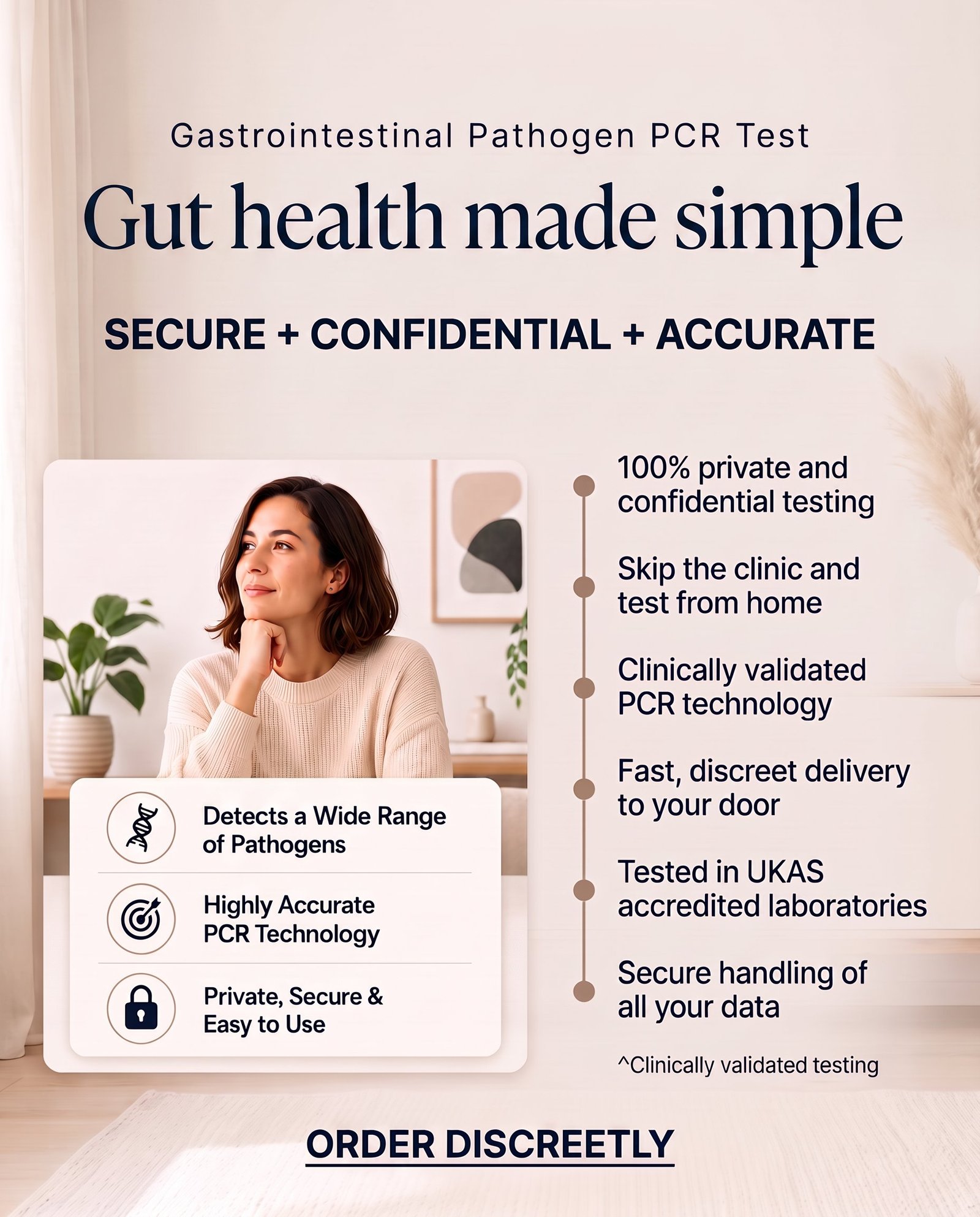
Gastrointestinal Pathogens PCR Test
Gastrointestinal Pathogens PCR Test for convenient at-home stool sample collection and laboratory analysis. Detects selected bacterial, viral and parasitic pathogens associated with gastrointestinal infections using PCR technology. Ideal for investigating symptoms such as diarrhoea, abdominal pain, nausea and vomiting
£119.99
- Home sample collection kit included
- Clear step-by-step instructions
- Discreet delivery
- Laboratory analysis
- Digital results within 2–5 working days
Gastrointestinal Pathogens PCR Test – At-Home Stool Test
Comprehensive Laboratory Testing for Gastrointestinal Infections
The Gastrointestinal Pathogens PCR Test is a comprehensive stool test which has been designed in the laboratory to detect various bacterial, viral and parasitic pathogens linked to gastrointestinal infections.
The test uses PCR technology to detect genetic material from a number of gastrointestinal pathogens in a stool sample, and the sample can be easily collected at home before being sent back to the laboratory for professional analysis.
The test could be appropriate for individuals who have persistent diarrhoea, abdominal pain, nausea, vomiting, a fever, blood or mucus in their stool, or gastrointestinal symptoms after travelling, suspected food poisoning or having come into contact with contaminated food or water.
The collection of the sample at home followed by laboratory analysis—this is not a self-diagnosis test. The stool sample is sent to the laboratory for professional PCR testing.
Key Features
- Comprehensive gastrointestinal pathogens PCR panel
- Detects selected bacteria, viruses and parasites
- Convenient at-home stool sample collection
- Professional laboratory PCR analysis
- Tests multiple pathogenss from one sample
- Secure online laboratory results
- Suitable for investigating a range of gastrointestinal symptoms
- Stool microscopy, culture and sensitivity (M/C/S) available separately where required
What does the gastrointestinal PCR test pick up?
The Gastrointestinal Pathogens PCR Test checks for a wide range of gastrointestinal pathogens.
Bacteria & Bacterial Targets
- Clostridioides difficile Toxin A/B gene
- Campylobacter spp.
- Enteroaggregative E. coli (EAEC)
- Enteroinvasive E. coli (EIEC) or Shigella
- Enterotoxigenic E. coli (ETEC)
- Enteropathogensic E. coli (EPEC)
- Plesiomonas shigelloides
- Salmonella spp.
- E. coli that produces Shiga toxin (stx1/stx2)
- STEC O157:H7
- Vibrio cholerae
- Vibrio parahaemolyticus
- Vibrio vulnificus
- Yersinia enterocolitica
Viruses
- Adenovirus 40/41
- Astrovirus
- Norovirus GI
- Norovirus GII
- Rotavirus A
- Sapovirus I, II, IV and V
Parasites
- Cyclospora cayetanensis
- Cryptosporidium spp.
- Entamoeba histolytica
- Giardia lamblia
It should be noted that the specific pathogens panel may vary depending on the laboratory’s validated testing method and is therefore subject to change. Please verify the current panel before placing your order.
Stool M/C/S Is Not Included
The PCR test does not cover stool microscopy, culture and sensitivity (M/C/S).
Should M/C/S testing of the stool be necessary, then it has to be asked for as a separate test and could involve the need to collect additional samples.
What does a gastrointestional pathogens PCR test consist of?
PCR, which stands for polymerase chain reaction, is a technique employed in the laboratory for detecting specific genetic material from microorganisms.
A single stool sample can be tested using a gastrointestinal PCR panel for various pathogens, such as certain bacteria, viruses, and parasites.
In contrast to conventional culture, PCR testing is able to detect the specific genetic material without it being necessary to grow the organism in the laboratory.
Benefits of PCR testing include:
- Broad pathogens coverage
- Molecular detection of targeted pathogenss
- Testing for bacteria, viruses and parasites
- Efficient laboratory processing
- Rapid laboratory analysis
When interpreting a positive PCR result you should take your symptoms, medical history and other clinical information into account.
What is there in the Gastrointestinal Pathogens PCR Test?
There are a variety of causes for gastrointestinal symptoms, such as infectious and non-infectious conditions.
It is possible to carry out testing in order to find out if genetic material from one or more of the pathogens that are in the panel is present in the stool sample which has been submitted.
You may consider testing if you have:
- Persistent or recurrent diarrhoea
- Abdominal pain or cramping
- Nausea or vomiting
- Fever with gastrointestinal symptoms
- Blood or mucus in your stool
- Symptoms following international travel
- Suspected food poisoning
- Possible exposure to contaminated food or water
- Gastrointestinal symptoms where an infectious cause needs to be investigated
It can provide useful information when discussing the matter with a healthcare professional.
For whom is the test suitable?
The test may be suitable for:
- Adults with gastrointestinal symptoms
- Children, subject to appropriate sample collection and laboratory requirements
- Travellers returning with gastrointestinal illness
- People with persistent or recurrent symptoms
- People concerned about foodborne or waterborne infection
- Individuals who may be at increased risk from gastrointestinal infections
If a person is immunocompromised, pregnant, elderly, or has severe symptoms, they should obtain the proper medical advice instead of depending only on a home testing service.
Common Symptoms of Gastrointestinal Infection
Gastrointestinal infections can cause symptoms including:
- Diarrhoea
- Abdominal pain or cramping
- Nausea
- Vomiting
- Fever
- Loss of appetite
- Blood or mucus in the stool
- Weakness or dehydration
Test results should also be interpreted in light of your symptoms and medical history since similar symptoms can appear in non-infectious gastrointestinal conditions.
How the At-Home Stool Test Works
The collection of the sample takes place at home, but the testing is carried out in the laboratory.
1. Order your test
The stool collection kit is sent to the address you have selected.
2. Collect your sample
Collect the required stool sample by following the given instructions.
3. Return your sample
Pack your sample securely and send it back by following the return instructions given.
4. Laboratory PCR analysis
The sample is processed in the laboratory by means of its approved PCR testing method and is tested for the pathogens that are included in the panel.
5. Receive your results
After the laboratory analysis, you will receive your results in the form of a secure online report.
What is contained in the test kit?
The kit that you receive for collecting your sample includes all the materials you need to collect and return it.
Depending on the specific kit, this may include:
- Stool sample collection container
- Sample collection instructions
- Secure sample packaging
- Sample return packaging
- Sample return instructions
Laboratory tests are not carried out at home; your sample is sent back to the laboratory for professional PCR analysis.
Understanding Your Results
The laboratory report will show if genetic material from the pathogens listed in the panel has been detected.
Not Detected
In the sample that was submitted, no genetic material from the pathogens in question was found.
A negative result does not rule out every possible infection or non-infectious cause of gastrointestinal symptoms, especially those conditions not included in the test panel.
Detected
Genetic material from one or more of the pathogens that were tested was found.
Just because a result has been detected does not mean that the pathogens are the only reason for your symptoms. The results must be interpreted in light of your clinical history and symptoms.
When a pathogen is detected, you should discuss the result with a healthcare professional to see if further assessment or treatment is suitable.
PCR Testing vs Stool Culture
PCR and stool culture are two different methods of laboratory testing.
The PCR test is able to detect the genetic material of pathogens that are included in the test panel.
The method of stool culture involves growing specific microorganisms under laboratory conditions so that they can be identified and, in suitable cases, be given further testing.
PCR and culture can thus offer different kinds of information.
Important
This gastrointestinal PCR test does not cover stool microscopy, culture and sensitivity (M/C/S).
If M/C/S testing is needed, then it should be arranged separately and will probably need extra samples.
Does getting a positive result mean that I need antibiotics?
Not necessarily.
Gastrointestinal infections can be caused by bacteria, viruses or parasites, and the treatment given will depend on the organism in question and on the patient’s clinical situation.
Instead, certain infections are treated with supportive care rather than with antimicrobial medication.
If the result is positive, you should discuss it with a healthcare professional before you start, stop or change the treatment.
What if I’ve recently taken antibiotics?
The detection of certain microorganisms may be influenced by recent antimicrobial treatment and therefore this should be considered when interpreting the laboratory results.
The effect of prior treatment may differ according to the pathogens involved, the timing of the treatment, and other factors, since PCR is able to detect genetic material from the target organisms.
When you are talking to your healthcare professional about your results, make sure to tell them about any antibiotics or other antimicrobial treatment you have had recently.
You should not discontinue taking your prescribed medication in order to get a test unless you have been told to do so by a healthcare professional.
Why Choose Repose Healthcare?
- Easy – you can collect your stool sample at home.
- Broad in scope – it includes tests for a wide range of gastrointestinal pathogens.
- Based on PCR – it uses molecular testing to detect the genetic material of the targeted pathogens.
- – The samples are analysed in the laboratory by professional laboratory analysts.
- Sample collection and return – carried out in a discreet and secure manner.
- Results that are clear – you can receive your laboratory report online.
Frequently Asked Questions
Do I need a doctor’s referral?
You do not need a referral if you want to order the test directly from Repose Healthcare, but medical advice could be suitable according to your symptoms and the results.
Is this a do-it-yourself test of the gastrointestinal system?
On the contrary, although the sample is collected at home the real PCR testing and analysis are carried out by the laboratory.
How soon will I get my results?
The results are usually issued within 3 – 5 working days after the laboratory has received an appropriate sample.
Can children take this test?
Although the test may be suitable for children, the collection of samples should still be carried out under the supervision of a parent or other adult responsible.
Is this test going to include stool M/C/S?
By no means is stool microscopy, culture and sensitivity (M/C/S) included in the gastrointestinal PCR panel since it is a separate test.
Can this test be used to detect food poisoning?
The test is able to identify those bacterial, viral and parasitic pathogens which are associated with gastrointestinal illness and with some cases of foodborne infection. It does not cover every possible cause of food poisoning.
Can this test be used to diagnose IBS?
Not at all; the PCR test is not used for the diagnosis of IBS. Since gastrointestinal symptoms can have a number of causes, they may need additional clinical evaluation.
What are my options if the result is positive?
Talk your results over with a general practitioner or with some other suitable healthcare professional. The appropriate next step will be determined by the pathogens that have been detected, your symptoms and your medical history.
When Is the Time to Get Medical Advice?
Seek prompt medical attention if you experience:
- Severe or worsening abdominal pain
- Significant dehydration
- Persistent vomiting
- Blood in your stool
- High or persistent fever
- Severe or persistent diarrhoea
- Fainting, confusion or marked weakness
- Symptoms in a young child or vulnerable person
- Rapidly worsening symptoms
An at-home test should not cause a delay in urgent medical evaluation if the symptoms are severe.
Order Your Gastrointestinal Pathogens PCR Test
The Gastrointestinal Pathogens PCR Test offers laboratory testing for a wide variety of bacterial, viral and parasitic pathogens which are associated with gastrointestinal illness.
Get your stool sample easily at home and send it back to the laboratory for professional PCR analysis.
Get online today for the convenient option of having your sample collected at home and having it tested for gastrointestinal pathogens in the laboratory.
Important Information & Disclaimer
The Gastrointestinal Pathogens PCR Test is a kind of laboratory screening procedure which is designed to detect the genetic material of certain bacteria, viruses and parasites that are included in the test panel, and it is meant to provide information that may be of assistance in the investigation of gastrointestinal symptoms.
A positive result doesn’t always indicate that the pathogen detected is the only cause of your symptoms, and a negative result doesn’t rule out all possible infections, gastrointestinal disorders, or other causes of the symptoms. The test only evaluates pathogens that are included in the validated test panel.
Since PCR testing can detect the genetic material of a pathogen it does not follow that the organism is still viable or causing active disease; therefore the results should be interpreted in light of your symptoms, medical history and other appropriate clinical information.
This test cannot take the place of a consultation, diagnosis or treatment by a qualified healthcare professional and you should not start, stop or alter your medication solely on the basis of your test result without first obtaining the appropriate medical advice.
The detection of certain pathogens might be influenced by recent antimicrobial treatment. When you are discussing your results with a healthcare professional, it is important to give them information regarding any recent antibiotics or other antimicrobial medication taken.
Stool microscopy together with culture and sensitivity (M/C/S) is not part of this test and must be specifically requested whenever it is required.
If you are experiencing severe abdominal pain, have significant dehydration, are still vomiting, have blood in your stool, have a high fever, are seeing your symptoms get much worse, or in any other way feel seriously unwell, then you should get medical help as soon as possible instead of using this test.
Just because you collect the sample at home doesn’t mean that you will get a diagnosis at home. The sample has to be sent to the laboratory where it will be analysed by professionals using the procedures for testing which have been validated by the laboratory.
Home Testing Kit
The required sample collection equipment for your selected test.
Sample Collection Materials
Appropriate tubes, swabs, lancets or collection containers depending on the test.
Step-by-Step Instructions
Clear instructions explaining how to prepare for and collect your sample.
Sample Return Packaging
Suitable packaging for safely returning your sample to the laboratory.
Laboratory Testing
Your sample is analysed for the biomarkers or health markers included in your selected test.
How does the home testing process work?
Choose your test online and place your order. Your test kit will be delivered with clear instructions and the equipment needed to collect your sample at home. Once your sample has been collected, return it using the provided return method. Your sample will then be analysed and your results provided securely.
How do I collect my sample?
Each test kit includes step-by-step instructions explaining how to collect your specific sample. Follow the instructions carefully to make sure your sample is collected correctly.
Do I need to visit a clinic or GP?
Our home testing service is designed to allow you to collect your sample from home. Whether you need to speak with a healthcare professional depends on your individual circumstances and the type of test you are taking.
How do I send my sample back?
Place your collected sample in the packaging provided with your kit and follow the included return instructions. Where applicable, a prepaid return envelope will be included.
When will I receive my results?
The turnaround time depends on the test you have purchased. Your product page and test instructions will provide the expected timeframe for your results.
What happens if my result is outside the normal range?
A result outside the laboratory reference range does not necessarily mean that you have a medical condition. If you are concerned about your results, discuss them with an appropriate healthcare professional.
What if I make a mistake while collecting my sample?
Follow the instructions provided with your kit. If you believe your sample has been collected incorrectly or your kit has been damaged, contact customer support before sending the sample back.
Can I order more than one test?
Yes. You can order multiple tests where appropriate. Make sure you follow the individual collection and preparation instructions for each test.
Is my personal information kept private?
Your personal and test information should be handled securely in accordance with the applicable privacy and data protection requirements.