
How Long to Wait for MRSA Culture Results: A UK Patient Guide
Imagine your long-awaited surgery is only days away, but your pre-operative screening results are still nowhere to be found. This scenario causes significant anxiety for thousands of patients across the UK every year. When your health and your schedule are on the line, the uncertainty of a lab timeline can feel overwhelming. You’re likely wondering exactly how long to wait for mrsa culture results and whether a delay might force your hospital to postpone your procedure.
We understand that waiting for medical answers is often the most stressful part of any clinical process. It’s frustrating to feel like a passenger in your own healthcare journey, especially when clear timelines aren’t provided. This guide will give you the clarity you need. You’ll learn the biological reasons why traditional cultures require specific timeframes, how modern PCR technology provides a faster alternative, and the exact steps to take if you need a rapid turnaround for an upcoming hospital admission. We’ll break down the differences between NHS and accredited private laboratory speeds to help you make an informed decision for your peace of mind.
Key Takeaways
- Standard MRSA culture results typically take 48 to 72 hours once the laboratory receives your sample, as this biological process requires time for the bacteria to grow.
- You’ll understand exactly how long to wait for mrsa culture results by accounting for both the laboratory’s processing time and the transit time of your postal sample.
- For urgent pre-surgery requirements, a Rapid PCR test provides a faster alternative, delivering results within 24 hours of the lab receiving your swab.
- Choosing an accredited UK laboratory ensures your results meet the rigorous standards required by both NHS and private hospitals for surgical admissions.
- Professional at-home screening kits offer a discreet and efficient way to complete your pre-operative requirements without needing an in-person clinical appointment.
Understanding the Timeline: How Long Do MRSA Culture Results Take?
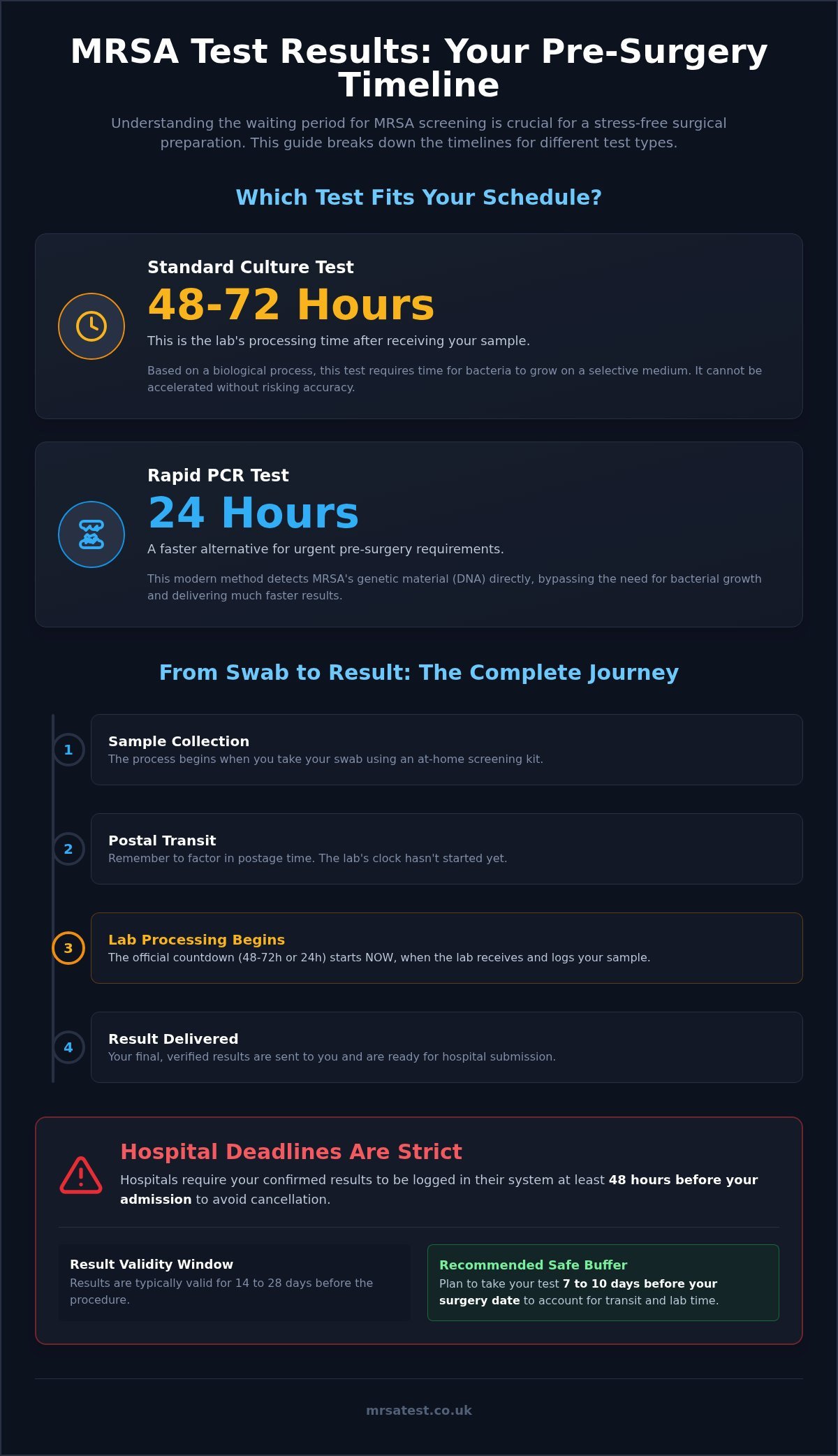
When you’re preparing for a hospital procedure, knowing exactly how long to wait for mrsa culture results is essential for your planning. The standard wait time for a traditional MRSA culture is typically 48 to 72 hours once your sample reaches the laboratory. It’s a biological process that depends on the natural growth rate of bacteria, which means it cannot be accelerated beyond certain physical limits.
It’s vital to understand that the “results clock” doesn’t start the moment you take your swab at home or in a clinic. Instead, the timeline begins when the laboratory officially receives and logs your sample. This distinction is often a source of confusion for patients. If you post a sample on a Monday and the lab receives it on Tuesday, your 48-hour window starts on Tuesday. You should also distinguish between preliminary and final results. A lab might see early bacterial growth after 24 hours, providing a “preliminary” indication, but a “final” negative result usually requires the full 72-hour incubation to be certain no bacteria are present.
The 48-72 Hour Standard Window
The reason for this specific timeframe lies in the “incubation period.” To identify Methicillin-resistant Staphylococcus aureus, scientists place your sample on a selective growth medium. This substance encourages MRSA to grow while suppressing other types of bacteria. It takes time for these microscopic organisms to multiply into visible colonies that a microbiologist can accurately identify. 48 hours is generally the minimum period required for a reliable negative result. If the lab technicians see suspicious growth, they may need an additional 24 hours to confirm the specific strain and its resistance to antibiotics. In the UK, you should also account for NHS laboratory operating hours. Many hospital labs have reduced staffing or different processing batches during weekends and bank holidays, which can extend your total waiting time unexpectedly.
Why Timing is Critical for Pre-Surgery Screening
Most UK hospitals require clear MRSA screening results within a specific window before your scheduled procedure, often between 14 and 28 days. However, the most critical deadline is the 48 hours immediately preceding your admission. If your results aren’t available and logged in the hospital system at least two days before you’re due on the ward, there’s a significant risk of your surgery being cancelled. Hospitals maintain strict infection control policies to protect all patients, and they cannot admit you for elective surgery without confirmed clearance. To ensure you stay on track, you can use our Preparing for Surgery Checklist to manage your screening dates alongside your hospital requirements. Planning your test at least 7 to 10 days before your surgery date provides a safe buffer for both transit and lab processing.
The Science of the Wait: Why Cultures Take Time
Testing for bacteria isn’t a digital process; it’s a biological one that follows a fixed natural timeline. When you’re determining how long to wait for mrsa culture results, it’s helpful to understand that the laboratory is essentially growing a microscopic garden. This process cannot be rushed without risking a false negative result, which would be dangerous for anyone heading into a sterile surgical environment. The accuracy of the test depends entirely on giving the bacteria enough time to multiply until they are detectable by clinical equipment.
Scientists use “selective media” to identify resistant strains. These are specialised agar plates containing specific antibiotics that kill off standard bacteria but allow MRSA to flourish. According to clinical guidelines regarding standard MRSA culture results, the initial growth phase typically requires 24 to 48 hours before any colonies become visible to the naked eye. This ensures the lab technicians aren’t just looking at random skin bacteria, but are specifically identifying the presence of Staphylococcus aureus. If your surgery is imminent and you can’t wait for this growth period, our rapid PCR options at mrsatest.co.uk offer a faster alternative by looking for DNA rather than waiting for growth.
Step-by-Step: From Swab to Result
Once your kit arrives at our accredited facility, the process follows three strict phases. First is inoculation, where the swab is carefully streaked across agar plates. Next is incubation, where these plates are kept in a temperature-controlled environment at exactly 37°C, mimicking human body temperature to encourage natural growth. Finally, identification occurs. Technicians perform chemical tests, such as the coagulase test, to confirm if the growing bacteria is indeed staph. These steps are vital to ensure the result you receive is clinically sound and accepted by your hospital admissions team.
The “Suspected Positive” Delay
Occasionally, a sample shows signs of growth that look like MRSA but aren’t yet confirmed. This is known as a “presumptive positive.” In these cases, the laboratory must perform sensitivity testing, which often adds an extra 24 hours to the timeline. Technicians place the bacteria in contact with specific antibiotics, like methicillin or oxacillin, to prove resistance. While this delay is frustrating, it’s a critical safety measure. It ensures that you don’t receive unnecessary decolonisation treatment if the bacteria is actually a harmless strain. This rigorous verification process ensures 100% accuracy, preventing both missed infections and unnecessary surgical delays.
Culture vs. PCR: Choosing the Right Test for Your Schedule
Deciding between a traditional culture and a modern PCR test is a balance of time, cost, and clinical requirements. While you now understand how long to wait for mrsa culture results based on the biological growth of the bacteria, molecular technology offers a different path. Traditional cultures are highly reliable but are limited by the speed of nature. In contrast, Polymerase Chain Reaction (PCR) testing identifies the genetic material of the bacteria, specifically looking for the mecA gene that grants resistance to methicillin. This means the lab doesn’t need to wait for colonies to grow to provide a definitive answer.
For most patients in the UK, the choice comes down to your surgery date. If your procedure is more than 10 days away, a standard culture is a cost-effective way to meet hospital requirements. However, if your admission is scheduled for the coming week, the speed of a PCR test becomes a vital safeguard against last-minute cancellations. Both methods are processed in our accredited UK laboratories, ensuring the results are valid for hospital admissions teams across the country.
Rapid PCR: Results in Under 24 Hours
If you’re facing a tight deadline, a MRSA Test: Get Fast Results with PCR is the most efficient option. Because this method detects DNA rather than waiting for bacterial multiplication, the laboratory can often deliver a result within 24 hours of receiving your sample. This speed doesn’t compromise accuracy. In fact, PCR is exceptionally sensitive and is widely used in high-stakes clinical environments to prevent the spread of infection. It’s the gold standard for patients who need clearance in a 3 to 5-day window before their surgery.
Traditional Culture: The Reliable Standard
Traditional culture testing remains a staple of clinical diagnostics for several reasons. Beyond simply identifying the presence of MRSA, a culture allows microbiologists to perform “sensitivity testing.” This process determines which specific antibiotics will be most effective if treatment is needed. If you have a longer lead time, you might choose between our Nose/Groin or Nose/Groin/Axilla culture options depending on your hospital’s specific instructions. While you’ll have to consider how long to wait for mrsa culture results (typically 48 to 72 hours), the lower price point makes it an accessible choice for routine pre-operative screening. It provides a thorough overview of your carrier status and ensures you have all the information required for a safe hospital stay.
Logistical Factors Affecting Your Result Delivery in the UK
While the technical growth phase of a laboratory test is fixed, the logistics of moving your sample from your home to the facility can vary significantly. When you’re calculating how long to wait for mrsa culture results, you must factor in the “pre-analytical” phase. This period includes the time your sample spends in transit and the administrative processing once it arrives at the lab. “Lab time” is only one component of the total waiting period, and understanding these external factors can help you plan your screening more effectively.
Efficiency in this stage is what differentiates a streamlined private service from the often-congested NHS system. To ensure your results are accepted by your consultant, we process all samples in UKAS accredited laboratories. This accreditation is the gold standard for clinical quality in the UK, providing the security and reliability that hospital admissions teams require before they can clear you for surgery.
Postage and Sample Transit
The speed of the UK postal service is a critical factor in your testing timeline. We provide prepaid Royal Mail Tracked 24 shipping with our kits to minimize delays. This service is designed to deliver samples within one working day, but external factors like regional sorting office backlogs can occasionally impact transit. To ensure the best results, we recommend following these logistical steps:
- Post on Monday through Thursday: This prevents your sample from sitting in a sorting office over the weekend when laboratory processing may be limited.
- Avoid Friday postings: Samples posted on a Friday may not reach the lab until Monday, which can lead to sample degradation.
- Use a Priority Postbox: These are collected more frequently and are prioritized for medical samples.
If a sample takes too long to reach the lab, the transport medium in the swab may no longer support the bacteria’s viability. This can lead to an “invalid” result, forcing you to start the process again and potentially jeopardizing your surgery date.
NHS vs. Private Laboratory Turnaround
NHS laboratories are often under immense pressure. They must prioritize “urgent” samples from inpatients already in hospital beds over “routine” outpatient screenings. This prioritization can extend the time you have to wait for mrsa culture results to 5 days or more during busy periods. In contrast, a private screening service operates on a dedicated workflow. Because we focus specifically on screening, your sample doesn’t compete with emergency hospital diagnostics. This allows for a guaranteed turnaround time that helps you meet strict pre-operative deadlines without the stress of NHS backlogs. If you need to secure your surgical slot with a fast, accredited result, you can order your priority MRSA screening kit here to begin the process today.
How to Get Your MRSA Results Faster with mrsatest.co.uk
Preparing for surgery is stressful enough without the added worry of administrative delays. While the NHS provides an essential service, their diagnostic pipelines are often stretched, leaving patients unsure of the exact timeline for their clearance. If you are concerned about how long to wait for mrsa culture results when using standard hospital pathways, our private service offers a much clearer and more predictable alternative. At mrsatest.co.uk, we’ve designed a streamlined process that puts you back in control of your healthcare schedule.
Our service is built around the needs of the patient, prioritising speed without sacrificing the technical precision required by hospital consultants. By using our dedicated UKAS accredited laboratory partners, we bypass the typical hospital backlogs to deliver clinical-grade results directly to your secure digital device. This allows you to manage your pre-operative requirements without the friction of traditional clinical appointments.
The mrsatest.co.uk Process
We’ve simplified every stage of the screening journey to ensure you can complete your requirements from the comfort of home. You don’t need a GP referral or an in-person appointment to get started.
- Order online: Select the specific test required by your hospital. Your kit arrives in discreet, plain packaging that fits through a standard UK letterbox.
- Simple collection: Our kits include clear instructions for taking your own nose, groin, or axilla swabs. It’s a non-invasive process that takes only a few minutes.
- Fast return: Every kit includes a prepaid Royal Mail Tracked 24 return envelope. This ensures your sample reaches our laboratory as quickly as possible.
For those with an imminent surgery date, our Rapid PCR service is the gold standard. While traditional growth methods take time, our PCR technology provides a definitive answer within 24 hours of the laboratory receiving your sample. This speed allows you to provide your consultant with the necessary clearance even if your procedure is only a few days away.
Guaranteed Peace of Mind
Accuracy and confidentiality are the foundations of our service. Every sample is processed in a verified UK laboratory, ensuring the reporting meets the rigorous standards required by both private and NHS hospitals. You’ll receive your results through a secure digital portal the moment they’re verified by a clinical scientist. This eliminates the delay of waiting for a letter or a phone call from a busy clinic. Your data is handled with the highest level of discretion, and your results are for your eyes only. Order your Rapid PCR or Culture kit today to secure your surgery date and eliminate the uncertainty of the waiting room.
Secure Your Surgical Slot with Timely Screening
Securing your surgery date requires more than just clinical preparation; it demands precise logistical planning. We’ve explored how traditional biological growth dictates how long to wait for mrsa culture results, typically requiring 48 to 72 hours in the lab. However, you don’t have to be at the mercy of standard hospital backlogs. By choosing a modern PCR approach, you can bypass the growth phase and receive verified results in as little as 24 hours from laboratory receipt.
Our service provides the professional security of a UKAS Accredited Laboratory while offering the convenience of at-home collection. This streamlined process is trusted by patients nationwide for reliable pre-op screening that meets strict hospital standards. Don’t let administrative delays or postal uncertainty jeopardize your procedure. Taking proactive control of your testing timeline ensures that you arrive at the hospital with confidence and clarity.
Order Your Private MRSA Test Kit Now to guarantee your results are ready when you are. Your health and peace of mind remain our priority throughout this simple, well-managed process.
Frequently Asked Questions
How long do MRSA results take from a swab?
Standard MRSA results typically take between 48 and 72 hours once the laboratory receives your swab. This timeframe is necessary for the bacteria to grow on selective media until they are visible for identification. If you’re wondering how long to wait for mrsa culture results, you should also account for the one working day it takes for your sample to travel through the Royal Mail Tracked 24 system.
Can I get MRSA results in 24 hours?
You can obtain results within 24 hours of the laboratory receiving your sample by choosing a Rapid PCR test. Unlike traditional cultures that rely on bacterial growth, PCR technology detects the genetic material of the bacteria almost immediately. This is the most efficient option for patients with an imminent surgery date, providing a definitive answer much faster than the standard 48 to 72 hour culture window.
What happens if my MRSA culture is positive before surgery?
A positive result generally means you’ll need to undergo a five day decolonisation treatment before your procedure. This typically involves using a specific antiseptic body wash and a nasal antibiotic cream to clear the bacteria from your skin. Your hospital consultant will review the results and may reschedule your surgery to ensure your safety. Taking a test early allows enough time to complete this treatment without causing major delays.
Is a PCR test for MRSA more accurate than a culture?
Both tests are clinically accurate but serve different diagnostic purposes. A PCR test is exceptionally sensitive at detecting the DNA of the bacteria, making it ideal for rapid screening. A culture test remains the standard for determining which specific antibiotics will effectively treat the strain. When considering how long to wait for mrsa culture results, the primary trade-off is speed versus the detailed antibiotic sensitivity data that a traditional culture provides.
Will the hospital accept an at-home MRSA test result?
Most NHS and private hospitals in the UK accept results from at-home kits, provided the samples are processed in an accredited laboratory. All tests from mrsatest.co.uk are analysed in UKAS accredited facilities, which meet the rigorous quality standards required for clinical diagnostics. We recommend sharing your digital result certificate directly with your pre-operative assessment team or consultant to ensure it’s logged into your medical records before your admission date.
Why has my MRSA result taken longer than 3 days?
Several factors can extend the timeline beyond the standard three day window. Delays often occur due to weekend postal collections or if the laboratory identifies a presumptive positive that requires an additional 24 hours of confirmatory testing. If your sample was posted on a Friday, it may not reach the lab until Monday. We use tracked shipping to help you monitor your sample’s progress and minimise these logistical uncertainties.
Do I need to stop using antiseptic washes before my MRSA swab?
You should avoid using antiseptic washes or antibiotic nasal creams for at least 48 hours before taking your swab. These products can temporarily suppress the bacteria on your skin, leading to a false negative result even if you’re a carrier. To ensure the highest level of accuracy for your hospital screening, use standard soap and water in the days leading up to your sample collection and follow the instructions included in your kit.
How will I receive my results from mrsatest.co.uk?
We deliver your results through a secure digital portal to ensure speed and confidentiality. As soon as our clinical scientists verify your sample, you’ll receive a notification to log in and view your report. This digital certificate is easy to download and can be emailed directly to your hospital’s pre-operative department. This streamlined method avoids the delays associated with traditional post and ensures you have your documentation ready for admission.