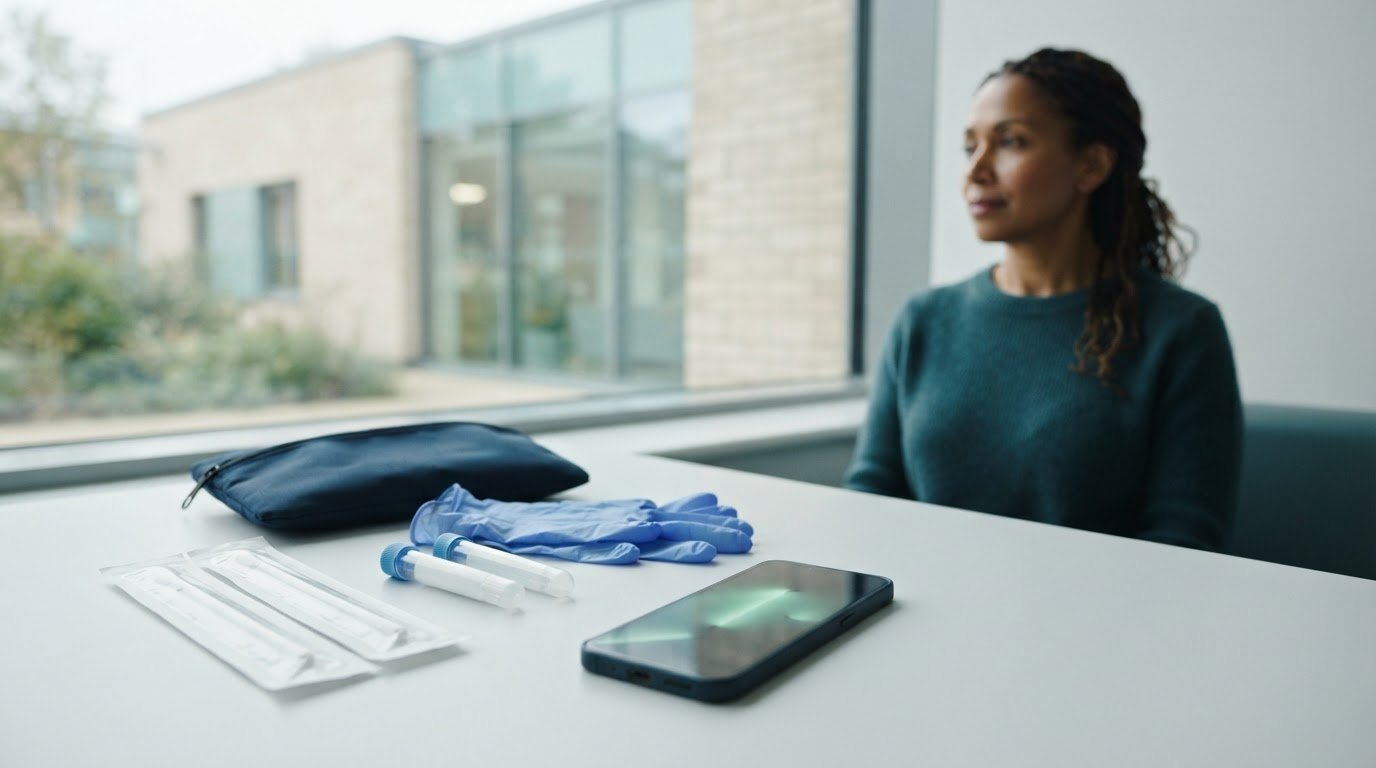

Approximately 3% of people across the UK carry MRSA harmlessly on their skin, yet carrying these bacteria increases the risk of a surgical site infection by ninefold. When preparing for the mrsa screening for elective surgery uk hospitals require, it’s completely natural to worry that a positive swab will derail your operation. Between confusing swab requirements across multiple body sites and tight hospital clinic deadlines, pre-admission checks often create needless anxiety.
Routine screening isn’t a barrier to your procedure; it’s a proactive safeguard designed to protect your recovery. In this 2026 guide, you’ll learn current UK hospital pre-admission rules, exact swabbing techniques for nasal, groin, and axillary areas, and how simple a five-day decolonisation wash really is if bacteria are detected. We’ll also examine how accredited UK postal screening services provide fast, certified laboratory results when hospital swab appointments are fully booked, keeping your surgical admission date safely on schedule.
Key Takeaways
- Understand why mrsa screening for elective surgery uk hospitals require is a routine safeguard designed to protect your recovery rather than delay your procedure.
- Learn what to expect during multi-site swabbing across the nostrils, groin, and axilla, including how to collect accurate self-swabs at home.
- Discover how a simple five-day decolonisation wash quickly manages positive results without permanently derailing scheduled operations.
- Compare turnaround times between rapid PCR testing and standard laboratory culture methods to match your hospital admission deadline.
- Explore certified UK postal screening options that provide verified pre-admission documentation when hospital clinic appointments are unavailable.
Why MRSA Screening is Mandatory for UK Elective Surgery
Preparing for planned surgery involves multiple clinical checks, but few are as critical to post-operative recovery as infection prevention. Completing mrsa screening for elective surgery uk healthcare providers require is a standard protocol across NHS trusts and private hospitals alike. Under National Institute for Health and Care Excellence (NICE) guidelines and GIRFT clinical pathways, hospitals maintain rigorous infection prevention measures. When a surgical incision breaches the skin, bacteria that live peacefully on your body surface can enter sterile tissue, potentially triggering deep surgical site complications or sepsis. Routine testing ensures these risks are neutralised before you enter the operating theatre.
Colonisation vs Active Infection: What Your Hospital Looks For
There is a fundamental difference between carrying bacteria and being sick. Methicillin-resistant Staphylococcus aureus (MRSA) frequently colonises healthy human skin and mucosal membranes without triggering any noticeable symptoms. You feel completely well, your body temperature remains normal, and you show no signs of illness.
Intact skin acts as an impenetrable shield against these microscopic organisms. The clinical danger arises only when that barrier is opened during a surgical procedure. Because an asymptomatic carrier feels identical to someone without the bacteria, pre-admission testing is required regardless of how healthy you feel.
High-Risk Elective Procedures Requiring Mandatory Pre-Op Swabs
While hospital policies can vary slightly across regional health boards, national guidance enforces universal pre-admission screening for elective inpatient stays, alongside specific day cases. Mandatory mrsa screening for elective surgery uk patients undertake is especially vital for procedures involving prosthetic implants, where post-operative infections prove difficult to treat:
- Orthopaedic surgeries: Total hip and knee arthroplasties, spinal fusions, and hardware revision procedures.
- Cardiothoracic operations: Heart valve replacements, coronary artery bypass grafts, and vascular reconstructions.
- Neurosurgical procedures: Craniotomies and procedures requiring shunt placements.
- Day cases involving metalwork: Day-case admissions requiring the insertion or removal of surgical plates, screws, or synthetic mesh.
Proactive screening safeguards your healing process while protecting hospital wards and vulnerable patients from preventable cross-contamination.
How the Pre-Operative MRSA Swab Process Works
Undergoing mrsa screening for elective surgery uk hospitals require is straightforward, painless, and completed in just a few minutes. Medical teams swab specific anatomical sites where staphylococcal bacteria naturally colonise, checking for bacterial presence before your procedure. Whether completed during an in-person hospital pre-assessment appointment or via a verified postal kit, the collection process follows standardised clinical steps.
Anatomical Swab Sites: Nose, Groin, and Axilla
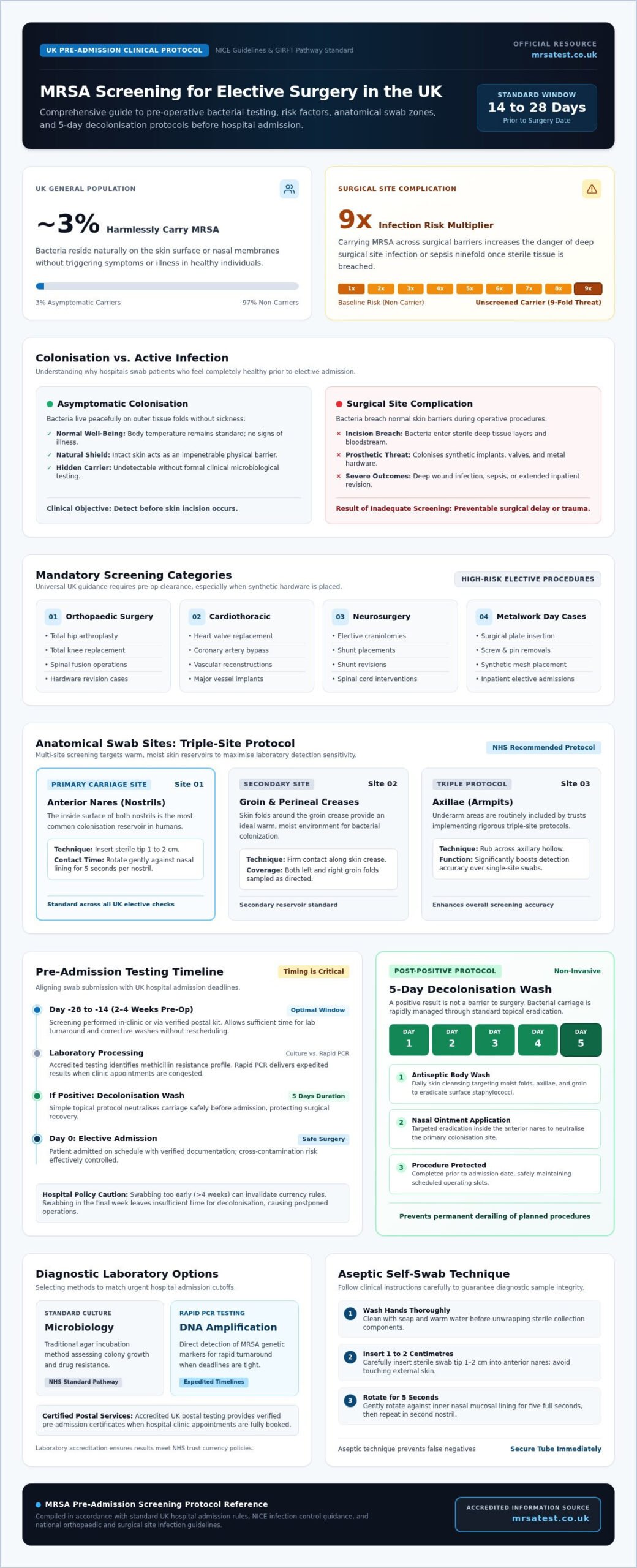
Clinical teams focus on warm, moist skin folds that serve as natural bacterial reservoirs. The primary swab covers the anterior nares (the inside of each nostril), which is the most common carriage site. Secondary swabs target the groin creases and perineal area. Many NHS trusts and private hospitals now implement a triple-site protocol that includes the axillae (armpits). As outlined in the NHS patient guide to MRSA screening, testing multiple areas significantly improves detection accuracy.
Recommended Testing Timelines Before Your Admission Date
Timing your screen correctly is vital. Pre-op screening normally takes place 2 to 4 weeks (14 to 28 days) before your scheduled surgery date. This window provides sufficient time to process laboratory samples and complete eradication washes if bacteria are detected. Testing too early can invalidate results under hospital currency policies, while waiting until the final week before admission leaves no room to address a positive result, risking unnecessary postponement.
Step-by-Step Guide to Taking an Accurate Self-Swab
Collecting your own sample at home is simple when you follow exact aseptic technique:
- Wash your hands: Clean your hands thoroughly with soap and warm water before unwrapping sterile components.
- Sample nostrils carefully: Insert the sterile swab tip roughly 1 to 2 centimetres into the nostril, rotating it gently against the inner nasal lining for five seconds before repeating in the other nostril with the same swab.
- Collect groin and axilla samples: Use separate designated swabs to sample skin folds firmly without touching surrounding clothing or unwashed skin.
- Seal immediately: Insert each swab into its labelled transport medium tube, ensuring the cap clicks tightly shut.
If hospital clinic slots are unavailable, securing a domestic postal kit from mrsatest.co.uk ensures you can submit multi-site samples to an accredited diagnostic laboratory well ahead of your pre-admission deadline.
What Happens If Your Pre-Surgery MRSA Test Is Positive?
Receiving an unexpected positive result can feel alarming, but it isn’t a diagnosis of illness. Detecting surface bacteria during your mrsa screening for elective surgery uk pre-admission check simply confirms harmless colonisation. Surgical teams encounter these findings every week. Rather than cancelling your operation outright, pre-assessment clinics initiate routine decolonisation steps to clear your skin safely before you enter theatre.
Standard UK Decolonisation Protocols Explained
Hospitals use targeted topical suppression treatments to eliminate bacteria from your skin and nasal passages. As detailed in official NHS guidance on MRSA, standard hospital eradication therapy lasts five consecutive days and relies on two core components:
- Antibacterial nasal ointment: Applied directly inside both nostrils three times daily to clear mucosal carriage reservoirs.
- Antiseptic skin wash: Used daily across the entire body, paying special attention to the groin, axillae, and hair.
- Clean environment protocols: Changing bed sheets, pillowcases, and towels daily alongside fresh clothing prevents immediate re-colonisation during treatment.
These topical wash routines are gentle, well tolerated, and complete within five days.
Will Your Surgery Be Cancelled or Rescheduled?
A positive screen rarely derails your treatment permanently. The clinical approach depends entirely on your specific procedure and local hospital infection prevention guidelines:
- Prosthetic and orthopaedic surgery: High-risk operations involving joint replacements or spinal hardware are typically rescheduled by 7 to 14 days. This short delay allows you to finish the five-day decolonisation wash and confirm clearance before inserting foreign implants.
- Time-critical or low-risk procedures: Many soft-tissue or minor day operations proceed on schedule. When your surgical team knows your colonisation status beforehand, anaesthetists simply adjust your pre-operative intravenous antibiotics, administering targeted options like teicoplanin or vancomycin just prior to incision.
Maintaining proactive mrsa screening for elective surgery uk timelines ensures any necessary eradication therapy finishes smoothly, protecting your health without compromising your planned admission date.
Diagnostic Options: Standard Culture vs Rapid PCR Testing
When completing mrsa screening for elective surgery uk hospitals require, samples are evaluated using one of two accredited laboratory methods. Diagnostic facilities process pre-operative swabs using either traditional microbiological cultures or molecular Polymerase Chain Reaction (PCR) analysis. Both analytical techniques provide verified, certified laboratory reports accepted by surgical teams, but their processing timelines differ significantly.
Turnaround Times and Laboratory Processing Speeds
Standard microbiological culture involves plating your swab samples onto selective nutrient agar and incubating them at body temperature. Technicians monitor bacterial growth over 48 to 72 hours before running susceptibility panels. While accurate and reliable, this biological incubation takes time.
Rapid PCR testing takes a genetic approach. Instead of waiting for live bacteria to multiply, automated laboratory platforms extract and amplify specific resistance genes (such as mecA) unique to MRSA. This molecular analysis delivers definitive results within 24 hours of the laboratory receiving your sample. For patients facing short pre-admission windows, molecular PCR eliminates days of anxious waiting.
Matching Test Choice to Your Pre-Op Timeline
Choosing the correct diagnostic method depends on your scheduled admission date and the specific testing locations requested by your hospital:
- Standard Culture (48 to 72-hour lab turnaround): An effective option when you have several weeks before your surgical date. It suits planned procedures where pre-assessment packs are submitted well in advance.
- Rapid PCR (24-hour lab turnaround): The gold standard when your admission is imminent. If your hospital clinic has limited availability or your operation date was moved forward unexpectedly, molecular testing ensures your paperwork is completed on time.
- Sampling sites: Check whether your surgical unit specifies dual-site testing (nose and groin) or triple-site screening (nose, groin, and axilla) before placing your order.
If you need certified pre-admission documentation on a tight schedule, you can order a rapid PCR home screening kit from mrsatest.co.uk to receive laboratory-verified results within 24 hours of sample arrival.
How to Arrange Private Pre-Admission MRSA Testing in the UK
Organising hospital paperwork can be stressful, especially when balancing work commitments with clinic appointments. While many NHS facilities provide in-person pre-assessment visits, appointments fill up quickly. Patients treated through independent providers often bear the responsibility of arranging their own documentation. Certified postal screening kits offer a dependable, convenient way to complete required mrsa screening for elective surgery uk hospitals mandate, all from the privacy of home.
Direct-to-consumer testing bypasses scheduling bottlenecks entirely. Screening packages arrive via discreet postal delivery throughout the UK, complete with clear instructions and pre-paid tracked return packaging. Once you collect your swabs, accredited domestic laboratories analyse the samples and generate formal diagnostic reports suitable for hospital pre-admission files.
Home Testing Kits from mrsatest.co.uk
Different surgical procedures demand specific testing timelines and swab sites. Choosing an option tailored to your hospital’s exact protocol ensures full compliance:
- MRSA Culture – Nose/Groin: The standard dual-site option for general elective operations planned several weeks ahead. Samples undergo biological agar incubation over 48 to 72 hours.
- MRSA Culture – Nose/Groin/Axilla: A triple-site culture kit designed for surgical teams requiring axillary swabs alongside routine nasal and perineal sampling.
- MRSA Rapid PCR Test- Nose/Groin: Utilises advanced molecular analysis to deliver definitive gene-level detection within 24 hours of laboratory receipt, protecting tight admission schedules.
- MRSA Rapid PCR Test- Nose/Groin/Axilla: The most comprehensive rapid option, covering all three primary bacterial reservoirs with 24-hour molecular results.
Every test provides a formal, verified laboratory report that can be handed straight to your clinical team.
Confirming Your Documentation with Your Surgical Team
Hospital protocols vary regarding the specific anatomical sites they evaluate. Before ordering, confirm whether your surgical team requires a standard two-site screen or a three-site panel covering the axillae. Once your analysis is complete, submit the digital laboratory certificate directly to your pre-assessment nurse or hospital admissions coordinator.
Sorting your test early eliminates the risk of last-minute administrative postponements. Along with arranging your screening, explore our comprehensive guide on preparing for surgery to review fasting rules, medication adjustments, and recovery planning ahead of your admission date.
Securing Your Surgical Date with Confidence
Pre-admission testing shouldn’t be a source of anxiety as your operation approaches. Routine mrsa screening for elective surgery uk hospitals require is fundamentally a protective measure designed to ensure uncomplicated wound healing. Even if bacteria are detected, standard five-day topical washes quickly resolve carriage without permanently derailing your planned procedure, provided you screen within the recommended two-to-four-week window.
When clinic slots are unavailable or your admission deadline is tight, certified postal testing offers total peace of mind. Kits arrive via discreet UK delivery with clear multi-site instructions and pre-paid tracked return packaging. Samples are analysed by accredited domestic laboratories, with rapid molecular PCR testing delivering verified reports within 24 hours of receipt. Don’t let administrative delays put your care on hold. Order your fast pre-op screening kit today and take the final step towards a smooth, confident hospital admission.
Frequently Asked Questions
Why is an MRSA test required before elective surgery in the UK?
Pre-operative testing is required to identify asymptomatic bacterial colonisation before a surgical incision breaches your skin’s natural barrier. Harmless surface bacteria can enter deep sterile tissue during theatre, potentially causing severe surgical site infections or prosthetic complications. Completing the routine mrsa screening for elective surgery uk hospitals mandate ensures proactive measures are taken in advance, protecting both your surgical recovery and other vulnerable patients on the ward.
How long before surgery should pre-operative MRSA screening be completed?
Pre-operative screening should be completed between two and four weeks (14 to 28 days) before your scheduled admission date. This timeframe gives accredited laboratories sufficient processing time while leaving adequate space to finish a standard five-day decolonisation wash if bacteria are detected. Testing more than a month in advance may expire under hospital currency rules, whereas swabbing during the final week risks unnecessary admission delays.
What happens if I test positive for MRSA before my scheduled operation?
A positive swab indicates harmless surface colonisation rather than active illness, prompting your clinical team to prescribe a five-day eradication protocol. You’ll apply an antibacterial nasal ointment inside both nostrils three times daily and use an antiseptic body wash each morning. This simple topical routine suppresses bacteria on skin surfaces, ensuring you can proceed to theatre with a significantly reduced risk of post-surgical complications.
Will my elective surgery be cancelled if my MRSA swab is positive?
Surgeries are rarely cancelled permanently due to a positive screen; operations are either postponed briefly or managed with adjusted medication. Complex procedures involving prosthetic implants or joint replacements may be delayed by 7 to 14 days to complete decolonisation washes first. Many soft-tissue or minor procedures continue entirely on schedule, with anaesthetic teams simply administering targeted intravenous antibiotics just before the operation begins.
Which body sites are swabbed for pre-operative MRSA screening?
Standard hospital protocols primarily swab the anterior nares (nostrils) and the groin or perineal area, where staphylococcal bacteria reside most frequently. Many healthcare providers also enforce a triple-site panel that includes the axillae (armpits) for greater diagnostic confidence. If you have chronic open wounds, active skin conditions, or entry sites for medical devices, clinical teams will swab those specific areas as well.
How quickly can I get private MRSA test results before surgery?
Private molecular PCR tests deliver verified results within 24 hours of your sample arriving at an accredited laboratory. Standard microbiological culture tests require biological incubation on agar plates, taking between 48 and 72 hours for confirmed readings. Choosing rapid molecular testing provides the fastest turnaround, making it ideal when your surgical admission date is imminent and clinic appointments are fully booked.
Can I do a pre-surgery MRSA swab at home rather than attending hospital?
Yes, you can complete pre-admission screening at home using certified postal kits processed by accredited domestic laboratories. Home collection kits include clear instructions for dual-site or triple-site swabbing alongside pre-paid tracked return envelopes. The resulting laboratory certificate provides formal pre-assessment documentation, making it a convenient way to complete the mrsa screening for elective surgery uk hospitals require without attending outpatient clinics.