
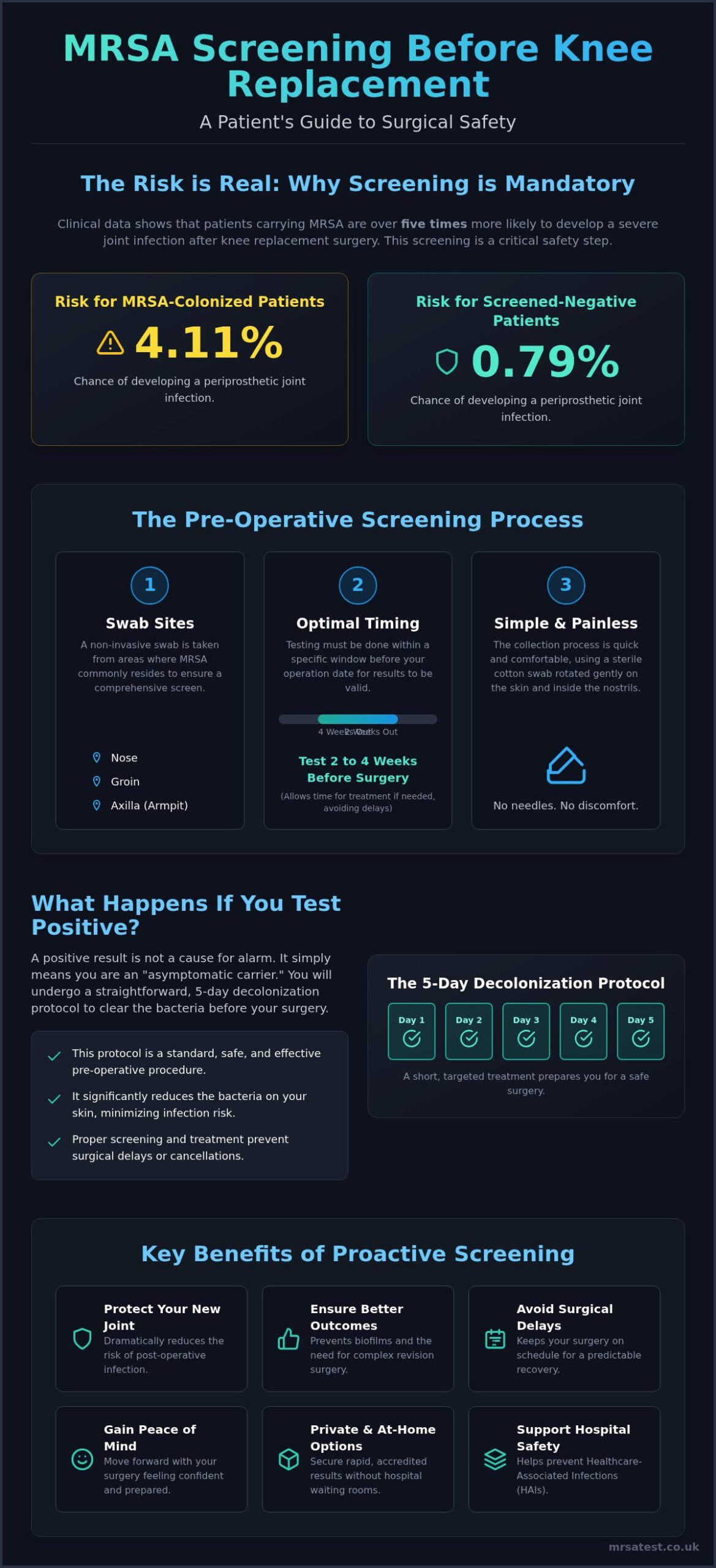
Did you know that patients carrying MRSA are over five times more likely to develop a joint infection after a knee replacement than those who are clear of the bacteria? Recent clinical data confirms that the risk of serious complications reaches 4.11% in colonized patients, compared to just 0.79% in others. Because mrsa screening before knee replacement is so vital for your safety, it’s now a standard requirement for elective surgery in the UK. It’s natural to feel anxious about potential infections or the fear that your operation might be postponed, but being proactive is the best way to protect your health.
This article explains why this screening is a mandatory safety requirement and how you can manage the process without unnecessary stress. We will preview the simple swabbing procedure, explain what happens if you require a decolonization protocol, and show you how to secure rapid, accredited results. By taking a professional approach to your pre-operative care, you can move forward with your surgery feeling confident and fully prepared for your new chapter of mobility.
Key Takeaways
- Understand why mrsa screening before knee replacement is a mandatory safety measure to protect your new joint from potential post-operative infections.
- Learn about the specific swabbing process for the nose, groin, and axilla, which identifies bacteria before they can impact your recovery.
- Discover how pre-operative screening prevents the formation of biofilms, the protective bacterial layers that can complicate joint replacements.
- Gain peace of mind by understanding the decolonization process, a straightforward treatment used to clear MRSA if your results are positive.
- See how opting for private, at-home screening can provide fast results and help you avoid the stress of surgical delays or hospital waiting rooms.
Why MRSA Screening is Essential for Knee Replacement Surgery
Before you step into the operating theatre for a joint replacement, your surgical team follows a strict safety checklist. At the top of that list is identifying Methicillin-resistant Staphylococcus aureus (MRSA). This is a specific type of bacteria that has developed resistance to several widely used antibiotics, making infections much harder to treat than standard staph infections. While these bacteria often live harmlessly on the skin, they pose a unique threat during orthopedic procedures. Unlike general surgery, knee replacements involve the insertion of prosthetic components made of metal and plastic. If bacteria reach these foreign materials, your body’s immune system struggles to clear them. Implementing mandatory mrsa screening before knee replacement helps identify these risks before the first incision is made, protecting both your new joint and the wider hospital environment from Healthcare-Associated Infections (HAIs).
The Hidden Risk of Asymptomatic Colonization
Many people are surprised to learn they carry MRSA without ever feeling ill. This state is known as colonization. You might feel perfectly healthy and have no visible skin issues, yet the bacteria can reside quietly in your nose, armpits, or groin. During the surgical process, these bacteria can be inadvertently moved from your skin surface deep into the surgical site. Because you don’t have symptoms, a professional diagnostic swab is the only way to know if you’re a carrier. It’s a common situation; it isn’t a reflection of your personal hygiene, but rather a biological factor that needs management. Knowing your status isn’t about your general health; it’s a specific safety data point required to ensure your surgery proceeds without complications.
The Impact of Infection on Surgical Outcomes
A post-operative infection is one of the most challenging hurdles in any recovery journey. When MRSA is present, it can lead to delayed wound healing and significant discomfort. Data from a large-scale study in January 2025 highlights that patients with pre-operative MRSA colonization face a periprosthetic joint infection rate of 4.11%, compared to just 0.79% in those who are clear. These infections often result in much longer hospital stays and may require complex treatments. By identifying the bacteria early through mrsa screening before knee replacement, you and your clinical team can take action. This proactive step dramatically reduces the likelihood of complications, ensuring your path to improved mobility remains as smooth and predictable as possible. To further support your journey, professional rehabilitation with RED Physiotherapy can help you regain full function and strength once your surgical site has healed.
MRSA screening is a non-invasive diagnostic tool used to identify antibiotic-resistant bacteria before invasive procedures. It isn’t a test for an active illness, but rather a check for “colonization,” which means the bacteria are living on your skin without causing symptoms. To get an accurate picture of your status, clinicians look at specific areas of the body known as carriage sites. While some older protocols focused solely on the nose, modern safety standards recognize that the bacteria frequently colonize other warm, moist areas. For a truly comprehensive screen, samples are typically taken from the nose, the groin, and the armpits (axilla). This multi-site approach ensures that colonization isn’t missed, providing a higher level of security for your upcoming surgery.
Timing is a critical factor in the screening process. Most UK hospitals and private clinics require mrsa screening before knee replacement to be performed within a specific window, usually between 2 and 4 weeks before your operation. This timeframe is chosen for two reasons. First, it ensures the results are representative of your current bacterial status. Second, it leaves a sufficient buffer for a five-day decolonization treatment if you test positive. If you wait until the last minute, you risk a surgical delay; however, testing too early might mean the results are no longer valid by your surgery date.
How the Swab Process Works
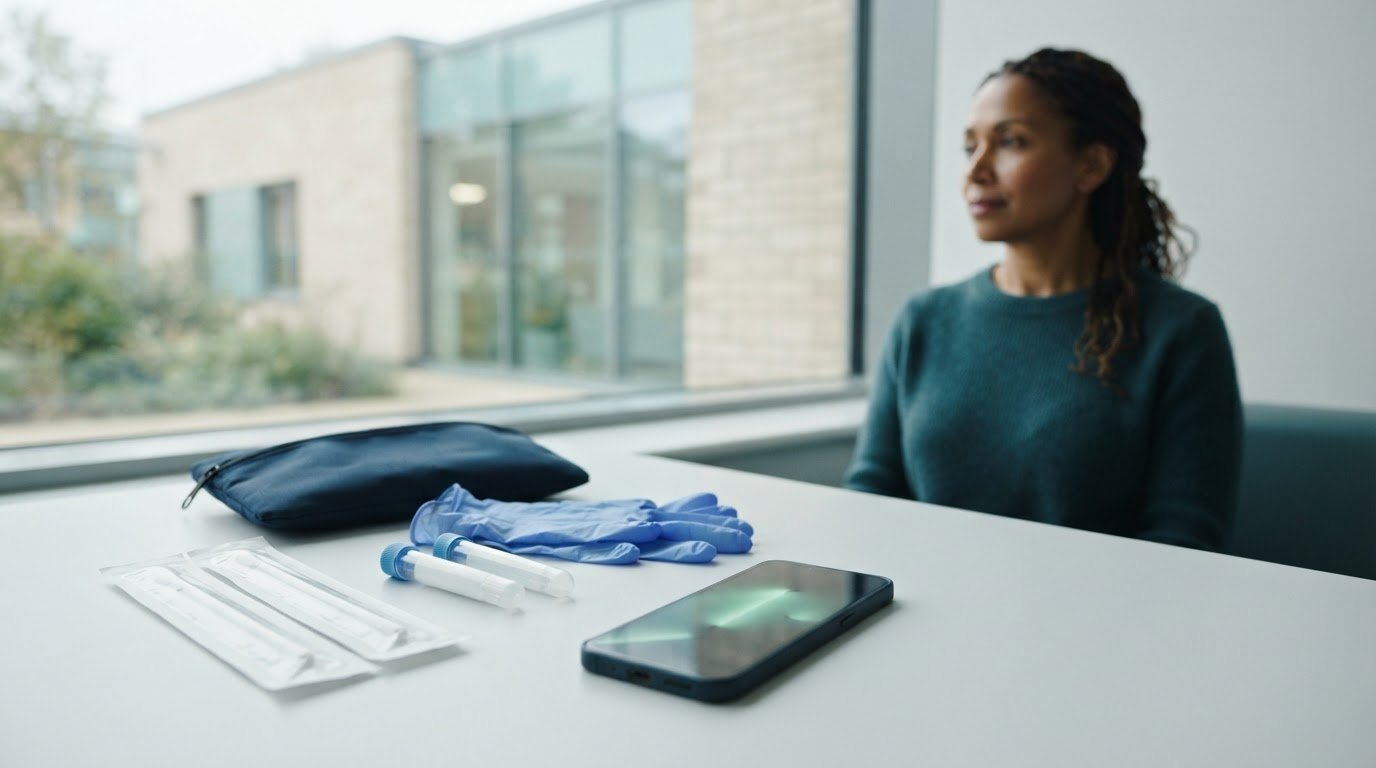
The collection process is simple and painless. Using a sterile swab, you or a professional will gently rotate the tip inside the nostrils and across the skin in the groin and armpit areas. When using a self-collection kit, it’s vital to follow the instructions carefully to ensure you capture enough material for the lab to analyze. Accuracy depends on the quality of the sample. By swabbing all the recommended sites, you provide the laboratory with the best chance of detecting even low levels of bacteria, ensuring your new joint is protected from the start.
PCR vs. Culture: Choosing the Right Test
There are two primary methods used to detect MRSA, and the choice often depends on how quickly you need your results. Standard culture testing involves placing the sample in a nutrient-rich environment to see if bacteria grow, a process that typically takes 48 to 72 hours. Rapid PCR (Polymerase Chain Reaction) testing is a more advanced molecular technique that searches for the specific DNA of the MRSA bacteria. This method is significantly faster, often delivering results within 24 hours of the lab receiving the sample. For many patients, especially those with urgent surgical dates, the speed of PCR provides essential peace of mind. You can explore the technical differences further in our guide on MRSA Culture vs. PCR Test: Which One Do You Need?
If you’re managing a busy pre-operative schedule, choosing a private at-home MRSA screening kit can help you avoid extra hospital visits while ensuring your results are ready well before your admission date.
Protecting Your New Joint: Biofilms and Revision Surgery
The introduction of a prosthetic knee changes the biological landscape of your joint. While your immune system is highly effective at fighting bacteria in living tissue, it faces a unique obstacle when those bacteria land on non-living surfaces like cobalt-chrome or polyethylene. Once MRSA attaches to these components, it begins to produce a substance known as a biofilm. Think of a biofilm as a protective shield or a “slime layer” that encases the bacteria. This shield makes it nearly impossible for antibiotics or your natural white blood cells to reach and destroy the infection. This is why mrsa screening before knee replacement is more than an administrative box to tick; it’s a vital defense for the hardware that’s meant to last you for decades.
The “Foreign Body” Challenge
In a healthy, natural joint, your blood supply delivers immune cells directly to the site of any potential threat. However, an artificial joint doesn’t have its own blood supply. This creates a “safe haven” for bacteria. If MRSA is present on your skin during surgery, it can migrate to the implant and establish a Prosthetic Joint Infection (PJI). These infections are notoriously difficult to treat because the bacteria are essentially hiding behind their biofilm on a surface where your body can’t easily reach them. By prioritizing mrsa screening before knee replacement, you’re performing a pre-emptive strike. You ensure that the bacteria are identified and addressed while they’re still on your skin, where they’re far more vulnerable to treatment.
Avoiding the Need for Revision
If a prosthetic joint becomes deeply infected, the standard solution is often revision surgery. This is a complex, multi-stage procedure where the infected implant is removed, the area is treated with high-dose antibiotics, and a new joint is eventually fitted. The physical and emotional toll of revision surgery is significantly higher than the initial replacement. It often involves a longer recovery period and more time away from the activities you love. To ensure you have a “clean” start for your 2026 knee replacement, identifying risks early is essential. For a broader look at how to stay safe during your hospital stay, you can consult our Hospital-Acquired Infections: A Patient’s Guide. Taking these steps now protects the longevity of your new joint and your overall peace of mind.
What Happens if You Test Positive for MRSA?
Receiving a positive result from your MRSA screen doesn’t mean you’re ill, nor does it mean your surgical journey has come to an end. It simply indicates that the bacteria are present on your skin and need to be cleared before your operation. This is a common and manageable part of pre-operative care. By identifying colonization through mrsa screening before knee replacement, your medical team can initiate a straightforward treatment plan called decolonization. This process significantly lowers the risk of surgical site infections by reducing the bacterial load on your body before you reach the hospital. It’s a proactive safety step that ensures your recovery starts on the best possible footing.
Standard Decolonization Protocols
The decolonization treatment usually lasts for five days and is performed in the comfort of your own home. It typically involves two main components. First, you’ll use a Chlorhexidine (CHG) antiseptic body wash. You’ll use this solution in the shower to cleanse your skin and hair, which effectively neutralizes bacteria on the body’s surface. Second, you’ll use Mupirocin nasal ointment. This is applied inside the nostrils several times a day to eliminate the bacteria from one of their primary carriage sites. Strict adherence to this protocol is essential. If you skip a day or miss a step, the bacteria may persist, which could compromise the safety of your new joint. Once the five-day course is finished, you’ll usually wait a few days before having a follow-up “clearance” swab to confirm the MRSA has been successfully removed.
Will My Surgery Be Cancelled?
One of the most common anxieties for patients is the fear that a positive test will lead to a cancelled surgery. In reality, a positive result rarely leads to a permanent cancellation. Instead, your surgery might be postponed by a week or two to allow time for the decolonization treatment and the follow-up swab. This is why proactive testing is so beneficial. If you discover your status early, you can complete the treatment well in advance of your scheduled date. This prevents the stress of a last-minute postponement on the morning of your surgery, which can happen if screening is left until the day of admission. For more tips on managing your timeline and ensuring everything is in place, see our Preparing for Surgery: A Complete Checklist.
To ensure you have enough time for decolonization and clearance if needed, you can order a private MRSA screening kit to get your results moving today and secure your surgical date.
Fast-Track Your Pre-Op Prep with Private MRSA Testing
Managing the logistics of a major operation can be overwhelming, especially when you’re balancing pre-assessment appointments with personal commitments. For many patients, the requirement for mrsa screening before knee replacement adds another layer of scheduling complexity. Choosing a private at-home test allows you to take control of this timeline. Instead of making extra trips to a clinical setting, you can complete the necessary swabs in a familiar environment. This approach not only saves time but also minimizes your exposure to hospital environments in the weeks leading up to your surgery. By handling this step independently, you ensure that your results are ready and waiting for your surgical team, preventing any last-minute administrative delays.
Convenience and Peace of Mind
When you order a screening kit online, it arrives in discreet, secure packaging, protecting your privacy from the start. The process is designed to be straightforward, allowing for simple self-collection in the comfort of your own home. Our kits include everything needed for a comprehensive screen of the nose, groin, and axilla carriage sites. Once you’ve completed the swabs, you simply use the prepaid return shipping to send your samples directly to our UK-accredited laboratory partners. This streamlined procedure removes the friction of traditional testing, providing a sense of quiet competence as you prepare for your procedure. To further ease your transition back home, Royal Care Companion provides flexible, on-demand caregiving that can support you during the first few weeks of recovery.
Speed is often the most critical factor when a surgery date is fixed. While standard hospital cultures can take 48 to 72 hours, our Rapid PCR testing provides results within 24 hours of the laboratory receiving your sample. This molecular detection method offers higher sensitivity, meaning it can detect the bacteria even in low concentrations that a standard culture might miss. For those with imminent surgery dates, this rapid turnaround is a significant logistical advantage. It provides the certainty you need to move forward, knowing you’ve met your safety requirements on time without the anxiety of waiting for slow lab results. To secure your surgical timeline and protect your recovery, you can order your pre-op MRSA test kit today.
Securing Your Surgical Timeline and Recovery
Prioritizing your safety before entering the operating theatre is the most effective way to ensure the long-term success of your joint replacement. By completing your mrsa screening before knee replacement, you’re taking a vital step to protect your new prosthetic from the risks of bacterial colonization and biofilm formation. Even if you test positive, the process is entirely manageable through a standard five-day decolonization protocol. This proactive approach allows your surgery to proceed safely and ensures your recovery starts with the highest level of protection.
Managing your pre-operative requirements doesn’t have to be a source of anxiety. Our private screening service offers a discreet, at-home solution designed to fit your busy schedule. With UK-accredited laboratory testing and results available in as little as 24 hours via Rapid PCR, you can secure the necessary clearance without the need for additional hospital visits. You deserve a smooth transition to your new level of mobility with the peace of mind that your health is being managed by experts.
Take the next step in your surgical preparation today. Order Your Private Pre-Op MRSA Test Kit to ensure your results are ready for your pre-assessment and your recovery stays on track.
Frequently Asked Questions
Is MRSA screening mandatory for all knee replacement surgeries in the UK?
Yes, MRSA screening is a mandatory safety requirement for all elective joint replacements in the UK. Both the NHS and private hospitals follow these protocols to minimize the risk of periprosthetic joint infections. Because knee surgery involves prosthetic implants, identifying colonization beforehand is essential. This universal approach helps maintain a sterile hospital environment and protects patients from the complications associated with antibiotic-resistant bacteria during their recovery period.
How long before my knee surgery should I have my MRSA test?
You should ideally have your test performed between 2 and 4 weeks before your scheduled surgery date. This specific timeframe ensures the results are valid for your admission while leaving enough of a buffer for a five-day decolonization treatment if required. Testing too close to your surgery date risks a postponement if the lab results aren’t ready in time, so early planning is the best way to secure your slot.
What is the difference between a standard MRSA culture and a PCR test?
The main difference lies in the technology used and the turnaround time for your results. A standard culture test involves growing the bacteria in a lab environment, which typically takes 48 to 72 hours. In contrast, a Rapid PCR test uses molecular detection to identify bacterial DNA. This advanced method is highly sensitive and provides results within 24 hours of the lab receiving your sample, making it ideal for tight deadlines.
Can I do my pre-op MRSA swab at home?
Yes, you can complete your mrsa screening before knee replacement at home using a professional self-collection kit. These kits provide all the necessary sterile swabs and instructions to sample the required body sites privately. Once you’ve collected the samples, you return them to a UK-accredited laboratory using prepaid shipping. This option is often preferred by patients who want to avoid extra hospital visits and ensure their results are ready early.
What happens if I test positive for MRSA just before my surgery?
A positive result usually leads to a short postponement of your surgery rather than a full cancellation. If you test positive, you’ll be asked to complete a 5-day decolonization protocol to clear the bacteria from your skin and nasal passages. After the treatment, a follow-up swab is required to confirm you’re clear. Taking these steps ensures that when your surgery does proceed, the risk of a deep-seated joint infection is significantly reduced.
How much does a private MRSA test kit cost for pre-op screening?
The cost of a private test depends on whether you choose a standard culture or a rapid molecular PCR method. PCR tests generally cost more because they utilize sophisticated laboratory equipment to deliver results much faster. While prices fluctuate across the UK market, opting for a private kit often provides the added value of convenience, discreet home delivery, and the speed necessary to meet strict pre-operative deadlines without hospital delays.
How long do MRSA decolonization treatments take to work?
Decolonization treatments typically follow a strict 5-day protocol to be effective. This involves using a prescribed antiseptic body wash and a specific nasal ointment every day for the full duration. It’s important don’t stop the treatment early, even if you feel fine, as the bacteria can persist. A clearance swab is usually taken two to three days after the course ends to verify that the MRSA has been successfully eliminated.
Where do I need to swab for an MRSA pre-op screen?
For a comprehensive screen, you need to take swabs from the nostrils, the groin area, and often the axilla (armpits). These are the primary sites where the bacteria tend to live on the skin without causing symptoms. Some clinical protocols may require additional swabs if you have existing wounds or skin conditions. Using a kit that covers all these carriage sites ensures the most accurate assessment of your MRSA status before surgery.