
Approximately 1 in 30 people in the United Kingdom are currently MRSA carriers, often without exhibiting a single symptom. It’s completely natural to feel anxious about an upcoming hospital admission, especially when the fear of a last-minute surgical delay hangs over your recovery plans. You want the peace of mind that comes with a “clear” result, but the prospect of additional clinical appointments for a mrsa test can feel both overwhelming and unnecessarily intrusive.
This guide provides everything you need to access professional-grade MRSA screening from the privacy of your own home, allowing you to prepare for surgery with total confidence. We’ll explore the critical differences between rapid PCR and traditional culture tests, explain the swabbing process for the nose, groin, and axilla, and help you understand exactly what your results mean for your admission. By the end of this article, you’ll know how to manage the 2026 screening process to ensure your health remains a priority without the stress of a clinical setting.
Key Takeaways
- Learn how to select the right screening method, such as Rapid PCR for 24-hour results or traditional Culture testing for standard timelines.
- Understand how an at-home mrsa test provides the clinical-grade accuracy required by UK hospitals for pre-operative assessments.
- Discover the difference between being a carrier and having an active infection, including why a positive result doesn’t necessarily mean your surgery is cancelled.
- Master the correct technique for swabbing the nose, groin, and axilla to ensure your samples are viable for professional laboratory analysis.
- Find out how to access discreet, accredited testing that bypasses the need for in-person clinical appointments while maintaining total privacy.
What is an MRSA Test and Why is it Necessary?
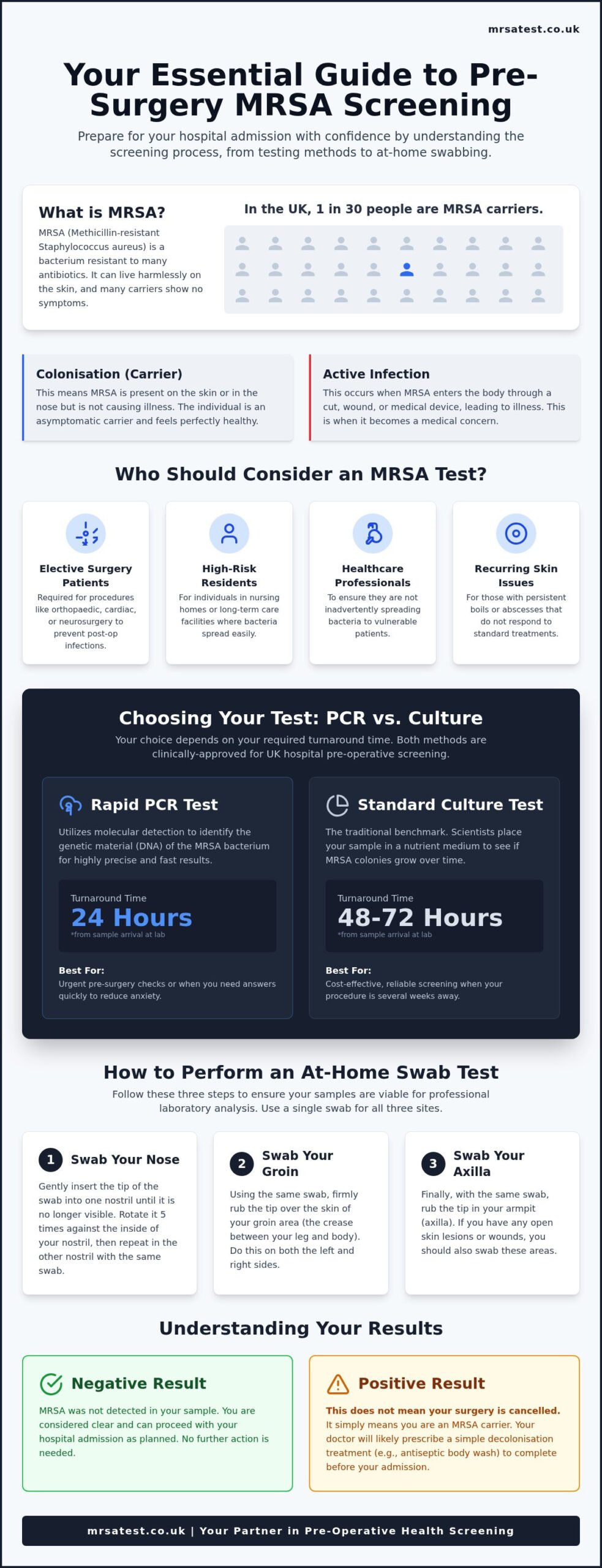
MRSA stands for Methicillin-resistant Staphylococcus aureus (MRSA), which is a specific type of bacterium that has developed resistance to several widely used antibiotics. While many people associate this “superbug” with hospital outbreaks, it often lives harmlessly on the skin or in the nose without causing any illness. An mrsa test is a professional diagnostic tool used to detect the presence of these bacteria on skin surfaces. By identifying individuals who carry the bacteria, healthcare providers can take steps to manage the risk before it escalates. MRSA screening serves as a vital preventative measure to stop hospital-acquired infections and ensure patient safety during recovery.
Colonisation vs. Active Infection
Understanding the difference between being “colonised” and having an active infection is essential for peace of mind. Most people carrying the bacteria are asymptomatic carriers, meaning they feel perfectly healthy and show no signs of illness. In the United Kingdom, approximately 1 in 30 people are carriers at any given time. Testing provides clarity. Colonisation only becomes a medical concern when the bacteria find a way to enter the body’s deeper tissues. This typically happens through surgical incisions, wounds, or the use of invasive medical devices like catheters. Once in the bloodstream, MRSA can cause serious complications such as pneumonia or sepsis. Because carriers show no symptoms, a professional mrsa test is the only reliable way to identify its presence and begin decolonisation treatment.
Who Should Consider an MRSA Test?
Screening is often a mandatory requirement for specific groups to maintain a sterile environment and protect vulnerable individuals. You should consider testing if you fall into any of the following categories:
- Elective Surgery Patients: Hospitals frequently require a negative result for orthopaedic, cardiac, or neurosurgical procedures where the risk of infection is higher.
- High-Risk Residents: Individuals living in or frequently visiting nursing homes and long-term care facilities where bacteria can spread more easily.
- Healthcare Professionals: Staff working in clinical settings who want to ensure they aren’t inadvertently spreading the bacteria to patients.
- Recurring Skin Issues: Those suffering from persistent boils, abscesses, or skin infections that don’t respond to standard treatments.
Proactive testing provides a clear path forward. It ensures you can enter a hospital or care setting with the necessary documentation and confidence.
PCR vs. Culture: Which MRSA Screening Method Do You Need?
Choosing the right mrsa test is a critical step in your pre-operative journey. While both laboratory methods are clinically valid for hospital screening requirements, they function in fundamentally different ways. The primary factor in your decision should be your required turnaround time. UK hospitals increasingly rely on a standardised approach to screening for MRSA to maintain safety, but patients often have the choice of which diagnostic path to take. For a more exhaustive analysis of these two technologies, please see our detailed comparison of MRSA Culture vs. PCR Test: Which One Do You Need?.
The Rapid PCR Method (24-Hour Results)
The Rapid PCR method utilizes molecular detection to identify the genetic material, or DNA, of MRSA in your sample. It’s incredibly precise and fast. Because the lab doesn’t need to wait for bacteria to grow in a petri dish, results are typically available within 24 hours of the sample’s arrival at our accredited UK facility. This method is the essential choice for urgent pre-surgery checks or if you simply prefer to resolve any health anxieties quickly. It provides a modern, efficient solution for a fast-paced medical environment where every day counts toward your recovery timeline.
The Standard Culture Test (48-72 Hour Results)
The standard culture test remains the traditional benchmark for MRSA detection. In this process, laboratory scientists place your sample in a nutrient-rich medium to see if MRSA colonies develop over time. While this takes longer, usually between 48 and 72 hours, it’s a highly reliable and cost-effective screening tool. If your procedure is several weeks away, the culture test offers the same level of clinical accuracy and diagnostic security at a lower price point. It’s widely accepted across all NHS and private hospital trusts for elective surgery clearance.
Before making a final choice, check your surgical letter for any specific deadlines. You can view our range of at-home kits to see which turnaround time best fits your upcoming hospital schedule. Both options provide the professional-grade results you need to proceed with your treatment safely and privately.
MRSA Screening Before Surgery: Navigating UK Hospital Requirements
Most UK hospitals mandate a negative MRSA result for elective procedures. It’s a standard safety protocol designed to protect you during your recovery. While the NHS provides this service, the timing can often feel tight, frequently occurring just days before your scheduled admission. This proximity creates significant anxiety for many patients who worry about potential delays. It’s helpful to remember that a positive result doesn’t usually mean your surgery is cancelled. Instead, it simply requires a short course of decolonisation treatment, typically involving antiseptic body washes and nasal creams for five days before you’re cleared for theatre.
Professional MRSA Tests identify whether the bacteria are present on your skin or in your nasal passages. Knowing your status early allows you to manage the logistics of your surgery without the stress of a last-minute surprise.
Why Hospitals Mandate MRSA Screening
Hospitals prioritise these screenings to prevent Surgical Site Infections (SSIs). These infections are particularly challenging to manage because MRSA doesn’t respond to standard antibiotics. By ensuring patients are clear before they enter the operating room, hospitals significantly reduce the risk of spreading “superbugs” across clinical wards. You can find more about integrating these requirements into your surgical preparation in our guide on Understanding MRSA Screening Before Surgery.
Private vs. NHS Screening: Meeting Your Deadlines
Private screening serves as a reliable safety net for patients on tight schedules. NHS pre-operative assessments are efficient, but their timing is fixed by hospital capacity. If you test positive through the NHS just 48 hours before your procedure, there may not be enough time to complete decolonisation, which could lead to a rescheduled surgery. Choosing an at-home mrsa test several weeks in advance allows you to identify your status early. If you’re a carrier, you’ll have ample time to complete treatment and arrive for your NHS assessment with total confidence.
It’s essential to ensure any private test uses an accredited UK laboratory. This ensures the results meet the high standards required by your surgical team. By testing privately, you also avoid an extra trip to the hospital, managing the entire process discreetly and conveniently from your own home. This proactive approach puts you back in control of your surgical timeline.
How to Perform an At-Home MRSA Swab Test Correctly
Conducting an mrsa test in the comfort of your own home is a simple, stress-free process that maintains the same clinical standards as a hospital environment. The accuracy of your final laboratory report depends heavily on the quality of the sample you provide. Our kits are equipped with high-quality sterile swabs and specialized transport media, which is a preservative liquid that keeps the bacteria stable during transit to our accredited UK facility. The entire procedure is non-invasive and painless, typically requiring less than five minutes of your time.
Before you start, it’s essential to wash your hands thoroughly with soap and water. This prevents environmental bacteria from contaminating the sample and ensures the laboratory identifies only the organisms present on the specific testing sites. Once you’re ready, find a private, well-lit space where you can lay out the kit components securely.
Swabbing the Nose, Groin, and Axilla
A comprehensive screen involves collecting samples from three primary areas where MRSA is most likely to reside. Follow these steps carefully to ensure a high-quality specimen:
- The Nose: Gently insert the tip of the sterile swab into one nostril and rotate it against the inside wall five times. Repeat this exact process in the second nostril using the same swab.
- The Groin: Use the swab to gently but firmly wipe the skin folds where the legs meet the torso. This warm area is a common site for bacterial colonisation.
- The Axilla: Swab the skin of the armpit (axilla). While some basic kits omit this step, including the axilla provides a more thorough and reliable screening result for your surgical team, as it’s a frequent site for the bacteria to thrive.
Ensuring Sample Integrity for Lab Analysis
After collecting your samples, immediately place the swab into the provided transport tube. It’s critical that the cotton tip doesn’t touch any external surfaces, such as tabletops or your clothing, before it’s sealed. This protects the integrity of the specimen. Once the tube is closed, check that the label is clearly filled out with your identifying information. This ensures our lab technicians can accurately match the sample to your record and process your results without delay.
Finally, place the tube into the prepaid shipping envelope. We strongly advise returning your kit via a priority post box on the same day you take the test. This minimizes the time between collection and analysis, ensuring the highest diagnostic accuracy. If you’re ready to begin your pre-operative preparation, you can order your professional MRSA swab kit here for fast, discreet delivery within the UK.
Confidential MRSA Testing with mrsatest.co.uk
mrsatest.co.uk stands as the UK’s leading dedicated provider for private, at-home MRSA screening. We recognize that preparing for surgery is stressful enough without the added logistical burden of extra clinical appointments. Our service bridges the gap between clinical excellence and personal convenience. Every sample is processed in fully accredited UK laboratories, ensuring the data you receive is of the same high standard used by the NHS. Whether you require a standard screen or an urgent check, we provide the tools to manage your health logistics with professional precision.
Discretion is fundamental to our process. We dispatch all kits in plain, unmarked packaging to maintain your total privacy throughout the delivery and return stages. Results are handled with the same level of care, delivered through a secure online portal or directly to your email. This ensures you remain in control of your sensitive health information at every stage. If you’re facing an imminent surgery date, our MRSA Rapid PCR Test provides the speed you need. With results available within 24 hours of the lab receiving your sample, you can resolve any uncertainties quickly and focus on your recovery.
The mrsatest.co.uk Advantage
The primary benefit of our service is the ability to conduct a professional mrsa test without leaving your home. You avoid the inconvenience of hospital travel, parking, and waiting rooms. By receiving your results digitally, you have a portable, professional document ready to share with your surgical team or pre-operative assessment nurse. This proactive approach saves time and reduces the risk of last-minute cancellations. To begin the process, you can Order Your Confidential MRSA Test Kit Online and take the first step toward a confident admission.
Next Steps After Your Result
Understanding how to act on your results is just as important as the test itself. Your path forward depends on the laboratory findings:
- Negative Result: If your test returns a negative result, you can proceed with your surgical preparations as planned. Simply keep a digital or printed copy of your laboratory report to present during your hospital admission process.
- Positive Result: A positive result indicates colonisation, which is common and manageable. If this occurs, don’t be alarmed. You should contact your GP or surgeon immediately to begin the standard decolonisation protocol. Private medical providers such as GP Plus can offer expert advice and support for patients managing their pre-operative health. This typically involves a five-day course of antiseptic body wash and nasal cream.
Having these results ready before your official pre-op assessment provides a significant advantage. It allows you to address any colonisation issues in advance, ensuring your surgery isn’t delayed at the last minute. By choosing a private screen, you’re investing in the peace of mind that comes with being fully prepared for your procedure.
Take Control of Your Surgical Preparation
Navigating the requirements for hospital admission doesn’t have to be a source of stress. By choosing a professional mrsa test, you ensure that you have the clinical-grade accuracy needed for a safe procedure without the inconvenience of extra hospital visits. Understanding the difference between Rapid PCR and culture methods allows you to select the best timeline for your specific surgical date. This proactive approach ensures you identify any colonisation early, providing ample time for decolonisation treatment if required.
Our service focuses on providing accredited UK laboratory results delivered through a secure and confidential process. With discreet plain packaging and 24-hour Rapid PCR options available, you can manage your health logistics privately and efficiently from your own home. Don’t leave your admission to chance or wait for last-minute clinical assessments. Order your professional MRSA test kit from mrsatest.co.uk today to secure your results and proceed with your treatment with total confidence. You’ve already taken the first step toward recovery; now ensure your admission is just as well-managed and stress-free.
Frequently Asked Questions
How long does an MRSA test take to get results?
Turnaround times for an mrsa test depend on the laboratory method you select. A Rapid PCR test provides results within 24 hours of the laboratory receiving your sample. Alternatively, the standard Culture test takes between 48 and 72 hours as it requires time for the bacteria to grow. Both options are processed in accredited UK facilities to ensure clinical accuracy and reliable reporting for your surgical team.
Can I do an MRSA test at home for surgery?
Yes, you can complete a professional screening at home using a self-collection kit. These kits are designed for pre-operative screening and allow you to collect samples from the comfort and privacy of your own environment. Once you return your swabs in the prepaid envelope, our accredited laboratory analyzes the specimens. This process bypasses the need for additional hospital appointments while meeting the necessary clinical standards for elective surgery.
Where do you swab for an MRSA test?
A comprehensive screen requires swabbing three specific body sites where the bacteria are most likely to live. You will need to rotate a sterile swab inside both nostrils, along the skin folds of the groin, and within the axilla (armpit). Our kits include clear instructions to ensure you collect a high-quality sample from each area. Including the axilla provides a more thorough assessment than basic kits that only focus on the nose.
What happens if my MRSA test is positive before surgery?
A positive result indicates that you are a carrier of the bacteria, not that you have an active illness. If this occurs, you should contact your GP or surgeon to begin a five-day decolonization protocol. This typically involves using a specialized antiseptic body wash and nasal cream. In most cases, completing this treatment allows your surgery to proceed as planned without any long-term delays to your recovery schedule.
Is the MRSA home test kit as accurate as the NHS one?
At-home kits are just as accurate as those provided by the NHS because both use the same UKAS-accredited laboratory standards for analysis. The primary difference is the location of the swab collection, not the quality of the science. Our kits use professional-grade sterile swabs and transport media to ensure the sample remains viable during transit. This guarantees that your private results are clinically valid and reliable for hospital admission purposes.
Do I need to fast or prepare in any way for the MRSA swab?
There is no need to fast or undergo complex medical preparation before using your kit. You should simply ensure that your hands are washed thoroughly with soap and water before starting the process to avoid contamination. It is also advisable to ensure the swabbing areas are free from heavy creams, ointments, or powders. This ensures the swab makes direct contact with the skin for the most accurate diagnostic result.
Will my hospital accept a private MRSA test result?
Most UK hospitals and private clinics accept results from private providers, especially when they are processed by accredited domestic laboratories. However, it is always a sensible precaution to confirm this with your specific surgical team or pre-operative assessment nurse. Providing them with a formal laboratory report from an accredited facility usually satisfies their screening requirements. This proactive step helps you avoid any last-minute administrative issues on the day of your procedure.
What is the difference between MRSA colonisation and infection?
Colonisation means the bacteria are living harmlessly on your skin or in your nose without causing symptoms. Approximately 1 in 30 people in the UK are carriers at any time. An infection occurs only if the bacteria enter the body through a wound or surgical incision, leading to illness. The purpose of a pre-operative mrsa test is to identify colonisation so it can be treated before it has the chance to become an infection.