What if you are carrying a potentially harmful bacterium without ever feeling a single symptom? For many people in the UK, the thought of MRSA evokes images of hospital wards and serious illness, but the reality is often much more discreet. You might be asking yourself, how do you know if you are an mrsa carrier when you feel perfectly healthy? It’s a common source of anxiety, especially if you’re worried about protecting vulnerable family members or fear a scheduled surgery might be cancelled at the last minute.
We understand that the confusion between being ‘colonised’ and having an active ‘infection’ can be stressful. This guide provides the clinical clarity you need to manage your health proactively. You’ll learn about the specific reservoirs on the body where these bacteria reside and the hidden signs of carriage that often go unnoticed. We also explain how to access rapid, UKAS-accredited screening that delivers definitive answers privately. By following this guide, you can move from uncertainty to quiet competence with a simple, professional testing process that fits your schedule and provides total peace of mind.
Key Takeaways
- Understand the vital difference between MRSA colonisation and active infection, and why an estimated 1 in 30 people in the UK carry the bacteria without any symptoms.
- Identify the specific body sites where MRSA thrives, including the anterior nares (nostrils), the groin, and the axilla (underarms).
- Learn why laboratory swabbing is the only definitive method to answer the question, how do you know if you are an mrsa carrier, as the bacteria are invisible to the naked eye.
- Discover how to bypass long waiting lists with private, UK-based at-home PCR or culture testing kits that provide rapid, UKAS-accredited results.
- Recognise common risk factors, such as upcoming surgery or frequent hospital visits, that make proactive screening a sensible choice for your peace of mind.
MRSA Colonisation vs. Infection: Understanding the Carrier State
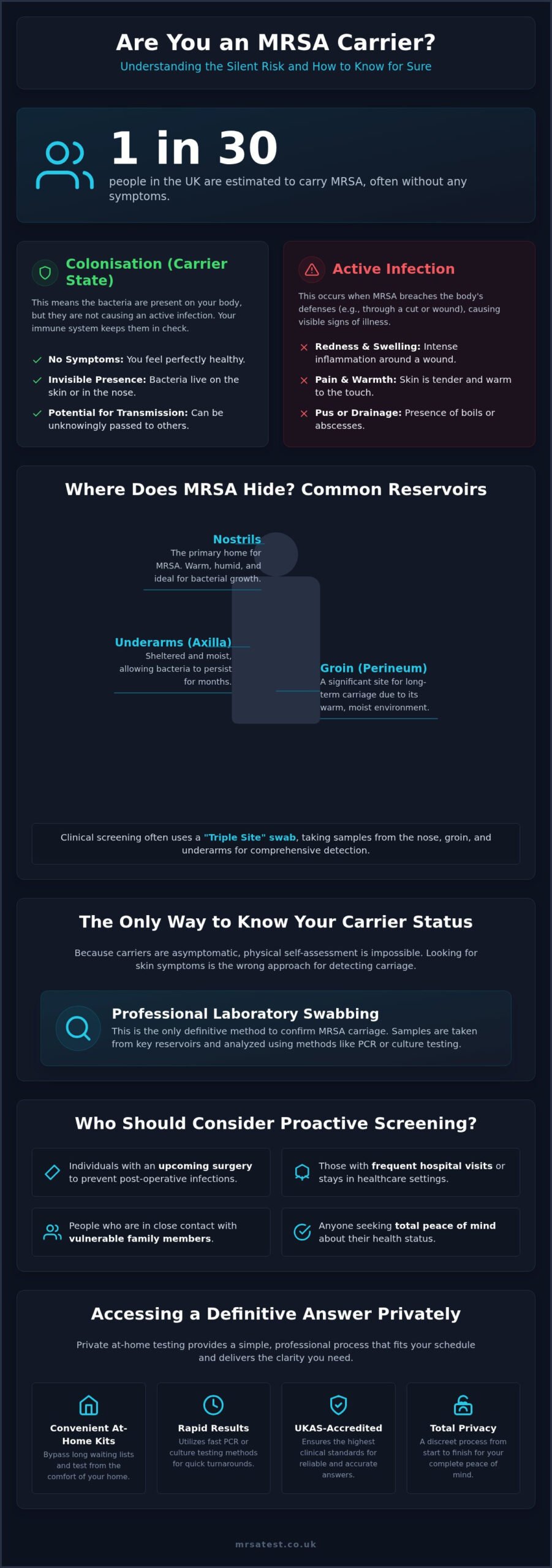
MRSA (Methicillin-resistant Staphylococcus aureus) is a type of bacteria that has developed resistance to several widely used antibiotics. While many people associate it with hospital-acquired infections, it’s actually quite common to host these bacteria without being ill. This state is known as colonisation. In the UK, it’s estimated that approximately 1 in 30 people are MRSA carriers at any given time. This means the bacteria are present on their body, but they aren’t causing an active infection.
There’s a vital distinction between being a carrier and having an infection. An active MRSA infection typically presents with visible symptoms such as:
- Intense redness and swelling around a wound or skin break
- Pain or tenderness at the site of the lesion
- Skin that feels unusually warm to the touch
- The presence of pus or other drainage from a boil or abscess
However, if you are simply colonised, you won’t experience any of these signs. You’ll feel perfectly healthy and your skin will look normal. This leads to the central question: how do you know if you are an mrsa carrier when you feel fine? Because the bacteria are invisible to the naked eye, you cannot rely on a physical self-assessment.
What does it mean to be a ‘carrier’?
Being a carrier essentially means the bacteria are ‘hitchhiking’ on your skin surface or inside your nostrils. Your immune system is effectively keeping the bacteria in check, preventing them from penetrating deeper into your tissues where they could cause harm. While you remain healthy, you can still unknowingly transmit the bacteria to others through skin-to-skin contact or by touching shared surfaces. This is why screening is so important before entering clinical environments or visiting vulnerable relatives.
Why ‘looking for symptoms’ is the wrong approach
Many people mistakenly wait for a ‘spider bite’ appearance or a painful boil before they suspect MRSA. This is the wrong approach for detecting carriage. Carriers do not have these inflammatory responses because the bacteria haven’t breached the skin barrier or entered the bloodstream. The bacteria only pose a significant risk if they enter a surgical wound or reach the internal systems of the body. Asymptomatic carriage is the clinical state of hosting MRSA on the body without any visible or physical signs of illness. Because of this, professional laboratory testing is the only reliable way to confirm your status and definitively answer how do you know if you are an mrsa carrier.
The Hidden Reservoirs: Where Does MRSA Hide on the Body?
MRSA is a biological hitchhiker that doesn’t survive well on dry, cool skin. Instead, it seeks out “reservoirs”, specific areas of the body that provide the warmth and moisture necessary for the bacteria to thrive. These sites allow the bacteria to live on your skin surface without causing any harm to you, the host. Identifying these specific locations is the first step in understanding the screening process.
Because these bacteria are microscopic and produce no scent or sensation, you cannot feel their presence. This often leads people to wonder, how do you know if you are an mrsa carrier without a professional test? The answer lies in targeted swabbing of the areas where the bacteria are most likely to cluster. If a screen only checks one area, it might miss a colony living elsewhere. This is why clinical protocols focus on several key regions simultaneously.
The Nose: MRSA’s primary home
The anterior nares, which is the medical term for the front of the nostrils, are the most common site for MRSA colonisation. This environment is perfectly suited for Staph bacteria. It’s warm, humid, and rich in oxygen. Because we naturally touch our noses throughout the day, the bacteria can easily transfer to our hands. From there, they spread to shared surfaces or other parts of the body. When performing a screen, it’s essential to swab both nostrils thoroughly. This ensures the laboratory receives an accurate sample of the nasal microbiome and provides a definitive answer to the question of how do you know if you are an mrsa carrier.
Groin, Axilla, and Skin Folds
While the nose is the primary reservoir, MRSA frequently colonises other damp regions. The groin, specifically the perineum, is a significant site for long-term carriage. The armpits (axilla) and various skin folds also provide the sheltered, moist conditions that allow these bacteria to persist for months or even years. In the UK, hospital pre-operative protocols often require a “triple site” swab. This involves taking samples from the nose, groin, and axilla to maximise the chances of detection.
Testing multiple reservoirs ensures that your results are definitive rather than a partial snapshot. If you want to be certain of your status before a hospital admission, using a comprehensive MRSA screening kit that covers these three vital sites is the most professional approach. Accuracy relies on hitting all these potential hiding spots to ensure nothing is missed.
Diagnostic Methods: How is MRSA Carriage Formally Detected?
Because you can’t see, feel, or smell the bacteria, a formal laboratory test is the only definitive answer to the question: how do you know if you are an mrsa carrier? Relying on physical appearance is impossible since colonisation doesn’t cause skin changes or illness. The diagnostic process is non-invasive and straightforward, involving the use of a sterile swab. This swab, which resembles a long cotton bud, is rotated gently over the skin or inside the nostrils to collect microscopic samples from the body’s reservoirs. These samples are then securely transported to a laboratory for professional analysis.
Clinical settings and hospitals prioritise these screens to safeguard patient health and prevent hospital-acquired infections. By identifying carriers before they enter a surgical environment, medical teams can implement decolonisation protocols. This proactive approach significantly reduces the risk of the bacteria entering a wound or the bloodstream during a procedure. There are two primary laboratory methods used in the UK to confirm carrier status, each offering specific diagnostic advantages.
The MRSA Culture Test
The culture test is the traditional gold standard for detection. In the laboratory, the collected sample is placed in a petri dish containing a growth medium and exposed to methicillin. If bacteria grow despite the presence of the antibiotic, an MRSA colonisation is confirmed. This method typically takes between 48 and 72 hours because the bacteria need time to multiply to detectable levels. A culture test confirms the presence of live, replicating bacteria, providing a high degree of clinical certainty for standard pre-operative screenings.
Rapid PCR Testing
PCR (Polymerase Chain Reaction) testing is a modern molecular technique that has changed how do you know if you are an mrsa carrier. Instead of waiting for bacteria to grow, this method uses advanced technology to detect the specific DNA signatures of the MRSA bacteria. It’s incredibly sensitive and efficient, often delivering results in under 24 hours from the time the lab receives the sample. This speed makes PCR testing the ideal choice for patients who need urgent clearance for a last-minute surgical procedure or those who want the fastest possible peace of mind. Both methods are performed in UKAS-accredited laboratories to ensure the highest standards of accuracy and reliability.
Risk Factors: Who is Most Likely to Be an MRSA Carrier?
MRSA transmission isn’t random. It follows specific patterns based on environment, activity, and medical history. While the bacteria can colonise anyone, certain factors significantly increase the probability that you are hosting them. If you fall into a high-risk category, the question of how do you know if you are an mrsa carrier moves from a general curiosity to a clinical necessity. Understanding these risks allows you to take proactive steps to protect yourself and those around you.
Healthcare and Hospital Exposure
Clinical settings are the most well-known environments for MRSA because of the high concentration of vulnerable individuals and the frequent use of medical devices. If you are a regular hospital visitor, a healthcare professional, or have recently undergone a procedure, your risk of carriage is statistically higher. It’s particularly important to be aware of your status when preparing for surgery. Knowing you are a carrier early on allows for decolonisation before your admission date, preventing surgical delays. Additionally, individuals who have used antibiotics frequently or for long periods may have a disrupted skin microbiome, which can sometimes make it easier for resistant bacteria to settle.
Community-Acquired Risk (CA-MRSA)
We’re seeing an increase in Community-Acquired MRSA, where the bacteria spread among healthy people outside of medical facilities. This often happens in environments where people live or work in close proximity. High-risk locations include:
- University dormitories and student housing
- Military barracks
- Care homes and assisted living facilities
- Busy gyms and sports clubs
Athletes who participate in contact sports, such as rugby or wrestling, are frequently exposed through skin-to-skin contact. Sharing personal items like towels, razors, or athletic equipment can also act as a transmission vector. If you live with someone who has a history of MRSA infections, you may be an asymptomatic carrier yourself. So, how do you know if you are an mrsa carrier in these community settings? Since you won’t have symptoms, a laboratory swab is the only way to confirm your status.
If you recognise these risk factors in your lifestyle, taking control of your health is simple. You can buy a private MRSA screening kit to get fast, UKAS-accredited results delivered discreetly to your home.
How to Get a Private MRSA Test in the UK
Waiting for a routine NHS screening can be a stressful experience, particularly if you have an upcoming surgery date and need clearance. In many cases, hospital protocols only screen patients shortly before admission, leaving very little time to act if the result is positive. This uncertainty often leads people to ask, how do you know if you are an mrsa carrier without the long wait? Private at-home screening offers a fast and reliable alternative, allowing you to take control of your health logistics on your own terms.
The process is designed to be as simple and manageable as possible. Once you order a kit, it arrives in discreet packaging to protect your privacy. You perform the swabs yourself in the comfort of your home, following the provided instructions to ensure you cover the key reservoirs like the nostrils and groin. After swabbing, you simply post the samples back to the laboratory in the pre-paid envelope. Results from a Rapid PCR test are typically available within 24 hours of the lab receiving your sample, delivered securely through a private portal or email.
The Benefits of At-Home Screening
Choosing an at-home kit eliminates the need for a GP appointment or a trip to a busy hospital clinic. It’s a professional solution that fits around your schedule, providing peace of mind without the clinical environment. For more information on selecting the right test for your needs, you can read our at-home test kits UK guide. This streamlined approach ensures that you get the answers you need efficiently and confidentially.
What to do if your result is positive
If your laboratory report indicates that you are colonised, there’s no reason to panic. Being a carrier is not an illness, and the bacteria are easily managed through a process called decolonisation. This typically involves a five-day course of specialized antimicrobial body washes and nasal creams to clear the bacteria from your skin and nostrils. Once you have your definitive answer to how do you know if you are an mrsa carrier, you can share the results with your surgical team. This allows them to update your care plan and ensure your procedure goes ahead safely and on schedule. Confirmed decolonisation before surgery significantly reduces the risk of complications, giving you and your family total confidence in your recovery.
Take Proactive Steps for Your Peace of Mind
Understanding the difference between harmless colonisation and active infection is vital for anyone entering a clinical setting or living in close-knit communities. Since the bacteria reside in hidden reservoirs like the nose and groin without causing symptoms, physical checks are never enough. So, how do you know if you are an mrsa carrier without a long wait for a GP appointment?
Accessing professional diagnostics is the only way to gain definitive clarity. You can Order a Confidential MRSA Home Test Kit Today to secure your health status privately. We provide UKAS-accredited laboratory analysis and deliver results in as little as 24 hours after your sample reaches the lab. All kits are dispatched with discreet, plain-packaging delivery to ensure your screening remains a private matter.
Confirming your status today allows you to move forward with your medical plans or personal health goals with quiet competence and total confidence. You don’t have to navigate medical uncertainty alone when expert support is just a click away.
Frequently Asked Questions
Can you be an MRSA carrier and not know it?
Yes, you can host MRSA without ever knowing it. This is because carriers are “colonised,” meaning the bacteria live on the skin surface or inside the nose without causing illness. Since there are no symptoms like redness or pain, many people remain unaware of their status until they undergo formal screening. It’s only when the bacteria enter a wound that they cause an infection.
How long does MRSA stay on your skin if you are a carrier?
MRSA can stay on your skin for weeks, months, or even years. Some people are “transient” carriers who clear the bacteria naturally, while others are “persistent” carriers. Without a decolonisation protocol, the bacteria often remain in moist reservoirs like the nostrils or groin. Regular hand hygiene and avoiding shared personal items can help reduce the duration of carriage, but laboratory testing is the only way to confirm clearance.
Is being an MRSA carrier contagious to my family?
Yes, MRSA carriage is contagious and can spread to family members through skin-to-skin contact or shared household items. Towels, razors, and bed linen are common vectors for transmission. While healthy family members usually won’t get sick, they can become carriers themselves. This poses a risk to anyone in the household who is elderly, has a weakened immune system, or is recovering from surgery.
Do I need to see a doctor to find out if I am an MRSA carrier?
You don’t need to see a GP or visit a hospital to find out your status. While the NHS provides screening for surgical patients, private at-home kits offer a discreet and faster alternative. These kits allow you to collect your own samples and send them to a UKAS-accredited laboratory. This is often the most efficient answer to how do you know if you are an mrsa carrier without waiting for a clinical appointment.
What happens if I test positive for MRSA before my surgery?
If you test positive before surgery, your medical team will start a decolonisation protocol. This usually involves using a special antimicrobial body wash and a nasal cream for five days. Clearing the bacteria before your procedure significantly reduces the risk of post-operative infections. Most surgeries can still go ahead as planned once the decolonisation is complete, providing safety for both you and the hospital environment.
Can MRSA carriage go away on its own without treatment?
It’s possible for MRSA carriage to go away on its own, but it isn’t guaranteed. Some individuals naturally clear the bacteria through their immune response or changes in their skin microbiome. However, many people remain persistent carriers for long periods. Relying on natural clearance is risky, especially if you’re approaching a surgical date. Targeted treatment with antiseptic washes is the most reliable way to ensure the bacteria are fully removed.
How often should I be tested if I work in a hospital?
Hospital staff should follow their specific occupational health guidelines regarding screening frequency. While routine testing isn’t always mandatory for all staff, it’s often required if there’s an outbreak on a ward or if you’ve been in close contact with an infected patient. Regular screening helps maintain a safe environment. If you’re concerned about your carrier status, private testing provides a confidential way to check between official workplace screens.
Are the at-home MRSA swab tests as accurate as hospital tests?
Yes, at-home swab tests are just as accurate as those performed in a hospital, provided they are analysed by a UKAS-accredited laboratory. The swabbing process is identical to the one used in clinical settings. Whether you choose a Culture or a Rapid PCR method, the laboratory technology used to detect the bacteria remains the same gold standard. This ensures you receive professional, reliable results from the comfort of your own home.