

Blog
What Happens If You Don’t Get an MRSA Test Before Surgery?

Aug
Could skipping a simple nasal swab actually cause your long-awaited operation to be cancelled at the hospital doors? Preparing for surgery is already a stressful experience, and it’s completely natural to feel overwhelmed by the list of pre-operative requirements. You might feel anxious about “superbugs” or worry that a positive result will postpone your recovery. However, understanding what happens if you don’t get mrsa test before surgery is the first step in ensuring your procedure goes ahead safely and on time.
In the UK, MRSA screening is a vital safety checkpoint rather than a bureaucratic hurdle. This article will help you understand the critical risks of skipping your pre-op screening and explain how a positive result impacts your surgical timeline. We’ll explore the standard five-day decolonisation protocols used in 2026 and show you how proactive testing protects you from serious post-surgical complications. By the end, you’ll know exactly how to manage your screening requirements to ensure your surgery proceeds with the highest level of safety and clinical confidence.
Key Takeaways
- Learn why MRSA screening is a vital safety checkpoint that prevents common skin bacteria from causing serious post-operative infections.
- Discover what happens if you don’t get mrsa test before surgery, including the high likelihood of your elective procedure being postponed to ensure patient safety.
- Understand the 2026 standard 5-day decolonisation protocol used to clear the bacteria and prepare your body for a successful operation.
- Find out about the mandatory re-testing process and why a negative clearance swab is required 48 hours after completing your treatment.
- Explore how rapid PCR testing options can provide accredited results in just 24 hours to help you meet tight surgical deadlines with ease.
The Role of MRSA Screening in Surgical Safety
Understanding the necessity of pre-operative checks is essential for a smooth hospital experience. Many patients wonder what happens if you don’t get mrsa test before surgery, often fearing that the requirement is just another piece of hospital paperwork. In reality, screening for Methicillin-resistant Staphylococcus aureus (MRSA) is a vital safety measure. This bacterium is a variation of common staph that has developed resistance to several widely used antibiotics. While the name sounds intimidating, it’s a very common organism. Research suggests that approximately 1 in 30 people in the UK carry MRSA on their skin or in their nose without ever knowing it.
It’s important to understand that carrying these bacteria isn’t a reflection of your personal hygiene. MRSA is found everywhere in our environment. You can pick it up through skin-to-skin contact or by touching shared surfaces in public spaces. Because it usually lives harmlessly on healthy skin, most people are entirely unaware of its presence until they’re screened for a medical procedure. Finding out you carry the bacteria is simply a clinical data point, not a cause for alarm or embarrassment.
Colonisation vs. Infection: Why You Feel Fine
The reason you likely feel perfectly healthy is due to the difference between colonisation and infection. Colonisation is the presence of bacteria on the body without causing any active illness or symptoms. In this state, the bacteria remain dormant on the skin’s surface or tucked away in the nostrils, held at bay by your natural immune system and the physical barrier of your skin.
The danger only arises during a surgical procedure. Surgery “breaks the seal” of the skin, providing a direct pathway for these bacteria to enter deeper tissues, the bloodstream, or the surgical site itself. Once inside, MRSA can cause serious infections that are difficult to treat because standard antibiotics don’t work against them. This is why hospitals are so diligent about screening. They want to identify and clear the bacteria while it’s still harmlessly on the outside of your body.
What Happens During the Screening Swab?
The screening process is designed to be as simple and stress-free as possible. A clinician or an at-home kit uses soft cotton swabs to collect samples from areas where the bacteria are most likely to live. The primary sites include:
- The nostrils: A gentle wipe inside the tip of each nostril.
- The groin: A quick swab of the skin fold where the leg meets the torso.
- The armpits (axilla) or throat: These are sometimes required depending on the specific hospital protocol or the type of surgery planned.
The entire process is completely painless and takes only a few seconds to complete. If you’re curious about how these bacteria behave or the specific complications they can cause if left unmanaged, you can read our guide on MRSA symptoms and risks for more detailed information. Knowing your status before you enter the operating theatre is the best way to ensure your recovery is as smooth as possible.
The Clinical Risks: Why Proceeding Without a Test is Dangerous
Proceeding with a procedure without knowing your colonisation status creates a significant clinical hazard. While the bacteria often live harmlessly on the surface of your skin, a surgical incision acts as a breach in your body’s primary defence. If you’ve been wondering what happens if you don’t get mrsa test before surgery, the primary concern is that these resistant bacteria can migrate from the skin into the sterile environment of the surgical wound. Unlike standard staph infections, MRSA is resistant to the common antibiotics usually administered during surgery, making any resulting infection much harder for doctors to control.
The Threat of Surgical Site Infections (SSIs)
Surgeons view Surgical Site Infections (SSIs) as one of the most serious post-operative hurdles. An SSI occurs when bacteria multiply at the site of the incision, leading to redness, pain, and discharge. However, with MRSA, the stakes are significantly higher. These infections can quickly escalate into deep-tissue complications or even sepsis, which is a life-threatening systemic reaction to infection. Clinical studies often focus on how to prevent MRSA surgical site infections through rigorous screening and decolonisation. Without a pre-op test, medical teams cannot tailor your antibiotic prophylaxis to account for resistant strains. For a deeper look at how these risks are managed in a clinical setting, you can explore our guide on hospital-acquired infections.
Complications and Recovery Delays
The physical and financial toll of an undiagnosed MRSA carriage can be immense. If an infection takes hold, especially in surgeries involving implants like hip or knee replacements, the bacteria can form a “biofilm” on the prosthetic material. This often requires “washout” surgeries to physically remove the bacteria. In severe cases, it may even require the complete removal of the new joint. This leads to significantly longer hospital stays and a much more taxing recovery period for the patient.
Beyond your own health, there’s a wider responsibility to the hospital environment. An undiagnosed carrier can inadvertently spread the bacteria to other vulnerable patients in the ward, potentially leading to outbreaks that are difficult for the NHS to manage. To avoid these complications and ensure you’re fully prepared for your procedure, you might consider an accredited at-home MRSA test to confirm your status privately before your hospital admission date. By identifying the bacteria early, you can complete the necessary treatment and protect both yourself and the wider community.
Will Your Surgery Be Cancelled If You Don’t Get Tested?
The most common fear for patients is that their operation will be permanently cancelled if they arrive at the hospital without a valid result. It’s important to clarify that in nearly all cases, your surgery is postponed rather than cancelled entirely. If you are concerned about what happens if you don’t get mrsa test before surgery, the most likely outcome is a short delay to allow for essential safety measures. For elective procedures, such as hip or knee replacements, hospitals almost always delay the operation. This is because these surgeries involve prosthetic materials that are highly susceptible to infection, making a “clear” status a non-negotiable requirement for the surgical team.
In high-risk departments, the rules are even stricter. For surgeries involving the heart, brain, or complex orthopaedics, proceeding without a confirmed negative status is considered a significant clinical risk. Surgeons in these specialties rely on pre-op screening to decide which antibiotics to use during the procedure. Understanding what happens if you don’t get mrsa test before surgery helps you prepare for the strict protocols used in these high-risk environments, where patient safety is the absolute priority. If a test is missing, the hospital must pause to ensure you are not carrying bacteria that could lead to life-altering complications.
The 5-Day Postponement Window
When an elective surgery is delayed due to a missing or positive MRSA test, the hospital typically implements a five-day postponement window. This duration matches the 2026 NHS standard for a full decolonisation course. During this time, the surgical list is managed to accommodate the delay, and you’ll be given a new date once treatment is complete. If you realise you’ve missed your screening window, contact your Pre-Op Assessment Clinic immediately. They may be able to fast-track a test to keep your original date, though this depends on the hospital’s specific laboratory capacity.
When Surgery Must Proceed Regardless
There are instances where waiting five days isn’t clinically viable. In emergency or urgent trauma cases, the surgical team cannot wait for a screening result or a decolonisation period. In these scenarios, the hospital follows an “MRSA-positive” protocol as a precaution. This involves using specific intravenous antibiotics, such as Vancomycin, which are effective against resistant strains. The theatre team will also use enhanced barrier nursing techniques to protect other patients. For a broader look at how to manage your medical logistics, see our pre-surgery health checklist to ensure every other aspect of your preparation is on track.
The Decolonisation Process: Clearing MRSA Before Surgery
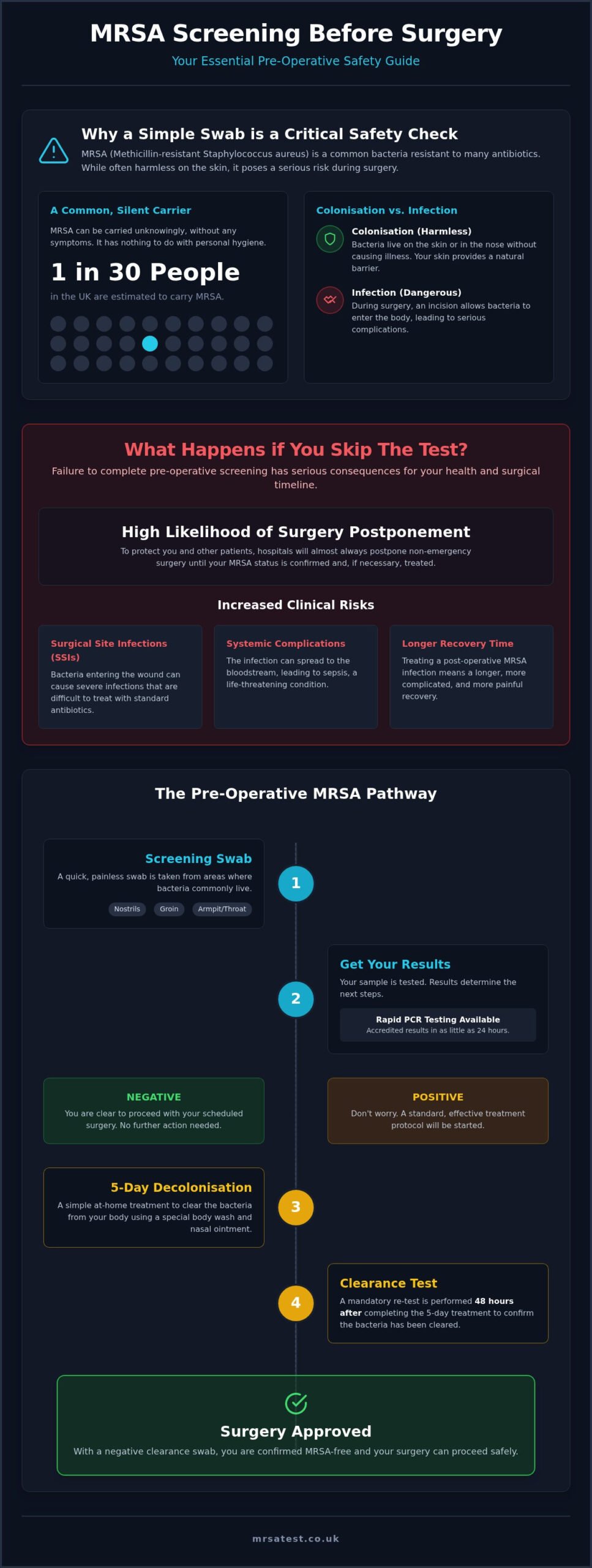
If your pre-operative screen returns a positive result, your medical team will initiate a decolonisation protocol. This is a proactive, five-day treatment plan designed to reduce the number of bacteria on your skin and in your nose to a safe level. While patients often worry about what happens if you don’t get mrsa test before surgery, the reality of a positive result is simply a structured hygiene routine rather than a medical emergency. It’s essential to complete the full five-day course exactly as prescribed. Stopping early, even if you feel perfectly fine, allows the bacteria to multiply again, which could lead to further surgical delays or increased infection risks during your recovery.
Applying Treatment: Nasal Ointment and Body Wash
The treatment consists of two primary components that must be used in tandem. First, you’ll be prescribed a nasal ointment, typically Mupirocin. You should apply a small amount to the inside of each nostril three times a day using a cotton bud or your small finger. After application, press your nostrils together to ensure the cream is distributed evenly. This targets the area where MRSA most commonly lives and replicates.
Second, you’ll use an antiseptic body wash, such as Chlorhexidine or Octenisan. This acts as a soap substitute for the entire five days. You must apply it to wet skin in the shower, paying close attention to your hair, armpits, and groin area. Leave the wash on your skin for at least one minute before rinsing. Avoid using your standard soaps, shampoos, or moisturising lotions during this period. These products can deactivate the antiseptic properties of the clinical wash, making the treatment less effective and potentially leaving bacteria behind.
The Home Hygiene Protocol
To successfully clear the bacteria, you must manage your home environment as strictly as your personal hygiene. MRSA can survive on surfaces and fabrics, meaning you could accidentally “re-infect” yourself during the treatment period. You should change your bedsheets, pillowcases, and towels every single day of the five-day course. All used linens must be washed at a minimum temperature of 60°C to ensure the bacteria are destroyed.
Don’t forget about high-touch items that frequently come into contact with your hands or face. Regularly clean your mobile phone, television remote controls, and doorknobs with antiseptic wipes. By maintaining this rigorous environment, you ensure that the decolonisation process is permanent. To ensure you have enough time to complete this protocol before your hospital admission, you can order an accredited pre-surgery MRSA test kit to confirm your status from the comfort of your home. Taking this step early gives you the peace of mind that your surgery can proceed without last-minute hygiene hurdles.
Ensuring You Are MRSA-Free: Re-testing and Clearance
Completing the decolonisation treatment is a significant milestone, but the process isn’t finished until you have clinical proof of clearance. A “clearance swab” is mandatory and is usually taken at least 48 hours after your five-day treatment programme ends. This specific gap is necessary to ensure the antiseptic washes and ointments have been fully removed from your skin, allowing for an accurate reading. If you’re still concerned about what happens if you don’t get mrsa test before surgery, remember that this final check is what gives your surgical team the definitive green light to proceed.
The Speed Advantage of Rapid PCR Re-testing
Timing is often the biggest challenge when you’re trying to meet a fixed surgical date. Standard culture tests, which involve growing the bacteria in a laboratory environment, typically take about three days to provide a result. This delay can be stressful if your operation is only a few days away. In contrast, Rapid PCR testing identifies the genetic material of the bacteria, offering accredited results in as little as 24 hours. This speed can save a surgical slot that might otherwise be lost to laboratory backlogs. At mrsatest.co.uk, we provide laboratory-verified PCR results, giving you the fast turnaround needed for peace of mind before admission.
What if the Result is Still Positive?
Occasionally, a clearance swab might still return a positive result. This is known as “persistent colonisation.” It doesn’t mean you’ve failed the protocol; some bacterial strains are simply more stubborn than others. If this occurs, your clinical team may prescribe a second course of treatment, perhaps using different antiseptic agents. In certain situations, your surgeon might still decide to proceed with the operation while using enhanced infection control measures and specific intravenous antibiotics.
To ensure you’re fully prepared on the morning of your procedure, follow this final checklist:
- Shower using your remaining antiseptic wash before leaving for the hospital.
- Wear clean, freshly laundered clothes that have been washed at 60°C.
- Avoid applying any makeup, deodorants, or body lotions after your final wash.
- Have your clearance test results ready to show the pre-assessment team.
Taking control of your screening early is the best way to avoid the anxiety of a last-minute postponement. You can order a private MRSA test kit to confirm your status discreetly from home. Understanding what happens if you don’t get mrsa test before surgery allows you to manage your health logistics effectively, ensuring your procedure goes ahead safely and without unnecessary delay.
Securing Your Surgical Timeline with Confidence
Pre-operative screening is your first line of defence against surgical complications. By identifying MRSA colonisation early, you ensure that any necessary decolonisation happens well before your admission date. This proactive approach prevents the high-risk scenario of entering theatre with resistant bacteria on your skin, which can lead to deep-tissue infections or sepsis. Understanding what happens if you don’t get mrsa test before surgery helps you navigate the hospital’s requirements without the stress of unexpected delays or cancellations.
If you’re on a tight schedule, our service provides a streamlined solution. We offer Accredited UK Laboratory Testing with a focus on speed and privacy. Our discreet and private home collection kits allow you to screen in comfort; our Rapid PCR options deliver results within 24 hours of receipt at the lab. This efficiency ensures you have the necessary documentation ready for your pre-assessment team exactly when they need it.
Don’t leave your recovery to chance. Order Your Rapid MRSA PCR Test Kit for Fast Clearance Results today and take the final step toward a safe and successful procedure. You’ve prepared for your surgery; now let us help you ensure everything goes according to plan.
Frequently Asked Questions
Can I still have my operation if I test positive for MRSA?
Yes, you can still have your procedure, but it’s usually delayed to allow for treatment. If your surgery is elective, you’ll need to complete a five-day decolonisation course before a new date is scheduled. In urgent or emergency situations, the surgery proceeds as planned using specific antibiotic cover and enhanced infection control measures to keep you safe.
How long does it take to get MRSA test results before surgery?
Standard laboratory culture tests typically take around three days to produce a definitive result. However, newer diagnostic methods like the Rapid PCR test can provide accredited results within 24 hours of the sample reaching the lab. This faster turnaround is often essential for patients who are close to their scheduled operation date.
Will my surgery be cancelled if I miss my MRSA swab appointment?
Your surgery will likely be postponed rather than permanently cancelled. This is exactly what happens if you don’t get mrsa test before surgery; the hospital cannot confirm your safety status, so they must move your slot. Contact your pre-op clinic immediately to reschedule the swab and minimise the length of the delay.
Is MRSA dangerous for my family members at home?
MRSA is generally harmless to healthy family members and is a common bacterium found on the skin of many people. The main risk at home is re-infecting yourself if you share towels or bedding during your decolonisation period. It’s best to use separate linens and wash them at 60°C until your clearance is confirmed.
What happens if I don’t finish the 5-day decolonisation wash correctly?
Failing to complete the full five-day course increases the risk that the bacteria will remain on your skin. This often leads to a positive result on your follow-up clearance swab, which will cause further delays to your surgical timeline. Consistency is vital to ensure the bacteria are reduced to a safe level for the operating theatre.
Do I need to stay in a private room in the hospital if I have MRSA?
Hospitals often place patients who carry MRSA in a private side room or a dedicated “cohort” bay. This is a standard clinical precaution designed to prevent the bacteria from spreading to other vulnerable patients on the ward. It doesn’t change the quality of your care or the success of your operation.
Can I get an MRSA test done privately to speed up my surgery?
Yes, you can use an accredited private service to acquire your results more quickly than traditional hospital routes. Using a private Rapid PCR test is a common way for patients to meet tight deadlines if they’ve missed an appointment or need a fast clearance swab after treatment. It provides the same laboratory-certified accuracy in a much shorter timeframe.
Is it common to have MRSA before going into hospital?
Carrying MRSA is more common than many people realise, with approximately 1 in 30 people in the UK carrying the bacteria without any symptoms. It’s often referred to as “colonisation” rather than an infection. Finding out you carry MRSA isn’t a sign of poor hygiene; it’s simply a clinical factor that needs management before surgery.
