
How Quickly Can I Get MRSA Results? Timelines for PCR and Culture Tests
You are only days away from a scheduled surgery when you realize you still haven’t received your clearance paperwork. The fear of a last-minute cancellation is real, and it often leads to one urgent question: how quickly can i get mrsa results to keep everything on track? It’s completely normal to feel anxious when your medical procedure depends on a lab’s schedule. Waiting for answers while a deadline looms creates unnecessary stress that no patient should have to handle alone.
We’ll show you exactly how to navigate these timelines so you can secure your results with confidence and meet your surgical requirements. Our goal is to provide the quiet competence you need to manage your health screening without the guesswork. This guide breaks down the critical differences between rapid PCR testing, which can provide answers in as little as 1 to 2 hours, and traditional cultures that typically require 24 to 48 hours. You’ll learn which method fits your specific timeline and how to ensure your status is confirmed before you ever step foot in the hospital.
Key Takeaways
- Understand the fundamental difference between standard culture growth and rapid PCR molecular detection to better plan your health screening.
- Discover exactly how quickly can i get mrsa results by comparing the 24-hour turnaround of genetic testing against the multi-day wait for traditional laboratory cultures.
- Learn how to navigate strict pre-surgical deadlines and ensure your results are ready well before your hospital admission date.
- Identify the logistical factors, like sample quality and postal timings, that can impact your wait time and how to manage them effectively.
- Explore the benefits of private at-home testing for maintaining control over your diagnostic timeline in a secure, discreet environment.
MRSA Result Timelines: Comparing PCR and Culture Methods
The wait time for medical results can feel like an eternity when your health or a surgical date is on the line. Most patients find themselves asking how quickly can i get mrsa results because they’ve been told their operation depends on it. There isn’t a single answer because the timeline is dictated by the laboratory technology used to process your sample. While one method relies on biology and slow growth, the other uses molecular science to provide answers much faster. It’s helpful to remember that Methicillin-resistant Staphylococcus aureus (MRSA) is a specific strain of bacteria that requires precise identification to ensure patient safety in clinical environments.
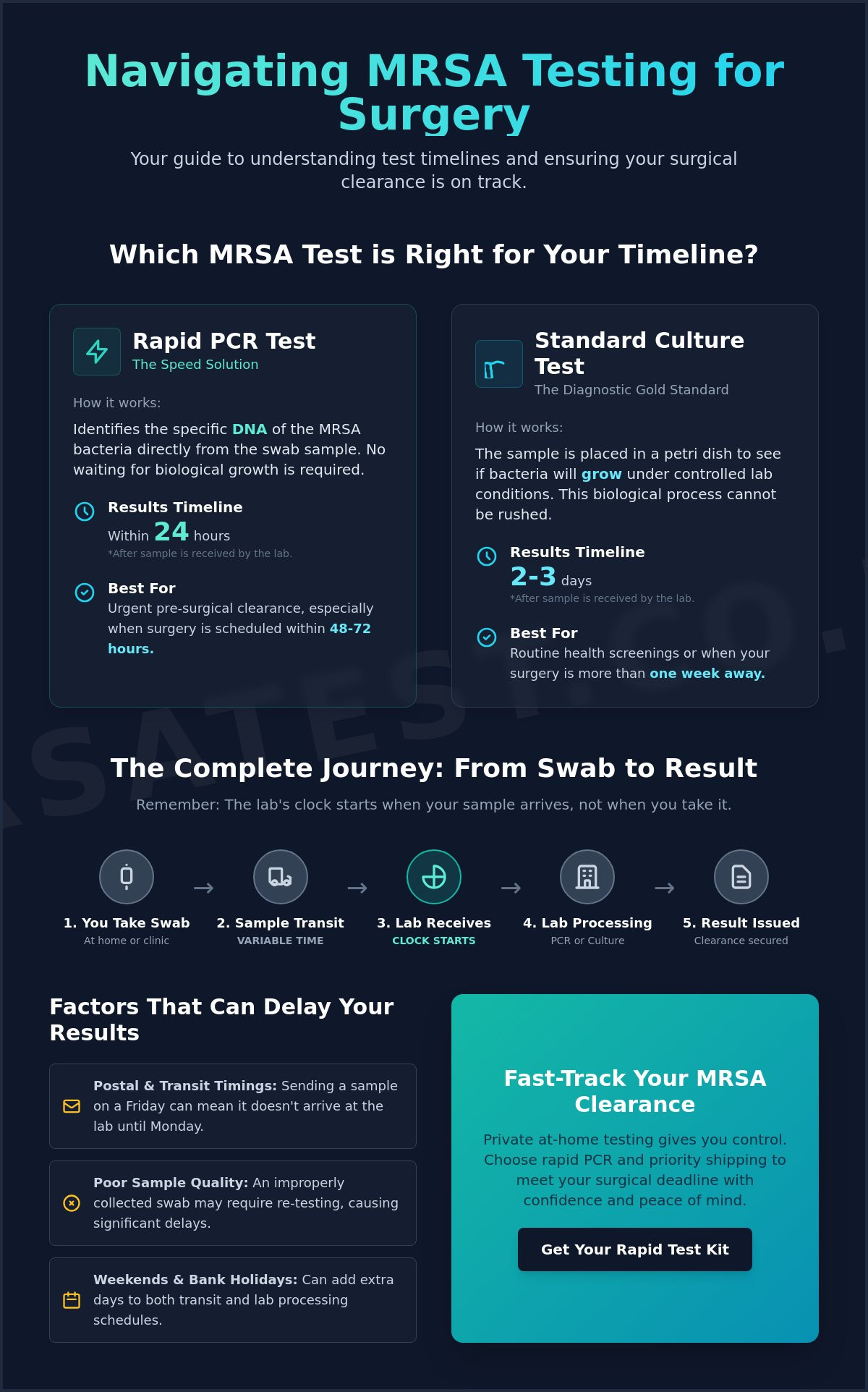
- Standard culture results: These typically require 2 to 3 days for a final confirmation.
- Rapid PCR results: These are usually available within 24 hours of the laboratory receiving the sample.
- Logistics matter: The timeline begins the moment the laboratory receives your swab, not the moment you take it.
- Clinical need: Urgency often dictates the choice; PCR is preferred for surgery, while cultures are used for routine screenings.
When considering how quickly can i get mrsa results, you should look at the total time from swab to sign-off. The clinical timeline officially begins the moment your sample reaches the laboratory. This is a critical distinction. If you send a sample via standard mail on a Friday, the lab might not receive it until Monday. In this scenario, even a 24-hour test won’t yield results until Tuesday. For those with a medical deadline, choosing a service that prioritizes both rapid testing and efficient sample transit is essential for peace of mind.
The 24-Hour Rapid PCR Advantage
PCR technology identifies the DNA of the bacteria directly from your swab. Because the lab doesn’t need to wait for the bacteria to colonize a petri dish, results are often ready within 24 hours of the sample’s arrival. This rapid turnaround is ideal if you’ve realized your surgical pre-assessment is missing a vital piece of paperwork. Our MRSA Rapid PCR Test options for the nose, groin, and axilla provide the speed necessary for patients with surgery scheduled in the next 48 to 72 hours. It’s a modern solution that removes the stress of biological waiting periods.
The 48-72 Hour Standard Culture Timeline
Traditional culture testing is a biological process that cannot be artificially rushed. The laboratory must wait to see if any bacteria present in the sample will grow under specific conditions. While this takes longer, it remains the gold standard for identifying which specific antibiotics will be most effective against a particular strain. If your procedure is more than a week away, an MRSA Culture for the nose and groin is a reliable and cost-effective choice. This method is excellent for routine monitoring where the immediate speed of molecular testing isn’t required.
Ultimately, your choice depends on your specific medical deadline. If you’re facing an upcoming surgery, the speed of a PCR test offers a significant logistical advantage. For general health checks, the standard culture provides the detailed information clinicians need at a different pace.
Why the Testing Method Dictates Your Wait Time
The discrepancy in turnaround times between different diagnostic methods isn’t a matter of laboratory efficiency. It’s a matter of science. When you ask how quickly can i get mrsa results, the answer depends on whether the laboratory is waiting for a biological process to occur or using molecular tools to find genetic evidence. Traditional testing relies on the natural life cycle of bacteria, which moves at its own pace. Modern molecular testing, however, bypasses these biological constraints entirely.
- Biological Growth: Cultures require specific windows of time where bacteria must multiply to become visible.
- Genetic Identification: PCR identifies the specific DNA markers of MRSA without needing the bacteria to grow.
- Incubation Windows: Laboratory protocols require set periods for samples to sit in controlled environments.
- Resource Intensity: Rapid molecular tests require specialized equipment and reagents, which facilitates the faster turnaround.
Understanding these differences helps you choose the right test for your situation. If you have weeks before a procedure, the biological pace of a culture is rarely an issue. If you’re facing a deadline, the molecular approach is often the only viable path forward.
The Science of Bacterial Incubation
Culture tests are essentially a waiting game. A laboratory technician places your sample onto a nutrient-rich agar plate and waits for colonies to form. This initial incubation period typically takes 24 hours. Once growth is visible, the lab must perform additional steps to confirm the identity of the bacteria. Methicillin-resistant Staphylococcus aureus must be isolated from other common skin bacteria to be accurately confirmed. This isolation and confirmation phase adds another 24 hours to the process. In some cases, if the initial growth is sparse or inconclusive, the laboratory may require an additional day to ensure the result is definitive and safe for clinical use.
Molecular Detection (PCR) Explained
PCR (Polymerase Chain Reaction) is a sophisticated technique that targets the mecA gene. This specific gene is responsible for the methicillin resistance that defines MRSA. Instead of waiting for the bacteria to multiply on a plate, the PCR process involves “amplifying” the DNA found on your swab. The laboratory equipment cycles through different temperatures to create millions of copies of the target genetic material. This makes the bacteria “visible” to digital sensors almost immediately. According to NIH research on MRSA test timelines, these molecular methods can provide results in approximately 2 hours, whereas traditional cultures often take 24 hours or longer.
Because the results are digital and based on genetic signatures, they’re considered definitive once the thermal cycling is complete. This precision is why an MRSA Rapid PCR Test is the preferred choice for patients who need to know their status with certainty and speed. It provides a level of quiet competence that helps alleviate the anxiety of a looming medical deadline.
At-Home Testing vs. Hospital Screening: Which is Faster?
Deciding between hospital-led screening and a private home kit often comes down to who controls the calendar. Hospital screening is typically tied to a specific pre-assessment clinic appointment. If that appointment is delayed or missed, your entire surgical timeline can stall. Private at-home testing empowers you to take control of the timeline immediately. When patients ask how quickly can i get mrsa results, they’re often surprised to find that using a rapid PCR MRSA test can be significantly faster than waiting for a GP or hospital slot to open up. This is because you aren’t waiting for an administrative opening; you are initiating the process yourself.
The efficiency of home testing relies on a streamlined ‘Total Turnaround Time.’ This includes every step from the moment you click ‘order’ to the second the result hits your inbox. In many cases, this entire cycle can be completed in just a few days, providing a reliable safety net for those with upcoming medical deadlines. It’s a simple, well-managed process designed to support you through a sensitive diagnostic requirement.
Understanding the Logistics Chain
The process is designed to be as straightforward as possible. On Day 0, you order your kit. By Day 1, the kit arrives at your door, allowing you to perform the swab in the privacy of your home. By Day 2, the laboratory receives your sample. We use trackable, prepaid envelopes to ensure your sample reaches our verified laboratory partners overnight. This tracking provides an extra layer of security, so you know exactly where your sample is at every stage. Once the lab begins processing, digital result delivery via email or a secure portal eliminates the need to wait for physical mail. This speed is essential for meeting tight surgical windows and provides the quiet competence you expect from a professional service.
Avoiding Hospital Lab Backlogs
Hospital laboratories are often overwhelmed by high-volume inpatient demands. They must prioritize emergency cases and active infections within the wards. Unfortunately, this means routine pre-operative swabs for elective procedures can sometimes be delayed in a backlog. Private accredited labs operate differently. They focus specifically on fast turnaround times for screening services. This dedicated focus ensures that your sample is processed with the efficiency it deserves. By choosing a private route, you gain a level of consistency that larger systems struggle to match. You receive a reliable result window, which is often the most critical factor in maintaining your surgical schedule and your peace of mind regarding your status.
Factors That Can Delay Your MRSA Screening Results
Even with access to advanced diagnostic technology, certain external variables can influence your final turnaround time. When you’re calculating how quickly can i get mrsa results, it’s vital to account for the logistical journey of your swab. A high-quality sample and clear documentation are just as important as the laboratory’s internal equipment. Most delays aren’t caused by the test itself but by hurdles that occur before the sample even reaches the thermal cycler or the incubator.
Administrative errors are a common but avoidable cause of frustration. Lab request forms that are missing information or contain illegible handwriting can lead to a sample being placed on hold. The laboratory must ensure every sample is perfectly matched to a patient record before processing begins. Additionally, in culture-based tests, a very low bacterial load might require an “enrichment” phase. This involves adding extra nutrients to the sample to encourage the bacteria to multiply to a detectable level, which can add an extra 24 hours to the standard timeline.
Tips for a Valid Swab Collection
Ensuring you follow the provided instructions for nose, groin, and axilla (armpit) swabs is the best way to prevent the need for a re-test. One of the most critical steps is the “moistening” of the swab. Using the provided transport medium to dampen the tip before swabbing ensures that you pick up enough biological material. A dry swab often fails to collect sufficient bacteria or DNA, resulting in an “insufficient sample” report from the lab. If you are balancing multiple medical requirements alongside your screening, our pre-op health checklist offers a comprehensive guide to staying on track with your logistics.
Laboratory Processing Windows
The time of week you send your sample plays a significant role in your wait time. Samples that arrive at a laboratory on a Saturday afternoon may not be entered into the system until Monday morning. At mrsatest.co.uk, we optimize our shipping routes to minimize weekend downtime, but it’s always wise to post your sample as early in the week as possible. There’s also the rare possibility of an “inhibited” PCR result. This occurs when substances like heavy skin creams, ointments, or even blood interfere with the chemical reaction. If this happens, the lab must perform a “clean-up” procedure or request a new swab, which directly affects how quickly can i get mrsa results.
By taking a few extra moments to ensure your sample is collected correctly and your forms are clear, you significantly increase the likelihood of a fast, definitive result. If you’re ready to take the next step in your pre-surgical preparation, you can order your MRSA test kit today and gain the peace of mind that comes with professional screening.
Fast-Tracking Your MRSA Results for Surgery
The final weeks leading up to a surgical procedure are often filled with logistical checklists and pre-operative requirements. Most UK hospitals operate under strict safety protocols that require a confirmed MRSA-negative result within 14 to 30 days of your scheduled admission. If you’ve missed your hospital pre-assessment or if the internal laboratory is experiencing a backlog, the question of how quickly can i get mrsa results becomes a matter of protecting your surgical date. A private PCR test serves as the fastest recovery option, ensuring that a missing piece of paperwork doesn’t lead to a last-minute cancellation.
Securing your results early also provides a vital window for action. If a test returns a positive result, you’ll still have time to complete a decolonization treatment before your surgery. This typically involves a five-day course of specialized antibacterial body wash and nasal cream. By identifying colonization early, you significantly reduce the risk of a surgical site infection. This proactive approach gives you the quiet competence needed to walk into the hospital with confidence, knowing your status is managed and your safety is prioritized.
Meeting Your Surgical Deadline
Before ordering your kit, verify your hospital’s specific requirements regarding the number of swab sites. Some clinical pathways only require swabs from the nose and groin, while others mandate an additional sample from the axilla (armpit). The MRSA test is a fundamental tool in preventing post-operative complications. Once your results are processed, you’ll receive a digital report that is easy to share. You can forward this directly to your NHS or private surgeon’s administrative team or print a copy to include in your pre-admission file. This streamlined sharing process is designed to eliminate friction between you and your healthcare provider.
The Voltie/MRSA Test Commitment to Speed
Our service is built on the pillars of efficiency and clinical reliability. We exclusively utilize UKAS-accredited laboratories for all our tests, ensuring that your results meet the highest professional standards. We understand that medical testing can be a sensitive matter, so we provide discreet packaging and rapid digital reporting as standard features of every order. You don’t have to navigate hospital backlogs or wait for a GP appointment to get the answers you need. When you’re concerned about how quickly can i get mrsa results, our streamlined process provides a dependable solution delivered in a private setting. Order your confidential MRSA test kit online today to secure your surgical timeline and gain peace of mind.
Secure Your Surgical Timeline with Confidence
Navigating pre-operative screening shouldn’t be stressful. Modern molecular science now offers a significantly faster alternative to slow biological cultures. By choosing the right diagnostic method, you can stop wondering how quickly can i get mrsa results and start focusing on your recovery. Taking control of your testing timeline ensures you meet hospital deadlines without the anxiety of potential backlogs.
Our service provides a seamless and professional experience. We utilize UKAS Accredited Laboratory Testing to maintain clinical accuracy, with all results delivered securely via email for your convenience. Every kit includes free tracked return shipping to ensure your sample reaches our experts as quickly as possible. This streamlined process offers the quiet competence you need to manage your health screening discreetly from home.
Order Your Rapid MRSA PCR Test Kit for 24-Hour Results and protect your surgical date today. We’re here to support you with reliable, efficient diagnostics every step of the way.
Frequently Asked Questions
How long does a standard MRSA culture test take?
A standard MRSA culture test typically takes 2 to 3 days from the moment the laboratory receives your swab. This timeframe is necessary because the process relies on biological growth. Technicians must wait for the bacteria to multiply on a nutrient-rich plate before they can confirm the presence of a specific strain. If the initial growth is sparse, the lab may require an additional 24 hours for a definitive confirmation.
Can I get MRSA results in under 24 hours?
Yes, you can receive results in under 24 hours by choosing a rapid PCR test. Unlike biological cultures, molecular testing identifies the genetic markers of the bacteria almost immediately. This method is the most efficient solution when you need to know how quickly can i get mrsa results to meet a looming surgical deadline. The 24-hour window begins once the sample is logged at our verified laboratory.
What happens if my MRSA test result is positive before surgery?
If your result is positive, your surgical team will likely initiate a decolonization protocol. This process usually involves using a specialized antibacterial body wash and a nasal cream for five consecutive days. The goal is to clear the bacteria from your skin and nasal passages to minimize the risk of infection during your procedure. You should contact your pre-assessment clinic immediately to discuss how this affects your operation date.
Is a PCR MRSA test more accurate than a culture test?
Both tests are clinically reliable, but they utilize different technologies for identification. PCR is exceptionally sensitive and excellent for rapid screening because it detects bacterial DNA even in small amounts. Culture testing remains the standard for determining which specific antibiotics will be most effective for treatment. For pre-surgical clearance, the speed and precision of a PCR test are often preferred by both patients and clinicians.
Will my surgeon accept a private MRSA test result?
Most surgeons and hospitals accept private results if they are processed by a UKAS-accredited laboratory. These reports provide the same level of clinical diagnostic rigour as those generated within a hospital setting. It’s always best practice to verify with your specific pre-assessment team or surgeon’s secretary to ensure the private report meets their internal documentation requirements before you submit your paperwork for surgical clearance.
How will I receive my MRSA test results?
You will receive your results through a secure digital platform. Once the laboratory completes the analysis, a professional report is generated and sent directly to your registered email address or secure portal. This digital format allows you to quickly forward the document to your healthcare provider or print it for your medical records. This method is significantly faster than waiting for a physical letter in the post.
Does the lab work on weekends to process MRSA swabs?
Laboratory processing schedules can vary, and many facilities operate with reduced staff or hours on weekends. While some samples may be processed on a Saturday, those arriving later in the weekend are often held until Monday morning. To ensure you understand how quickly can i get mrsa results in your specific case, we recommend posting your swab early in the week to avoid any potential weekend transit or laboratory downtime.