Private MRSA Screening Before Surgery UK: A Guide to Pre-Op Testing in 2026
What if your path to the operating theatre didn’t require an extra trip to a crowded hospital waiting room? For many patients, securing a private mrsa screening before surgery uk can feel like just another administrative hurdle that delays their recovery. While the NHS moved to a targeted screening approach for high-risk groups like orthopaedic and cardiac patients in 2026, the reality of pre-operative appointment wait times often leaves individuals searching for more efficient, discreet alternatives.
It’s understandable to feel anxious about hospital-acquired infections or confused by which body sites require swabbing for a valid certificate. This guide explains how to navigate mandatory requirements and accelerate your surgical timeline using professional at-home testing options. We’ll explore the differences between rapid PCR and culture tests, detail why sites like the nose and groin are screened, and show you how to get results sent directly to your surgeon. By choosing a streamlined diagnostic process, you can focus on your health instead of the logistics of hospital visits.
Key Takeaways
- Understand why MRSA screening is a clinical requirement for elective surgery and how it significantly reduces the risk of surgical site infections.
- Learn how to secure a private mrsa screening before surgery uk to bypass lengthy NHS wait times and ensure you meet your hospital’s strict deadlines.
- Discover the essential steps to prepare for your assessment, including how to confirm which body sites your surgical team requires you to swab.
- Compare the benefits of standard culture tests with rapid PCR technology to determine which method best fits your specific surgical timeline.
- Explore how professional at-home testing kits provide a discreet and clinically-backed alternative to traditional hospital-based swabbing appointments.
What is Private Pre-Surgery Screening and Why is it Mandatory?
Pre-operative screening is a structured clinical process designed to identify potential risks before you ever enter the operating theatre. It acts as a safety protocol to ensure your body can handle the stress of surgery and anaesthesia. In the United Kingdom, hospitals have a clinical obligation to perform these checks to maintain high safety standards. A central part of this process involves testing for Methicillin-resistant Staphylococcus aureus (MRSA), a type of bacteria that can cause serious infections if it enters a surgical wound. By identifying carriers before they arrive at the hospital, medical teams can implement decolonisation protocols that keep both the patient and the clinical environment safe.
The Care Quality Commission (CQC) oversees healthcare providers in England, setting strict infection control standards that all facilities must meet. Private hospitals and independent clinics are equally bound by these regulations. These institutions often require a private mrsa screening before surgery uk to demonstrate they’re proactively managing the risk of hospital-acquired infections. For many, choosing a private pathway for these tests isn’t just about speed. It’s about ensuring every regulatory box is ticked well in advance of their scheduled procedure date, providing peace of mind for both the patient and the surgeon.
The Goals of Pre-Operative Assessment
The primary objective is patient safety. By reviewing your medical history and conducting specific tests, clinicians can identify underlying conditions like anaemia or kidney dysfunction that might complicate your recovery. Crucially, screening helps reduce the likelihood of surgical site infections (SSIs), which can lead to longer hospital stays or further procedures. Establishing a clear baseline for your vital signs and blood chemistry allows the surgical team to monitor your progress more accurately during and after the operation. This proactive approach ensures that any manageable health issues are addressed before they become surgical complications.
Who Needs a Private Pre-Op Test?
You’ll typically need this service if you’re booked for elective surgery at a private UK hospital or an independent cosmetic clinic. It’s also essential for UK residents who are travelling abroad for medical procedures and require a documented “fitness for surgery” certificate. Many people opt for private mrsa screening before surgery uk because it bypasses the logistical delays often found in NHS pre-assessment clinics. This efficiency is vital when you have a firm surgical date and can’t afford last-minute cancellations due to missing test results or delayed administrative processing.
Key Components of a Pre-Operative Assessment in 2026
A pre-operative assessment ensures your body is prepared for the upcoming physiological stress of a procedure. This starts with a thorough review of your medical history. Clinicians examine your past surgeries, allergies, and current prescriptions. Even herbal supplements are audited. This is because some natural products can interfere with anaesthesia or blood clotting. Next, physical measurements provide a baseline for your care. Blood pressure, heart rate, and Body Mass Index (BMI) are recorded. For certain procedures, an Electrocardiogram (ECG) assesses heart rhythm to detect hidden cardiac issues, while lung function tests ensure your respiratory system is robust enough for general anaesthesia. These checks help the medical team tailor the anaesthetic plan to your specific needs.
The most critical safety measure involves mandatory infection screening. Hospitals prioritise identifying resistant bacteria to prevent outbreaks within the clinical environment. Securing a private mrsa screening before surgery uk is often the fastest way to obtain the necessary clearance. If you don’t want to wait for a hospital-based appointment, this screening identifies carriers who might otherwise unknowingly introduce bacteria into sterile environments.
Essential Pre-Surgery Blood Tests
Blood work provides a clear window into your internal health status. A Full Blood Count (FBC) checks for anaemia, which can affect oxygen delivery during surgery. It also looks for elevated white cell counts that might suggest an active infection. Similarly, Urea and Electrolytes (U&E) tests are vital for assessing kidney function. Healthy kidneys are necessary to process and clear anaesthetic drugs from your system efficiently. You can find more detail in our Understanding Blood Tests: A Simple Guide for Patients.
The Critical Role of MRSA Screening
MRSA remains a primary concern for surgical wards because it resists many common antibiotics. If these bacteria enter a surgical site, they can cause deep-tissue infections or lead to life-threatening sepsis. Following official UK government guidance on MRSA, hospitals use swab tests to identify carriage on the skin before admission. It’s a simple precautionary step that saves lives by allowing for pre-treatment decolonisation, usually involving antiseptic washes and nasal ointments, before the first incision is made. For a deeper look at the bacteria itself, read our What Is MRSA? Your Complete Guide to Symptoms, Causes & Risks.
Streamlining this process is easier than you might think. If you want to avoid extra hospital visits, consider an at-home MRSA test kit to complete your private mrsa screening before surgery uk discreetly and professionally.
NHS vs. Private Clinic vs. At-Home Screening: A Comparison
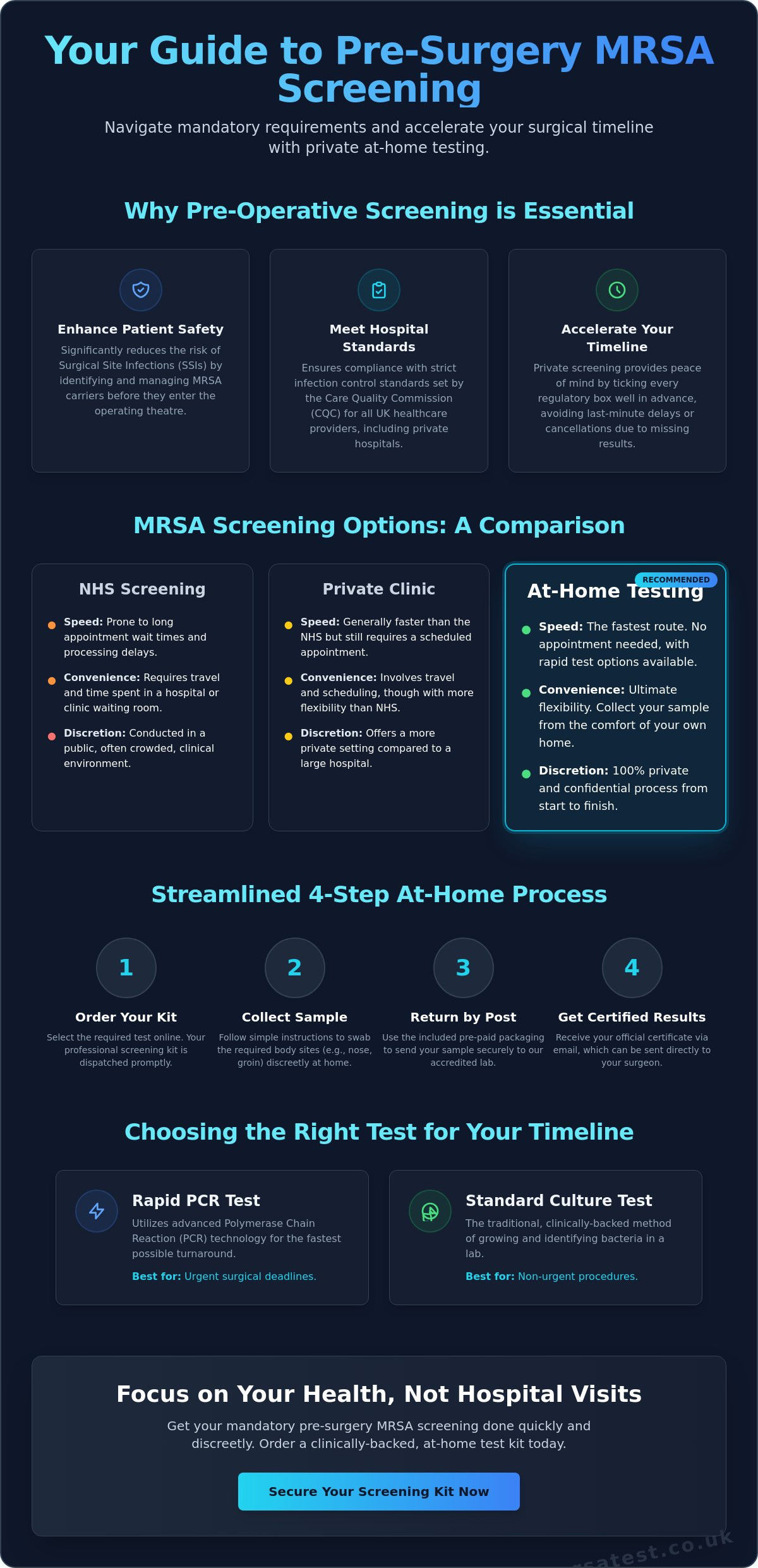
Choosing the right environment for your pre-operative tests depends on your surgical timeline and personal preferences. While the NHS provides screening for high-risk patient groups, the waiting list for a pre-assessment clinic appointment can often span several weeks. For many patients, this uncertainty creates unnecessary stress. Securing a private mrsa screening before surgery uk offers a faster alternative, with results typically available in just one to three days. This efficiency is particularly valuable when your surgical date is already confirmed and you need to provide clearance documents quickly.
The cost-benefit analysis of private screening often comes down to protecting your surgical date. A positive result discovered on the day of surgery can lead to immediate cancellation, causing emotional distress and potential financial loss. By testing early, you gain the time needed for decolonisation if it’s required. According to NHS guidance on pre-surgery MRSA screening, identifying the bacteria before admission is a standard safety measure to protect both you and the hospital environment. Moving this process into a private or domestic setting doesn’t compromise accuracy; it simply adds a layer of convenience and control to your preparation.
When to Choose a Private Clinic
A private clinic is often the best choice if your surgeon requires a wider range of diagnostic tests. If you need a resting ECG, chest X-ray, or a full physical examination by a GP alongside your MRSA swabs, a clinic provides a consolidated service. This route is also helpful if you prefer a face-to-face consultation to discuss anaesthetic risks or specific health concerns with a medical professional. While it requires a physical trip to a facility, it ensures all complex pre-op requirements are met in a single visit.
The Benefits of At-Home MRSA Screening
At-home testing has become a preferred option for those who only require infection screening. It eliminates the need for a separate hospital visit, saving you time and travel costs. One of the most significant advantages is the total privacy it provides during the self-collection process. Swabbing sensitive areas like the groin or axilla can feel intrusive in a clinical setting; at home, you can follow the instructions at your own pace in a comfortable environment. Once collected, your samples are processed by verified laboratories, with results that can be sent directly to your surgical team to accelerate your clearance. It’s a professional solution that fits seamlessly into a busy schedule, ensuring your private mrsa screening before surgery uk is completed without hospital-related anxiety.
How to Prepare for Your Private Pre-Surgery Screening
Preparation is the foundation of a successful surgical outcome. When you arrange a private mrsa screening before surgery uk, the goal is to provide your medical team with accurate, timely data that prevents last-minute cancellations. Start by requesting a formal list of required tests from your surgeon’s secretary. This ensures you don’t miss specific requirements like a three-site swab or a particular blood panel. You should also compile a detailed medical history. Include any past issues with general anaesthesia or family history of reactions. This information is vital for the anaesthetist to plan your care safely.
Managing your body’s state in the 24 hours before testing is equally important. While MRSA swabs aren’t affected by diet, accompanying blood tests often are. You’ll also need to coordinate how your results reach the hospital. Most private labs provide a digital report via email. You should forward this directly to your surgeon’s private secretary or the hospital’s pre-assessment department. Confirming they’ve received and filed your results three days before your surgery date provides an essential safety net.
Step-by-Step Preparation Checklist
- Please list all supplements, including herbal remedies, for the consultant to review before your procedure.
- Check if fasting is required for your specific blood panels, such as glucose or lipids, to avoid inaccurate readings.
- Review our Preparing for Surgery: A Complete Pre-Op Health & Logistics Checklist for a full breakdown of requirements.
What to Ask Your Surgeon About Screening
Clear communication with your surgical team prevents administrative errors. Before booking your private mrsa screening before surgery uk, ask these three specific questions:
- How many days before the procedure must the MRSA screening be completed to remain valid?
- Do you accept results from a UKAS-accredited private laboratory for my pre-op assessment?
- Which specific body sites must be swabbed for this procedure, such as the nose, groin, or axilla?
Taking control of these logistics reduces pre-surgery anxiety. If you’re ready to complete your requirements from the comfort of your home, you can order your professional MRSA test kit here to ensure your surgical timeline stays on track.
Streamlining Your Pre-Op Prep with Fast, Private MRSA Testing
Securing a private mrsa screening before surgery uk doesn’t have to involve additional hospital visits or clinical anxiety. Mrsatest.co.uk provides a professional alternative that brings hospital-standard diagnostics directly into your home. This service is designed for patients who need to meet strict pre-operative requirements without the wait times often associated with traditional hospital pathways. By choosing a private screening route, you take direct control of your surgical timeline, ensuring that your results are processed and ready well before you arrive for your procedure.
Understanding the technology behind your test is essential for meeting urgent surgical dates. We provide both standard MRSA culture tests and rapid PCR options. While a culture test involves growing the bacteria over 24 to 72 hours, a Rapid PCR test identifies the genetic material of the bacteria much faster. This distinction is vital for patients with short lead times who need a definitive answer to stay on schedule. Both methods adhere to the high clinical standards required for UK surgical admission, providing the accuracy your surgeon demands.
Why Choose Mrsatest.co.uk for Pre-Surgery Swabs?
- All samples are processed by UKAS-accredited laboratories, ensuring maximum clinical accuracy and professional reliability for your results.
- Kits arrive in discreet, plain packaging and contain everything you need for successful sample collection in total privacy.
- Results are typically delivered within 24 to 72 hours of the laboratory receiving your swabs, allowing for rapid surgical clearance.
- The process is managed by experts, providing a sense of security and quiet competence throughout your pre-operative preparation.
Ordering Your Pre-Surgery Kit Today
To begin, you must select the kit that matches your hospital’s specific instructions. Most surgical teams require a two-site (Nose and Groin) or three-site (Nose, Groin, and Axilla) swab to provide a comprehensive screen. Every box includes simple, step-by-step instructions to ensure you collect a valid sample for the laboratory. For those on a tight schedule, you can learn more about our MRSA Test: Get Fast, Accurate Results at Home with a Rapid PCR Kit. Once your sample is returned using the provided pre-paid envelope, our clinical partners handle the rest, letting you focus on your upcoming recovery with peace of mind.
Securing Your Surgical Date with Confidence
Preparing for surgery involves many moving parts, but your infection screening shouldn’t be a source of stress. We’ve explored how mandatory MRSA checks act as a vital safety net to prevent surgical site complications. By choosing to bypass hospital wait times, you can ensure your results are ready exactly when your surgical team needs them. Arranging a private mrsa screening before surgery uk allows you to complete this essential step from the comfort of your own home, maintaining your privacy while meeting strict clinical standards.
Since 2016, we’ve helped thousands of UK patients navigate their pre-operative requirements with speed and discretion. Our kits are processed by a UKAS Accredited Laboratory, ensuring the highest level of diagnostic accuracy. With results available in as little as 24 hours from the lab receiving your sample, you can avoid the risk of last-minute cancellations and stay focused on your recovery.
Take control of your surgical timeline today. Order Your Private Pre-Surgery MRSA Screening Kit and move forward with the peace of mind that your health is in professional hands. You’re one step closer to a successful procedure and a smooth return to health.
Frequently Asked Questions
How long are pre-op tests valid for in the UK?
An MRSA screening result is valid for a maximum of 9 months before a procedure in the UK. This validity remains as long as you haven’t been admitted to a hospital as an inpatient during that time. If you have stayed in a hospital since your last test, your surgical team will likely require a new screen to ensure your carriage status hasn’t changed.
Do I need to fast before my private pre-surgery blood tests?
Fasting requirements depend entirely on the specific blood panels your surgeon has requested. Tests for blood glucose or lipid levels usually require you to avoid food and drink for 8 to 12 hours. However, a private mrsa screening before surgery uk involves skin swabs rather than blood work, so you don’t need to fast if you’re only performing an infection screen.
Will my private surgeon accept an at-home MRSA test result?
Most private surgeons and independent clinics accept results from at-home kits as long as they’re processed by a UKAS-accredited laboratory. You should always verify this with your surgeon’s private secretary before ordering. Providing a professional laboratory report ensures your results meet the necessary clinical standards for admission to sterile operating environments.
What happens if my pre-surgery MRSA screen comes back positive?
A positive result means you’re a carrier of the bacteria, which triggers a five-day decolonisation protocol. This treatment typically involves using a 4% Chlorhexidine body wash and Mupirocin nasal ointment to clear the bacteria from your skin and nose. Surgery is rarely cancelled but may be delayed until you’ve completed this five-day course to minimize the risk of infection.
Is private pre-surgery screening covered by health insurance?
Many private health insurance providers cover the cost of pre-operative assessments if they’re a mandatory part of an authorised surgical procedure. You should check the specific terms of your policy or contact your insurer for a pre-authorisation code. If your insurance doesn’t cover it, paying for a private mrsa screening before surgery uk ensures you can meet your surgical deadlines without delay.
How quickly can I get my results from a private pre-op assessment?
The timeframe for results depends on the type of technology used by the laboratory. A rapid PCR test can provide results within 1 day of the lab receiving your sample. Standard culture tests, which involve growing the bacteria in a controlled environment, typically take between 24 and 72 hours to yield a definitive result.
Why do I need an MRSA test if I feel perfectly healthy?
You need the test because approximately one-third of healthy people are persistent carriers of Staphylococcus aureus. While these bacteria are harmless on intact skin, they can cause serious complications if they enter a surgical wound. Screening identifies carriers who feel fine but still pose a risk of developing a surgical site infection or sepsis during recovery.
Can I do my pre-op screening if I am currently taking antibiotics?
Taking antibiotics can sometimes mask the presence of MRSA, leading to a false-negative result. It’s generally recommended to wait until you’ve finished any course of antibiotics before performing your swabs. If you’re currently on medication, you should inform your surgical team so they can advise on the best timing for your pre-operative screening.