

Blog
Reliable MRSA Home Testing: A Complete Guide to Accuracy and Pre-Op Screening

May
Could a simple swab collected in your own bedroom really be the key to keeping your surgery date on track? Many patients worry that choosing reliable mrsa home testing might compromise their clinical results or lead to last-minute hospital cancellations. It’s completely normal to feel anxious when your upcoming operation depends on a clear screening result, especially since less than 1% of people living at home in the UK carry MRSA. When GP appointments are scarce and you value your medical privacy, you need to know that your test is just as accurate as one performed in a hospital ward.
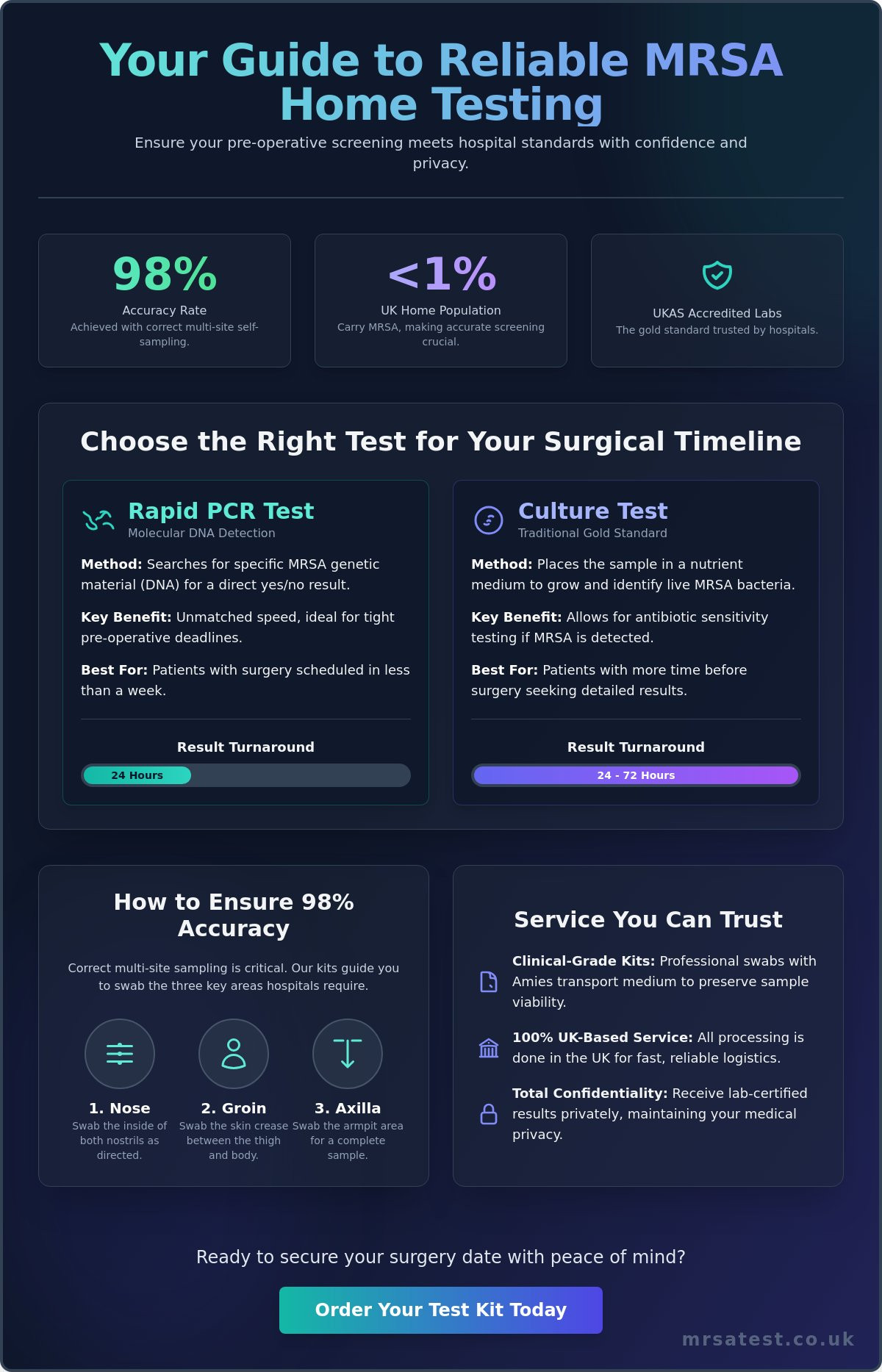
We understand that peace of mind is your priority before a major procedure. This guide will show you how to ensure your at-home kit meets the latest hospital standards as of April 2026, achieving up to 98% accuracy through precise multi-site sampling of the nose, groin, and axilla. We’ll explain the critical differences between the MRSA culture test and the 24-hour PCR rapid test, which uses molecular detection to provide fast results. You’ll learn exactly how to meet pre-operative screening criteria with confidence and how our 100% UK-based service and UKAS-accredited laboratory ensure your path to surgery remains clear, safe, and confidential.
Key Takeaways
- Learn why UKAS-accredited laboratory processing is the essential gold standard for ensuring clinical reliability in every test result.
- Understand the technical differences between PCR molecular detection and traditional culture methods to choose the right test for your surgical timeline.
- Discover how reliable mrsa home testing serves as a trusted, private alternative to hospital clinics for meeting pre-operative screening requirements.
- Master the correct swabbing techniques for the nose, groin, and axilla to minimize user error and maximize the accuracy of your sample.
- Find out how to maintain complete medical confidentiality while receiving fast, lab-certified results from a 100% UK-based service.
Defining Reliability in At-Home MRSA Screening
Reliability isn’t just a vague feeling of trust. In a clinical context, it’s a measurable standard defined by two primary factors: sensitivity and specificity. Sensitivity refers to the test’s ability to correctly identify those who carry the bacteria, while specificity ensures the test doesn’t produce a “false positive” by mistaking other skin flora for Methicillin-resistant Staphylococcus aureus (MRSA). Choosing a reliable mrsa home testing solution means looking beyond the packaging and focusing on the laboratory technology and the quality of the collection materials provided.
A critical component of this reliability is the physical swab itself. We provide professional-grade swabs containing Amies transport medium. This specialized gel preserves the sample during transit, ensuring the bacteria remain viable for analysis once they reach the lab. Without this clinical-grade protection, a sample could degrade, leading to an inconclusive or inaccurate result. When you use a high-quality kit, you aren’t just taking a shortcut; you’re using the same tools a nurse would use in a pre-assessment clinic.
The Importance of UKAS Accreditation
The gold standard for any medical laboratory in the UK is UKAS accreditation to ISO 15189 standards. This isn’t just a badge; it’s a rigorous, ongoing audit of the lab’s equipment, staff training, and result accuracy. Hospitals and surgical teams specifically look for UKAS-accredited results during pre-operative audits because they provide a guaranteed level of integrity. We partner exclusively with these accredited facilities to ensure your results are accepted by your surgical team without hesitation. It’s this level of clinical rigor that allows you to test for MRSA from the comfort of your own home with total confidence.
Clinical Accuracy vs. Convenience
It’s a common misconception that “at-home” diagnostics are naturally inferior to hospital-based tests. Data from April 2026 confirms that multi-site sampling of the nose, groin, and axilla can achieve up to 98% accuracy in carrier detection. While the convenience of a home kit is obvious, the clinical accuracy is what truly matters for your surgery. Recent studies suggest that self-collection can be just as effective as clinician-led swabbing when clear instructions are followed.
There’s also a psychological benefit to reliable mrsa home testing. Testing in a stress-free environment often leads to a more thorough collection process compared to a rushed hospital appointment. By taking the time to follow our simple, step-by-step guide, you ensure the highest possible accuracy while avoiding the anxiety of clinical waiting rooms and potential surgery delays.
MRSA PCR vs. Culture: Which Method is More Reliable for You?
Choosing the right path for reliable mrsa home testing often comes down to a choice between two distinct laboratory technologies: culture and PCR. While both are clinically valid, they work in fundamentally different ways. A culture test looks for live, growing bacteria, while a PCR test searches for specific strands of bacterial DNA. Understanding these biological differences helps you select the method that aligns best with your surgical timeline and clinical needs.
The distinction between detecting live organisms and genetic material is more than just technical. It affects how long you wait for an answer and what that answer tells your surgeon. For most patients, the decision is driven by how many days remain before their hospital admission. Both methods are processed in the same UKAS-accredited facilities used by the NHS, ensuring that your choice is supported by professional clinical rigor.
MRSA Culture Testing: The Standard Approach
This method is the traditional gold standard because it allows scientists to observe the bacteria in real time. The laboratory places your sample into a nutrient-rich environment to see if MRSA grows over a period of 24 to 72 hours. One major benefit of this approach is the ability to perform sensitivity testing. If the bacteria grow, the lab can identify exactly which antibiotics will effectively treat the colonization. It’s a thorough and dependable choice if you have at least a week before your scheduled procedure, providing a deep level of detail for your medical team.
Rapid PCR Testing: Molecular Precision
When time is of the essence, reliable mrsa home testing via PCR provides the fastest path to clarity. PCR stands for Polymerase Chain Reaction, a technique that amplifies the genetic material of the bacteria. It specifically targets the mecA gene, which is the marker responsible for methicillin resistance. Because it doesn’t require the bacteria to grow, results are typically available within 24 hours of the lab receiving your sample. This method is highly sensitive. It can detect even very low levels of colonization that might be missed by other methods, making it the ideal choice for imminent hospital admissions.
Your choice should be dictated by your surgical deadline and the specific requirements of your hospital. For those with an admission date just a few days away, the speed of molecular detection is invaluable. If you have more time and want the most traditional assessment, the culture method remains a dependable pillar of clinical practice. You can find both options among our at home test kits uk, ensuring your pre-op preparation is handled with professional care.
Pre-Surgery Requirements: Why Hospitals Trust Private MRSA Screening
Hospitals prioritize patient safety above all else. This is why MRSA screening is a mandatory requirement for almost all elective inpatient admissions and day-case surgeries involving metalwork in the UK. By identifying carriers before they enter a clinical environment, healthcare providers can significantly reduce the risk of hospital acquired infections. While many patients assume they must attend a hospital pre-assessment clinic, reliable mrsa home testing is a widely accepted and valid alternative. Private screening results from UKAS-accredited laboratories provide the same clinical assurance as hospital-led tests, often with significantly more convenience.
It’s vital to understand the difference between being “colonized” and having an active “infection.” Most people who test positive for MRSA are colonized. This means the bacteria live harmlessly on the skin or inside the nose without causing any symptoms. In fact, less than 1% of the UK population living at home carry MRSA. However, if these bacteria enter a surgical wound, they can cause serious complications. To ensure the highest level of safety, hospitals insist on the “Three-Site” rule. Testing the following areas increases the reliability of the screen:
- The Nostrils: A primary reservoir for staphylococcal bacteria.
- The Groin: A common area for skin colonization due to warmth and moisture.
- The Axilla (Armpit): Often included to ensure no carrier sites are overlooked.
Meeting Hospital Protocols
NHS and private hospital trusts have strict protocols for MRSA clearance. You’ll typically need to present a lab-certified certificate during your pre-operative assessment. According to current standards as of April 2026, an MRSA screen is generally valid for at least three months for major surgery, and potentially up to six months. Timing your reliable mrsa home testing is key. We recommend ordering your kit early enough to allow for results to be processed and shared with your surgical team, preventing any last-minute delays to your procedure.
Reducing Surgical Risks
Identifying MRSA early isn’t just a box-ticking exercise. It’s a critical step in your recovery journey. If you test positive, you’ll be offered a simple decolonization treatment, which usually includes an antiseptic body wash and a specific nasal cream. This proactive approach drastically lowers the risk of post-operative surgical site infections. For more information on managing your clinical timeline, read our guide on preparing for surgery. Taking this step ensures you enter the ward with confidence and peace of mind.
Ensuring Accuracy: A Guide to Proper Swab Collection at Home
The clinical integrity of your results depends on two factors: the precision of the laboratory and the quality of the sample you provide. While our UKAS-accredited partners use the latest diagnostic technology, the collection process is where reliable mrsa home testing truly begins. User technique is the most variable factor in home screening. By following a few simple clinical steps, you can ensure your sample is viable and your results are as accurate as those taken by a healthcare professional.
Reliability starts with preparation. Before you begin, wash your hands thoroughly with soap and water and dry them completely. It’s vital to avoid using any antiseptic creams, nasal sprays, or medicated body washes for at least 24 hours before swabbing. These substances can interfere with the bacteria on your skin, potentially leading to a false negative result that doesn’t reflect your true carrier status.
Step-by-Step Collection Process
Each kit contains clear instructions, but the goal is to capture enough biological material for the lab to analyze. For the anterior nares (nostrils), insert the swab tip about 1cm into the first nostril. Apply the “Rotation Rule”: rotate the swab firmly but gently five times against the inside wall. Repeat this exact process in the second nostril using the same swab. This ensures maximum coverage of the area where MRSA is most likely to reside.
When swabbing the groin or axilla, use the same firm rotation technique over a 5cm area of skin. Once the collection is complete, immediately place the swab into the plastic tube containing the Amies transport medium. Ensure the cap is clicked shut so the swab tip remains in constant contact with the preservative gel. This gel is what keeps the sample stable during its journey through the postal system.
Avoiding Common Mistakes
Contamination is the primary cause of inconclusive results. Never touch the soft tip of the swab with your fingers or let it come into contact with any external surfaces like a table or clothing. If the tip touches anything other than the designated screening sites, the sample is compromised. Additionally, clear labelling is vital for result reliability. Ensure you’ve marked the tube with your name, date of birth, and the date the sample was taken.
Timing your postage is equally important. To ensure your sample reaches the lab in the best possible condition, we recommend using the prepaid tracked envelope on a Monday, Tuesday, Wednesday, or Thursday. This avoids the sample sitting in a sorting office over the weekend. By taking these small, professional steps, you guarantee that your path to surgery remains on schedule. You can order your reliable mrsa home testing kit today to begin your pre-operative preparation with clinical confidence.
Reliable MRSA Testing with mrsatest.co.uk: Your Path to Peace of Mind
Preparing for surgery is often a stressful experience, but your MRSA screening shouldn’t be. At mrsatest.co.uk, we bridge the gap between hospital-grade clinical accuracy and the comfort of your own home. We’ve designed our service to provide reliable mrsa home testing that satisfies both your surgical team’s requirements and your need for privacy. By combining the convenience of at home test kits uk with rigorous laboratory standards, we ensure you can focus on your recovery rather than logistics.
Our promise is built on three pillars: clinical integrity, speed, and discretion. Every sample is processed by 100% UK-based, UKAS-accredited partner laboratories. These are the same facilities used by healthcare professionals across the country. To protect your privacy, all kits are sent in discreet, plain packaging with no mention of MRSA or medical testing on the outside. Your data is handled with the highest level of security, and results are delivered through a confidential digital report that you can easily share with your hospital.
If your result returns as positive, please stay calm. A positive result simply means you are “colonized” with the bacteria. It’s a manageable situation that involves a simple decolonization treatment, such as antiseptic washes and nasal creams, before your surgery proceeds. For a deeper understanding of what a positive result means for your health, read our what is mrsa guide for full treatment context.
Why Choose Our Accredited Service?
We believe in transparent healthcare. Our pricing is all-inclusive, meaning there are no hidden laboratory fees or extra costs for reporting. Once your sample reaches the lab, efficiency is our priority. Whether you choose the traditional culture method or the ultra-fast PCR molecular detection, you’ll receive your results swiftly. This fast turnaround is essential for meeting tight pre-operative deadlines and ensuring your surgery remains on schedule as planned.
Ordering Your Reliable Home Test
Selecting the right test depends on your timeline. If your surgery is imminent, the MRSA PCR rapid test offers molecular detection in 24 hours. If you have more time, the traditional culture test is a dependable gold standard. The process is simple:
- Order: Select your kit online for fast, discreet delivery.
- Swab: Follow our clinical guide to collect your samples at home.
- Return: Use the prepaid tracked envelope to send your sample to our UK lab.
Don’t let screening delays interrupt your surgical journey. You can order your reliable MRSA home test kit today and take the first step toward a safe and successful procedure with total peace of mind.
Secure Your Surgical Success with Reliable Screening
Securing a clear MRSA status is a vital step toward a safe and successful operation. You now understand that reliable mrsa home testing depends on a partnership between your careful swabbing technique and our UKAS-accredited laboratory processing. Whether you require the traditional detail of a culture test or the 24-hour speed of molecular PCR detection, you can meet hospital pre-op requirements without the stress of a clinical appointment. This professional approach ensures your surgery remains on schedule.
Our 100% UK-based service prioritizes your privacy through discreet, plain-cover packaging and secure digital reporting. By following the “Three-Site” rule and using our professional-grade collection materials, you ensure your surgical team receives accurate, trusted data. Hospital protocols as of April 2026 emphasize the importance of these accredited results to prevent post-operative complications. Don’t let medical logistics or lack of GP availability cause unnecessary anxiety before your procedure.
Take control of your pre-operative preparation today. Order Your Reliable MRSA Home Test Kit Now and move forward with the clinical confidence you deserve. It’s time to focus on your health and recovery, knowing your screening is in expert hands.
Frequently Asked Questions
How accurate are at-home MRSA tests compared to hospital tests?
At-home MRSA tests achieve up to 98% accuracy, matching hospital standards, provided you use a UKAS-accredited laboratory. The reliability of the results depends on using professional-grade materials, such as swabs with Amies transport medium. Because we use the same accredited facilities as the NHS, the diagnostic quality remains identical to a test performed in a clinical setting.
Will my hospital accept private MRSA test results from mrsatest.co.uk?
Most UK hospitals accept private screening results if they’re processed in a UKAS-accredited lab. You should check with your surgical team’s pre-assessment clinic, but results showing ISO 15189 compliance are the industry standard. Providing a lab-certified report from reliable mrsa home testing helps avoid surgery delays caused by GP appointment shortages.
What is the difference between a PCR and a Culture MRSA test?
A culture test grows live bacteria over 24 to 72 hours, while a PCR test identifies the mecA gene in bacterial DNA within 24 hours. PCR is often preferred for imminent surgeries because it’s faster and more sensitive. Culture tests are beneficial if you need to know which specific antibiotics will effectively treat the bacteria.
How long do MRSA home test results take to come back?
Turnaround times depend on the method you choose, ranging from 24 hours for PCR to up to 72 hours for culture. This clock starts once our 100% UK-based laboratory receives your kit. To ensure the fastest possible delivery of your secure digital report, we recommend posting your sample between Monday and Thursday.
What happens if my MRSA home test result is positive?
Testing positive indicates colonization, not necessarily an active infection, and it’s a common finding for about 1% of the UK population. Your surgical team will prescribe a five-day decolonization protocol involving antiseptic body wash and nasal cream. Once you complete this simple treatment, you can usually proceed with your operation as scheduled.
Can I use one swab for both my nose and my groin to save money?
You must use separate swabs for different sites to ensure a high-quality sample and prevent cross-contamination. Using one swab for the nose and groin reduces the amount of material collected from each area, which can lead to false negatives. Our kits provide the specific number of swabs required to meet the ‘Three-Site’ rule for clinical reliability.
Do I need to see a GP before ordering an MRSA home test?
You don’t need to see a GP or obtain a prescription to access our testing services. This direct-to-consumer model provides a fast and confidential way to meet hospital pre-op requirements without waiting for local surgery availability. You can simply order the kit online and test for MRSA from the comfort of your own home.
How long are my MRSA test results valid for before surgery?
According to current guidelines as of April 2026, MRSA screening results are valid for at least three months for major procedures. Some trusts may accept results for up to six months if you haven’t had a hospital admission in the interim. Always confirm the exact window with your pre-operative coordinator to ensure your clearance certificate is current.
