
The MRSA Decolonisation Process: A Complete UK Patient Guide
You’ve waited 18 weeks for your NHS surgery date, only to receive a phone call explaining that your pre-operative swab came back positive for MRSA. It’s a common situation, yet the news often brings immediate anxiety about your procedure being cancelled or the risk of spreading the bacteria to your family. Understanding the mrsa decolonisation process uk hospitals require is the first step to regaining control and ensuring your health remains the priority.
We understand that clarity is the best cure for this stress. This guide explains exactly how to follow the 5-day protocol to successfully clear colonisation and protect your upcoming surgery. You’ll learn how to use antimicrobial body washes and prescribed nasal ointments with clinical precision. We also provide practical steps for maintaining a sterile home environment, ensuring you can return to the hospital with confidence and keep your scheduled appointment on track.
Key Takeaways
- Understand the vital difference between colonisation and infection, and why removing bacteria from your skin is a critical safety step before any surgical procedure.
- Master the 5-day mrsa decolonisation process uk hospitals require, including the specific two-pronged approach using prescribed nasal creams and antiseptic body washes.
- Learn how to manage your home environment with the “clean start” rule to prevent the bacteria from surviving on fabrics and re-colonising your skin during treatment.
- Discover the timeline for verifying success, including the 48-hour waiting period and the number of negative swabs typically needed to confirm you are clear.
- Find out how proactive private screening can help you identify colonisation early, allowing you to complete the protocol and avoid stressful last-minute hospital cancellations.
What is the MRSA Decolonisation Process?
The What is the MRSA Decolonisation Process? refers to a specific clinical treatment plan used to eliminate Methicillin-resistant Staphylococcus aureus (MRSA) from a person’s body. It’s a preventative measure rather than a treatment for an active illness. The primary goal is to clear the bacteria from common “reservoirs” on the body, specifically the skin, hair, and the lining of the nostrils. By removing these bacteria, healthcare providers significantly reduce the risk of the germ entering the body during medical procedures.
It’s vital to understand the difference between being “colonised” and having an “infection.” If you’re colonised, you’re a healthy carrier. The MRSA bacteria live on your skin or in your nose without causing any symptoms or harm. You won’t feel unwell, and you likely won’t know the bacteria are there without a specific swab test. An infection, however, happens when those same bacteria bypass the skin’s natural barrier. This usually occurs through a wound, a catheter, or a surgical incision, leading to redness, swelling, fever, or more serious systemic complications.
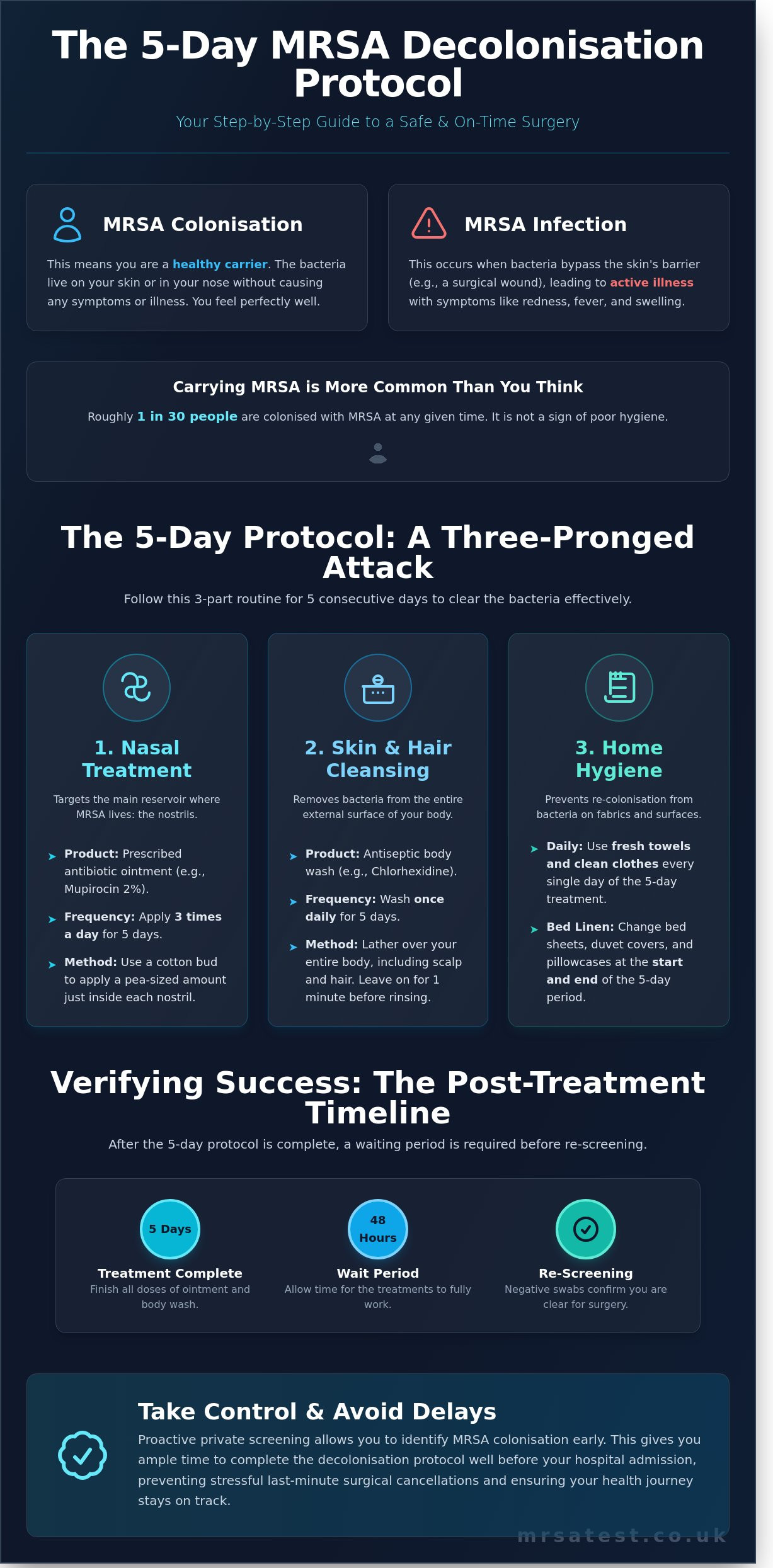
The standard mrsa decolonisation process uk follows a strict 5-day timeframe. This window is used by both the NHS and private hospitals to ensure the bacterial load is suppressed before a patient enters a sterile operating environment. Consistency is key during these five days. If a dose of the nasal cream or a body wash session is missed, the bacteria can quickly repopulate, potentially delaying your surgery date.
- Nasal Treatment: An antibiotic ointment (usually Mupirocin) applied inside the nostrils three times a day.
- Skin Cleansing: Daily washing with an antiseptic solution, such as Chlorhexidine, covering the entire body and hair.
- Hygiene Maintenance: Using fresh towels, clothes, and bed linen every day during the treatment period to prevent re-contamination.
Why is it necessary before surgery?
When a surgeon makes an incision, the skin’s primary defence is breached. If MRSA is present on your skin, it can easily travel into the surgical site. This can lead to hospital-acquired infections that are difficult to treat with standard antibiotics. Statistics show that patients who carry MRSA are significantly more likely to develop post-operative complications. By undergoing decolonisation, you’re protecting yourself from deep-tissue infections and ensuring the ward environment remains safe for other vulnerable patients. It’s a proactive step that reduces the average hospital stay by preventing avoidable infections.
The “Search and Destroy” strategy in the UK
UK healthcare policy has utilised a “Search and Destroy” approach since 2010, making MRSA screening mandatory for most elective surgical admissions. This strategy treats MRSA as a manageable risk rather than a threat. If your screening returns a positive result, don’t be alarmed. Carrying the bacteria is common; roughly 1 in 30 people carry MRSA at any given time, and it isn’t a reflection of your personal hygiene. It’s simply a biological factor. The mrsa decolonisation process uk is a routine safety measure, much like wearing a seatbelt, designed to “clear the path” for a successful and uncomplicated recovery.
The 5-Day Protocol: Nasal Creams and Body Washes
The mrsa decolonisation process uk healthcare providers implement is a precise, five-day clinical routine. It’s designed to significantly reduce or eliminate Staphylococcus aureus from your body’s primary “reservoirs.” This is a two-pronged strategy. You must treat the internal reservoir (the nostrils) and the external reservoir (the skin and hair) simultaneously. Completing the full course is vital. If you skip a single dose, the remaining bacteria can quickly recolonise the area, which might lead to a cancelled surgery or a persistent infection risk. Most NHS trusts provide a specific kit containing a nasal ointment and a medicated body wash to be used for five consecutive days.
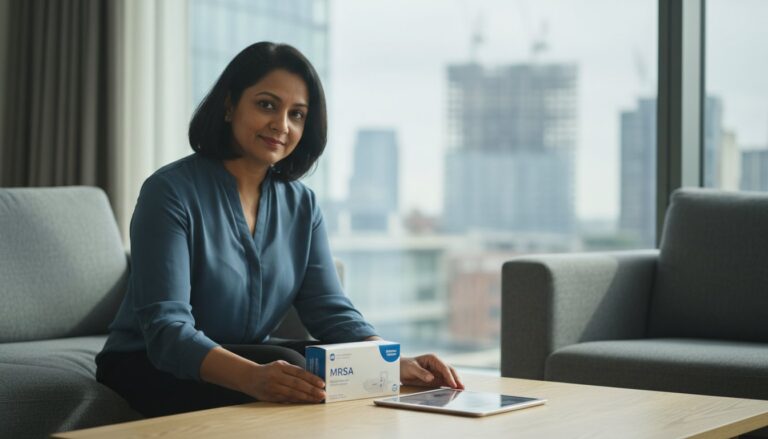
To make the protocol effective, you should use fresh towels and put on clean clothes every day of the treatment. Bed linen should also be changed at the start and end of the five days. This prevents you from picking up bacteria that were shed onto fabrics before the treatment began. If you’re preparing for a hospital admission, you can check your status early with a private MRSA screening kit to ensure your decolonisation is on track.
How to apply nasal ointment correctly
Start by washing your hands thoroughly with soap and water. Apply a pea-sized amount of Mupirocin 2% ointment, often branded as Bactroban, to a cotton bud or your small finger. Place the ointment just inside each nostril. Close your nose by pressing your nostrils together with your thumb and forefinger, then massage gently to spread the cream across the internal membranes. You’ll usually repeat this three times every day for the full 5-day duration. This ensures the bacteria living deep in the nasal passages are neutralised.
Using antiseptic body wash and shampoo
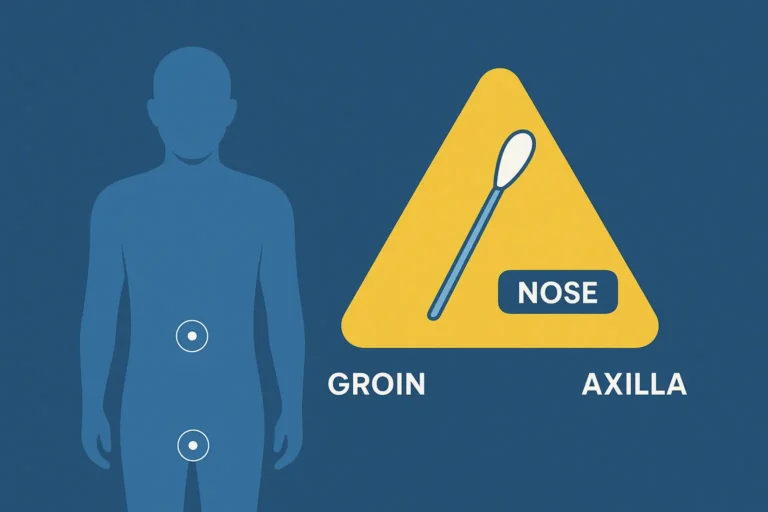
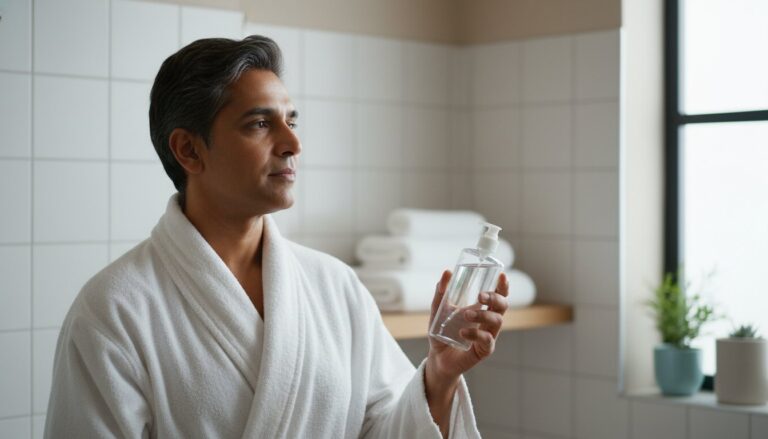
Chlorhexidine gluconate 4%, commonly known as Hibiscrub, is the standard external treatment. Unlike regular soap, you shouldn’t dilute this in bathwater. Wet your skin in the shower, turn the water off, and apply the wash directly to your body like a lotion. Pay close attention to the “high-colonisation” areas: the armpits, the navel, and the groin. Leave it on your skin for about three minutes before rinsing thoroughly. You must also wash your hair with the solution twice during the five days, typically on day one and day four. If you have eczema or sensitive skin, your doctor may prescribe Octenisan as a gentler alternative.
Common side effects to monitor
Most people tolerate these products well, but mild reactions can occur. You might notice slight skin dryness or a “tight” feeling after using the body wash. Nasal ointments can occasionally cause a brief tingling sensation or a few sneezes immediately after application. These are generally normal and don’t require you to stop the treatment. However, if you develop a widespread itchy rash, severe redness, or any difficulty breathing, stop the treatment immediately and seek medical advice from your GP or hospital team.
Understanding the timeline is vital for Verifying Success: What Happens After the 5 Days? as follow-up swabs are usually taken 48 hours after the course finishes. This gap allows the clinical team to see if the bacteria return once the active medication is no longer being applied. Following the mrsa decolonisation process uk guidelines exactly as written is the most effective way to ensure these follow-up tests come back negative, allowing your medical procedures to move forward safely.
Environmental Control: Managing Your Home During Decolonisation
Effective decolonisation isn’t just about applying nasal ointments and using antiseptic body washes. MRSA is a resilient organism that can survive on dry surfaces like dust, fabric, and hard furniture for up to 38 weeks. If these environmental factors aren’t managed, the bacteria can quickly re-colonise your skin as soon as the 5-day treatment finishes. Creating a clinical environment at home ensures that the mrsa decolonisation process uk patients undergo is successful and lasting.
The 5-day treatment window requires a strict “clean start” rule for every fabric that touches your body. This protocol aims to eliminate the reservoir of bacteria in your immediate surroundings while you’re actively reducing the bacterial load on your skin. Following the MRSA decolonisation process accurately means treating your home with the same level of discipline as your personal hygiene routine. By breaking the cycle of shedding and re-acquisition, you protect yourself and other household members from potential infection.
Bacteria persist on household items because they thrive in organic matter, such as shed skin cells and hair. During your decolonisation programme, you’ll be shedding bacteria that have been weakened by the antiseptic washes. If these remain on your bedding or sofa, they can easily find their way back to your skin. Maintaining a high standard of environmental cleanliness is a simple but vital step in ensuring your screening results return as negative after the treatment period.
Daily laundry and bedding changes
Towels and flannels must be changed after every single wash to prevent the transfer of bacteria back onto your clean skin. This is a non-negotiable part of the protocol because damp fabrics are the perfect breeding ground for staphylococcal bacteria. You should also follow these specific laundry guidelines:
- Wash all bedding, towels, and clothing at the highest temperature the fabric allows, ideally at 60°C or above, to kill the MRSA germ.
- Use fresh pyjamas every single night of the 5-day protocol to ensure you aren’t sleeping in a concentrated area of shed bacteria.
- Don’t overload the washing machine; clothes need enough space to move so that the heat and detergent can reach every fibre effectively.
- Dry items in a tumble dryer on a high heat setting if possible, as the heat provides an extra layer of decontamination.
Hygiene in shared spaces
Shared areas in the home require extra attention, particularly high-touch surfaces that multiple people use throughout the day. You don’t need to isolate yourself from your family or stay in one room. However, you must be disciplined about not sharing personal items like razors, toothbrushes, or hairbrushes. Focus your cleaning efforts on door handles, taps, and toilet flushes, using a standard household disinfectant or 70% alcohol wipes at least twice a day.
Your family and pets can remain in the home, but they should be aware of the 5-day programme. Pets can occasionally carry MRSA in their fur, so it’s wise to limit close contact, such as sleeping on the same bed, during these five days. Hand hygiene remains the primary defence for everyone in the household. Encourage family members to wash their hands with soap and water frequently, especially after touching communal surfaces. This collective effort makes the mrsa decolonisation process uk residents follow far more effective and reduces the risk of the bacteria moving between people. If you have any open wounds or eczema, keep these covered with clean dressings to prevent the bacteria from spreading into the environment.
Verifying Success: What Happens After the 5 Days?
Completing the five-day treatment programme is a significant milestone, but it doesn’t automatically mean the bacteria has been eradicated. You must enter a strict “clearance” period to confirm the treatment worked. This involves waiting at least 48 hours after your final dose of nasal ointment and antiseptic body wash before any re-testing begins. This 48-hour pause is vital; it ensures the laboratory results aren’t skewed by the lingering effects of the antiseptic products, which could provide a false sense of security.
Most UK hospitals and clinical protocols require three consecutive negative sets of swabs before they’ll classify you as “clear.” These sets are typically taken 48 to 72 hours apart. If any one of these swabs returns a positive result, the mrsa decolonisation process uk is generally considered unsuccessful and must be repeated. Data from various NHS trusts suggests that approximately 15% to 20% of patients require a second round of treatment. This often happens because the bacteria has found a “reservoir” in the home, such as on a shared towel or a frequently touched surface that wasn’t properly disinfected during the initial five days.
The infection control team plays a decisive role during this phase. They don’t just look at “positive” or “negative” results; they assess the site of the colonisation and your overall health status. If the bacteria persists, they might prescribe a different combination of topical agents or investigate if a family member or pet is unknowingly acting as a carrier, leading to re-colonisation. It’s a meticulous process designed to ensure that when you eventually enter the operating theatre, the risk of a surgical site infection is as close to zero as possible.
The re-screening process
Your clinical team will take swabs from several key areas: the nostrils, the throat, the armpits, and the groin. They’ll also check any active skin lesions, wounds, or catheter sites. These samples are sent to a UKAS-accredited laboratory where they’re cultured for 24 to 48 hours. If the mrsa decolonisation process uk has been successful, no Staphylococcus aureus growth will be detected. The infection control team reviews these results daily to coordinate your care and update your medical records.
Managing surgery timelines
Ideally, you’ll finish your treatment and receive your final negative result between 2 and 7 days before your operation. Clinical guidelines are strict about these windows. If your surgery date is delayed by more than 28 days after your negative result, you’ll usually need a fresh set of swabs. This is because re-colonisation can occur quickly in community settings. Understanding Why an MRSA Test is a Crucial Part of Pre-Op ensures you’re prepared for these strict timelines and don’t face last-minute cancellations. If your date moves, contact your pre-assessment clinic immediately to see if you need to repeat the screening.
Don’t leave your surgical safety to chance. Confirm your status with a professional MRSA test kit and ensure your decolonisation has been successful before your hospital admission.
Taking Control: Private MRSA Testing and Your Surgery Date
Securing a surgery date in the UK often involves months of waiting and significant personal preparation. The final hurdle is the hospital pre-assessment, where MRSA screening is mandatory. If you test positive at this late stage, your surgery will almost certainly be postponed. This delay isn’t just a minor inconvenience; it can set your recovery back by weeks or even months while you begin the mrsa decolonisation process uk hospitals require. Taking a proactive approach by testing privately allows you to identify colonisation early, giving you the window needed to clear the bacteria before your official NHS appointment.
Most patients don’t realise that roughly 1 in 30 people carry MRSA on their skin or in their nose without showing any symptoms. When you wait for the hospital to conduct the test, you’re leaving your surgery date to chance. A positive result found 48 hours before an operation causes a logistical nightmare for both the patient and the surgical team. By choosing to test early, you gain the peace of mind that comes with knowing your status. If the result is positive, you can complete the five day treatment of antimicrobial body wash and nasal cream well in advance of your hospital screening.
Why choose a private home test kit?
Speed is the most significant factor when surgery is approaching. Our PCR rapid test provides molecular detection results within 24 hours of the sample reaching our lab. In contrast, standard NHS culture tests can take up to five days to process. This rapid turnaround is vital if your pre-op appointment is fast approaching. You’ll receive a clear, professional report from a UKAS-accredited facility, ensuring the same clinical-grade reliability you would expect from a hospital laboratory.
Discretion also plays a major role for many of our clients. Testing from the comfort of your own home means you don’t need to visit a clinic or explain your concerns to a GP. The results are delivered securely and privately to you. This allows you to manage your health data without it immediately impacting your official medical records. It’s a simple, confidential way to ensure you’re “theatre ready” without the stress of a public waiting room.
Ordering your MRSA kit from mrsatest.co.uk
The process of using a home kit is designed to be straightforward and stress-free. Each kit contains everything you need to collect samples from the primary colonisation sites: the nose and the groin. The instructions are written in plain English, guiding you through the swab collection in less than five minutes. We provide free, discreet shipping in plain packaging to protect your privacy, along with a prepaid tracked return envelope to send your samples directly to our UK partner laboratory.
- Simple Swab Collection: Clear steps for nose and groin samples ensure accuracy.
- Prepaid Returns: Use the included Royal Mail tracked envelope for fast delivery to the lab.
- Secure Results: Access your report through a confidential digital portal as soon as it’s ready.
- UK-Based Expertise: All samples are processed in accredited UK labs for maximum reliability.
Don’t let a surprise screening result derail your medical plans. Identifying a colonisation early means you can start the mrsa decolonisation process uk protocols on your own terms. This ensures that when you arrive for your hospital pre-assessment, you can do so with the confidence that your surgery will proceed as scheduled. Order your private MRSA test kit today to ensure your surgery stays on track and take the uncertainty out of your pre-operative preparation.
Secure Your Surgery Date With Confidence
Successfully navigating the mrsa decolonisation process uk requires discipline over the prescribed 5-day treatment period and careful management of your home environment. By strictly following the nasal cream and body wash protocol, you significantly reduce the risk of post-surgical infections. Accuracy matters when your health and surgery date are on the line. You don’t have to wait for weeks to find out if your treatment worked. Our 100% UK-based professional service provides the clinical clarity you need to proceed with your medical plans without unnecessary delays.
We partner with a UKAS-accredited laboratory to ensure every sample is processed to the highest standards of safety and precision. If you need answers quickly, our rapid PCR testing option delivers results within 24 hours. Taking this proactive step ensures your hospital admission remains on track and your recovery stays the priority. Order your confidential MRSA test kit online today and get the professional reassurance you deserve. You’re in safe hands, and we’re here to help you move forward with total peace of mind and complete confidence in your results.
Frequently Asked Questions
How long does the MRSA decolonisation process take in the UK?
The standard MRSA decolonisation process in the UK typically lasts for 5 consecutive days. During this specific timeframe, you apply a prescribed nasal ointment three times daily and use an antiseptic body wash once per day. It’s essential to complete the full 5-day course without interruption to ensure the bacteria are effectively suppressed before your scheduled hospital admission or surgical procedure.
Can I go to work while undergoing MRSA decolonisation?
You can usually continue to go to work while undergoing the mrsa decolonisation process uk. Colonisation means the bacteria live on your skin without causing an active infection, so you aren’t considered ill. However, if you work in healthcare or food handling, you must inform your employer immediately. Approximately 33% of the population carries Staph bacteria, so being colonised is a common and manageable situation.
What happens if I miss a dose of the nasal cream or body wash?
If you miss a dose of your nasal ointment or antiseptic wash, apply it as soon as you remember. Don’t apply a double dose to make up for the one you missed. To maintain the 5-day schedule, simply continue the treatment as planned. Consistent application is key, as missing more than two doses might require you to restart the entire protocol to ensure clinical effectiveness.
Do I need to wash my hair every day during the 5-day protocol?
You typically only need to wash your hair twice during the 5-day treatment period. Most UK hospital protocols suggest using the antiseptic wash as a shampoo on the first and second days of the process. Ensure the wash stays on your scalp for at least 1 minute before rinsing. For the remaining 3 days, you can use your regular shampoo and conditioner if you prefer.
Is MRSA decolonisation permanent?
MRSA decolonisation isn’t always permanent. The primary goal is to clear the bacteria temporarily to reduce the risk of infection during surgery or hospital stays. Studies show that up to 25% of patients may become recolonised within 12 weeks of treatment. If you’re frequently in clinical environments or have long-term health conditions, you may need periodic screening to monitor your status and protect your health.
Can my family catch MRSA from me during the decolonisation process?
There’s a small risk of passing MRSA to family members through close physical contact or shared items. To prevent this, don’t share towels, flannels, or bed sheets during your 5-day treatment. Changing your bedding and towels daily can reduce the risk of transmission by 40%. Your family doesn’t usually need treatment unless they have weakened immune systems, skin conditions, or open wounds.
What should I do if the antiseptic wash makes my skin sore?
If the antiseptic wash causes skin soreness, redness, or itching, stop using it immediately and contact your GP or pre-operative assessment team. Skin irritation occurs in roughly 2% of patients using Chlorhexidine-based washes. Your clinical team can provide a gentler alternative, such as Octenisan or povidone-iodine, to ensure you can safely complete your mrsa decolonisation process uk without further discomfort.
How soon after decolonisation can I have my surgery?
Surgery is usually scheduled to take place within 24 to 48 hours after you complete the 5-day decolonisation course. This precise timing ensures the bacterial load on your skin is at its lowest possible level when the procedure occurs. If your surgery is delayed by more than 7 days, your clinical consultant might ask you to repeat the protocol to maintain high safety standards.