
MRSA Screening Before Surgery UK: A Complete Patient Guide
Preparing for an operation can bring a mix of anticipation and anxiety. The last thing any patient wants is the worry of a last-minute cancellation or the risk of a post-operative infection. This is precisely why a simple MRSA screening before surgery in the UK has become a crucial and standard part of the pre-operative process. It is a routine safety measure designed to protect you and ensure the best possible outcome for your procedure, removing a significant source of stress from your journey.
In this complete patient guide, we provide clear, professional, and reassuring information to help you feel prepared. You will understand exactly why this screening is so important, what the testing process involves, and what your options are-especially if you need a fast, convenient, and confidential result for a short-notice procedure. Our goal is to demystify the process, allowing you to focus on your recovery with confidence, knowing that your surgery can proceed safely and on schedule.
Key Takeaways
- Understand that MRSA screening is a routine safety measure in UK hospitals designed to protect you from post-operative infections.
- Learn what to expect during the screening process, which consists of a quick, simple, and painless swab collection from specific areas of the body.
- A positive MRSA test result does not mean your surgery will be cancelled; discover the simple treatment steps required to proceed safely.
- Explore your pathways for mrsa screening before surgery uk, from the standard NHS route to the option of a fast, confidential at-home test kit.
Why is MRSA Screening Essential Before Surgery?
If you are scheduled for an operation, you will almost certainly be asked to have an MRSA test. This is a completely routine and essential safety measure within UK hospitals, designed to protect your health and ensure the best possible outcome from your procedure. Taking proactive steps for safety, whether in healthcare or for personal assets like your vehicle, is key to peace of mind. For those also considering vehicle protection, you can visit Safe & Sound Mobile for nationwide security installations. The goal of MRSA screening is simple: to identify if you are carrying the bacteria before your surgery, allowing your medical team to take proactive steps for a safer experience.
This straightforward check is a vital part of pre-operative care, minimising risks for both you and other patients in the hospital.
Understanding MRSA: Colonisation vs. Infection
It is crucial to understand the difference between being ‘colonised’ with MRSA and having an MRSA ‘infection’. MRSA (Methicillin-resistant Staphylococcus aureus) is a type of bacteria resistant to several antibiotics. For a comprehensive background, you can read this guide on what MRSA is and how it functions. Many people carry these bacteria without any ill effects.
- Colonisation: This means the bacteria is living harmlessly on your skin or inside your nose or groin. You feel perfectly well and show no symptoms.
- Infection: This occurs only when the bacteria enters the body through a break in the skin, like a surgical wound, and begins to multiply, causing illness.
Surgery creates a deliberate entry point for bacteria. Think of screening like checking for termites before building an extension on your house; you want to identify any potential issues before creating a new vulnerability. This is precisely why the standard practice of MRSA screening before surgery in UK hospitals is so important.
The Goal: Preventing Surgical Site Infections (SSIs)
The primary objective of pre-operative screening is to prevent a serious complication known as a Surgical Site Infection (SSI). An SSI is an infection that develops in the part of the body where the surgery took place. While you are colonised, MRSA poses little threat. However, if it enters a surgical wound, it can cause a stubborn infection that is difficult to treat and may lead to a longer recovery period.
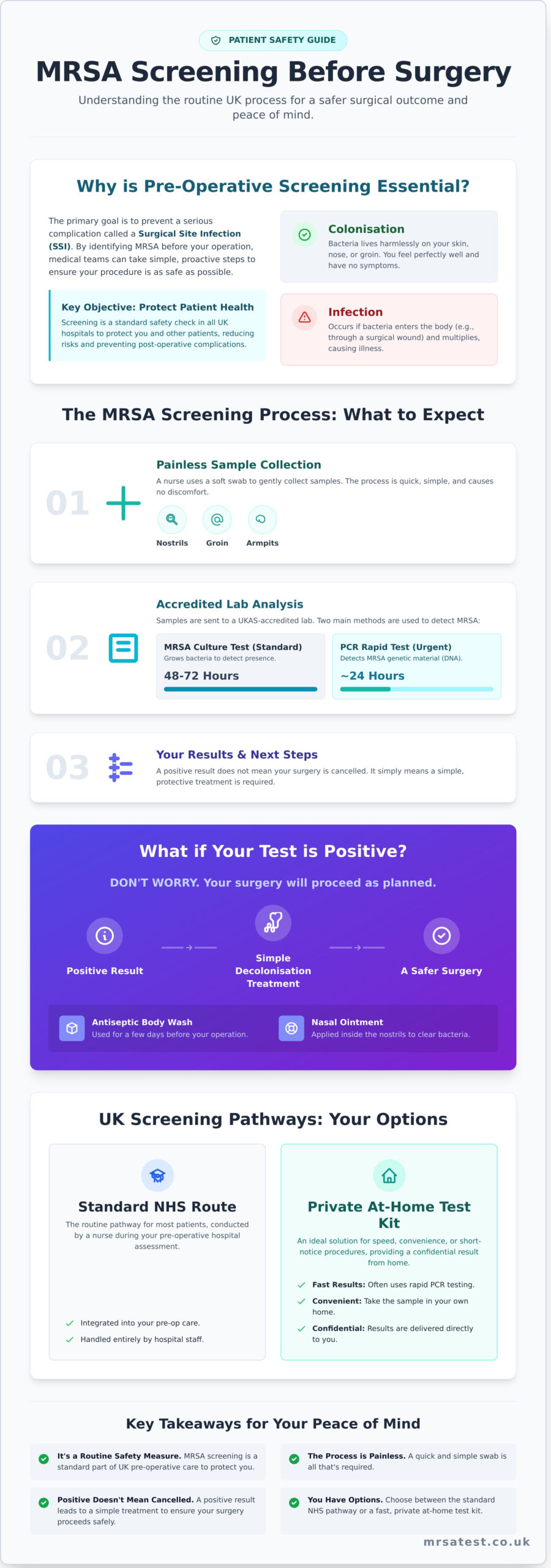
By identifying MRSA carriers beforehand, hospitals can provide a simple decolonisation treatment. This typically involves using a special antiseptic body wash and a nasal ointment for a few days before your operation. This proactive step dramatically reduces the amount of bacteria on your skin, significantly lowering the risk of an SSI and making your procedure much safer. It is a testament to the proactive safety culture in modern healthcare.
The MRSA Screening Process: What to Expect
The idea of being tested for MRSA might sound daunting, but the screening itself is a straightforward, quick, and entirely painless procedure designed to ensure your safety. The goal is not to diagnose an infection, but to check if MRSA bacteria are harmlessly present on your skin or in your nose-a state known as ‘colonization’. This proactive step is a routine part of the mrsa screening before surgery uk pathway. Understanding what to expect can help demystify the process and provide complete peace of mind before your operation.
How and Where the Sample is Taken
In most NHS settings, this screening is conducted by a nurse during your pre-operative assessment appointment. They will use a soft, cotton-bud-like swab to gently collect a sample from the surface of your skin. The collection takes only a few seconds. The most common areas for swabbing are those where MRSA is often found:
- The inside of both nostrils
- The groin area (near your underwear line)
- The armpits
If you have any open wounds, skin lesions, or use medical devices like a catheter or feeding tube, these sites will also be swabbed to ensure a comprehensive screening. For those opting for an at-home test kit, the process is just as simple and reliable. Clear, step-by-step instructions guide you on how to take the sample yourself from the comfort of your home, offering a confidential and convenient alternative. The swab is soft and only needs to be lightly wiped over the specified areas; it is not invasive and causes no discomfort.
From Swab to Result: Culture vs. PCR Analysis
Once your sample is collected, it is securely packaged and sent to a UKAS-accredited laboratory for expert analysis. There are two primary methods used to detect MRSA. The standard method is an MRSA Culture Test. This involves placing the sample in a special dish with nutrients that encourage bacteria to grow. If MRSA is present, it will become detectable within 48-72 hours. For more urgent pre-surgical situations, a faster PCR (Polymerase Chain Reaction) rapid test is often used. This advanced molecular test doesn’t need to wait for bacteria to grow; instead, it directly detects MRSA’s genetic material (DNA). This allows for a highly accurate result, often within 24 hours. The NHS provides comprehensive guidance on The MRSA Screening Process and the steps that follow a result. The type of test used determines how quickly your results are ready, a crucial factor in the mrsa screening before surgery uk pathway.
What Happens If Your MRSA Test is Positive?
Receiving a positive MRSA test result can be worrying, but the first and most important thing to know is that this does not usually mean your surgery will be cancelled. It simply indicates that you are ‘colonised’ with the bacteria, meaning it’s living harmlessly on your skin or in your nose without causing illness. To protect you from infection after your operation, your healthcare team will prescribe a simple, short, and effective treatment course.
This standard pre-operative procedure is known as ‘decolonisation’. The goal is not to treat an active infection, but to significantly reduce the amount of MRSA bacteria on your body before you enter the operating theatre. This simple precaution minimises the risk of the bacteria entering your surgical wound.
The Decolonisation Protocol
The standard treatment is straightforward and is carried out in the comfort of your own home. Your pre-op assessment nurse will provide you with a kit and clear instructions. Typically, the protocol lasts for five to seven days and includes a two-part approach:
- Antiseptic Body Wash: You will be given a special skin cleanser, often containing an active ingredient like chlorhexidine. You’ll use this daily instead of your usual soap or shower gel.
- Nasal Cream/Ointment: A small tube of antibacterial cream will be provided to apply to the inside of your nostrils, usually two to three times a day. This targets the main area where MRSA resides.
- Good Hygiene: You may also be advised to use freshly laundered towels, flannels, and bed linen during the treatment period to prevent re-colonisation.
Ensuring your home environment is clean and comfortable for your return is also a key part of preparing for recovery. For professional help with carpets and upholstery, services from companies like The Rutland Cleaning Company can ensure your space is fresh and hygienic.
This protocol focuses on external decolonisation. Alongside these specific medical instructions, many people also focus on supporting their body’s overall wellness to prepare for the upcoming procedure and recovery. For those exploring nutritional support as part of their preparation, women’s health specialists like Nutrahara can be a useful resource.
Preparing for any major life event, whether medical or celebratory, is all about feeling confident and ready. For gentlemen planning for a wedding, for example, finding the perfect suit is a key part of that preparation. If you’re looking for inspiration for custom tailoring, you can check out Your Tailor Robin.
Will My Surgery Be Postponed?
It is very unlikely your surgery will be postponed. Hospitals that conduct routine mrsa screening before surgery uk build time into their pre-operative schedules to allow for this exact scenario. It is a common and managed part of the patient pathway. The key is to start the treatment as soon as you are instructed.
In some cases, your hospital may require a follow-up screen after the treatment to confirm the decolonisation was successful. For this reason, it is vital to complete the full course exactly as prescribed by your medical team. Following the instructions carefully is the best way to ensure your surgery proceeds on time and with the lowest possible risk of infection.
UK Screening Pathways: NHS vs. Private At-Home Testing
When preparing for an operation, your mrsa screening before surgery uk pathway will typically follow one of two routes: the standard NHS process or a private at-home test. Both are effective, but they differ significantly in terms of speed, convenience, and process. Understanding these differences can help you make an informed choice based on your personal circumstances and timeline.
The standard NHS pathway is managed through your hospital’s pre-operative assessment clinic or your GP. In contrast, private testing offers a direct-to-consumer service, allowing you to manage the process yourself from home. Here’s a clear comparison:
| Feature | NHS Screening Pathway | Private At-Home Testing |
|---|---|---|
| Cost | Free at the point of care. | A paid, one-off fee for the kit and lab analysis. |
| Speed | Results typically take 2-5 days, but can vary by NHS Trust. | Rapid PCR results available within 24 hours of sample receipt. |
| Convenience | Requires a scheduled appointment at a clinic or GP surgery. | Sample is taken in the comfort and privacy of your own home. |
| Process | A healthcare professional takes the swab during your assessment. | You self-administer a simple swab using an easy-to-follow kit. |
Speed and Turnaround Time
NHS laboratory timelines can vary depending on the hospital trust and their current capacity. While reliable, you may wait several days for your result. For those needing certainty quickly, private testing offers a significant advantage. Our rapid PCR tests deliver definitive results within 24 hours of the sample arriving at our UKAS-accredited lab. This makes it an ideal solution for short-notice surgeries or for anyone seeking prompt peace of mind.
Convenience and Privacy
The primary benefit of at-home testing is the unparalleled convenience and discretion it provides. Rather than travelling to a clinical appointment, you can perform the simple swab test yourself at a time that suits you. The process is designed to be straightforward and stress-free. Your results are then delivered securely and confidentially via email or a secure portal, ensuring your privacy is maintained throughout. A private test for MRSA is particularly beneficial if you feel anxious about the screening and prefer to manage it in a familiar environment. Explore our fast and confidential MRSA test kits.
How to Use an At-Home MRSA Test Kit for Your Surgery
If you need to arrange your own pre-operative screening, an at-home test kit offers a fast, confidential, and clinically reliable solution. The process is designed to be simple and can be completed from the comfort of your home in just four straightforward steps. To ensure your results are accepted, it is vital to choose a reputable provider that uses a 100% UK-based, UKAS-accredited laboratory. Before ordering, we also recommend informing your surgeon or hospital’s pre-operative assessment team that you will be using a private service for your mrsa screening before surgery uk requirements.
Step 1 & 2: Ordering Your Kit and Collecting Your Sample
Ordering your test is a simple online process. Once you select the appropriate test (such as a culture or rapid PCR test), it will be dispatched in discreet, unbranded packaging directly to your door. Inside your kit, you will typically find:
- Sterile swabs for sample collection (usually for the nose, and sometimes groin or armpit).
- Clear, step-by-step instructions.
- A prepaid Royal Mail return envelope.
Follow the included guide carefully to collect your sample. It is a quick and painless process. For extra clarity, many providers also offer visual guides or videos on their websites to walk you through taking the swabs correctly, ensuring a viable sample for the lab.
Step 3 & 4: Posting Your Sample and Receiving Results
After collecting your sample, simply place it in the secure packaging and post it back using the prepaid Royal Mail envelope. The laboratory will begin processing it as soon as it arrives. You will receive your confidential results, usually via a secure email or online portal, within the timeframe specified for your test.
Once you have your official lab report, it is crucial to forward it directly to your surgical team or the pre-operative assessment clinic. This allows them to update your medical records and confirm that you are clear to proceed with your surgery, avoiding any potential delays. Taking control of your pre-op screening provides both you and your clinical team with valuable peace of mind.
Get your pre-surgery peace of mind. Order your test today.
Your Final Step Towards a Safe and Successful Surgery
Undergoing a procedure is a significant step, and ensuring your safety is paramount. As we’ve explored, MRSA screening is a simple yet critical measure to prevent post-operative complications and support a smooth recovery. Understanding your MRSA status, whether positive or negative, empowers you and your surgical team to take the correct precautions. This proactive approach is a cornerstone of effective mrsa screening before surgery uk protocols, providing you with essential peace of mind before your operation.
For a convenient and reliable solution, you can take control of your pre-operative preparation from the comfort of your home. Our test kits are processed by a trusted, UKAS-accredited UK laboratory, with a fast 24-hour PCR test option available for urgent results. Shipped in discreet packaging with free and fast delivery, your privacy and convenience are guaranteed.
Prepare for your procedure with confidence. Order Your Confidential Pre-Surgery MRSA Test Kit Today and take a crucial step towards a safe and healthy outcome.
Frequently Asked Questions About MRSA Screening
How long before surgery should I do my MRSA screening?
The ideal time for MRSA screening is typically 1 to 2 weeks before your scheduled surgery. This timeframe allows for the sample to be processed by the laboratory and provides enough time for any necessary decolonisation treatment if you test positive. However, you should always confirm the exact requirements with your hospital or surgical team, as their pre-admission policies can vary. Following their specific timeline is crucial for a smooth pre-operative process.
Does a positive MRSA test mean I am sick or contagious?
A positive result simply means you are “colonised” with MRSA, where the bacteria live harmlessly on your skin or in your nose. It does not mean you have an active infection or that you are sick. Most colonised individuals are healthy and pose no risk to others in daily life. The screening is a preventative measure to stop the bacteria from entering your body through a surgical wound, which could cause a serious post-operative infection.
Are at-home MRSA test kits as accurate as those used by the NHS?
Yes, when processed by a certified laboratory, at-home MRSA test kits are highly accurate. Reputable services use the same gold-standard testing methods (such as culture or PCR tests) that the NHS uses, and samples are analysed in UKAS-accredited facilities. The accuracy is determined by the laboratory’s quality, not the location where the sample is taken. This makes at-home testing a reliable, convenient, and confidential alternative for pre-operative screening.
Can I refuse to be screened for MRSA before surgery?
While you have the right to refuse any medical procedure, refusing a pre-operative MRSA screen is strongly advised against and may result in your surgery being postponed or cancelled. Screening is a standard safety protocol in UK hospitals designed to protect you and other patients from surgical site infections. If you have concerns, it is best to discuss them directly with your surgeon or pre-operative assessment nurse to understand the importance of the test.
What should I do with my private MRSA test result certificate?
Your private MRSA test result certificate is an official medical document that you must provide to your hospital or clinic. You should bring a printed copy to your pre-operative assessment appointment or email a digital copy to the surgical admissions team, as per their instructions. This document serves as official proof that you have met the screening requirements, ensuring your surgical procedure can go ahead as planned without any administrative delays.
If I’ve had MRSA in the past, will I need to be screened again?
Yes, you will need to be screened again. A past history of MRSA colonisation or infection means a new test is essential, as the bacteria can be cleared and then re-colonise later. Hospitals require a recent, negative result to confirm your status at the time of surgery. This is a vital part of the MRSA screening before surgery UK protocol to ensure the highest standards of patient safety and infection control are maintained.