
MRSA Screening for Care Home Residents: A Guide to Safety and Prevention
Did you know that individuals over the age of 75 are statistically 10 times more likely to develop a serious MRSA bloodstream infection compared to younger adults? It’s natural to feel anxious when a loved one moves into a communal environment, especially when you’re unsure whether the facility or the NHS is responsible for routine checks. This confusion often leads to unnecessary risks. Proactive mrsa screening for care home residents is a vital step in maintaining a safe, infection-free living space and providing the clinical protection your family deserves.
We understand that you want the best possible care without the stress of handling complex medical systems. You’ll discover why early detection is the most effective way to manage MRSA colonization, which is when the bacteria live on the skin without causing immediate illness. This guide explains the step-by-step screening process and how to organise discreet, reliable testing through a UKAS-accredited facility. By the end of this article, you’ll have the knowledge needed to secure your loved one’s health and gain true peace of mind regarding their status.
Key Takeaways
- Understand the vital difference between MRSA colonisation and active infection to ensure the right level of care and protection for your loved ones.
- Discover why communal living environments and age-related health factors make mrsa screening for care home residents an essential safety measure.
- Identify the common misconceptions regarding residential hygiene and learn why you cannot always rely on routine NHS testing for regular monitoring.
- Learn how to facilitate a discreet and comfortable swabbing process that maintains a resident’s dignity while providing clinical accuracy.
- Find out how private, UK-based testing kits offer a fast and reliable way to secure peace of mind from the comfort of a care home setting.
What is MRSA Screening for Care Home Residents?
MRSA screening for care home residents is a proactive health check designed to identify the presence of methicillin-resistant Staphylococcus aureus. This process involves a simple, non-invasive swab test usually taken from the nose, throat, or skin folds. It’s a standard procedure in UK care facilities because it helps staff manage risks before they become clinical issues. By identifying who carries the bacteria, homes can apply targeted hygiene protocols to keep everyone safe.
Understanding What is MRSA? is the first step in appreciating why these tests are vital. This specific bacterium has developed resistance to common antibiotics like methicillin and penicillin; this makes it much harder to treat if an infection develops. In a communal setting, screening acts as an early warning system to prevent “reservoirs” of bacteria from causing widespread outbreaks among vulnerable individuals.
Colonisation vs. Infection: What Families Need to Know
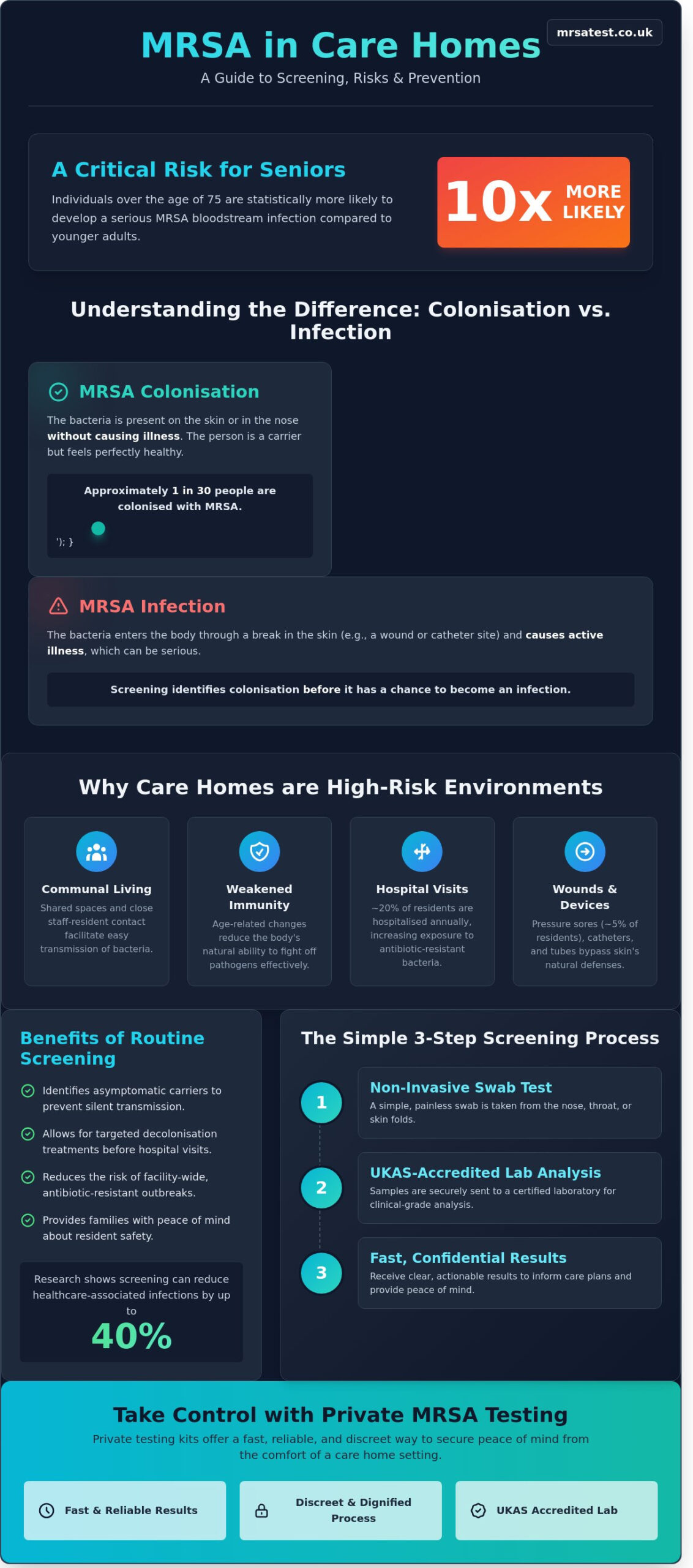
Families should understand that testing positive doesn’t always mean a resident is ill. Statistics suggest that approximately 1 in 30 people carry MRSA on their skin or in their nose without any adverse effects. MRSA colonisation is the presence of bacteria without clinical symptoms of illness. However, if a colonised resident undergoes a medical procedure or their immune system weakens, the bacteria can enter the bloodstream and cause a serious infection. Screening ensures that carers know when to take extra precautions during daily care routines to prevent this transition from colonisation to active illness.
The Goal of Resident Screening
The primary objective of mrsa screening for care home residents is safety through visibility. When a care home identifies a carrier, they can implement specific decolonisation treatments, such as antiseptic body washes or nasal creams, to reduce the bacterial load. This protects the individual and their neighbours. For families, screening provides peace of mind during the admission process. It ensures that the facility maintains a high standard of clinical oversight; research indicates that routine screening can help reduce healthcare-associated infections by as much as 40% in long-term care settings.
- Identifies asymptomatic carriers to prevent transmission.
- Allows for decolonisation before surgery or hospital visits.
- Provides a clear baseline for infection control audits.
- Reduces the risk of antibiotic-resistant outbreaks in communal areas.
Why Care Home Residents Are at Higher Risk of MRSA
Care homes provide essential support, but their communal nature creates a specific environment where bacteria can spread easily. Residents share dining areas, lounges, and bathrooms; meanwhile, staff members provide close personal care to multiple individuals throughout the day. This frequent physical contact makes mrsa screening for care home residents a necessary safety measure to prevent silent transmission between rooms.
Biological changes also play a significant role. As we age, our immune systems become less efficient at fighting off pathogens. Skin also loses elasticity and becomes thinner; this makes it more susceptible to minor tears or abrasions that allow Staphylococcus aureus to enter the bloodstream. The “revolving door” effect is another major factor. Data suggests that approximately 20% of care home residents are admitted to a hospital at least once a year. These clinical environments are often hotspots for resistant bacteria. Implementing a proactive MRSA screening process ensures that residents returning from hospital stays don’t unknowingly introduce the bacteria to the wider residential population.
Chronic health conditions often require the frequent use of antibiotics. While these drugs are necessary, they can disrupt the body’s natural flora, giving resistant strains like MRSA a competitive advantage. When a resident’s natural bacterial balance is weakened, colonization becomes more likely.
The Role of Chronic Wounds and Catheters
Clinical needs often increase the risk of colonization. Chronic wounds, such as stage 2 or 3 pressure sores and leg ulcers, provide a direct entry point for bacteria. Statistics indicate that roughly 5% of care home residents may have a pressure ulcer at any given time. Indwelling devices like urinary catheters or feeding tubes also bypass the body’s natural defenses. Regular screening is vital for these residents because colonization can quickly escalate into a serious infection if it’s not managed properly.
EMRSA-15: The Healthcare-Associated Strain
The UK Health Security Agency (UKHSA) identifies EMRSA-15 as a dominant strain in UK healthcare settings. It’s highly transmissible and specifically adapted to survive in residential care environments. Monitoring this strain requires precision and clinical expertise. Using a UKAS-accredited laboratory is the only way to ensure accurate identification of these specific resistant patterns. For families or managers seeking peace of mind, you can order a professional test kit to identify colonization quickly and discreetly. This helps maintain a high standard of safety within the home without causing unnecessary stress to the resident.
Common Misconceptions About MRSA in Residential Care
Many people believe MRSA only exists in poorly cleaned facilities. This is a dangerous myth. MRSA lives on healthy skin and can survive on dry surfaces for up to 7 months. It spreads through skin-to-skin contact or shared items like towels and linens. While high standards of hygiene are essential, they don’t eliminate the risk of colonization. Even the cleanest home can host the bacteria if a resident, visitor, or staff member is an asymptomatic carrier.
Another common misunderstanding involves the level of support provided by the state. You might think the NHS provides regular mrsa screening for care home residents, but routine testing is rarely proactive. National guidelines often limit NHS screening to patients entering hospital for high-risk surgeries. In a residential setting, testing usually happens only after a resident shows symptoms of an active infection. This reactive approach leaves a gap where carriers can unknowingly spread the bacteria to others. Viewing a test as a positive safety measure, rather than a cause for alarm, helps build a safer environment for everyone.
Is Screening Mandatory for Admission?
UK care home providers set their own infection control policies. While there’s no universal legal requirement, approximately 20% of private homes now request a “clear” screen before a new resident moves in. This protects their current vulnerable population from potential outbreaks. Waiting for a GP to arrange a swab can take 10 days or more. Using a private, UKAS-accredited service provides results in 24 to 48 hours, ensuring a smooth and fast transition into a new home without administrative delays.
The ‘Hospital-Acquired’ Label
We often associate these bacteria strictly with clinical wards. However, community-associated MRSA is now widespread across the UK. It’s no longer just about hospital acquired infections. Residents frequently move between their home and outpatient appointments, which increases exposure risks.
Screening before a hospital visit is just as important as testing after one. It ensures the resident doesn’t carry bacteria into a high-risk environment or bring a new strain back to their peers. Regular mrsa screening for care home residents bridges the gap between community living and clinical safety. Key benefits of proactive testing include:
- Early detection: Identifying colonization before it becomes a difficult-to-treat infection.
- Peace of mind: Families feel more secure knowing the home monitors for risks.
- Reduced transmission: Allowing for simple decolonization treatments that stop the spread to others.
Testing is a simple, discreet process. It’s a clinical tool used to maintain the health and dignity of residents, ensuring they receive the right care at the right time.
How the MRSA Screening Process Works
The mrsa screening for care home residents starts with a simple, non-invasive swabbing procedure. This process focuses on areas where the bacteria are most likely to live, specifically the nostrils, throat, and skin folds like the groin or armpits. Because the test only requires a gentle surface wipe, it doesn’t cause pain or distress to the resident. Maintaining dignity is a priority; residents can often use self-collection kits in private, or a trusted family member can assist if the resident feels uncomfortable with staff involvement.
Once the samples are collected, they’re sent to a UKAS-accredited laboratory for analysis. There are two primary ways the lab identifies the bacteria. A standard culture test involves growing the bacteria in a controlled environment, which typically takes 48 to 72 hours. Alternatively, an MRSA PCR rapid test uses molecular detection to provide results within 24 hours. A ‘negative’ result means no MRSA was found. A ‘positive’ result indicates ‘colonisation,’ meaning the bacteria are present on the skin but aren’t necessarily causing an active infection at that moment.
Step-by-Step Swab Collection Guide
To ensure accuracy, the swabbing must be done correctly. Use a sterile swab to gently rotate inside each nostril for about five seconds. For skin samples, focus on the groin or any areas of broken skin. These at home test kits in the UK are specifically designed for non-professionals to use safely. Once finished, place the swab in the transport tube, label it clearly with the date and time, and dispatch it to the lab immediately to prevent sample degradation.
What Happens After a Positive Result?
If a resident tests positive, the care home begins ‘decolonisation’ therapy. This isn’t a reason for alarm or social isolation. It usually involves a five-day course of special antiseptic body washes and antibiotic nasal creams, such as Mupirocin. The goal is to clear the bacteria from the skin surface to prevent future infections. After the treatment ends, the resident will wait two days before a follow-up test. Achieving three consecutive negative results is the standard way to confirm the resident is clear. Choosing a reliable method for mrsa screening for care home residents ensures that the environment remains safe and supportive for everyone.
Protect your loved ones with a professional and confidential service. Order your discreet MRSA test kit today for fast, laboratory-confirmed results.
Private MRSA Testing: Fast Results for Peace of Mind
Families often face long waiting lists for routine NHS screening, which can delay a resident’s admission to a new facility or stall necessary medical procedures. Opting for private mrsa screening for care home residents removes these hurdles by providing immediate access to testing. This proactive approach ensures that infection risks are managed before they become a problem for the wider care home community. It’s about taking control of the timeline rather than waiting for a busy system to catch up.
The benefits of at-home collection are particularly significant for elderly residents. Traveling to a hospital or clinic can be physically exhausting and emotionally distressing for those with mobility issues or cognitive decline. Our kits allow samples to be collected in a familiar, comfortable environment. This reduces stress for the resident and simplifies the process for family members or care staff. By choosing a private service, you get the same clinical accuracy found in a hospital without the logistical challenges of a clinical visit.
Confidentiality and Professionalism
We prioritize your trust by using only 100% UK-based, UKAS-accredited laboratory testing. This ensures that every sample is processed under strict quality controls and meets national clinical standards. Your sensitive health data is handled securely, and we deliver results through private, password-protected channels to maintain total confidentiality. All kits are dispatched in discreet packaging to protect resident privacy.
Choosing the Right Kit for Your Needs
Selecting the appropriate test depends on your specific situation and how quickly you need answers. We offer two primary options to suit different requirements:
- Nose/Groin Culture Test: This is the traditional method for identifying colonization. It involves growing a culture in the lab and typically provides results within 48 to 72 hours.
- Rapid PCR Option: For those who need answers urgently, the PCR test uses molecular detection to identify MRSA DNA. This method is highly accurate and provides results in as little as 24 hours after the lab receives the sample.
Understanding the clinical context of these tests is vital for making an informed choice. You can learn more by reading our guide on what is MRSA to see how colonization affects health. Using mrsa screening for care home residents allows for better infection control and provides the data needed to keep everyone safe. It’s a simple step that offers significant protection.
Order a confidential MRSA test kit today and get the professional results you need to ensure a safe environment for your loved ones.
Prioritise Safety with Proactive MRSA Screening
Ensuring the wellbeing of family members in residential care starts with proactive health management. Residents face increased risks due to shared living spaces and underlying health conditions, making regular testing a critical safety measure. Professional mrsa screening for care home residents identifies potential issues early, preventing the spread of infection and allowing for prompt medical intervention when it’s needed most. By choosing a private testing route, you bypass long waiting lists and gain immediate clarity on your loved one’s health status.
Addressing one aspect of health, like infection control, often highlights the need for a holistic approach to a resident’s wellbeing. Families may find themselves managing multiple complex issues, from chronic illnesses to behavioral health challenges such as addiction. Navigating these systems for support can be difficult, which is why independent advisory services are so valuable. For confidential help with substance abuse, for example, Detox Rehab Clinics UK offers free consultations to guide families toward appropriate care.
You don’t have to navigate this process alone or wait weeks for clinical updates. Our service utilises a UKAS-accredited partner laboratory to provide the same level of accuracy as a hospital setting. We offer discreet and fast UK-wide shipping so you can collect samples in total privacy. For those requiring immediate answers, our rapid PCR testing provides results in just 24 hours after the sample reaches our facility. It’s a straightforward way to gain clinical clarity from the comfort of home.
Order a Confidential MRSA Test Kit for Your Loved One
Taking this small step today provides the reassurance you need to ensure your loved one stays protected and healthy in their care environment.
Frequently Asked Questions
Is MRSA screening mandatory for all care home residents in the UK?
MRSA screening isn’t a universal legal requirement for every resident, but the Department of Health strongly recommends it for high-risk individuals. Most facilities follow the NICE clinical guideline CG139, which suggests screening for those admitted from hospitals or other clinical settings. While it’s not a blanket law, roughly 90% of UK care providers implement their own screening protocols to protect their vulnerable population. It’s a standard safety measure rather than a mandate.
How often should a resident in a care home be screened for MRSA?
Residents should undergo mrsa screening for care home residents during their initial admission and after any hospital stay exceeding 24 hours. The UK Health Security Agency advises regular monitoring if a resident has chronic wounds or indwelling devices like catheters. If an outbreak occurs within a facility, staff might perform weekly screenings until they achieve 3 consecutive negative results across the unit. This proactive approach ensures colonization is managed quickly and effectively.
Can a care home refuse admission if a resident tests positive for MRSA?
Care homes cannot legally refuse admission based solely on a positive MRSA result under the Equality Act 2010. According to the Health and Social Care Act 2008, providers must manage the risk through appropriate infection control rather than exclusion. As long as the facility can provide the required level of care and necessary isolation, a positive colonization status isn’t a valid reason to deny a resident their place in the home.
What is the difference between a PCR and a culture test for MRSA?
The main difference is speed and the specific information provided. An MRSA PCR rapid test offers molecular detection in 24 hours by identifying the bacteria’s DNA. In contrast, a culture test takes 48 to 72 hours because it requires growing the bacteria in a laboratory environment. While PCR is faster for initial screening, a culture test is essential for determining which specific antibiotics will effectively treat the infection if it’s present.
How long does it take to get MRSA screening results?
You can expect results within 24 to 72 hours depending on the testing method you choose. Our UKAS-accredited laboratory processes PCR tests within 1 business day of receiving the sample. Culture tests require a longer incubation period, typically taking 3 days to confirm a definitive result. We provide these results through a secure and confidential online portal, ensuring you get the information you need without any unnecessary delays or added stress.
Is the swabbing process painful for elderly residents?
The swabbing process is entirely non-invasive and shouldn’t cause any pain for elderly residents. It involves gently rubbing a sterile cotton swab over the skin’s surface, typically in the nostrils, throat, and groin area. Each site takes only 5 to 10 seconds to sample. Because there aren’t any needles or skin punctures involved, it’s a simple procedure that can be completed quickly without causing any physical distress or anxiety for the resident.
What are the first signs of an MRSA infection in the elderly?
The first signs often appear as skin changes that look like minor sores or painful insect bites. You should look for areas of redness, swelling, or warmth that feel tender to the touch. In many cases, these spots might produce pus or other types of drainage. If the infection spreads, the resident might develop a fever above 38°C or feel generally unwell, which requires immediate medical attention from a GP.
Can family members perform the MRSA swab for their relative?
Yes, family members can easily perform the swab using a dedicated home test kit. Our kits are designed for simplicity, allowing you to collect the samples from the comfort of your own home or a private room. Each kit includes clear instructions and pre-paid, discreet packaging for returning the sample to our trusted UK partner laboratory. This ensures the process stays private and comfortable while maintaining the highest level of clinical accuracy.