

Blog
How to Reduce the Risk of Surgical Site Infection: A Patient’s Guide

Mar
Did you know that according to NHS estimates, approximately one in every 20 patients in the UK develops an infection after surgery? It’s a statistic that can feel unsettling, and it’s completely understandable to be concerned about complications like MRSA or other “superbugs” when you’re preparing for a procedure. The good news is that you have a significant role to play in your own safety. You don’t have to be a passive participant; you can take proactive, evidence-based steps to protect yourself.
This guide is designed to give you that control. We will show you exactly how to reduce the risk of surgical site infection both before you enter the hospital and during your recovery at home. We’ll provide a clear pre-operative checklist, explain the importance of MRSA screening, and give you the trusted information you need to walk into the theatre feeling confident and prepared for a smooth recovery.
Key Takeaways
- Learn how your proactive involvement complements hospital safety measures, giving you more control over your surgical outcome.
- Identify the specific bacteria, including MRSA, that pose the greatest risk for post-operative complications and why they are a concern.
- Follow simple, evidence-based steps before your operation to reduce risk of surgical site infection, including specific skin preparation techniques.
- Discover how knowing your MRSA status with a simple pre-operative test is a critical step in creating a personalised infection prevention plan.
What is a Surgical Site Infection (SSI) and Why Does it Occur?
Following any surgical procedure, your primary focus is on a smooth and speedy recovery. However, one of the most common complications that can disrupt this process is a surgical site infection. A Surgical site infection (SSI) is clinically defined as an infection that occurs at or near the surgical incision within 30 days of an operation, or within one year if an implant, such as a knee joint or heart valve, was put in place. The fundamental cause is pathogen entry: when the skin is cut, its natural barrier is broken, creating an opportunity for bacteria that normally live harmlessly on your skin to enter the wound and multiply.
In the UK, SSIs represent a significant challenge within the NHS. They are the second most common type of healthcare-associated infection, with surveillance data from Public Health England suggesting they affect up to 1 in 20 patients who undergo surgery. These infections are not all the same; they are categorised by how deep they go:
- Superficial Incisional SSI: This is an infection of the skin layer only, right where the incision was made.
- Deep Incisional SSI: This affects the deeper soft tissues, such as the muscles and fascia beneath the skin incision.
- Organ or Space SSI: This is the most serious type, involving any part of the body, other than the incision, that was opened or manipulated during the operation.
The Impact of SSI on Your Recovery
An SSI can significantly delay your healing process, often leading to longer hospital stays, additional courses of antibiotics, and in some cases, further surgical procedures to clean the wound. Beyond the physical discomfort, the emotional and financial toll of an unexpected complication can be substantial, causing anxiety and extending time away from work. The reassuring news is that most SSIs are preventable, and understanding the risks is the first step towards a safer recovery.
Who is at Higher Risk?
While any patient can develop an SSI, several factors can increase your personal risk profile. It’s crucial to understand these so you can work with your healthcare team to effectively reduce risk of surgical site infection. Key factors include:
- Patient Health: Pre-existing conditions like diabetes can impair healing, while smoking reduces oxygen flow to the wound. Other factors include advanced age, obesity, or having a compromised immune system.
- Type of Surgery: Operations are classified by their contamination risk. A “clean” procedure, like a planned hernia repair, has a lower risk than a “contaminated” one, such as surgery on a perforated bowel, where bacteria are already present.
- Bacterial Load: This refers to the amount and type of bacteria present on your skin before surgery. A higher bacterial load, especially the presence of antibiotic-resistant bacteria like MRSA (Methicillin-resistant Staphylococcus aureus), directly elevates the risk of a post-operative infection.
The Role of MRSA and Staph Bacteria in Surgical Risks
To effectively reduce your risk of a surgical site infection (SSI), it’s vital to understand the primary bacteria involved. The most common culprit behind SSIs is a bacterium called Staphylococcus aureus, often shortened to “Staph”. For about one-third of the population, this bacteria lives harmlessly on the skin or in the nose. However, when it enters the body through a surgical incision, it can cause a serious infection.
A specific and more challenging strain of this bacteria is Methicillin-resistant Staphylococcus aureus, or MRSA. This is not a different type of bacteria, but rather a strain of Staph that has evolved to resist several widely used antibiotics. This resistance makes an MRSA-related SSI significantly harder to treat.
It’s crucial to distinguish between “colonisation” and “infection”. Colonisation simply means the bacteria is present on your body without causing any illness. You feel perfectly healthy. An infection occurs when the bacteria breaches your body’s defences, like a surgical wound, and begins to multiply, causing harm and symptoms like redness, pain, and fever. The primary concern for your surgical team is preventing colonised bacteria from causing an active infection.
Why Colonisation is the “Silent Risk”
According to the NHS, approximately 1 in 30 people in the UK are colonised with MRSA, typically in their nasal passages, and are completely unaware of it. This creates a silent risk. During a hospital stay, the bacteria can be transferred from your nose or skin directly into your fresh surgical wound. This is the most common pathway for an SSI to develop. Because of this, UK clinical guidelines from NICE (National Institute for Health and Care Excellence) often recommend pre-operative screening and nasal decolonisation with a special ointment for patients undergoing specific high-risk surgeries.
The Danger of Antibiotic Resistance
Treating an SSI caused by MRSA is far more complex than a standard Staph infection. The first-line antibiotics that doctors would normally prescribe are ineffective. This means your clinical team must use different, often more powerful, antibiotics which may have more side effects. Knowing your MRSA status before the first incision is made is a critical step to reduce risk of surgical site infection. This knowledge isn’t a cause for alarm; it’s a powerful tool for prevention. Identifying MRSA early allows your surgical team to implement a simple and effective pre-treatment plan, often involving an antiseptic body wash and a nasal ointment to clear the bacteria before your procedure. These proactive measures are central to international best practices, as detailed in the comprehensive WHO Global SSI Guidelines. For patients wanting complete peace of mind, an at-home MRSA screening test provides a confidential and accurate way to know your status well in advance of your hospital admission.
Hospital Protocols vs. Patient Action: Closing the Gap
When you enter a hospital for surgery, you are stepping into a highly controlled environment. UK hospitals adhere to stringent infection control standards designed to protect you. These protocols form the first line of defence against SSIs and typically include:
- Sterile Operating Theatres: Using specialised air filtration systems and rigorous cleaning procedures to minimise airborne pathogens.
- Prophylactic Antibiotics: Administering antibiotics shortly before your operation begins to help your body fight off potential infections.
- Antiseptic Skin Preparation: Thoroughly cleaning the surgical site with a powerful antiseptic solution immediately before the first incision is made.
These measures are incredibly effective, but they are part of a wider system. A significant limitation is that pre-operative MRSA screening is often reserved for patients classified as “high-risk.” This means that while the environment is sterile, the hospital may not know if a patient is unknowingly carrying MRSA on their skin, especially for procedures considered routine or “low-risk” like minor orthopaedic repairs or day surgeries. An infection following these procedures can still lead to significant complications and a difficult recovery.
This is where patient action becomes a powerful tool. By taking proactive steps, you can help close this gap and create an extra layer of security, ensuring you arrive for your procedure with total peace of mind.
Understanding NHS Screening Criteria
Within the NHS, MRSA screening is standard practice for specific elective procedures, such as heart surgery and major joint replacements, where the risk of a deep-seated infection is highest. While this risk-based approach is logical for managing resources, it means many patients fall outside the criteria. Choosing to self-test provides definitive confirmation of your MRSA status, empowering you with information you and your surgical team can act on. You can learn more by Understanding MRSA Screening Before Surgery.
The Swiss Cheese Model of Surgical Safety
Think of surgical safety as a series of barriers, much like slices of Swiss cheese stacked together. Each slice, from hand hygiene to sterile instruments, is a layer of protection. However, every layer has “holes,” or potential weaknesses. An error only occurs when the holes in every slice align. Adding your own pre-operative screening and hygiene regimen is like adding another slice of cheese to the stack. It makes it far less likely that any single weakness will lead to an infection.
By confirming you are MRSA-negative before your hospital admission, you actively lower the “bacterial pressure” on the clinical environment. This proactive approach is the hallmark of a well-prepared patient and is the most effective way to partner with your clinical team to reduce risk of surgical site infection. It’s not about mistrusting the hospital; it’s about contributing to a shared goal: your safe and successful recovery.
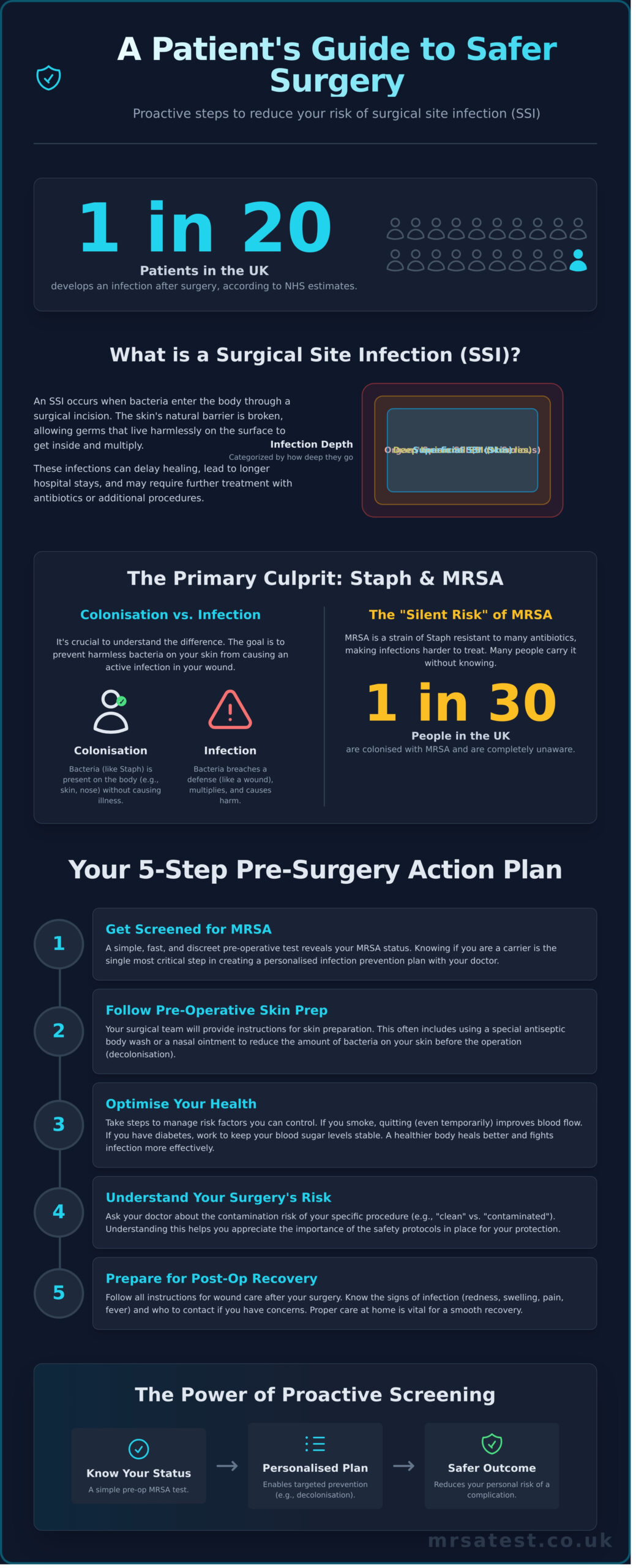
5 Steps to Reduce Your Risk of Infection Before Surgery
Your surgical outcome doesn’t just depend on the clinical team; it also depends on you. Taking an active role in your pre-operative care is one of the most effective ways to reduce risk of surgical site infection. These five evidence-based steps are designed to prepare your body for a safe procedure and a smooth recovery, putting you in control of your health.
1. Know Your MRSA Status with Pre-Operative Screening
Methicillin-resistant Staphylococcus aureus (MRSA) is a type of bacteria that can live harmlessly on the skin and in the nose of about 1 in 30 people. If it enters the body through a surgical incision, however, it can cause a serious and difficult-to-treat infection. That’s why pre-operative screening is a critical safety measure. Knowing your MRSA status allows your clinical team to take targeted preventative measures if needed, such as prescribing specific antibiotics or decolonisation treatments before your operation.
How to Perform an At-Home MRSA Test
Modern testing has made this process incredibly simple and convenient. A home test kit allows you to collect your own samples without a hospital visit. The process involves gently rubbing sterile swabs on the key areas where bacteria colonise: the inside of both nostrils, the groin, and sometimes the axilla (armpit). For urgent pre-operative needs, a PCR rapid test option provides highly accurate molecular detection with results in just 24 hours from receipt at our UKAS-accredited lab. To take this first proactive step, you can order a confidential MRSA home test kit today.
“Home screening provides clinical-grade accuracy without the need for additional hospital appointments.”
2. Prepare Your Skin with Antiseptic Washes
Your skin is your body’s first line of defence, but it naturally hosts a vast community of microorganisms. To prepare for surgery, your goal is to lower the number of bacteria on your skin to minimise the chance of them entering the wound. Your surgeon will likely instruct you to wash with a special antiseptic solution, such as one containing Chlorhexidine Gluconate (CHG), for a few days leading up to your procedure.
The Pre-Op Shower Routine
Follow the instructions provided by your hospital precisely. Generally, this involves a “head-to-toe” wash, paying special attention to the area around your planned surgical site. On the morning of your surgery, do not apply any lotions, deodorants, perfumes, or powders after your final antiseptic wash, as these can interfere with the solution’s effectiveness. It’s also vital to use freshly laundered towels and sleep in clean bedsheets the night before to avoid re-contaminating your skin.
3. Address Bacteria with Nasal Decolonisation
The nostrils are a primary reservoir for S. aureus bacteria, including MRSA. For this reason, your pre-operative plan may include nasal decolonisation. This typically involves applying a small amount of a prescribed antiseptic ointment or spray just inside each nostril, usually twice a day for the five days before your surgery. This simple, painless step directly targets bacteria where they often hide, forming a key part of the strategy to prevent infection.
4. Optimise Your Health with Lifestyle Adjustments
Strengthening your body’s natural defences is a powerful way to prepare for the stress of surgery. Two key lifestyle factors have a direct impact on your infection risk:
- Smoking Cessation: According to the World Health Organization (WHO), smokers have a significantly higher risk of post-operative complications, including surgical site infections. Nicotine constricts blood vessels, which reduces blood flow and oxygen delivery to the healing wound. Quitting, even just 4-6 weeks before surgery, can substantially improve your outcome.
- Blood Sugar Control: High blood sugar levels can weaken your immune system’s response and create an environment where bacteria thrive. For patients with diabetes, maintaining strict glycaemic control in the days and weeks before an operation is essential for a safe recovery.
5. Practice Excellent Hand Hygiene
It’s the simplest rule in infection prevention. Your own hands are a primary vehicle for transferring germs. Be diligent about washing your hands with soap and water at home, especially before touching your skin or applying any pre-operative treatments. This discipline helps prevent cross-contamination and is a cornerstone of how you can help your surgical team reduce risk of surgical site infection and ensure the best result.
Proactive Protection: Fast and Discreet MRSA Screening
Taking control of your health before an operation is the final, critical step to ensure a smooth recovery. While hospitals perform their own checks, confirming your MRSA status beforehand provides invaluable peace of mind and empowers you to work with your surgical team proactively. For patients in the United Kingdom, mrsatest.co.uk is the trusted, confidential source for pre-operative screening, giving you the knowledge you need to help reduce risk of surgical site infection and enter the hospital with confidence.
Our entire process is designed around your privacy and clinical accuracy. Every sample is processed at our 100% UK-based, UKAS-accredited partner laboratory, which operates under stringent ISO 15189 medical laboratory standards. This guarantees that your results meet the highest benchmarks for reliability. From the discreet packaging that arrives at your door to the secure delivery of your results, your confidentiality is our priority.
We understand that every patient’s timeline is different. That’s why we offer two distinct testing options to fit your specific needs. Our standard MRSA Culture Test is a reliable method that identifies the presence of the bacteria, with results typically available in 2-3 days. For those who need answers more urgently, we provide a state-of-the-art alternative.
Why Choose Our PCR Rapid Test?
Our MRSA PCR rapid test uses Polymerase Chain Reaction technology to detect the specific DNA of the MRSA bacteria. This molecular-level analysis is incredibly precise and delivers a definitive result within 24 hours of your sample arriving at our lab. It’s the ideal choice for patients with imminent surgery dates or for anyone who wishes to eliminate the anxiety of a longer waiting period. Your at-home kit arrives in plain, unbranded packaging for total discretion.
Simple Steps to Order Your Kit
Getting your pre-surgery screening is a simple, three-step process you can complete from the comfort of your own home. We’ve removed the hassle so you can focus on preparing for your procedure. The process works like this:
- Order Online: Place your order through our secure website in just a few minutes. Your test kit will be dispatched promptly.
- Self-Swab at Home: The kit contains everything you need, including simple, clear instructions for taking a painless swab sample.
- Return and Receive Results: Use the included Royal Mail Tracked 24 prepaid shipping label to post your sample back to our lab. Your confidential results will be delivered securely to you via your choice of email or phone call.
Knowing your status is a powerful way to take an active role in your surgical outcome. It allows for any necessary precautions to be taken well in advance, ensuring you and your clinical team are fully prepared. Don’t leave your health to chance. Order your pre-surgery MRSA test kit today and gain the assurance you deserve.
Take Control of Your Surgical Outcome
Preparing for surgery isn’t just a hospital procedure; it’s a partnership where your proactive steps play a vital role. You’ve learned how simple hygiene and open communication with your medical team make a significant difference. Most importantly, understanding your own MRSA status is one of the most powerful actions you can take to reduce risk of surgical site infection.
Taking this step is simple and confidential. Our at-home test kits are processed by UKAS-accredited UK partner laboratories, ensuring clinical accuracy you can trust. We provide discreet, plain-cover shipping for your complete privacy, and you can receive rapid PCR results within just 24 hours of the lab receiving your sample.
Secure your peace of mind-order your pre-surgery MRSA test kit now.
Entering your procedure with this knowledge empowers both you and your surgical team. Here’s to a smooth and healthy recovery.
Frequently Asked Questions
Can I reduce my risk of SSI if I am already in the hospital?
Yes, you can still take active steps. The most important action is practicing excellent hand hygiene and reminding your healthcare providers and visitors to do the same before touching you or your wound. Don’t be afraid to ask questions about your care plan and follow all instructions for looking after your incision site. Keeping the area clean and dry is crucial, so report any dressing issues or signs of leakage to your nurse immediately.
How much does a private MRSA test kit cost in the UK?
The cost of a private MRSA test kit in the UK varies by provider and test type. At mrsatest.co.uk, our confidential at-home MRSA Culture Test kit costs £59. For faster results, our MRSA PCR rapid test kit is available for £99. Both prices include the kit, all postage, processing at our UKAS-accredited partner laboratory, and your secure, confidential results. There are no hidden fees.
Is a surgical site infection always the hospital’s fault?
No, a surgical site infection is not always the hospital’s fault. While healthcare facilities follow strict infection control protocols, many SSIs are caused by bacteria already present on a patient’s own skin, like Staph aureus. Patient-specific factors, such as having diabetes, smoking, or being overweight, can also increase infection risk. Preventing an SSI is a shared responsibility between the healthcare team and the patient, both before and after surgery.
What are the first signs of a wound infection I should look for?
You should watch for several key signs of a developing wound infection. The most common indicators include increasing redness, swelling, or warmth around the incision area. Other signs are new or worsening pain, pus or cloudy fluid draining from the wound, a foul odour, or developing a fever over 38°C. If you experience any of these symptoms after your surgery, contact your GP or surgical team without delay for a professional assessment.
Does a pre-op shower really make a difference in infection rates?
Yes, a pre-operative shower with an antiseptic wash makes a significant difference. Your skin is a natural home for bacteria, and a special wash reduces the number of germs present before an incision is made. A 2014 Cochrane review confirmed that pre-operative showering or bathing helps to reduce the risk of surgical site infection. Following your hospital’s specific instructions for washing is a simple yet highly effective step in preparing for a safe procedure.
What happens if my MRSA test comes back positive before surgery?
If your MRSA test is positive, your surgery will most likely still go ahead as planned. A positive result simply means you are “colonised” with the bacteria. Your surgical team will prescribe a straightforward decolonisation treatment, which typically involves using an antiseptic body wash and a special nasal ointment for about five days leading up to your operation. This procedure is very effective at clearing the bacteria and making your surgery safer.
Can I use normal soap instead of antiseptic wash before my operation?
No, you should always use the specific antiseptic wash recommended by your surgical team. Normal soap is effective for general hygiene, but it doesn’t have the powerful germ-killing properties of a medical-grade antiseptic like chlorhexidine gluconate (CHG). The goal of a pre-operative wash is to drastically reduce the bacterial load on your skin to minimise infection risk, and only a prescribed antiseptic wash can achieve this level of cleanliness effectively.
How long does it take to get MRSA test results from mrsatest.co.uk?
Our turnaround times are designed for your peace of mind. For our standard MRSA Culture Test, you will receive your secure results within 2-3 working days after our UK-based lab receives your sample. If your needs are more urgent, our MRSA PCR rapid test provides a faster option, with results delivered confidentially within just 24 hours of the sample arriving at our laboratory. We will notify you by your chosen method as soon as they are ready.
