

Blog
What Infection Screening is Done Before Surgery in the UK? A Patient Guide

Jun
What if the most vital step in your surgical journey happens days before you even enter the operating theatre? It is natural to feel anxious about hospital-acquired infections or the fear that a positive test result might lead to a cancelled procedure. In the UK, pre-operative infection screening acts as a two-tier safety shield. It checks your blood for active illness and your skin for hidden colonisers. Understanding the process for mrsa screening before surgery uk is essential for any patient preparing for an elective operation. Under the latest GIRFT standards updated in May 2025, these protocols are now streamlined to ensure your safety and reduce unnecessary surgical delays.
We understand that the difference between a nasal swab and a blood test can be confusing when you are already managing pre-surgery nerves. You deserve to feel confident and supported by clinical experts through this simple, well-managed process. This guide provides the clear information you need to navigate your screening requirements with ease. We will explain exactly which tests are mandatory, how long you can expect to wait for your results, and the proactive steps hospitals take if a colonisation like MRSA is detected. You will learn how these professional diagnostics provide the peace of mind required for a safe and successful recovery.
Key Takeaways
- Learn why pre-operative screening is a mandatory safety step designed to prevent surgical site infections and ensure a smooth recovery.
- Understand the role of routine blood tests, such as the Full Blood Count (FBC), in identifying active systemic infections before you enter the operating theatre.
- Discover the standard protocols for mrsa screening before surgery uk, including which body sites are swabbed to detect bacteria that could complicate your healing.
- Gain clarity on the pre-op timeline and the typical turnaround times for laboratory results to help you plan your procedure with confidence.
- Find out how private at-home screening offers a discreet and efficient way to check your status early and avoid the stress of last-minute surgical cancellations.
Why Infection Screening is Mandatory Before Surgery in the UK
Hospitals in the UK operate under strict clinical safety protocols to ensure every patient has the best possible outcome. These rules exist because surgery naturally bypasses your body’s primary defence, which is your skin. When you undergo an operation, any bacteria present on your surface or in your nasal passages can find a way into your bloodstream or deep tissues. Pre-operative screening acts as your first line of defence. It identifies these hidden colonisers before they have a chance to cause complications during your recovery.
One of the most significant concerns for surgical teams is Methicillin-resistant Staphylococcus aureus (MRSA). While this bacterium often lives harmlessly on the skin of healthy people, it can become dangerous if it enters a surgical wound. Because it is resistant to several widely used antibiotics, treating an infection after it has started is much more difficult than preventing it in the first place. This is why mrsa screening before surgery uk is a standard, mandatory requirement for most elective procedures.
Screening protects you as an individual, but it also protects the wider hospital environment. By identifying carriers early, medical staff can implement decolonisation protocols. This prevents the spread of resistant bacteria to other vulnerable patients. It is a proactive approach that maintains the safety of the entire ward. You aren’t just being tested for your own sake; you’re part of a larger effort to keep UK hospitals free from preventable outbreaks.
Understanding Surgical Site Infections (SSIs)
A Surgical Site Infection (SSI) occurs when pathogens enter the body through the surgical incision. These infections are a primary reason for unplanned readmissions to UK hospitals. They don’t just delay your healing; they can lead to long-term health issues and additional surgeries. Screening allows the surgical team to use prophylactic antibiotics more effectively. When they know exactly what bacteria are present on your skin, they can provide targeted protection the moment the procedure begins. This quiet competence ensures your recovery stays on track.
The Role of NICE Guidelines in Pre-Op Testing
The National Institute for Health and Care Excellence (NICE) provides the framework that all UK hospitals follow. These guidelines ensure that testing is logical and risk-stratified. You won’t always need every possible test. For example, a minor procedure requires far less screening than a major joint replacement. Your medical history and the complexity of your operation determine your specific testing path. This tailored approach ensures you aren’t overwhelmed by unnecessary procedures while maintaining the highest standards of clinical safety and professional care.
Common Pre-Surgery Blood Tests for Infection Detection
While surface swabs identify bacteria living on your skin, blood tests provide a vital window into your internal health. These diagnostics allow clinicians to identify active systemic infections that might not be causing obvious symptoms yet. By checking your blood before an operation, the surgical team ensures your immune system isn’t already under strain. This proactive approach is a cornerstone of patient safety in the UK. Along with NHS guidance on MRSA screening, these blood-based diagnostics form a comprehensive safety net for every patient.
If a blood test reveals an underlying issue, it doesn’t necessarily mean your surgery will be cancelled. In many cases, it simply means the medical team will provide treatment, such as a course of antibiotics, to clear the infection first. This ensures you’re in the best possible condition for a successful recovery. Integrating these tests with your mrsa screening before surgery uk allows for a well-managed and predictable hospital experience. If you want to understand your status sooner, you can explore private MRSA screening options to gain peace of mind before your formal pre-assessment.
The Full Blood Count (FBC) and White Cell Levels
The Full Blood Count (FBC) is the most frequent blood test performed before surgery in the UK. It measures various components of your blood, with a particular focus on white blood cells. These cells are your body’s primary infection fighters. When white cell levels are elevated, a condition known as leukocytosis, it suggests your body is currently fighting a pathogen. Clinicians also monitor your platelets, as low platelet counts can significantly impact how well your blood clots during and after the procedure.
CRP and ESR: Markers of Inflammation
Clinicians often check for specific proteins that indicate inflammation. C-Reactive Protein (CRP) is a fast-responding marker that rises quickly if there’s acute infection or tissue damage. While CRP doesn’t tell doctors exactly where an infection is, it acts as a sensitive “red flag” that the body is not in an optimal state for surgery. Another test, the Erythrocyte Sedimentation Rate (ESR), tracks inflammation over a longer period. For a more detailed breakdown of these markers, you can read our guide on understanding blood tests.
Abnormal results in these markers often lead to a clinical review. For elective procedures, your surgeon might choose to delay the operation by a few weeks to allow your body to recover. This decision is always made with your long-term safety in mind. It’s far better to wait a short period for your immune system to stabilise than to risk the complications that can arise from operating while an infection is present.
Screening for Asymptomatic Colonisation: MRSA and CPE
Colonisation is a clinical term that sounds more alarming than it is. It simply means you are carrying bacteria on your skin or in your nasal passages without actually being ill. For most people, these bacteria are harmless residents that cause no issues in daily life. However, surgery changes the environment. When a surgeon makes an incision, these “hitchhiking” bacteria can enter your body and cause severe complications. This is why mrsa screening before surgery uk is a vital part of your pre-operative care, acting as a preventative measure to ensure your safety.
The screening process is straightforward and painless. A healthcare professional uses sterile swabs to collect samples from specific areas where bacteria tend to reside. These typically include your nostrils, throat, groin, or the axilla (armpit). According to NHS information on MRSA, these tests are usually performed during your pre-assessment clinic. By identifying these bacteria early, the clinical team can provide a decolonisation kit, which usually involves a special antiseptic body wash and nasal cream to clear the bacteria before your operation date.
While the NHS manages these screenings efficiently, pre-assessment clinics can sometimes be scheduled very close to your surgery date. If you’re anxious about a potential positive result causing a last-minute delay, seeking a private screen earlier in your journey can provide valuable peace of mind. This allows you to manage any necessary decolonisation in a private setting before your formal hospital appointment.
Why MRSA Screening is Crucial for Surgery
MRSA is particularly concerning because it has developed resistance to many standard antibiotics. If it enters a surgical wound, treating the resulting infection becomes significantly more complex. This risk is even higher for patients receiving metalwork or prosthetic implants, such as hip or knee replacements. Bacteria can adhere to these surfaces, making them very difficult to clear once an infection takes hold. You can learn more about these specific risks in our guide on What Is MRSA?.
CPE Screening: Protecting the Gut and Hospital
While MRSA lives on the skin, Carbapenemase-producing Enterobacteriaceae (CPE) are bacteria that typically live in the gut. These organisms are resistant to carbapenems, which are some of the most powerful antibiotics available to doctors. Screening for CPE is often required for high-risk patients, such as those who have recently stayed in other hospitals. This usually involves a rectal swab or a stool sample. Maintaining strict screening protocols for CPE is essential for upholding Hospital-Acquired Infection control standards, ensuring the safety of every patient on the ward.
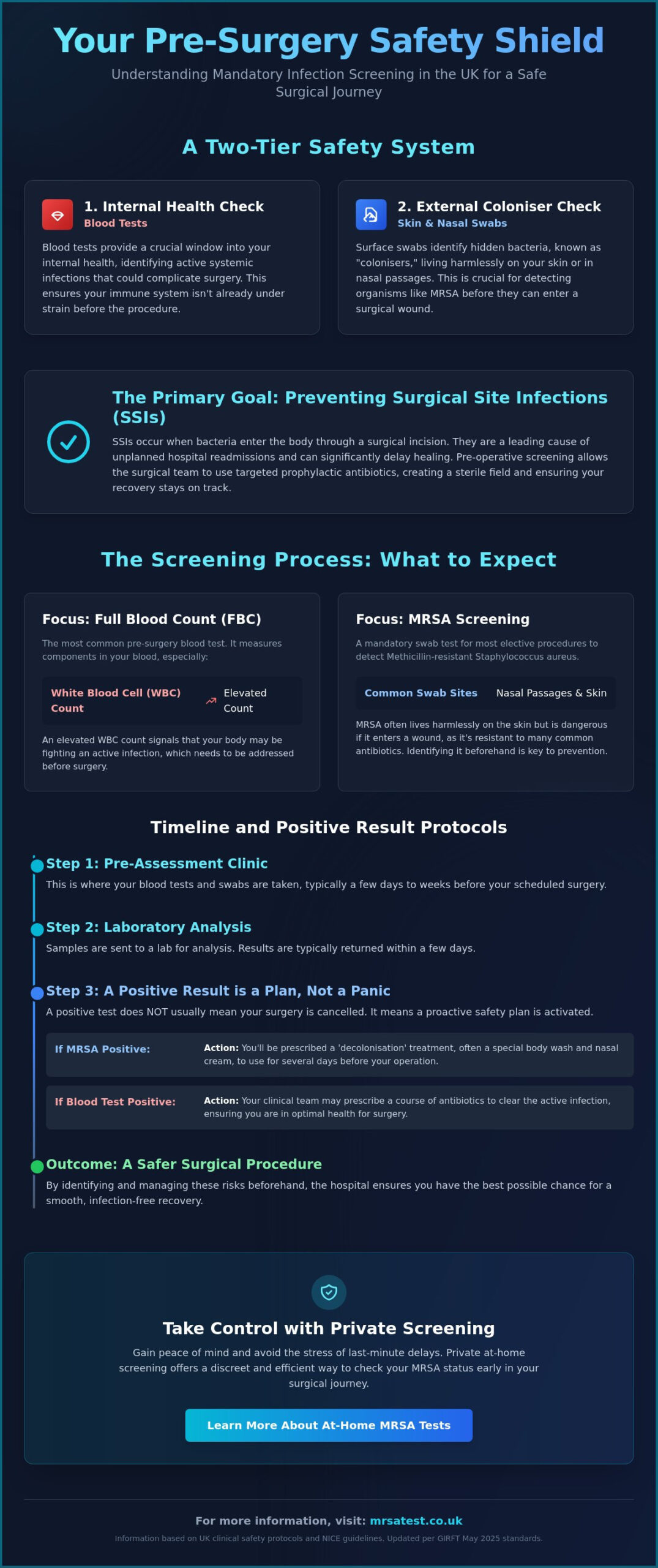
The Screening Timeline: What Happens if You Test Positive?
Planning for a procedure involves several logistical steps, and the timing of your tests is one of the most critical. Most pre-operative assessments in the UK occur between two and four weeks before your scheduled surgery date. This window allows the hospital enough time to process your results and act if any issues arise. When you undergo mrsa screening before surgery uk, the laboratory typically uses a culture method. These results usually take 48 to 72 hours to be processed, as the lab needs time to see if any bacteria grow from your swabs.
While standard cultures are thorough, some modern facilities now use rapid PCR testing, which can provide results in as little as 24 hours. Knowing your status early is the best way to prevent last-minute stress or the fear of a cancelled operation. If you want to avoid the uncertainty of waiting for hospital results, you can order a private MRSA test to confirm your status well in advance of your pre-assessment clinic.
It’s vital to remember that a positive test result rarely leads to a permanent cancellation of your surgery. In most cases, it simply means your care plan is adjusted to include a decolonisation period. This ensures that when you do enter the operating theatre, your risk of a surgical site infection is as low as possible. This proactive management is a hallmark of professional clinical care, designed to support a straightforward and safe recovery.
The Decolonisation Protocol (The Five-Day Plan)
If your screen returns a positive result for MRSA colonisation, your surgical team will provide a decolonisation kit. This isn’t a reason for alarm; it’s a standard clinical procedure. The treatment usually involves a five-day routine using a special antiseptic body wash, such as Chlorhexidine (CHG), and an antibiotic nasal cream. You apply these at home in the days leading up to your surgery to clear the bacteria from your skin and nostrils. It’s a simple, well-managed process that you can easily integrate into your daily routine.
Retesting and Clearance
Depending on the hospital’s specific policy and the type of surgery you are having, you might need a follow-up swab to confirm the bacteria has been cleared. For urgent procedures, surgeons may decide to proceed without a re-test by using enhanced antibiotic cover during the operation itself. This decision is always based on your individual risk profile and the clinical necessity of the surgery. To stay organised during this period, follow your specific Pre-Op Checklist to ensure you’ve completed every required safety step before your admission date.
Taking Control: Private MRSA Screening for Peace of Mind
NHS pre-assessment clinics are often scheduled just two or three weeks before your operation. While this system works for many, it leaves a very narrow window for results to be processed and acted upon. If you’re found to be a carrier of MRSA during this late stage, the sudden rush to complete a decolonisation protocol can add significant stress to an already anxious time. Choosing to arrange your own mrsa screening before surgery uk allows you to manage this process on your own terms. It eliminates the “wait and see” period that often accompanies hospital-led diagnostics, giving you back a sense of control over your surgical journey.
Knowing your status in advance is the most effective way to ensure your recovery stays on track. If a private test identifies colonisation, you have the luxury of time. You can begin the necessary skin and nasal treatments well before your formal hospital appointment. This proactive approach ensures that when you do arrive for your pre-op assessment, you can do so with the confidence that you’ve already taken every possible step to protect your health. It’s a simple way to replace uncertainty with quiet competence.
The Benefits of At-Home MRSA PCR Testing
Rapid PCR testing is a significant advancement in surgical preparation. Unlike standard hospital cultures that require several days to grow and identify bacteria, molecular PCR detection looks for the specific genetic signature of the bacteria. This allows the laboratory to identify MRSA within 24 hours of receiving your sample. Speed is not the only advantage. Our kits are designed for total privacy, allowing you to take swabs from your nose and groin in your own home. Every sample is processed in UK-accredited laboratories, ensuring you receive clinical-grade accuracy through a discreet and efficient service.
Preparing for Your Operation with mrsatest.co.uk
We’ve designed our service to be as straightforward and supportive as possible for patients awaiting surgery. The process is built around your convenience and peace of mind:
- Next-Day Delivery: Order your kit online and it will arrive at your door the next working day.
- Simple Collection: Follow the clear instructions to collect your samples in total privacy.
- Prepaid Return: Use our tracked, prepaid shipping to send your samples directly to our professional laboratory.
- Rapid Results: Receive your secure clinical report quickly, allowing you to plan your next steps with certainty.
By identifying your status early, you remove the fear of last-minute surgical cancellations. You can order your MRSA Test (PCR) today to ensure you’re fully prepared for your admission date. This professional screening service provides the clinical accuracy you need with the convenience of a non-clinical environment, letting you focus entirely on your recovery.
Ensuring Your Path to Surgery is Clear
Pre-operative screening is your first step toward a safe and predictable surgical outcome. By identifying potential risks like asymptomatic colonisation or underlying inflammation, you and your clinical team can ensure your body is in the best possible condition for healing. We’ve explored how these mandatory protocols, including the standard process for mrsa screening before surgery uk, protect both your health and the hospital environment from preventable complications. Understanding these requirements replaces anxiety with the confidence that your safety is the highest priority.
You don’t have to wait for your hospital appointment to gain peace of mind. Taking control of your diagnostics early allows you to manage your health with discretion and clarity. Our professional service provides fast 24-hour PCR results through accredited UK laboratory testing, all delivered via a discreet and confidential home service. You can Order Your Private MRSA Pre-Op Test Kit today to secure a certain path to your recovery. Our team is here to support you through every step of this simple, well-managed process, ensuring you feel prepared and empowered for your upcoming procedure.
Frequently Asked Questions
How long before surgery is MRSA screening done?
MRSA screening is typically performed between two and four weeks before your scheduled operation date. This timeframe ensures the hospital has sufficient time to review your results and initiate any necessary treatments. Under current GIRFT guidance updated in May 2025, a negative screen is often considered valid for three to six months, though this can vary depending on your specific hospital trust’s policy.
What happens if I test positive for MRSA before my surgery?
If you test positive, you will undergo a five-day decolonisation protocol to clear the bacteria from your skin and nose. This involves using a prescribed antiseptic body wash and an antibiotic nasal ointment. It is a standard clinical procedure designed to make your surgery safer. A positive result rarely leads to a permanent cancellation; it simply means your care is managed with extra precautions.
Do I need to be screened for infections if I am having minor surgery?
Screening requirements depend on the type of surgery and your individual risk factors. While major procedures like joint replacements or heart surgery always require mrsa screening before surgery uk, minor operations might not. Your surgical team will decide based on NICE risk-stratification guidelines and whether you are receiving a prosthetic implant or have a history of hospital admissions.
Can I do my pre-operative infection swabs at home?
You can perform your swabs at home by using a private screening kit. While the NHS usually performs these tests during a pre-assessment clinic appointment, private at-home kits offer a discreet and professional alternative. These kits include everything you need to collect samples from the nose and groin in total privacy before returning them to an accredited laboratory for analysis.
Is an MRSA test a blood test or a swab?
An MRSA test is a swab test rather than a blood test. Healthcare professionals use sterile swabs to collect samples from your nostrils and groin area, and sometimes your throat or armpits. Blood tests are performed separately during your pre-op assessment to check for systemic issues, such as high white blood cell counts or inflammation markers like C-Reactive Protein (CRP).
How long do pre-op infection test results take to come back?
The turnaround time depends on the specific laboratory method used. Standard culture tests, which involve growing the bacteria in a lab environment, typically take 48 to 72 hours. Rapid PCR tests are much more efficient and can provide results within 24 hours of the sample reaching the laboratory. Knowing your results quickly helps to minimise anxiety and supports better surgical planning.
What is the difference between MRSA colonisation and an MRSA infection?
Colonisation means the bacteria are living harmlessly on your skin or in your nose without making you ill. An infection occurs when those bacteria enter a wound or the bloodstream and cause symptoms like redness, swelling, or fever. The primary goal of mrsa screening before surgery uk is to identify colonisation so it doesn’t transition into a dangerous infection during your recovery.
Will my surgery be cancelled if I have a cold or minor infection?
Your surgery might be delayed if a minor infection, like a cold or chest infection, affects your clinical fitness for anaesthesia. Surgeons and anaesthetists review your white blood cell levels and inflammation markers to make this decision. If your immune system is currently compromised, delaying the procedure is often the safest professional choice to ensure you recover without further complications.
