What if your long-awaited surgery is cancelled just hours before the theatre door opens because of a single missing lab report? It’s a common fear for many patients, especially since the incidence of MRSA bacteraemia in the UK independent sector rose to 0.4 cases per 100,000 bed days during the 2023-2024 period. You’ve likely spent months preparing for your recovery, so the last thing you need is confusion over PCR versus culture tests or anxiety about being a carrier of a superbug.
We understand that meeting clinical requirements can feel overwhelming when you’re already focused on your health. This guide explains exactly what mrsa tests are required before a private hospital procedure uk so you can approach your admission with total confidence. Following the updated May 2025 GIRFT guidance, most private facilities now mandate specific screenings for any procedure involving prosthetics or high-risk specialities like orthopaedics and neurosurgery.
You’ll discover the precise swab sites required, such as the nose and groin, and learn why a 24-hour PCR test is often the most efficient way to secure a hospital-approved result. We provide a clear timeline for your screening to ensure you have your documentation ready for the admissions team, keeping your surgery date firmly on track from the comfort of your own home.
Key Takeaways
- Understand why leading providers like Nuffield and Spire mandate MRSA screening to maintain their CQC safety ratings and protect patient health.
- Compare the benefits of a standard MRSA culture test against a rapid PCR test, which offers molecular detection results in as little as 24 hours.
- Identify the specific swab sites your consultant expects, typically focusing on the nose and groin to determine what mrsa tests are required before a private hospital procedure uk.
- Learn how to manage your pre-operative timeline by testing 10 to 14 days before your surgery to ensure results stay within the required 4 to 6-week validity window.
- Discover how using a UKAS-accredited home testing kit provides a discreet and efficient way to secure the paperwork needed for your hospital admissions team.
Mandatory MRSA Screening Requirements for UK Private Hospitals
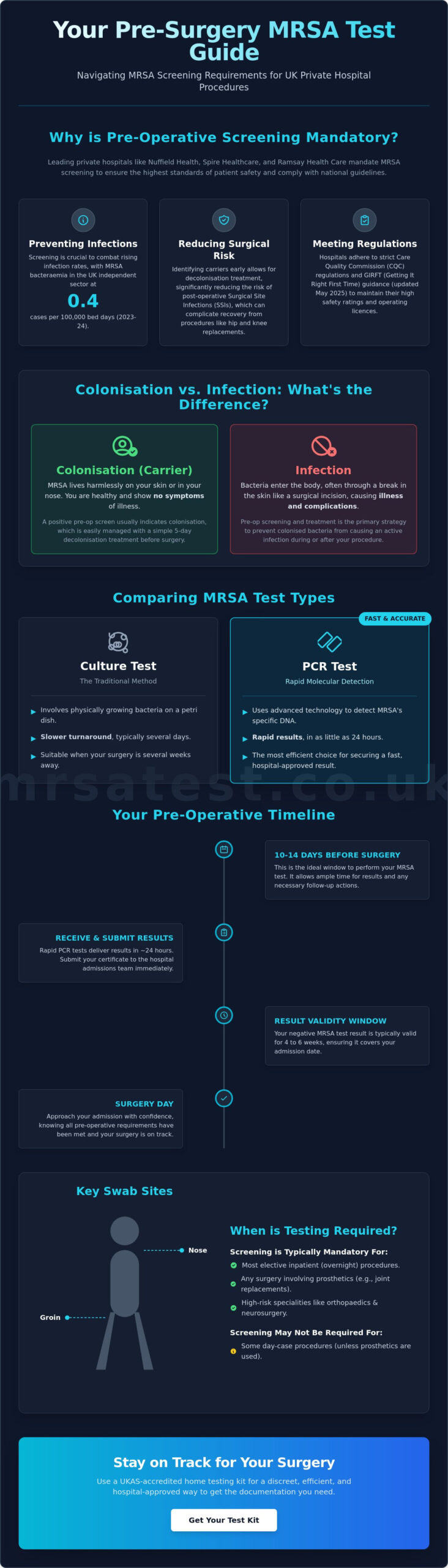
Private hospitals across the United Kingdom maintain some of the highest safety standards in clinical care. To protect these standards, pre-operative screening is a mandatory safety protocol for the majority of patients. If you are wondering what mrsa tests are required before a private hospital procedure uk, the answer depends largely on the nature of your surgery and the specific policy of your provider. Major groups like Ramsay Health Care, Nuffield Health, and Spire Healthcare require these tests to comply with Care Quality Commission (CQC) regulations and the updated Getting It Right First Time (GIRFT) guidance from May 2025.
The requirement for testing usually hinges on the level of clinical risk. Most elective inpatient procedures, where you stay overnight, require a full screen as a standard admission hurdle. Day-case procedures might not always require testing unless they involve the insertion of prosthetic material, such as a joint replacement or a pacemaker. These rules exist because the incidence rate of MRSA bacteraemia in the independent sector was recorded at 0.4 cases per 100,000 bed days in the 2023-2024 financial year, and private hospitals are determined to keep this figure as low as possible.
MRSA colonisation is the state of carrying the bacteria on your skin or in your nose without showing any active symptoms or signs of illness.
Why Private Consultants Insist on Pre-Op Screening
Your consultant prioritises your safety and the success of your procedure above all else. Screening significantly reduces the risk of surgical site infections (SSIs), which affected approximately 0.2% of private hip and knee replacement patients in 2018-2019. By identifying carriers early, the surgical team can implement decolonisation protocols before the first incision is made. This is also a matter of legal and insurance compliance; private facilities must prove they have followed all national infection control guidelines to maintain their operating licences. Preventing an infection isn’t just about patient health; it also avoids the significant post-operative care costs and extended recovery times associated with treating a superbug in a private clinical setting.
Colonisation vs. Infection: What Patients Need to Know
It’s common for patients to feel anxious if a test comes back positive, but it’s vital to understand the difference between being a carrier and being ill. Methicillin-resistant Staphylococcus aureus (MRSA) can live harmlessly on the skin of healthy individuals, a state known as colonisation. Being MRSA positive on a pre-op screen does not mean you are sick or that you have an active infection. However, once the skin is broken during surgery, these bacteria can enter the body and cause serious complications. Screening allows the hospital to identify these healthy carriers and provide a simple five-day decolonisation treatment, ensuring the surgical site remains protected and the bacteria don’t spread to other vulnerable patients in the facility.
Understanding the Different Types of MRSA Tests: Culture vs. PCR
When you’re determining what mrsa tests are required before a private hospital procedure uk, you’ll encounter two primary laboratory methods: the culture test and the PCR test. While both aim to identify the presence of bacteria, they function very differently once your samples reach the lab. A culture test is the traditional approach, involving the physical growth of bacteria on a petri dish. In contrast, a Polymerase Chain Reaction (PCR) test uses molecular technology to detect the specific DNA signatures of the bacteria. Most private hospitals accept both methods, but your choice often depends on your surgery date and how quickly you need your results.
The Healthcare Infection Society confirms that both methods are acceptable for pre-operative screening. However, the mechanism behind each affects both the cost and the turnaround time. According to NHS guidance on MRSA testing, the goal is to ensure you aren’t carrying the bacteria into a sterile surgical environment. If your admission is several weeks away, a culture test provides a reliable and cost-effective solution. If your procedure is scheduled for early next week, the speed of a PCR test becomes essential to avoid a last-minute cancellation.
The Standard MRSA Culture Test
A standard MRSA culture screen involves placing your swabs into a nutrient-rich environment to see if bacteria grow over time. This process typically takes between 48 and 72 hours. It’s often considered the traditional gold standard because it allows scientists to physically observe the live bacteria. While it’s a dependable method, the wait time can be stressful for patients who need immediate paperwork for their admissions team. It remains a popular choice for routine screenings where time isn’t a critical factor.
The Rapid MRSA PCR Test Option
If you’re on a tight deadline, the rapid PCR test is the most efficient choice. This method uses molecular detection to identify MRSA DNA directly from your sample. It’s incredibly fast; results are often available in as little as 24 hours after the lab receives your swabs. For patients with surgery scheduled within the next five days, PCR provides the fastest “Yes/No” answer possible. This speed ensures that even if you’ve left your screening late, you can still provide the necessary pass result to your private consultant without delay. You can easily order a rapid PCR kit online to ensure your surgery stays on schedule.
Choosing between these tests involves balancing your budget with your timeline. In the UK, a culture test for the nose and groin typically costs around £99.99, while a rapid PCR test for the same sites is approximately £129.99. While PCR carries a slightly higher price point, the peace of mind and guaranteed speed are often worth the investment for private patients. Regardless of the method you choose, the laboratory must be UKAS-accredited to ensure the results are accepted by your hospital’s infection control team.
Which Body Sites Need Swabbing? A Detailed Breakdown
To understand what mrsa tests are required before a private hospital procedure uk, you need to know exactly which areas of your body the clinical team is interested in. It isn’t a random selection. The protocol targets specific “reservoirs” where the bacteria are most likely to colonise. These are typically warm, moist environments that provide the ideal habitat for bacteria to live without being noticed.
The equipment used for this process is straightforward. Each test kit contains sterile applicators with soft, synthetic tips. Before you begin, you’ll usually moisten the tip with a few drops of sterile saline or water provided in your kit. This step is vital because a dry swab is far less effective at capturing the microscopic samples needed for an accurate lab result. Once moistened, the swab is applied to the skin with gentle pressure.
Standard Dual-Site Screening (Nose and Groin)
The nostrils and the groin (perineum) are the two standard sites required for almost every pre-operative screen in the UK. MRSA has a strong preference for the mucosal lining of the nose. To swab this area correctly, you’ll insert the tip about 1cm to 2cm into each nostril and rotate it gently against the inside wall. The groin is equally important because the skin there is frequently warm and moist. You’ll use a separate swab for this area, ensuring you cover the skin surface thoroughly. For more detail on why these specific areas are targeted, you can explore our what is MRSA guide.
Triple-Site and Wound Screening
Sometimes a consultant will request a “triple-site” screen. This involves an additional swab of the axilla, more commonly known as the armpit. This is standard practice for high-risk surgeries, such as heart valve replacements or complex joint surgeries. If you have any active skin lesions, such as eczema flares, psoriasis, or open cuts, these must also be swabbed. Bacteria are naturally drawn to broken skin, which increases the risk of a surgical site infection. According to the UK guidance on preoperative MRSA screening, patients with indwelling devices like catheters or ports will also need those entry sites tested.
Accuracy depends on following these instructions carefully. While it might feel slightly unusual to perform these swabs yourself, the process is designed to be simple and painless. Taking the time to swab each required site correctly ensures your results are robust enough to meet the strict standards of UK private hospitals. It’s the most reliable way to ensure your admission goes ahead without any last-minute delays or administrative hurdles.
The Pre-Operative Timeline: When to Test Before Your Procedure
Success in private healthcare depends heavily on precise timing. If you are researching what mrsa tests are required before a private hospital procedure uk, understanding the validity window is just as important as the test itself. Most private facilities, including Spire and Nuffield, require a negative result that is no older than 4 to 6 weeks at the time of your surgery. If your screening falls outside this window, the hospital’s infection control policy will likely mandate a repeat test, which can cause unnecessary stress in the days leading up to your operation.
We recommend a “safety buffer” of at least 10 to 14 days before your scheduled admission. This timeframe provides a vital cushion for laboratory processing and administrative reviews. More importantly, it accounts for the “decolonisation lead time.” If your result returns a positive finding, you’ll need enough time to complete a standard treatment protocol before you can be cleared for theatre. A positive MRSA result usually requires 5 days of specialised antiseptic washes and nasal creams before a re-test can be performed to confirm the bacteria has been cleared.
The 14-Day Countdown
To ensure a seamless journey, follow this reliable timeline for your pre-operative screening:
- Day 14: Order your testing kit or book your screening. This ensures the kit arrives at your home with plenty of time to spare.
- Day 10: Collect your swabs from the nose and groin and send them to the lab. Using a 24-hour PCR test at this stage is highly efficient.
- Day 7: Receive your results. Once you have your UKAS-accredited report, forward it immediately to your hospital’s pre-operative team to secure your slot.
What Happens During a Pre-Op Assessment UK?
Your pre-operative assessment is a final logistical check to ensure you are fit for surgery. For the pre-op nurse, a negative MRSA result is a critical “tick-box” item on your clinical record. The assessment team uses these results to finalise your theatre slot and prepare the surgical environment. Without this documentation, the hospital cannot guarantee the sterile conditions required by the CQC. You can use our preparing for surgery checklist to stay organised and ensure no paperwork is missed during this busy period.
Managing these logistics early is the best way to protect your mental well-being before surgery. By testing two weeks in advance, you eliminate the risk of a last-minute cancellation due to missing lab reports. If you’re nearing your surgery date, you can order a rapid PCR test today to get your results back in as little as 24 hours and keep your procedure on track.
How At-Home MRSA Testing Streamlines Your Private Healthcare Journey
Preparing for a major operation involves a long list of logistics. Adding a hospital visit just for a swab can feel like an unnecessary burden on your time and energy. By understanding what mrsa tests are required before a private hospital procedure uk, you can choose the most efficient path to compliance. At-home testing kits allow you to complete this mandatory step without leaving your house, ensuring your focus remains on your upcoming recovery.
These kits offer a level of discretion and convenience that traditional clinic appointments cannot match. Once you perform the swabs, the samples are sent directly to a UKAS-accredited facility for analysis. You don’t have to worry about NHS lab backlogs or waiting weeks for a letter in the post. Instead, you receive secure digital results that you can email directly to your private consultant or admissions nurse. This speed is especially crucial if your surgery was booked at short notice; it guarantees your paperwork is ready before the theatre doors open.
Reliability of Home Collection Kits
Some patients worry that a self-collected sample might be less accurate than one taken by a nurse. It’s a common misconception. Our home kits use the exact same clinical-grade swabs and laboratory processes found in private hospitals. The key to a valid result is using a 100% UK-based laboratory that adheres to strict quality standards. For a deeper look at how these systems work, you can read our at-home test kits UK guide. This ensures your results are legally and clinically robust enough to satisfy your hospital’s infection control team.
Next Steps if Your Result is Positive
If your test returns a positive result, please don’t panic. It doesn’t mean you are sick or that your surgery will be cancelled indefinitely. It simply means you are a carrier of the bacteria. Your private consultant will typically prescribe a five-day decolonisation treatment. This usually involves a specialised nasal cream and an antiseptic body wash. Once this course is finished, a re-test is performed to confirm the bacteria has been cleared. By testing at least 14 days in advance, you ensure there is enough time to complete this process and stay on track for your original surgery date.
Choosing to test for MRSA from the comfort of your own home gives you control over your healthcare timeline. It’s a simple, accurate, and confidential way to meet hospital requirements while avoiding the stress of extra appointments. With your negative result in hand, you can walk into your procedure knowing you’ve taken every possible step to ensure a safe and successful outcome.
Secure Your Surgery Date with Confidence
Navigating the clinical requirements for your upcoming operation shouldn’t be a source of stress. You now have a clear understanding of what mrsa tests are required before a private hospital procedure uk, from the specific swab sites like the nostrils and groin to the critical 14-day testing window. Whether you choose a traditional culture test or a rapid PCR option, the priority is securing a valid, lab-certified result that satisfies your consultant’s safety protocols and hospital admission standards.
Our 100% UK-based clinical service provides everything you need to complete your screening from the comfort of home. By using our UKAS-accredited laboratory results, you ensure that your paperwork meets the highest clinical benchmarks. We offer discreet 24-hour PCR testing to help you bypass lab backlogs and keep your healthcare timeline on track. It’s a professional, efficient way to manage your pre-operative logistics without the need for extra hospital visits.
Order your Pre-Op MRSA Test Kit for fast, hospital-approved results and take the final step toward a safe, successful procedure. You’ve done the hard work of preparing for your recovery; let us help you handle the screening with quiet competence. It is a simple, reliable process that gives you the peace of mind you deserve before your surgery.
Frequently Asked Questions
Do I need an MRSA test for a day-case procedure in a private hospital?
Yes, you often need a test for day-case procedures, especially if they involve the insertion of prosthetic material or medical devices. While elective inpatient admissions always require screening, private hospitals follow the May 2025 GIRFT guidance which prioritises safety for any surgical intervention. This ensures that even minor procedures maintain a sterile environment and protect patient health.
How long is an MRSA pre-op test result valid for in the UK?
A pre-operative MRSA result is generally valid for a window of 4 to 6 weeks before your surgery date. Some private facilities may extend this validity to 3 months if you haven’t had any other hospital admissions in the interim. It’s best to check your specific consultant’s policy to ensure your paperwork remains current and acceptable for your admission.
Can I use an at-home MRSA test kit for my private surgery requirements?
You can use an at-home kit as long as it is processed by a UKAS-accredited facility and a 100% UK-based laboratory. These kits satisfy the administrative requirements for most private hospitals because they use the same clinical-grade swabs as a hospital setting. This option is a popular way to determine what mrsa tests are required before a private hospital procedure uk without attending extra appointments.
What happens if I test positive for MRSA before my private surgery?
If you test positive, your consultant will prescribe a five-day decolonisation protocol involving antiseptic washes and nasal creams. This process is simple and highly effective at clearing the bacteria from your skin. Once the treatment is complete, you’ll perform a re-test to confirm you’re clear for admission. It is a standard safety delay rather than a permanent cancellation.
Which swab sites are required for a standard pre-operative MRSA screen?
The standard UK requirement involves swabbing two primary sites: the nostrils and the groin. For high-risk procedures like cardiac or orthopaedic surgery, a “triple-site” screen including the axilla is often mandatory. If you have any open wounds, skin lesions, or indwelling medical devices, these must also be swabbed to ensure a comprehensive safety profile for the hospital.
How much does a private MRSA test cost compared to waiting for the NHS?
Private at-home tests typically range from £99.99 for a standard culture test to £159.99 for a comprehensive triple-site PCR screen. While the NHS provides screening as part of your pre-assessment, private testing offers the benefit of skipping lab backlogs and getting results within 24 to 72 hours. This efficiency helps patients avoid the stress of potential last-minute surgical delays.
Is a PCR test better than a culture test for pre-op screening?
A PCR test is often considered more efficient for pre-op screening because it provides molecular detection results in just 24 hours. While culture tests are a reliable gold standard, they require 48 to 72 hours for bacteria to grow in the lab. PCR is the best choice if your surgery is scheduled for early next week and you need results quickly.
Will my private surgery be cancelled if I have MRSA?
Your surgery won’t be cancelled permanently, but it might be postponed by 5 to 7 days to allow for decolonisation. This delay ensures you are in the safest possible condition for your procedure and prevents the spread of bacteria in the hospital. Private facilities prioritise these safety measures to keep infection rates low and protect your post-operative recovery.