
Understanding MRSA Test Results: A Comprehensive Guide for Patients
Imagine you are preparing for a scheduled surgery next Tuesday, but a single line on your lab report brings your plans to a sudden standstill. Seeing “MRSA detected” often triggers immediate worry, making understanding mrsa test results your top priority. It’s completely natural to feel anxious when technical terms like “colonisation” appear without a clear explanation. You want to ensure your procedure stays on schedule, yet the medical jargon can make you feel like you’ve lost control of the process.
This guide simplifies the interpretation process so you can regain your peace of mind. We will explain exactly how to read findings from a UKAS-accredited laboratory, including the vital difference between carrying the bacteria on your skin and having an active infection. You’ll learn the specific decolonisation steps required to clear the bacteria, a process that typically takes five days of targeted treatment. We provide a clear roadmap to help you meet surgical requirements and protect your household, ensuring you feel prepared and confident for your upcoming appointment.
Key Takeaways
- Gain confidence in understanding mrsa test results by learning how to distinguish between simple bacterial colonisation and an active infection.
- Discover why a positive result doesn’t always indicate illness and what a “negative” finding means for your specific screening sites.
- Compare the benefits of PCR and culture testing to understand how different laboratory methods affect your report’s turnaround time and detail.
- Follow a clear, actionable guide on the essential next steps to take with your surgical team or GP once you receive your report.
- Learn why choosing a UKAS-accredited laboratory is vital for ensuring your samples are processed with the highest clinical standards of accuracy and discretion.
What is an MRSA test and why are results so significant?
An MRSA test is a simple diagnostic tool used to detect the presence of Methicillin-resistant Staphylococcus aureus (MRSA). This specific bacterium is a variation of the common “staph” germ that has developed a resistance to several widely used antibiotics. While many people carry these bacteria on their skin without any symptoms, the test’s primary goal is to identify “colonisation.” This is a state where the bacteria live on your body, often in the nose or skin folds, without causing an active infection. Understanding mrsa test results is the first step in managing your health before the bacteria can enter the bloodstream or a surgical wound.
If you’ve been asked to take a test, it’s important to remember that this is a proactive safety measure. Carrying MRSA isn’t a sign of poor hygiene or a messy home. In fact, approximately 1 in 30 people carry MRSA on their skin at any given time. Testing allows healthcare providers to implement “decolonisation” protocols, such as antiseptic body washes, to clear the bacteria before they cause complications. It’s a routine part of modern clinical care designed to protect you and those around you.
The role of MRSA screening in modern healthcare
Screening has become a cornerstone of patient safety in the UK. Since 2009, NHS trusts have implemented mandatory screening for most elective surgical admissions to reduce the risk of post-operative infections. These infections can extend hospital stays by several days and complicate recovery. Many patients now choose private home testing to gain peace of mind or to speed up their preparation for surgery. Using a UKAS-accredited facility ensures that your results are accurate and meet the strict requirements held by both private and public hospitals. A negative result is often a mandatory prerequisite before a surgeon will proceed with an elective operation.
Common reasons for taking an MRSA test
While hospital requirements are the most frequent reason for testing, there are several other scenarios where screening is beneficial:
- Pre-surgery requirements: Most UK hospitals require a clear screen within 4 to 6 weeks of your procedure date.
- Persistent skin issues: If you suffer from recurring boils, abscesses, or skin infections that don’t respond to standard over-the-counter treatments, a test can identify if MRSA is the underlying cause.
- Caring for the vulnerable: If you live with or care for someone with a weakened immune system, knowing your status helps prevent the accidental spread of resistant bacteria.
- Workplace safety: Healthcare professionals often require regular screening to ensure patient safety in clinical environments.
By understanding mrsa test results early, you can take control of the situation. Whether you choose a traditional culture test or a rapid PCR test, which can provide molecular detection in as little as 24 hours, the process is designed to be fast, reliable, and discreet.
Decoding your lab report: Positive vs. Negative results
Receiving your lab report is a pivotal moment in managing your health. While the document might look technical, its primary purpose is to tell you whether specific bacteria were found on your body at the time of the swab. To ensure accuracy, clinicians typically sample areas where the bacteria are most likely to live. These sites include the nostrils, the groin, and the axilla (armpit). Understanding mrsa test results starts with recognizing that these tests are a snapshot of your status on a specific day.
What a negative MRSA result means for you
A negative result means the laboratory did not detect methicillin-resistant Staphylococcus aureus in the samples provided. For most patients, this is a validation that you aren’t currently colonised. If you’re preparing for an operation, a negative result is often a requirement for surgical clearance. Hospitals use this data to ensure they don’t need to implement extra isolation protocols during your stay.
It’s important to remember that a negative result today isn’t a permanent guarantee. You can still be exposed to the bacteria in the future. Because MRSA is common in community settings, clinicians view a negative result as a “clear for now” status rather than a lifelong immunity. If you’ve had a recent negative test but develop a new skin abscess or high fever, you should still seek medical advice.
Understanding a positive MRSA result
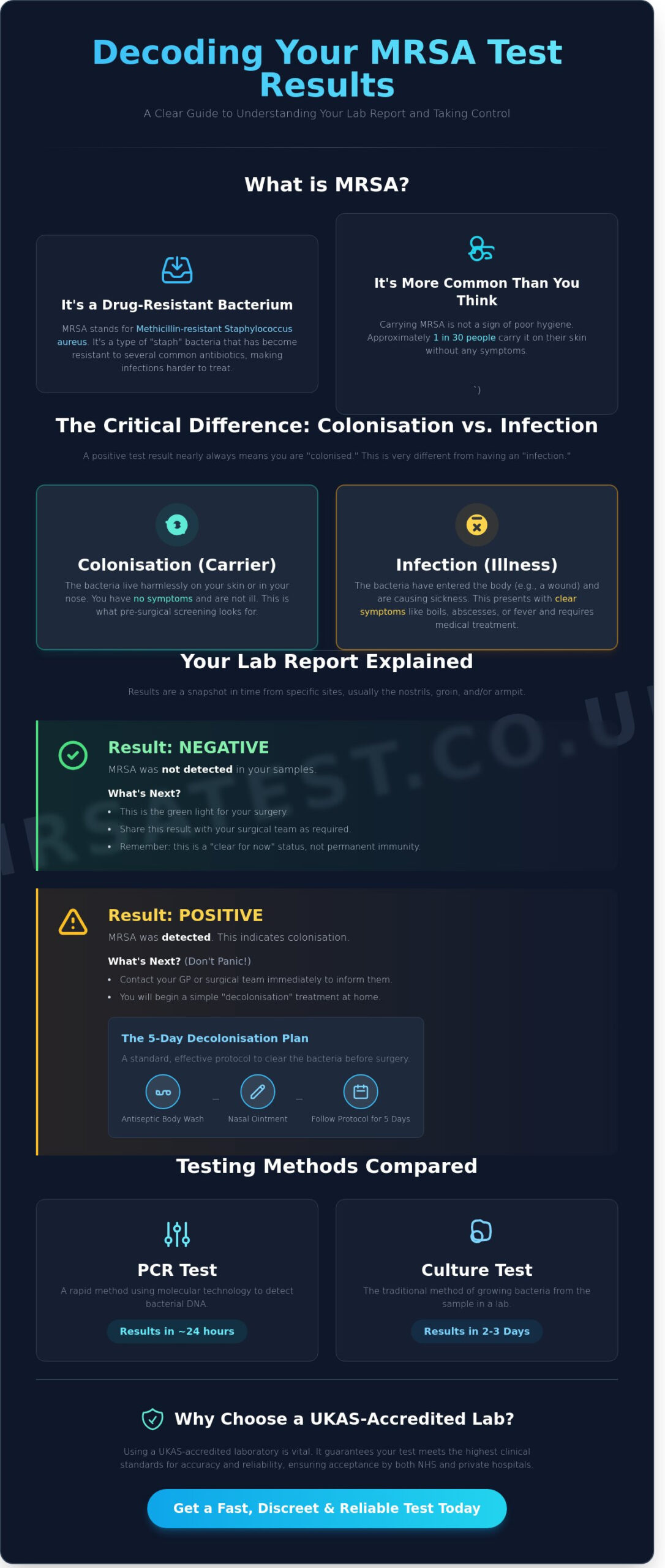
A positive result confirms the presence of the bacteria, but it doesn’t automatically mean you have a dangerous illness. In fact, most positive results found during routine screening indicate “colonisation” rather than an active infection. According to official MRSA Tests, the distinction between these two states is the most critical part of your diagnosis.
- Colonisation: You’re a “carrier.” The bacteria live on your skin or inside your nose without causing harm or symptoms. Approximately 2% of the general population carries MRSA in this way.
- Infection: The bacteria have bypassed your skin’s natural barrier through a cut, wound, or catheter, leading to redness, swelling, or pus.
When you’re understanding mrsa test results, remember that being a carrier is manageable. If you’re colonised, a doctor might suggest a “decolonisation” treatment, which involves using a special antibacterial body wash and nasal cream for five days. This simple process reduces the risk of the bacteria moving from your skin into a surgical wound.
If you’re looking for peace of mind before a hospital admission, you can order a discreet screening kit to check your status from home. Knowing your results early allows you to complete any necessary decolonisation steps without delaying your planned medical procedures.
PCR vs. Culture: Understanding the methodology behind your results
UK laboratories typically use two distinct methods to identify the presence of Methicillin-resistant Staphylococcus aureus. The technique chosen by the lab directly affects your turnaround time, which is the period between the lab receiving your sample and you receiving your report. While both methods are highly accurate when performed in UKAS-accredited facilities, they provide different levels of detail and speed.
For a general overview of why these procedures are necessary for your health, you can refer to this guide on MRSA Tests. Most UK hospitals select a method based on clinical urgency. If you’re preparing for a scheduled surgery, the speed of the analysis is often the primary concern. In contrast, for routine monitoring where time is less critical, the traditional method remains a staple of clinical practice. Understanding mrsa test results begins with knowing which of these two paths your sample took.
Rapid PCR testing: Speed and molecular accuracy
PCR (Polymerase Chain Reaction) is a sophisticated molecular technique that detects the specific DNA signatures of the MRSA bacteria. Instead of waiting for bacteria to grow, the lab identifies the genetic material itself. This method provides results within 24 hours of the sample reaching the laboratory. Because of this speed, PCR is the gold standard for pre-operative screening. It ensures patients are cleared for surgery without unnecessary delays, which is vital when a surgical window is narrow.
- Speed: Results are often ready in as little as 24 hours.
- Precision: High sensitivity in detecting even small amounts of bacterial DNA.
- Urgency: Ideal for patients with upcoming hospital admissions or procedures.
Standard Culture testing: The traditional approach
Culture testing involves placing your sample on a nutrient-rich agar plate to see if bacteria grow over a period of 48 to 72 hours. While it’s a slower process, it remains a highly reliable and cost-effective option for routine, non-urgent screenings. This method allows microbiologists to see the living bacteria and, if necessary, perform further sensitivity tests. To help you decide which path is right for your situation, you can read our detailed MRSA Culture vs. PCR Test comparison for deeper technical insight.
The process of understanding mrsa test results becomes much simpler when you know whether the lab looked for DNA or grew a live culture. Both methods are trusted by medical professionals across the UK to provide a clear picture of your colonization status. Whether you choose the rapid 24-hour PCR option or the 3-day culture test, you can rest assured that the findings are based on rigorous clinical standards.
I’ve received my results; what happens next?
Receiving your lab report is a critical milestone in your surgical preparation. Once you have the document, your first priority is verifying that all personal details, including your full name and date of birth, match your medical records exactly. Hospitals often reject reports with even minor clerical errors. Effectively understanding mrsa test results allows you to take the correct clinical steps without delay.
If your result is negative, you should immediately forward the digital or physical report to your GP or hospital surgical team. Most UK NHS trusts and private clinics require these results to be dated within 30 days of your scheduled procedure. If your result is positive, don’t feel alarmed. A positive result simply means you’re “colonised” with the bacteria, which is common in approximately 3% of the UK population. Your next step is to contact your healthcare provider to begin a standard decolonisation protocol.
While waiting for treatment to begin, you can manage your home environment to protect others. Focus on these four practical steps:
- Launder linens: Wash your bedding, towels, and clothing at a minimum of 60°C to eliminate bacteria.
- Personal items: Avoid sharing razors, towels, or toothbrushes with other household members.
- Hand hygiene: Use an alcohol-based hand sanitiser or antibacterial soap frequently.
- Surface cleaning: Disinfect high-touch areas like door handles and taps daily.
The decolonisation process for positive carriers
Decolonisation is a straightforward, 5-day treatment designed to clear MRSA from your skin and nose. You’ll typically be prescribed a specific nasal ointment to be applied three times daily and a medicated body wash. A common clinical standard is the use of Chlorhexidine (CHG) wash, which significantly reduces bacterial load on the skin’s surface. It’s vital to follow this protocol exactly as instructed. Skipping a single day can lead to a failed re-test, which may further delay your medical treatment.
Preparing for surgery with an MRSA result
A positive result doesn’t mean your surgery is cancelled, but it does mean the timeline might shift. Most hospitals will delay a non-urgent procedure by 5 to 7 days to ensure you’ve completed the decolonisation wash and ointment cycle. You’ll need to communicate directly with the hospital’s infection control team to confirm when you can be cleared for admission. To ensure you’re fully prepared for every aspect of your upcoming procedure, consult our Pre-Op Health Checklist for a wider view of surgical logistics. Understanding mrsa test results early gives you the time needed to clear the bacteria and proceed with your surgery safely.
Ensure your surgical prep is on track with a fast, reliable screening solution. Order your discreet MRSA test kit today for professional results from the comfort of your home.
Why choosing a trusted UK laboratory matters for your results
When you receive your report, the laboratory’s credentials are just as vital as the data itself. A UKAS-accredited facility operates under strict ISO 15189 standards, which govern the quality and competence of medical laboratories. This accreditation means the processes used to analyze your swabs are regularly audited for accuracy and reliability. Choosing a local, accredited lab eliminates the risks associated with international shipping, such as sample degradation or temperature fluctuations that could lead to an inconclusive result. Professional handling ensures your sample remains sterile from the moment you seal the tube until it reaches the diagnostic technician.
Clinical-grade reports are the gold standard for healthcare providers. Private consultants and NHS trusts require documentation they can trust before they proceed with invasive procedures. A report from a certified UK laboratory provides the specific, high-level details needed for a consultant to sign off on your surgical clearance. Because our service is 100% UK-based, your sensitive medical data stays within the country, protected by stringent UK GDPR regulations. This infrastructure also enables rapid turnaround times, often delivering results within 24 to 48 hours of the sample arriving at the facility. Understanding mrsa test results becomes a much simpler process when the report is clear, medically validated, and delivered promptly.
The benefit of at-home discretion and comfort
Hospital environments are often high-stress and time-consuming, especially when you’re already preparing for a major health event. Testing from home removes the need for unnecessary travel and the anxiety of sitting in clinical waiting rooms. This privacy allows you to manage your health on your own terms without external pressure. If you’re preparing for an upcoming operation, private testing gives you the power to secure your clearance ahead of schedule. Fast-tracked results provide the peace of mind you need, ensuring you’re not left in the dark as your surgery date approaches. Understanding mrsa test results in a familiar, calm environment helps reduce the emotional burden of pre-operative prep.
Secure your pre-op clearance with mrsatest.co.uk
The self-collection process is designed for simplicity and clinical precision. You’ll receive a kit containing everything you need, along with clear instructions to ensure you collect a high-quality sample. Once you’ve completed the swabs, you just use the pre-paid trackable return packaging to send them directly to our laboratory. To begin the process and take control of your surgical timeline, you can order a confidential MRSA test kit today. This professional service ensures you get the answers you need without the typical delays of the healthcare system. Test for MRSA from the comfort of your own home.
Take Control of Your Pre-Surgery Screening
Gaining clarity on your health status is essential before any medical procedure. Whether you’re decoding a positive colonization result or a negative screen, understanding mrsa test results allows you to move forward with your treatment plan with confidence. Our process uses a UKAS-accredited partner laboratory to ensure every sample meets rigorous clinical standards. If you choose the PCR rapid test option, you’ll receive molecular detection results in as little as 24 hours, which is significantly faster than traditional culture methods that can take several days.
Testing from the comfort of your own home eliminates the stress of clinical appointments while maintaining total professional accuracy. We’ve supported patients across the UK with pre-operative screening that prioritizes speed and privacy. By choosing a 100% UK-based service, you ensure your data remains secure and your results are handled by experts. Don’t let uncertainty delay your surgery or compromise your safety.
Order your fast, discreet MRSA test kit for pre-surgery clearance today
You’re in safe hands, and we’re here to help you prepare for a successful recovery.
Frequently Asked Questions
What does “MRSA screen positive” mean on my lab report?
A positive result means the lab found Methicillin-resistant Staphylococcus aureus on your swabs. This usually indicates colonization, which means the bacteria live on your skin or in your nose without causing illness. According to the NHS, about 1 in 30 people carry MRSA without knowing it. Understanding mrsa test results is the first step in starting a simple decolonisation process to protect yourself and others.
Can I still have surgery if my MRSA test is positive?
You can still have your operation, but your surgical team will likely postpone it to complete a decolonisation treatment. This routine process usually involves using a special antibacterial body wash and nasal cream for 5 days. Research from the Journal of Hospital Infection shows that preoperative screening and treatment can reduce surgical site infections by up to 40%. Your surgeon will confirm the new date once the risk is managed.
How long do MRSA test results take to come back in the UK?
Standard culture test results typically take 48 to 72 hours because the laboratory needs time to grow the bacteria. If you choose a PCR rapid test, results are often available within 24 hours of the sample reaching our UKAS-accredited laboratory. We’ll send your results via a secure, confidential email as soon as the clinical team verifies them. This speed helps you plan your healthcare or surgery without unnecessary delays.
Is a positive MRSA result the same as having a staph infection?
No, a positive result often means you’re “colonised” rather than infected. Colonisation means the bacteria are present on your skin but aren’t currently making you ill. An infection occurs only if the bacteria enter the body through a break in the skin, such as a surgical wound or catheter site. Understanding mrsa test results helps distinguish between these two states, ensuring you receive the correct clinical advice for your specific situation.
Will I need to be re-tested after completing decolonisation treatment?
Yes, most UK hospitals require 3 sets of negative swabs, taken at least 48 hours apart, to confirm the bacteria are gone. You should wait at least 2 days after finishing your 5-day treatment course before taking the first follow-up test. This protocol ensures the treatment worked effectively. If any of these “clearance swabs” come back positive, your GP might recommend a second course of treatment to ensure your safety.
What should I do if my home MRSA test result is positive?
You should contact your GP or surgical team to discuss starting a decolonisation protocol. Don’t panic, as being a carrier doesn’t mean you’re sick or in immediate danger. Your doctor will likely prescribe a specific regimen, such as 4% Chlorhexidine wash, to clear the bacteria from your skin. It’s also a good idea to wash your bedding and towels at 60 degrees Celsius to remove any bacteria from your home environment.
Are home MRSA test results as accurate as hospital tests?
Our home test kits use the same UKAS-accredited laboratories and clinical methods as the NHS. Whether you use a traditional culture or a PCR molecular test, the accuracy levels are comparable to hospital-based screening. The primary difference is the convenience of collecting your samples in private. We provide clear instructions to ensure you collect a high-quality sample, which is vital for an accurate and reliable laboratory reading.
Do I need to tell my family if I test positive for MRSA?
You don’t usually need to isolate from healthy family members, but you should practice good hygiene. Since MRSA spreads through skin-to-skin contact or shared items, avoid sharing towels, razors, or bedsheets. Public Health England notes that the risk to healthy people is very low. However, if a family member is immunocompromised or has an open wound, you should take extra care and consult a medical professional for specific guidance.