
MRSA Screening for Knee Replacement: The Complete Pre-Surgery Guide (2026)
Did you know that approximately 3% of the UK population carries MRSA on their skin or in their nose without ever showing symptoms? If you’re preparing for a total knee arthroplasty in 2026, finding out you’re a “carrier” can feel like a major setback. You’ve likely spent months managing joint pain and finally have a surgery date in sight, so the last thing you want is a positive result causing a last-minute postponement. It’s completely normal to feel a sense of unease about “superbugs,” but understanding the difference between simple colonisation and an active infection is the first step toward peace of mind.
This guide clarifies exactly why mrsa screening for knee replacement is a non-negotiable safety standard in British hospitals and how it protects your new joint from post-operative complications. You’ll discover how to manage the decolonisation process with confidence and why many patients now choose private, at-home testing to avoid NHS delays. We’ll walk you through the simple swabbing process, the role of PCR rapid testing for molecular detection in 24 hours, and how to secure UKAS-accredited results from the comfort of your own home.
Key Takeaways
- Understand why mrsa screening for knee replacement is a mandatory safety measure to protect your new prosthetic joint from persistent surgical site infections.
- Learn how to correctly perform a self-collection swab of the nose and groin to ensure your samples are accurate and clinical-grade.
- Discover the science of biofilms and why antibiotic-resistant “superbugs” pose a unique risk to metal and plastic knee implants.
- Gain peace of mind by understanding the standard five-day decolonisation protocol used to manage positive results without permanent surgery cancellations.
- See how a discreet, home-based screening service provides the fast, UKAS-accredited results you need for a smooth pre-operative journey.
Why MRSA Screening is Mandatory for Knee Replacement Surgery
Preparing for a total knee replacement (TKR) involves more than just physical therapy and home adjustments. One of the most critical steps in your pre-operative journey is the MRSA screen. This is a preventative check designed to identify Methicillin-resistant Staphylococcus aureus (MRSA), a specific type of bacteria that has developed resistance to common antibiotics. While the term “superbug” often sparks unnecessary fear, the screening process is a routine, safety-first measure. It ensures your surgical environment remains sterile and your recovery stays on track. By identifying these bacteria early, clinicians can manage risks before you even step into the hospital.
Surgeons insist on this clear screen because prosthetic joints are particularly vulnerable. Once a knee implant is in place, it lacks its own blood supply; this makes it difficult for the body’s natural immune system to fight bacteria that might settle on the metal or plastic surfaces. A positive mrsa screening for knee replacement isn’t a reason to panic or a sign that you’re unwell. Instead, it’s a manageable piece of data that allows your medical team to protect your new joint from the very start.
The Difference Between Colonisation and Infection
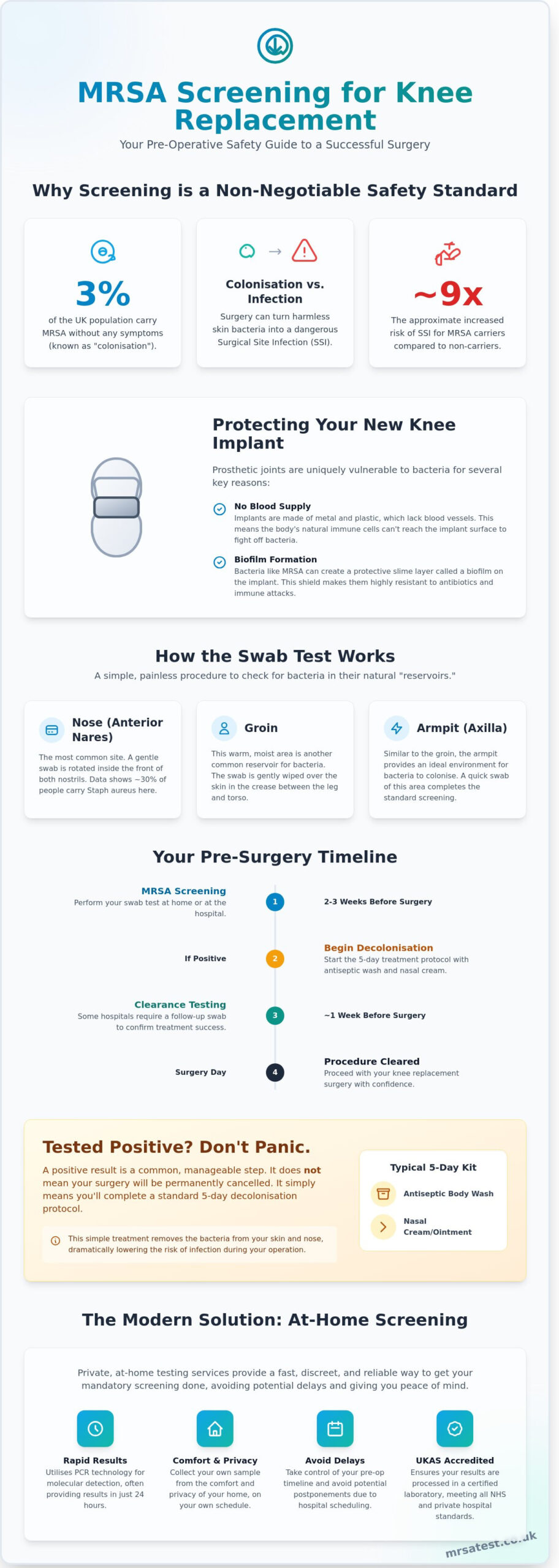
It’s a common misconception that carrying MRSA means you’re ill. In reality, about 3% of the UK population carry MRSA on their skin or in their nostrils without any symptoms. This state is known as “colonisation.” These bacteria live harmlessly on healthy skin and don’t cause harm to the carrier in daily life. However, surgery changes the equation entirely. When a surgeon makes an incision for a knee replacement, the protective skin barrier is broken. This provides a gateway for bacteria to enter deeper tissues or the bloodstream. For a colonised patient, the risk of developing a surgical site infection (SSI) increases by approximately 9 times compared to non-carriers. Identifying carriers before they enter a sterile surgical environment allows for simple, effective preventative treatment.
UK Healthcare Standards for Pre-Op Screening
The NHS and private healthcare providers follow strict clinical protocols to maintain patient safety across the country. National Institute for Health and Care Excellence (NICE) guidelines recommend that all patients undergoing elective orthopaedic surgery must be screened. This mandatory requirement protects the individual patient and prevents the transmission of resistant bacteria to other vulnerable people on the ward. Most UK hospital trusts require your mrsa screening for knee replacement results to be documented in your file at least 14 to 21 days before your scheduled surgery date. This timeline is vital for the following reasons:
- Treatment Window: If you test positive, you’ll need a five-day decolonisation kit consisting of antiseptic body wash and nasal cream.
- Clearance Testing: Hospitals often require a follow-up swab after treatment to confirm the bacteria are no longer present.
- Theatre Planning: Confirmed results allow the hospital to allocate resources and maintain the highest levels of theatre hygiene.
Using a trusted, UK-based laboratory ensures your results meet these stringent hospital standards. Whether you use a hospital-led clinic or a discreet at-home testing kit, the goal remains the same: a safe, successful surgery and a complication-free return to mobility. Taking this step seriously is the first part of ensuring your new knee lasts for years to come.
How the MRSA Swab Test Works: Sites, Samples, and Science
The testing process is a straightforward procedure designed to be entirely painless. It doesn’t involve needles or blood samples. Instead, it relies on collecting surface samples from specific areas where Staphylococcus aureus bacteria naturally colonise. Completing your mrsa screening for knee replacement accurately is a vital step because identifying these bacteria before your operation allows for effective treatment, significantly reducing the risk of a post-operative infection.
Common Swabbing Locations Explained
Clinical teams focus on “reservoirs,” which are the warm, moist parts of the body where bacteria thrive. The anterior nares, or the front part of your nostrils, are the most common site for testing. Medical data shows that roughly 30% of the population carry Staph aureus in their nose at any given time. Other common sites include the groin and the axilla, also known as the armpit. These areas are sampled because they provide the ideal environment for bacterial growth and persistence.
To perform a self-collection swab correctly at home, you should follow a standardised routine to ensure the sample is viable for the lab:
- Wash your hands thoroughly with soap and water before opening the sterile swab package.
- Carefully remove the swab, being careful not to touch the tip against any household surfaces.
- Moisten the swab tip with the provided sterile liquid if your kit requires it.
- Carefully insert the tip into the nostril or press it against the skin of the groin area.
- Ensure the swab is rotated against the skin surface for at least five seconds to collect an adequate biological sample.
- Place the swab back into the transport tube immediately and ensure the cap is clicked shut.
Culture vs. PCR: Which Test Suits Your Timeline?
Once your sample reaches the laboratory, it’s processed using one of two primary scientific methods. The Standard Culture method is the traditional approach. Scientists place your sample on a nutrient-rich agar plate and monitor it for bacterial colony growth. This typically takes 48 to 72 hours to yield a definitive result. It’s a highly reliable method, but it requires a longer lead time before your scheduled surgery date.
If you’re on a tighter schedule, the Rapid PCR (Polymerase Chain Reaction) test is the better option. This molecular detection method identifies the specific DNA sequences of the MRSA bacteria. It provides results within 24 hours of the lab receiving the sample. Many surgical teams follow the AAOS guidelines on MRSA screening to determine which testing window is most appropriate for their patients. Choosing the PCR method ensures your results are ready in time for your final pre-operative assessment, even if your surgery was booked at short notice.
Accuracy is a priority for surgical safety. All samples should be processed in UKAS-accredited laboratories. These facilities meet strict ISO 15189 standards, which means every result is verified for precision. Using a discreet home test kit that connects to these accredited labs gives you the same level of clinical certainty as a hospital-based test. These labs maintain a 99% accuracy rate, providing you and your surgeon with the confidence needed to proceed. Knowing your status early allows for a five-day decolonisation treatment if you’re found to be a carrier, which prevents the stress of a last-minute surgical cancellation.
MRSA vs. Knee Replacement: The Risks of Surgical Site Infections (SSI)
A total knee replacement (TKR) is a life-changing procedure designed to restore mobility. However, the very materials that make your new joint durable, such as cobalt-chrome, titanium, and high-grade plastic, also make it a target for bacteria. Unlike your natural bone, these synthetic materials lack a blood supply. This means your body’s immune cells cannot reach the surface of the implant to fight off invading pathogens like MRSA.
When MRSA reaches a prosthetic joint, it doesn’t just sit on the surface. It creates a “biofilm,” which is a sticky, protective layer of proteins and sugars. This film acts as a fortress. It shields the bacteria from both your immune system and standard oral antibiotics. Because the bacteria are “hiding” in this film, infections on a prosthetic joint are significantly more difficult to treat than simple skin or soft tissue infections. If an infection becomes established, the consequences are often severe, leading to months of additional medical intervention.
The clinical impact of a post-operative infection is substantial. Research indicates that patients with a surgical site infection face a recovery period that is three times longer than average. In many cases, the only way to clear the bacteria is through a “two-stage revision” surgery. This involves removing the infected knee replacement entirely and replacing it with a temporary cement block known as a “spacer.”
The Danger of Prosthetic Joint Infection (PJI)
A Prosthetic Joint Infection is one of the most feared complications in orthopaedic surgery. If you develop a PJI, you may require a spacer for six to twelve weeks while you undergo intensive intravenous antibiotic therapy. During this time, your mobility is severely limited, and you’ll likely experience significant pain. The emotional toll is equally heavy; the frustration of losing the progress made during your initial recovery can lead to anxiety and depression. Statistics show that the cost to the NHS for a single revision surgery can exceed £20,000, but the physical and mental cost to the patient is often much higher.
How Screening Saves Your Surgery
The most effective way to prevent these complications is through a “Decolonisation before Incision” strategy. By identifying if you are a carrier of the bacteria through mrsa screening for knee replacement, your surgical team can take action before you ever enter the operating theatre. This simple step creates a “sterile shield” around your procedure, ensuring that any bacteria on your skin are neutralised before the first incision is made.
The preventative power of this process is backed by significant clinical evidence. A landmark research on MRSA screening in orthopedic surgery demonstrates that proactive screening and decolonisation programmes can reduce the risk of surgical site infections by up to 50%. Using mrsa screening for knee replacement allows you to move forward with your surgery with the quiet confidence that you’ve minimised one of the largest risks to your new joint. It’s a simple, at-home step that protects your investment in your future mobility.
- Reduced Risk: Screening can cut infection rates by half.
- Faster Recovery: Avoiding SSI means you stay on track with your physiotherapy.
- Peace of Mind: Knowing you are clear of MRSA reduces pre-surgery anxiety.
Managing a Positive Result: Decolonisation and Your Surgery Date
Receiving a positive result from your mrsa screening for knee replacement can feel like a setback. It isn’t a reason to panic. Public Health England data suggests about 1 in 30 people carry MRSA on their skin or in their nose without any symptoms. This is known as colonisation. Finding the bacteria now is actually a success because it allows your surgical team to clear it before you enter the operating theatre. A positive result doesn’t mean your surgery is cancelled permanently; it simply means we need to follow a proven decolonisation protocol to ensure your safety.
The 5-Day Decolonisation Programme
The UK standard for clearing MRSA involves a specific five-day treatment plan. This process targets the areas where the bacteria typically live and multiply to reduce the risk of it entering your surgical wound. It’s a simple but disciplined routine that you perform at home.
- Step 1: Nasal Treatment. You’ll apply Mupirocin 2% ointment to the inside of both nostrils three times a day. Clinical studies show the nose is the primary reservoir for MRSA. Clearing it here is vital for preventing the bacteria from spreading back onto your skin.
- Step 2: Skin Cleansing. You’ll use an antiseptic body wash, usually Chlorhexidine (CHG) 4% solution, once a day for the full five days. This acts as a powerful disinfectant. Use it as a shampoo on days two and four of the programme to ensure your scalp is also treated.
- Step 3: Environmental Hygiene. To prevent re-contamination, you must change your bedsheets, towels, and clothes every day during the treatment. Wash these items at a minimum of 60°C. This temperature is necessary to kill any bacteria shed onto the fabric during the day.
Will My Surgery Be Postponed?
A positive mrsa screening for knee replacement usually results in a short delay to your procedure. Most UK hospitals will postpone surgery for 7 to 14 days. This window provides enough time for the five-day treatment cycle plus a 48-hour waiting period before follow-up swabs are taken. This gap is crucial because it ensures the antiseptic isn’t simply masking the bacteria during the re-test.
Honest communication with your orthopaedic consultant is essential. They’ll explain that this delay is a proactive safety measure. Rushing into a knee replacement while colonised with MRSA significantly increases the risk of a deep prosthetic joint infection. These infections are difficult to treat and can lead to further operations. Waiting two weeks to ensure a sterile environment is a small price to pay for a successful recovery and a long-lasting joint.
Once you’ve finished the treatment, your hospital or a private lab will perform “clearance swabs.” In most cases, three sets of negative results are required to confirm the bacteria has been successfully suppressed. If the results are clear, your surgery can proceed as planned, often within days of the final negative test. If you’ve received a positive result and want to monitor your status privately, you can order a discreet MRSA test kit to check your progress from the comfort of your own home.
Professional MRSA Screening from the Comfort of Your Own Home
Preparing for major surgery is a significant life event. You’re likely managing pre-operative assessments, physical therapy schedules, and home recovery plans. Adding another hospital visit for mrsa screening for knee replacement can feel overwhelming. By choosing a private home test kit, you reclaim control over your schedule. You don’t need to spend 45 minutes in a crowded waiting room or navigate hospital parking. Instead, you complete the process in a familiar, stress-free environment.
Why Choose a Private Home Test Kit?
Hospital-led screenings are often subject to NHS backlogs or administrative delays. A private test avoids these bottlenecks entirely. You’ll take your swabs in total privacy at a time that works for you. Whether that’s 7:00 am or midnight, the choice is yours. Every kit arrives in discreet, unbranded packaging to ensure your medical history remains your business. Once the laboratory processes your sample, you’ll receive a confidential report directly via email. It’s a streamlined process designed for modern patients who value their time and privacy.
Your mrsatest.co.uk kit arrives with everything required for a clinical-grade sample. It includes sterile swabs specifically for the nose, throat, and skin sites, alongside clear, step-by-step instructions. We include a prepaid Royal Mail Tracked 24 return envelope to ensure your samples reach our UKAS-accredited partner laboratory without delay. Using a lab with ISO 15189 accreditation means your results meet the highest clinical standards required by UK surgeons. This provides the same level of accuracy you’d expect from an in-hospital test, but without the logistical headache.
Getting Results in Time for Your Procedure
Timing is critical when your surgery date is fixed. Our PCR rapid test option provides molecular detection within 24 hours of our lab receiving your sample. This speed is essential if your hospital requires a recent screen within 72 hours of admission. Traditional culture tests can take several days, but our rapid technology identifies MRSA DNA quickly and accurately. This ensures you have the necessary documentation ready for your final pre-admission check.
Once your results are ready, you’ll receive a professional certificate. You can simply forward this PDF to your surgical team or print it for your pre-admission folder. It’s a simple way to ensure mrsa screening for knee replacement doesn’t become a last-minute hurdle. Having your clearance confirmed early allows you to focus on your recovery rather than worrying about infection risks or postponed operation dates. Our service is 100% UK-based, ensuring that your data and samples are handled according to strict national standards.
Take Control of Your Surgical Outcome
Preparing for your total knee arthroplasty involves more than just physical therapy; it’s about eliminating clinical risks before you enter the operating theatre. Mandatory mrsa screening for knee replacement is a vital safety standard across UK hospitals to prevent surgical site infections that could lead to complex revision surgeries. By identifying colonisation early, you can complete decolonisation protocols and keep your 2026 surgery date on track. We simplify this process by providing professional testing from the comfort of your own home.
Our service relies on a UKAS-accredited laboratory to ensure absolute accuracy for every patient. We offer a rapid PCR test option that delivers results in just 24 hours, alongside free and discreet UK-wide shipping. You’ll receive your kit in plain packaging, and your data remains strictly confidential throughout the process. Don’t let avoidable delays or infection risks compromise your new joint.
Secure your surgery date with a fast, private MRSA test kit
Take this simple step today to ensure a safe, successful procedure and a faster return to the activities you enjoy.
Frequently Asked Questions
Is MRSA screening mandatory for all knee replacement surgeries in the UK?
Yes, according to Department of Health guidelines updated in 2014, all elective surgical admissions in the UK must undergo screening. This protocol ensures that 100% of patients scheduled for a total knee arthroplasty are checked to prevent post-operative infections. It’s a standard safety measure across NHS trusts and private hospitals to protect your health during recovery.
How long does an MRSA screen result take to come back?
A standard MRSA culture test typically takes 48 to 72 hours for the laboratory to confirm the results. If you need a faster turnaround, an MRSA PCR rapid test offers molecular detection in 24 hours or less. Most UKAS-accredited facilities process these samples within 1 to 3 working days of receipt, ensuring you have the information you need before your pre-op assessment.
What happens if I test positive for MRSA before my knee replacement?
If your mrsa screening for knee replacement returns a positive result, your surgical team will prescribe a decolonisation treatment plan. This usually involves a 5-day course of antiseptic body wash and antibiotic nasal cream to clear the bacteria from your skin and nostrils. You’ll then be re-tested to ensure the colonisation, which is the presence of bacteria without active infection, has been successfully managed.
Can I fail my surgery if I have MRSA on my skin?
You won’t fail your surgery, but the hospital will likely postpone the operation if MRSA is detected. Data from clinical studies indicates that untreated MRSA increases the risk of surgical site infections by approximately 33% in orthopaedic cases. Postponing the date allows time for decolonisation; this ensures your new joint is placed in the safest possible environment to prevent long-term complications.
How much does a private MRSA test kit cost in the UK?
A private MRSA home test kit in the UK typically costs between £45 and £90, depending on how quickly you need the results. For example, a standard culture test is often priced at £49, while a rapid PCR test for faster molecular detection usually costs around £85. These prices include the collection kit, laboratory analysis in a UKAS-accredited facility, and discreet delivery to your door.
How do I perform the MRSA swab test at home correctly?
You’ll use the provided sterile swabs to sample three main areas: the inside of both nostrils, the throat, and the groin or armpits. Rub the swab firmly but gently against the skin for 5 to 10 seconds in each location to collect enough material for the lab. Once you’ve finished, place the swabs into the transport tubes and send them to our laboratory immediately using the provided pre-paid envelope.
Do I need to re-test if my surgery is delayed by several months?
Yes, most UK hospitals require a fresh mrsa screening for knee replacement if your previous result is more than 12 weeks old. Since you can pick up MRSA in the community at any time, a test from 4 months ago won’t reflect your current status. Keeping your screening current is a vital part of the pre-operative process and ensures the hospital staff can maintain a sterile environment.
Is the decolonisation treatment for MRSA painful or difficult?
The treatment isn’t painful and is very simple to follow from the comfort of your own home. It consists of using a chlorhexidine-based wash instead of your usual soap and applying mupirocin ointment inside your nostrils twice daily for 5 days. While some patients report mild skin dryness, 95% of individuals complete the protocol without any significant discomfort or side effects.