

Food Intolerance Tests: A Scientific Guide to Their Accuracy and Value
Persistent bloating, unexplained fatigue, or frustrating skin issues can leave you searching for answers. It is a common and understandable response to suspect that a specific food is the culprit, leading many in the UK to consider an at-home food intolerance test. But with a wide array of tests available online, often costing a significant amount, it is crucial to understand their scientific validity. How can you be sure you are investing in a reliable diagnostic tool and not just an expensive guess?
This guide is designed to provide clarity. We will explore the key differences between a food allergy and an intolerance, examine the science behind common at-home testing methods like IgG antibody tests, and discuss their limitations. Furthermore, we will outline the clinically-proven approaches recommended by healthcare professionals to accurately identify trigger foods. Our goal is to provide you with the trusted, evidence-based information needed to make an informed decision, understand your symptoms, and find a reliable path to feeling better.
Understanding Food Reactions: Allergy vs. Intolerance vs. Sensitivity
Navigating the world of negative food reactions can be confusing. Terms like allergy, intolerance, and sensitivity are often used interchangeably, yet they describe distinct biological processes with very different symptoms and management strategies. Understanding these differences is the crucial first step before considering any type of food intolerance test.
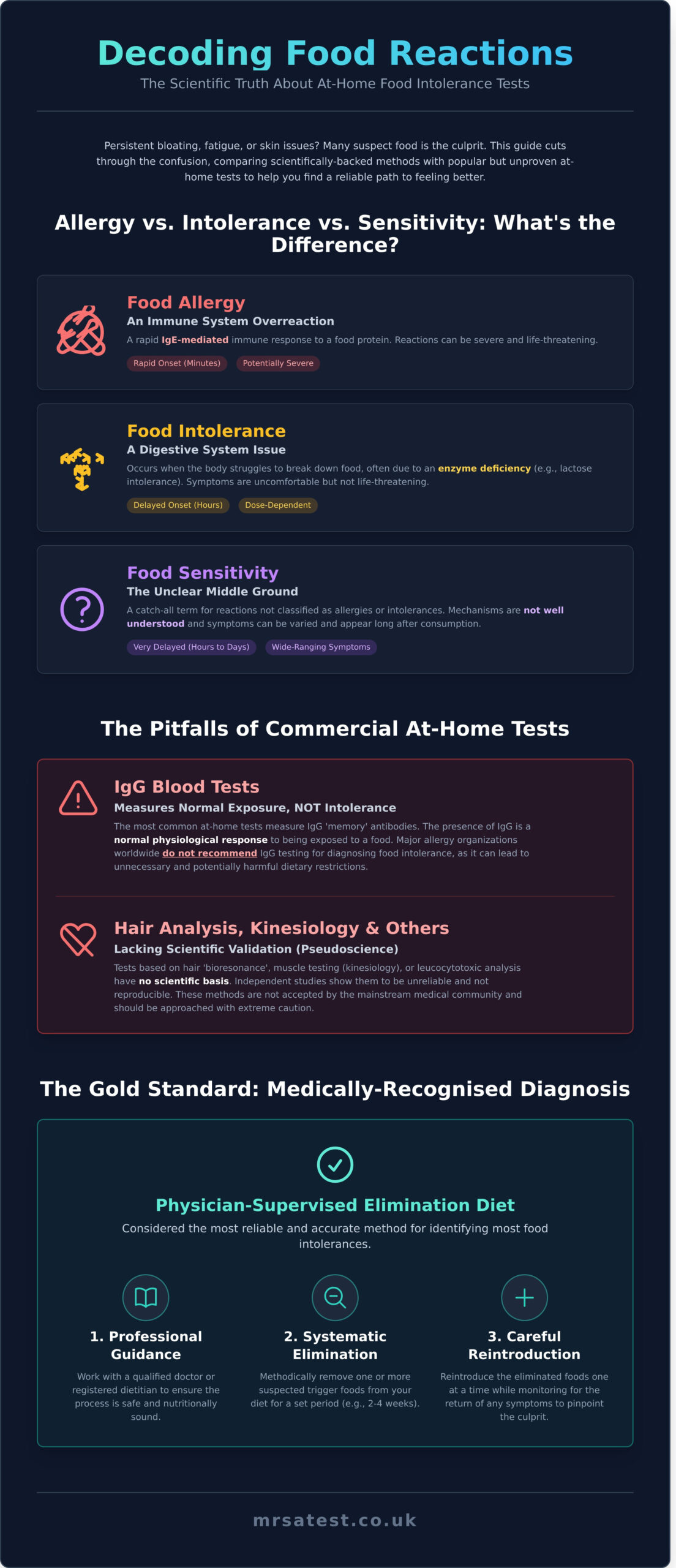
Think of it this way: a food allergy is like your body’s security system mistakenly identifying a food as a dangerous intruder and launching an immediate, overwhelming attack. A food intolerance is more like a factory issue, where your digestive system lacks the right tool (an enzyme) to process a food, causing a backlog and discomfort. A food sensitivity is a more subtle, delayed reaction whose mechanisms are still being researched.
Correctly identifying the nature of your reaction is essential for your health and well-being, as it dictates whether you need strict avoidance, medical supervision, or simple dietary adjustments.
What is a Food Allergy? The Immune System’s Response
A true food allergy is a rapid, IgE-mediated immune response. This means your immune system produces Immunoglobulin E (IgE) antibodies in reaction to a specific food protein. Symptoms can appear within minutes and range from mild to severe. They often include:
- Hives, itching, or eczema
- Swelling of the lips, face, tongue, and throat
- Wheezing or trouble breathing
- Anaphylaxis, a life-threatening reaction
Because of the risk of anaphylaxis, food allergies require strict avoidance of the trigger food and are diagnosed by a medical professional using skin-prick tests or specific IgE blood tests.
What is a Food Intolerance? The Digestive System’s Role
A food intolerance primarily involves the digestive system, not the immune system. It occurs when your body struggles to break down and absorb certain foods. A common cause is an enzyme deficiency, such as lactase deficiency in lactose intolerance. To better understand this, you might ask, What is a food intolerance? It is a chemical reaction, not an immune one. Symptoms are generally not life-threatening but can cause significant discomfort, often depending on the amount of food consumed. Typical symptoms include bloating, gas, diarrhoea, and stomach pain.
What is a Food Sensitivity? The Unclear Middle Ground
Food sensitivity is a term used to describe adverse reactions that are not classic allergies or clear-cut intolerances. The underlying mechanisms are less understood by the scientific community and may involve different parts of the immune system (like IgG antibodies) or other pathways. Symptoms are often delayed, appearing hours or even days after consumption, and can be wide-ranging, from migraines and brain fog to joint pain and fatigue. This is the complex area where a home food intolerance test often claims to provide insights.
How At-Home Food Intolerance Tests Work: A Look at the Methods
When searching for an at-home food intolerance test, you will encounter several different methods, each claiming to identify problematic foods. However, the scientific principles and validity behind these tests vary significantly. Understanding how each test works is crucial for making an informed decision about your health.
IgG Blood Tests: The Most Common Commercial Method
The most widely marketed at-home tests involve a finger-prick blood sample. This sample is sent to a laboratory to measure Immunoglobulin G (IgG) antibodies to a wide range of food proteins. The theory is that elevated IgG levels to a specific food indicate an intolerance.
However, it is important to understand that IgG is a ‘memory’ antibody. Its presence simply indicates exposure to a food, not a pathological reaction. In fact, a raised IgG level is considered a normal physiological response of the immune system. For this reason, major UK and international allergy organisations do not recommend IgG testing for diagnosing food intolerance. Relying on these results can lead to unnecessary and potentially harmful dietary restrictions without clinical benefit.
Hair Analysis Tests: Examining the Evidence
Another popular option is hair analysis. These tests claim to identify food intolerances by analysing a hair sample for its “bioresonance” or energetic profile. The provider suggests that imbalances detected in the hair correspond to adverse reactions to certain foods.
From a clinical perspective, there is no scientific basis for this methodology. The principles of bioresonance are not supported by established biology or physics. Independent studies have consistently shown these tests to be unreliable, often providing contradictory results from the same person’s sample. Consumers should exercise extreme caution when considering this type of test.
Other Methods: Kinesiology and Leucocytotoxic Tests
You may also encounter other alternative methods, such as applied kinesiology (muscle response testing) or leucocytotoxic tests, which involve observing how white blood cells react to food extracts under a microscope. Both of these methods lack scientific validation and are not accepted by the mainstream medical community.
These techniques, alongside hair analysis, are widely regarded as unproven food intolerance tests because their results are not reproducible or clinically meaningful. When investigating symptoms, it is vital to choose diagnostic pathways that are grounded in robust, evidence-based science to ensure your safety and well-being.
The Gold Standard: Medically-Recognised Diagnostic Approaches
While many commercial kits claim to offer a simple solution, the most reliable and accurate way to identify a food intolerance is through clinically-proven methods supervised by a healthcare professional. These approaches move beyond guesswork to provide a definitive diagnosis, ensuring your symptoms are correctly identified and managed safely. If you suspect a food issue, these are the diagnostic pathways recommended by the NHS and medical experts.
The Physician-Supervised Elimination Diet
Considered the primary tool for diagnosing most food intolerances, an elimination diet is a methodical process managed by a doctor or registered dietitian. It is far more precise than a generic food intolerance test and involves two distinct phases:
- The Elimination Phase: You will temporarily remove all suspected trigger foods from your diet for a period of 2-4 weeks until your symptoms resolve.
- The Reintroduction Phase: Under guidance, you will reintroduce one food group at a time in a controlled manner, carefully monitoring for the return of any symptoms.
Throughout this process, keeping a detailed food and symptom diary is essential for pinpointing the exact cause. Professional supervision is crucial to ensure your diet remains nutritionally complete and the results are interpreted correctly.
Specific Tests for Known Intolerances
For certain well-understood conditions, specific clinical tests can provide a clear diagnosis. Unlike broad-spectrum screening kits, these tests are highly targeted and used to confirm a specific suspicion.
- Hydrogen Breath Test: This is used by the NHS to diagnose lactose intolerance or fructose malabsorption. It measures the level of hydrogen in your breath after you consume a specific sugar solution.
- Coeliac Disease Screening: While not an intolerance (it is an autoimmune condition), coeliac disease is often confused with gluten intolerance. A GP can arrange for specific blood tests to check for antibodies, followed by a gut biopsy to confirm the diagnosis.
When to See Your GP or a Registered Dietitian
If you are experiencing persistent digestive issues, your first port of call should always be your GP. They can help rule out underlying medical conditions that may present with similar symptoms, such as Irritable Bowel Syndrome (IBS) or coeliac disease. Once other conditions are excluded, a registered dietitian is the best-qualified professional to guide you through an elimination diet safely and effectively.
Taking control of your health starts with seeking trusted, professional advice. For other areas where clinically-proven screening is vital, you can explore reliable options such as at-home MRSA testing.
Are Food Intolerance Tests Accurate? What the Experts Say
When dealing with persistent symptoms like bloating, fatigue, or skin issues, the promise of a simple at-home test is understandably appealing. However, a crucial question remains: are the results reliable? The scientific and medical consensus is clear and consistent-the evidence does not support the use of most commercial kits for diagnosing a food intolerance.
This section provides an objective overview of the expert position, helping you make an informed decision based on trusted, evidence-based guidance.
The Official Stance from the NHS and Allergy UK
Leading UK health bodies advise against using commercial testing kits. The NHS explicitly states there is “no evidence that these tests are able to diagnose food intolerances” and warns they can lead to unnecessary and potentially harmful dietary restrictions. Similarly, the patient charity Allergy UK does not recommend any food intolerance test that relies on IgG antibody results. Both organisations advocate for the medically-recognised “gold standard” for diagnosis: keeping a detailed food and symptom diary, followed by a professionally supervised elimination diet under the guidance of a GP or registered dietitian.
Why IgG Results Can Be Misleading
The core issue with these tests lies in their interpretation of Immunoglobulin G (IgG) antibodies. A positive IgG result for a specific food does not signify an intolerance. Instead, it indicates a normal, healthy immune response to exposure. Your body creates IgG antibodies to foods you eat regularly; a high level simply means you’ve eaten that food.
Following a diet based on these results can lead to several problems:
- Unnecessary Restriction: You may cut out numerous nutritious foods without a valid medical reason.
- Nutritional Deficiencies: Eliminating entire food groups without professional guidance can risk a lack of essential vitamins and minerals.
- Masking the Real Cause: It may prevent you from seeking a proper diagnosis for the true underlying cause of your symptoms.
Lack of Regulation in the At-Home Testing Market
The direct-to-consumer health testing market is not as strictly regulated as medical diagnostics used within the NHS. This allows for marketing claims that may lack robust scientific backing. This is in sharp contrast to clinically validated tests, such as laboratory-based MRSA screening, which must adhere to stringent standards for accuracy and reliability to be used in healthcare decisions. As a consumer, it is vital to be critical of health products and to prioritise guidance from qualified medical professionals over commercial promises.
Navigating Your Health: The Importance of Clinically-Validated Testing
In summary, understanding your body’s reaction to food begins with recognising the critical difference between a true allergy and an intolerance. While many at-home kits are available, the scientific consensus is clear: medically-supervised methods, like an elimination diet guided by a GP or dietitian, remain the gold standard for accuracy. A commercial food intolerance test often lacks the clinical evidence to provide a reliable diagnosis and should be approached with caution.
This commitment to clinical accuracy is the foundation of trustworthy at-home health screening. At mrsatest.co.uk, we focus exclusively on scientifically-proven diagnostic methods. We provide confidential, reliable, and professional screening services, with all samples processed in fully UKAS-accredited laboratories to ensure the highest standard of care from the comfort of your home. Learn about our clinically-validated at-home MRSA screening kits.
Making informed decisions based on trusted, scientific evidence is the most powerful step you can take towards managing your well-being. Choose accuracy, choose confidence.
Frequently Asked Questions
What is the difference between a food intolerance test and a food allergy test?
A food allergy involves an immediate immune system reaction, mediated by IgE antibodies, which can be severe and life-threatening. This is diagnosed by a GP or allergy specialist. In contrast, a food intolerance is typically a delayed digestive system response that causes discomfort but is not life-threatening. Many at-home kits measure IgG antibodies, which is a different mechanism from a true allergy. It is vital to seek medical advice to accurately distinguish between these conditions.
Are food intolerance tests from the pharmacy or online a waste of money?
The clinical value of many commercial intolerance tests is debated. The NHS and the British Dietetic Association do not currently recommend IgG antibody tests for diagnosing food intolerances due to a lack of robust scientific evidence. These tests may indicate food exposure rather than a true intolerance, potentially leading to unnecessary and restrictive diets. They can be a starting point, but an elimination diet supervised by a professional is considered the gold standard for diagnosis.
Can a food intolerance test detect coeliac disease or lactose intolerance?
No, a standard food intolerance test cannot diagnose these specific conditions. Coeliac disease is a serious autoimmune disorder requiring a specific blood test and biopsy for diagnosis. Lactose intolerance is caused by an enzyme deficiency and is typically identified through a hydrogen breath test or a medically supervised elimination diet. If you suspect you have either of these conditions, you must consult your GP for accurate NHS-approved testing and a formal medical diagnosis.
What are the most common symptoms of a food intolerance?
Symptoms of a food intolerance usually appear several hours after consuming the problematic food. Common digestive symptoms include bloating, abdominal pain, excessive gas, diarrhoea, and constipation. However, symptoms can also be non-digestive and may include headaches or migraines, skin conditions like eczema, joint pain, fatigue, and a general feeling of being unwell. Keeping a detailed food and symptom diary can be a very effective way to identify potential trigger foods.
How can I test for food intolerances at home without a kit?
The most reliable method, recommended by dietitians and GPs, is an elimination diet. This process involves completely removing a suspected trigger food from your diet for a period of 2-4 weeks to see if your symptoms improve. Afterwards, you carefully reintroduce the food to observe if symptoms return. It is highly recommended to undertake this process under the guidance of a healthcare professional to ensure it is done safely and that your diet remains nutritionally complete.
Can you suddenly develop a food intolerance as an adult?
Yes, it is common to develop a food intolerance in adulthood, even to foods you have previously eaten without any issues. Factors such as changes in gut bacteria (for instance, after an illness or a course of antibiotics), increased stress, or age-related changes in digestion can all contribute to the onset of a new intolerance. If you notice persistent, negative symptoms after eating certain foods, it is advisable to discuss them with your GP.