

CRP Blood Analysis: A Clear Guide to Understanding Your C-Reactive Protein Test
Receiving your blood test results can be a source of anxiety, especially when they contain unfamiliar terms like ‘C-reactive protein’. If you’re looking at your report and wondering what this marker means, you’re not alone. A crp blood analysis is a common but often misunderstood test used to detect inflammation somewhere in the body. It can feel intimidating to try and decipher these results on your own, leaving you with more questions than answers.
This clear guide is designed to help. We will walk you through what the C-reactive protein test measures, why it’s a valuable tool for your doctor, and what different levels-high or low-might signify. By the end of this article, you will understand the normal range for CRP, know the potential causes of an elevated result, and feel better prepared for a follow-up conversation with your GP. Our aim is to replace medical jargon with straightforward, reassuring information, giving you confidence in understanding your health.
What is C-Reactive Protein (CRP) and Why Do Doctors Measure It?
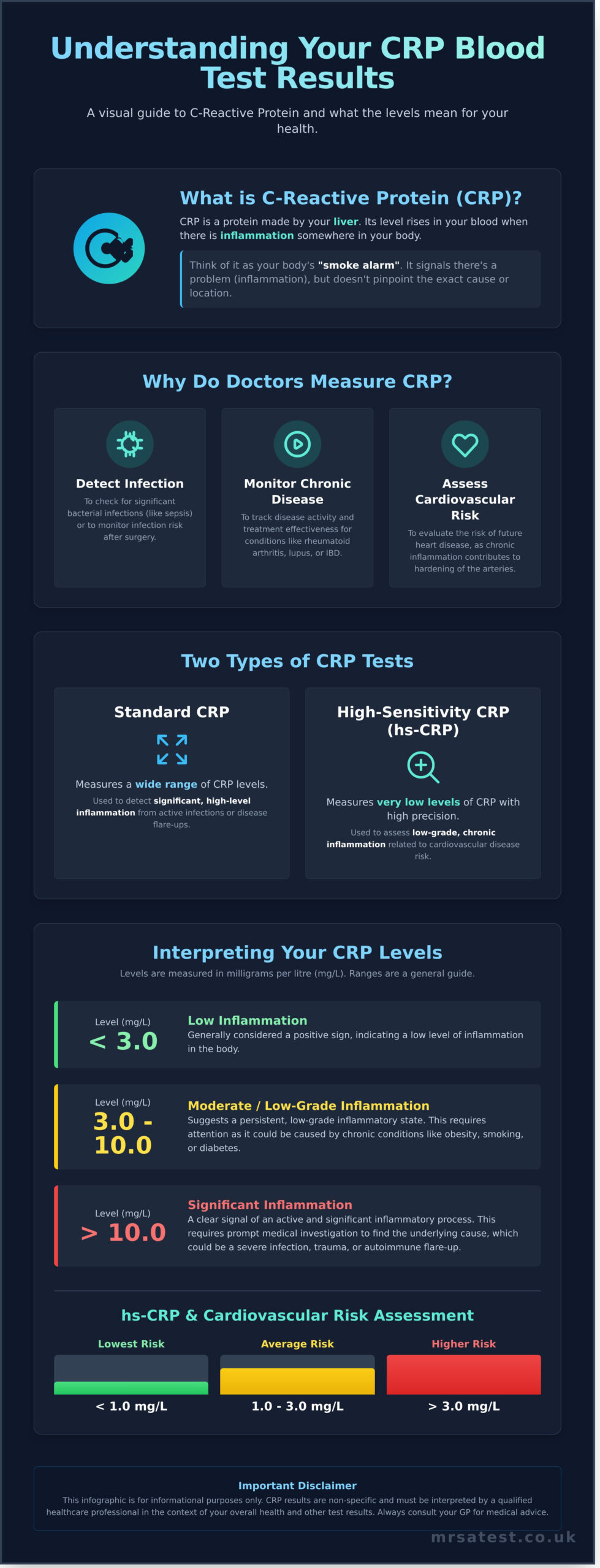
C-Reactive Protein, often abbreviated as CRP, is a substance produced by your liver in direct response to inflammation somewhere in your body. Think of it as your body’s natural “smoke alarm”-a high CRP level signals that there is inflammation, but it does not pinpoint the exact location or cause of the fire. A comprehensive C-reactive protein test measures the amount of this protein in your bloodstream, providing your doctor with a valuable, non-specific marker of your inflammatory status.
This information is crucial for distinguishing between two types of inflammation: acute inflammation, which is a sudden and short-term response to an injury or infection, and chronic inflammation, a persistent, low-level inflammation that can contribute to long-term health conditions over time.
A doctor in the UK may order a CRP test for several key reasons, including:
- Detecting Infection: To check for bacterial infections, particularly after surgery, or to monitor conditions like sepsis.
- Monitoring Chronic Inflammatory Diseases: To track the activity of conditions such as rheumatoid arthritis, lupus, or inflammatory bowel disease (IBD) and assess treatment effectiveness.
- Assessing Cardiovascular Risk: To evaluate the risk of developing heart disease, as chronic inflammation is linked to atherosclerosis (the hardening of arteries).
The Role of Inflammation in Your Body
Inflammation is a fundamental part of your body’s immune response. When you get a cut or catch a virus, inflammation is the process that brings immune cells to the area to fight off invaders and begin healing. However, when this process doesn’t switch off, it becomes chronic. Persistent, low-grade inflammation can damage healthy cells and is a contributing factor in many serious health conditions. A crp blood analysis provides a reliable, quantitative measure of this underlying inflammatory activity.
Standard CRP vs. High-Sensitivity CRP (hs-CRP)
It is important to understand that there are two different types of CRP tests. The standard CRP test is used to detect high levels of inflammation caused by significant infections or a flare-up of an inflammatory disease. In contrast, the high-sensitivity CRP (hs-CRP) test is far more precise. It measures very low concentrations of CRP, making it an effective tool for assessing the risk of future cardiovascular events, like a heart attack, by detecting persistent, low-grade inflammation in the blood vessels.
Interpreting Your CRP Blood Test Results: A Guide to the Levels
Once you receive your results, the primary value you will see is your C-reactive protein level, measured in milligrams per litre (mg/L). It is crucial to understand that while there are general guidelines, ‘normal’ ranges can vary slightly between different UK laboratories. Therefore, your results must always be interpreted by a healthcare professional who can consider them in the full context of your health, symptoms, and medical history. For a detailed overview, authoritative sources like MedlinePlus offer valuable guidance on interpreting CRP test results, but this is not a substitute for professional medical advice.
The following table provides a general guide to what different CRP levels may indicate:
| CRP Level (mg/L) | General Interpretation |
|---|---|
| Less than 3.0 mg/L | Indicates a low level of general inflammation. |
| 3.0 to 10.0 mg/L | Suggests low-grade, often chronic, inflammation. |
| Greater than 10.0 mg/L | Strongly suggests a significant, active inflammatory process. |
Low CRP Levels (Typically < 3.0 mg/L)
A CRP level below 3.0 mg/L generally indicates a low level of inflammation in the body and is considered a positive sign. When using the more sensitive hs-CRP test to assess cardiovascular risk, the ranges are more specific:
- Less than 1.0 mg/L: Suggests the lowest risk of developing cardiovascular disease.
- 1.0 to 3.0 mg/L: Suggests an average risk of developing cardiovascular disease.
Moderately Elevated CRP Levels (3.0 to 10.0 mg/L)
This range often points to low-grade, chronic inflammation. It is not high enough to suggest a severe infection but indicates a persistent inflammatory state that should be addressed. Potential causes can include conditions such as obesity, smoking, diabetes, or chronic gum disease. In the context of an hs-CRP test, a result in this range (and specifically above 3.0 mg/L) is associated with a higher risk for future cardiovascular events.
Significantly High CRP Levels (> 10.0 mg/L)
A result above 10.0 mg/L is a clear signal of an active and significant inflammatory response somewhere in the body. This requires prompt medical investigation to identify the underlying cause. Levels can rise dramatically, often exceeding 100 mg/L, in cases of severe bacterial infections (like pneumonia or sepsis), major physical trauma, or a flare-up of an autoimmune condition like rheumatoid arthritis. A complete crp blood analysis showing a high value is a critical diagnostic tool that will prompt your doctor to conduct further tests.
Common Causes of High CRP Levels
An elevated C-reactive protein level signals the presence of inflammation somewhere in the body. However, the test itself is non-specific, meaning it does not identify the exact cause or location of the inflammation. Therefore, a comprehensive crp blood analysis is just one component of a full medical evaluation. A doctor will use your CRP result in conjunction with a physical examination, your medical history, and other tests to reach an accurate diagnosis. For more detailed information on what the test involves, MedlinePlus provides a trusted overview of the C-Reactive Protein (CRP) Test and its applications.
The following are some of the most common reasons for a high CRP level, though this list is not exhaustive. Healthcare professionals also use CRP levels to monitor the activity of these conditions and the effectiveness of treatment.
Infections
Acute infections are a primary driver of significantly elevated CRP. The body’s immune response to pathogens triggers a rapid increase in this inflammatory marker.
- Bacterial Infections: These often cause a very sharp and high rise in CRP. Common examples include pneumonia, sepsis, appendicitis, or a severe urinary tract infection (UTI).
- Viral Infections: Viruses like influenza or the common cold can also raise CRP levels, but typically to a lesser extent than severe bacterial infections.
- Post-Surgical Monitoring: Hospitals frequently monitor CRP levels in patients after major surgery to detect any developing infections early.
Chronic Inflammatory Diseases
For individuals with long-term inflammatory conditions, CRP levels can be persistently elevated. Tracking these levels helps doctors assess disease activity and adjust treatment plans.
- Autoimmune Conditions: Diseases where the immune system attacks the body’s own tissues, such as rheumatoid arthritis and lupus, are common causes.
- Inflammatory Bowel Disease (IBD): Conditions like Crohn’s disease and ulcerative colitis cause chronic inflammation in the digestive tract.
- Other Conditions: Vasculitis (inflammation of the blood vessels) and pericarditis (inflammation of the sac surrounding the heart) can also lead to high CRP.
Tissue Injury and Other Conditions
Inflammation is a natural part of the body’s healing process, and it can also be influenced by long-term lifestyle factors.
- Trauma or Injury: A physical injury, burn, or major surgery will cause a significant, albeit temporary, spike in CRP as the body works to repair the damaged tissue.
- Lifestyle Factors: Chronic, low-grade inflammation can be caused by factors such as smoking, obesity, and a lack of regular physical exercise, leading to modestly elevated CRP.
- Cancers: Certain types of cancer can be associated with inflammation, which a crp blood analysis may detect. However, it is important to remember that this is just one of many potential causes and is not a diagnostic marker for cancer on its own.
My CRP Level Is High: What Are the Next Steps?
Receiving a lab result showing a high C-reactive protein (CRP) level can be concerning, but it is important to view it correctly. A high CRP result is an indicator of inflammation, not a final diagnosis. It is a starting point for a conversation with your doctor, providing a crucial piece of information that helps guide the next steps in your healthcare.
The most critical action is to discuss the result with your GP or healthcare provider. They will interpret your crp blood analysis within the full context of your health, leading to an accurate and safe diagnostic process.
Consulting Your Healthcare Provider
Your doctor will not base a diagnosis on a single lab value. They will perform a comprehensive evaluation, considering your specific symptoms, your personal and family medical history, and the findings from a physical examination. To make the most of your appointment, consider writing down any questions or symptoms you have beforehand. It is vital to avoid self-diagnosing online, as a CRP level can be elevated for many different reasons.
Potential Follow-Up Tests
To determine the underlying cause of the inflammation, your doctor will likely order further investigations. The initial crp blood analysis helps to direct this process. Common follow-up tests may include:
- Other Blood Tests: A Full Blood Count (FBC) can check for signs of infection, while an Erythrocyte Sedimentation Rate (ESR) test provides another measure of inflammation. Specific antibody tests may be used to investigate autoimmune conditions.
- Imaging Studies: Depending on your symptoms, you may be referred for an X-ray, ultrasound, CT scan, or MRI to look for evidence of injury, infection, or disease in specific parts of the body.
Monitoring Treatment and Recovery
CRP tests are also an effective tool for monitoring progress. If you are being treated for a condition like a bacterial infection or an autoimmune flare-up, your doctor may order serial CRP tests. A falling CRP level is a positive clinical indicator, suggesting that the treatment is working effectively and inflammation is subsiding. In a hospital setting, this is also common practice to monitor a patient’s recovery after surgery and to quickly detect any potential complications.
Your Path Forward After a CRP Blood Test
Understanding your C-reactive protein test is a crucial step towards managing your health. The key takeaway is that while CRP levels indicate inflammation, they are not a specific diagnosis. An elevated result is a signal to consult with your healthcare professional, who can investigate the underlying cause-whether it’s a temporary infection or a chronic condition-and determine the necessary next steps.
A comprehensive crp blood analysis provides vital information, and being well-informed for what comes next is equally important. At mrsatest.co.uk, we are committed to providing professional health information you can trust. As a UK-Based service utilising an Accredited Laboratory Partner, we prioritise delivering a Confidential and Discreet Service, empowering you on your health journey.
To feel confident and prepared for your consultations, we invite you to explore our health guides to learn more about preparing for medical procedures. Taking proactive steps to understand your health is a powerful and positive action.
Frequently Asked Questions About CRP Blood Analysis
Can stress or lack of sleep cause high CRP levels?
Yes, chronic psychological stress and persistent lack of sleep can contribute to low-grade inflammation in the body. This may result in a modest, but still significant, elevation in your C-reactive protein levels. It is important to discuss these lifestyle factors with your GP, as managing stress and improving sleep hygiene can be part of a comprehensive approach to lowering inflammation and supporting your overall health.
What is the difference between a CRP test and an ESR test?
Both tests are used to detect inflammation, but they measure it differently. The CRP test directly measures the amount of C-reactive protein in your blood, which rises and falls quickly. The Erythrocyte Sedimentation Rate (ESR) test is an indirect measure, assessing how fast red blood cells settle in a tube. Because CRP levels change more rapidly, it is often preferred for monitoring acute inflammation and response to treatment.
How quickly can CRP levels change after an infection or injury?
CRP levels change very rapidly, making it a highly effective marker. Following the onset of a significant infection or injury, CRP production increases within 4 to 6 hours and typically peaks within 48 hours. Just as quickly, as your body heals or an infection is treated successfully, the levels will fall, often halving every 24 hours. This quick response allows clinicians to monitor inflammation in real-time.
Are there ways to lower my C-reactive protein levels naturally?
Yes, certain lifestyle changes can help lower CRP levels associated with chronic inflammation. Adopting an anti-inflammatory diet rich in fruits, vegetables, and omega-3s, engaging in regular moderate exercise, and maintaining a healthy weight are all effective strategies. Additionally, quitting smoking and managing stress can have a significant positive impact. Always consult your GP before making major changes to your diet or fitness routine.
Does a normal CRP level mean I am perfectly healthy?
A normal CRP level is a very positive indicator, suggesting there is no significant inflammation or infection present at the time of the test. However, a CRP blood analysis is one part of a larger clinical picture. It does not rule out all health conditions. Your doctor will interpret this result in the context of your symptoms, medical history, and other diagnostic tests to assess your overall health status.
Can pregnancy or certain medications affect my CRP test results?
Yes, several factors can influence your CRP levels. Levels naturally rise during the later stages of pregnancy. Medications such as oral contraceptives and hormone replacement therapy (HRT) can also cause a slight elevation. Conversely, drugs like statins, aspirin, and non-steroidal anti-inflammatory drugs (NSAIDs) may lower your CRP levels. It is crucial to inform your healthcare provider about any medications you are taking or if you are pregnant.