
Feeling Anxious About Hospital Stay: A Practical Guide to Regaining Control
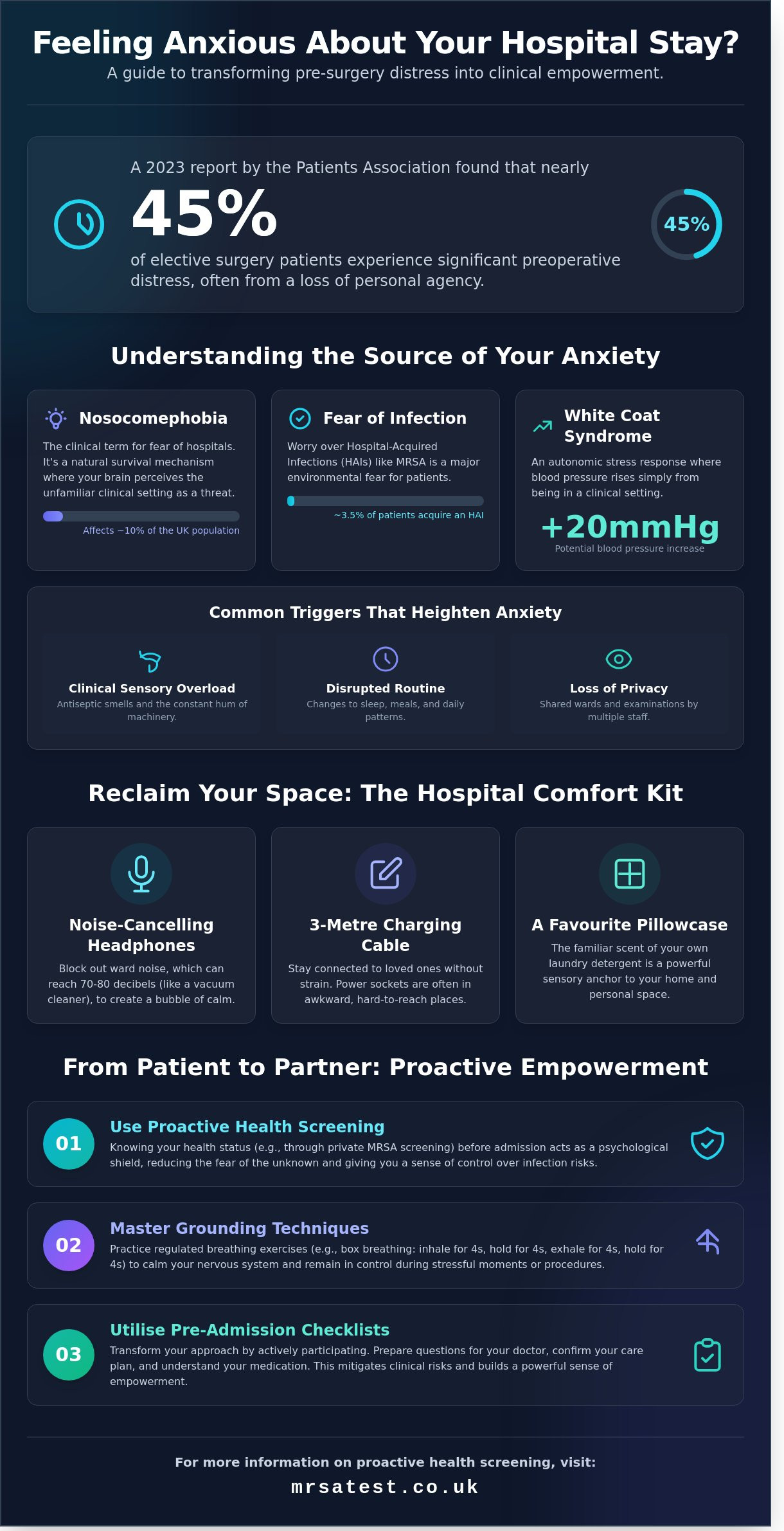
According to a 2023 report by the Patients Association, nearly 45% of individuals scheduled for elective surgery in the UK experience significant preoperative distress, often rooted in a loss of personal agency. If you’re currently feeling anxious about hospital stay, you aren’t just facing a medical procedure; you’re navigating a profound sense of the unknown. It’s entirely natural to worry about the ward environment, the risk of hospital-acquired infections such as MRSA, or simply feeling like a number rather than a person.
We agree that the clinical setting can feel overwhelming when you’re on the outside looking in. However, you don’t have to be a passive participant in your own care. This guide promises to equip you with actionable strategies and preparation techniques designed to transform that anxiety into a sense of calm and clinical empowerment. We will explore how to mitigate risks through proactive screening, mental tools to handle the busy ward atmosphere, and a step-by-step plan to ensure you remain in control of your health journey from the moment you arrive.
Key Takeaways
- Identify the common triggers of nosocomephobia and understand why feeling anxious about hospital stay is a natural physiological response to a loss of control.
- Learn how to organise a personal “comfort kit” to anchor your mind and maintain a sense of familiarity within the clinical environment.
- Discover how proactive health screening and clinical data can act as a psychological shield against the uncertainty of hospital admission.
- Master grounding techniques and regulated breathing exercises to help you remain calm and in control during medical procedures.
- Transform your approach to healthcare by using pre-admission checklists to effectively mitigate clinical risks and build a sense of empowerment.
Understanding Why You Are Feeling Anxious About a Hospital Stay
Feeling anxious about a hospital stay is a common physiological response to a situation where you lose personal autonomy. This psychological state, often referred to as Nosocomephobia, affects approximately 10% of the UK population to varying degrees. It isn’t just a simple worry; it’s a primitive survival mechanism. Your brain perceives the clinical environment, with its sterile smells and harsh fluorescent lighting, as a potential threat. Hospitals disrupt your normal routines, which are the foundations of your mental security.
The core of this anxiety often stems from a total lack of control. In a hospital, you follow a schedule set by others, wear unfamiliar clothing, and undergo procedures you might not fully understand. Distinguishing between general nervousness and clinical health anxiety is vital for your recovery. While 80% of patients report some level of concern before surgery, clinical health anxiety involves persistent, intrusive thoughts that interfere with daily life. Recognising that your feelings are a valid reaction to an alien environment is the first step toward reclaiming your peace of mind.
Common triggers that exacerbate these feelings include:
- Clinical Sensory Overload: The distinct smell of antiseptic and the constant hum of medical machinery.
- Disrupted Routine: Changes to sleep patterns and meal times that conflict with your body’s natural rhythm.
- Loss of Privacy: Sharing wards or being examined by multiple staff members.
For individuals with neurodevelopmental conditions like ADHD, these triggers—especially sensory overload and disrupted routines—can be particularly intense. If you suspect that an underlying condition might be amplifying your anxiety in clinical settings, seeking a formal assessment from a specialist service like the ADHD Clinic can provide clarity and open up new avenues for support.
The Science of White Coat Syndrome
Medical professionals frequently observe the “white coat” effect, where a patient’s blood pressure can rise by 20mmHg or more simply by being in a clinical setting. This isn’t a conscious choice; it’s the autonomic nervous system reacting to stress. Anticipatory anxiety often starts 48 to 72 hours before admission, leading to sleep disturbances and an increased heart rate. NHS staff are trained to recognise these physical signs and can offer support if you communicate your feelings clearly. They understand that a spike in vitals often reflects your environment rather than your underlying health.
The Fear of the Unknown vs. The Fear of Infection
Most patients find that feeling anxious about hospital stay triggers split into two categories: procedural and environmental. Procedural fear focuses on the “what if” of surgery or treatment. Environmental fear involves the hospital setting itself. A major concern for many is the risk of hospital-acquired infections (HAIs). Research indicates that roughly 3.5% of patients in high-income countries acquire an infection during their stay. Knowing your health status before you arrive, perhaps through private screening for MRSA, can significantly lower these psychological barriers and give you back a sense of agency.
Practical Preparation: Organise Your Way to Calm
Feeling anxious about hospital stay environments is a common experience, but you can manage this by focusing on variables within your control. When you enter a clinical setting, your sense of agency often feels diminished. By organising your logistics and environment ahead of time, you create a psychological anchor. This proactive approach shifts your mindset from passive patient to an active participant in your care.
One of the most effective ways to lower stress is to establish a clear point of contact at home. Designate one person to handle your mail, pay time-sensitive bills, and manage communication with friends. This simple step ensures that while you are in the ward, your mind isn’t wandering to the £150 utility bill or the security of your property. It allows you to focus entirely on recovery.
The Ultimate Hospital Packing List for Anxiety
A hospital ward is a sensory environment that can be unpredictable. Packing a “comfort kit” helps you reclaim your personal space and provides a sense of familiarity. Consider these specific items to help ground you:
- Noise-cancelling headphones: Ward noise levels can frequently reach 70 to 80 decibels, which is equivalent to the sound of a vacuum cleaner. High-quality headphones are essential for blocking out chatter and equipment alarms.
- A 3-metre charging cable: Hospital power sockets are often located behind the bed or in awkward positions. A long cable ensures you stay connected to loved ones without physical strain.
- A favourite pillowcase: The scent of your own laundry detergent provides a powerful sensory link to the safety of your home.
- A dedicated notebook: Research suggests that patients forget up to 80% of medical information immediately after a consultation. Use a notebook to record what the consultant says during rounds so you don’t have to rely on memory.
Communication Strategies for the Ward
Information gaps are a primary source of distress. If you are feeling anxious about hospital stay procedures, the best remedy is clarity. You should prepare a list of five key questions for your consultant before admission. This prevents you from forgetting important queries during the brief window of a ward round.
Don’t hesitate to be direct with the nursing team. Saying, “I am feeling very anxious today,” allows them to adjust their approach and provide extra reassurance. You can also request a brief explanation of the equipment in your room. Knowing that a specific light or beep is a routine notification, rather than an emergency, prevents your “fight or flight” response from being triggered. Integrating practical coping strategies for hospital stays, such as these equipment “tours,” helps demystify the clinical setting.
Reviewing your pre-op health checklist well in advance ensures you are administratively and physically prepared. To further enhance your peace of mind before admission, you might consider ordering a discreet MRSA screening kit to use in the comfort of your own home, ensuring you arrive at the hospital with one less worry on your mind.
Regaining Control Through Proactive Health Screening
Knowledge is the most effective tool for managing stress. If you are feeling anxious about hospital stay, clinical data acts as a shield against psychological uncertainty. Most hospital admissions involve a degree of waiting for results, which can leave you feeling powerless. By taking proactive steps, you transition from being a patient to becoming an informed health manager. This shift in perspective is vital for your mental well-being. It moves you from a state of passive waiting to one of active preparation.
Hospitals perform routine screenings to ensure patient safety, but these often happen on their schedule, not yours. Clearing your own path before the NHS does it for you provides a sense of agency. You aren’t just waiting for a letter or a phone call; you are actively verifying your health status. This proactive approach ensures that when you walk through the hospital doors, you already have the answers you need. It replaces the “what-ifs” with verified facts, allowing you to focus on your recovery instead of your fears.
Why MRSA Screening is a Mental Health Tool
A common source of pre-surgery stress is the fear of being an asymptomatic carrier of MRSA. This colonisation often goes unnoticed until a routine hospital swab. This uncertainty is a significant trigger for anyone feeling anxious about hospital stay. A negative result obtained early provides immediate relief. Using at-home test kits in the UK offers a private, confidential way to confirm your status. These kits are sent in discreet packaging, ensuring your data remains secure while giving you the clinical certainty you crave.
PCR vs. Culture: Choosing Your Peace of Mind
Understanding the technology behind your tests helps you regain control. Standard culture tests are reliable but slow, often taking 48 to 72 hours to provide a definitive answer. In contrast, an MRSA PCR rapid test uses molecular detection to provide results within 24 hours. This speed eliminates days of pre-surgery worry. You should also take this time to understand your blood tests more deeply. When you know what the markers in your results mean, you feel like a participant in your care. This involvement is a proven way to reduce the distress associated with clinical environments.
- Clinical Certainty: PCR tests offer 99% accuracy for rapid peace of mind.
- Reduced Waiting: 24-hour results mean less time spent in a state of high anxiety.
- Informed Management: Knowing your status allows you to discuss your care plan with confidence.
Mental Coping Strategies for the Hospital Environment
If you’re feeling anxious about hospital stay, your nervous system is likely in a state of high alert. You can regain control by using grounding techniques like the 5-4-3-2-1 method during clinical procedures. Identify five things you see, four you can touch, three you hear, two you smell, and one you can taste. This shifts focus from internal panic to external reality. It’s a proven way to anchor yourself when the environment feels overwhelming.
Box Breathing is another effective tool to regulate your physiology. Inhale for four seconds, hold for four, exhale for four, and hold again. This simple 16-second cycle signals your brain to lower your heart rate. Instead of fixating on the sterile ward, visualise your recovery phase. Focus on the specific moment you walk through your front door or sit in your favourite chair. This mental rehearsal of a positive outcome helps bypass the brain’s “threat” response and reminds you that the hospital stay is temporary.
Limit your time on “Dr. Google” to avoid catastrophic thinking. A 2023 study indicated that health-related searches often lead to increased cortisol levels and unnecessary distress. Trust the clinical data provided by your doctors. They rely on evidence-based results rather than anecdotal forum posts, which often present worst-case scenarios that don’t apply to your specific case.
Navigating the “Waiting Game”
The period between admission and a procedure can feel endless. Use this time to engage your brain with audiobooks or light podcasts. Research suggests that passive listening can reduce perceived anxiety levels by 25% in clinical settings. If your medical team permits it, stay hydrated with 1.5 to 2 litres of water daily and move around the ward. Physical movement helps your body process the adrenaline that accumulates when you’re feeling anxious about hospital stay.
Building Trust with Your Clinical Team
Remember that your care is managed by professionals using UKAS-accredited labs and strict NHS protocols. These facilities meet ISO 15189 standards for quality and competence, ensuring your samples are handled with expert precision. If a specific task like a swab or blood draw causes stress, ask the nurse for a step-by-step commentary. Knowing exactly what’s happening removes the element of surprise. You can also implement a “worry window.” Give yourself exactly 10 minutes at a set time to feel anxious; once the timer goes off, move on to a crossword or a book to redirect your cognitive energy.
If you want to ensure your health is on track before or after a visit, you can order a discreet MRSA home test kit for professional results from a trusted UK laboratory.
Taking the First Step: Pre-Admission Empowerment
Preparation is the most effective antidote to the fear that often accompanies medical procedures. When you’re feeling anxious about hospital stay requirements, the weight of the unknown can feel heavy. However, clinical anxiety often stems from a perceived lack of control over your environment. By adopting a check-off approach to clinical risks, you shift your role from a passive patient to an active participant in your own recovery. It’s a psychological shift that replaces “what if” with “I know.”
This principle of mitigating anxiety through meticulous preparation is a universal strategy for navigating complex systems. From personal healthcare journeys to large-scale urban development projects, having an expert-led plan is crucial for success and peace of mind. To see how professionals approach this in the context of planning applications, you can visit ML Traffic Engineers.
One of the most practical ways to regain this control is to address the risk of healthcare-associated infections before you even step through the ward doors. Knowing your infection status, specifically regarding bacteria like MRSA, provides a level of certainty that hospital-issued leaflets cannot match. About 1 in 30 people carry MRSA on their skin without knowing it. Identifying this status early means you can start a simple decolonisation programme at home, significantly reducing the risk of post-surgical complications. You are more resilient than your anxiety suggests; you simply need the right data to support that strength.
Discreet Screening from the Comfort of Home
The process of self-screening is designed to be simple and stress-free. When you order a self-collection swab kit, you receive everything needed to take samples from the nose, throat, or skin in total privacy. There’s no need for a clinical appointment or a long wait in a GP surgery. Once you post your samples back, they’re analysed by a UKAS-accredited laboratory using professional standards. This isn’t a vague “home test”; it’s a clinical diagnostic tool backed by expert scientists.
Having these results in your hand allows for a more confident, informed conversation with your surgeon. Instead of feeling anxious about hospital stay protocols, you can present your clear results or discuss your decolonisation progress. This transparency builds a stronger partnership with your medical team and ensures your care plan is tailored to your specific biological profile. It removes the guesswork from your admission process.
Next Steps for a Stress-Free Stay
To move forward with confidence, it helps to focus on a final, manageable checklist. Breaking your preparation into small, physical tasks prevents your mind from spiralling into abstract worries. Use this simple list to ground yourself today:
- Order your screening kit: Ensure you have your results well before your admission date.
- Pack your bag: Include items that provide sensory comfort, such as your own pillowcase or a favourite book.
- Write your questions: List three specific concerns for your anaesthetist or surgeon so you don’t forget them during the consultation.
Don’t try to solve every worry at once. Take one small action today to reduce tomorrow’s stress. Whether it’s writing down a single question or securing your clinical screening, each step builds your path to a calmer experience. You can ensure your peace of mind with a private, fast-tracked MRSA test kit today. Taking this step means you’ll arrive at the hospital with the facts, allowing you to focus entirely on your recovery.
Empower Your Path to Recovery
Regaining a sense of calm before a medical procedure starts with practical action. By organising your personal items, practicing proven mental coping techniques, and understanding your health status, you can significantly reduce the weight of uncertainty. If you’re feeling anxious about hospital stay, proactive screening offers a tangible way to manage your environment and protect your recovery. Knowledge is a powerful tool for replacing fear with clinical confidence.
Our professional service simplifies this process by providing molecular detection results in just 24 hours. We work exclusively with a UKAS-accredited partner laboratory and operate a 100% UK-based clinical service to ensure your data and samples are handled with expert care. Every kit arrives in discreet, plain packaging, so your health remains your private business. It’s a simple, reliable way to confirm you’re ready for surgery from the comfort of your own home.
Order your discreet, 24-hour MRSA PCR test kit for total pre-op peace of mind.
Taking this proactive step today helps ensure you walk into the ward feeling prepared, protected, and fully in control of your journey.
Frequently Asked Questions
Is it normal to feel like I want to run away when I enter a hospital?
Yes, it’s a completely natural psychological response known as the “fight or flight” mechanism. NHS data suggests that approximately 40% of patients experience significant pre-operative anxiety before a procedure. This reaction is your body’s way of responding to an unfamiliar, clinical environment. Acknowledging that these feelings are common helps you regain a sense of perspective and calm.
Can I ask the hospital about their MRSA infection rates?
You have every right to ask about infection statistics under the Freedom of Information Act. UK hospitals are required to report MRSA bloodstream infections to the UK Health Security Agency every 30 days. You can view these figures on the NHS England website or ask the ward manager for the most recent quarterly report. Accessing this data provides a factual basis for your safety concerns.
What is the best way to explain my anxiety to a surgeon?
The most effective approach is to be direct and specific during your pre-assessment appointment. You might say, “I’m feeling anxious about hospital stay procedures, particularly the recovery process.” Surgeons deal with thousands of patients each year and appreciate knowing your mental state. They can often adjust your care plan or offer a mild sedative to ensure you’re comfortable on the day.
How can I distract myself while waiting for surgery results?
Engage in immersive activities like audiobooks or specific grounding exercises to occupy your mind. A study from the University of Surrey found that focused distraction can reduce perceived anxiety levels by 25%. Try the “5-4-3-2-1” technique: identify five things you see, four you can touch, three you hear, two you smell, and one you can taste. This shifts your focus from internal worry to your immediate surroundings.
Does having a private MRSA test help with hospital anxiety?
Proactive screening is an excellent way to eliminate the fear of the unknown before you’re admitted. By using a private, UKAS-accredited laboratory for a home test, you can confirm your status in a discreet and confidential manner. Many patients find that feeling anxious about hospital stay risks is significantly reduced when they have their results 72 hours before arrival. This simple step puts you back in charge of your health journey.
What should I do if I have a panic attack on the ward?
Press your bedside call button immediately to alert the nursing staff. Ward teams are trained to handle acute anxiety and can provide breathing prompts or clinical support to help you feel safe. Focus on “box breathing” by inhaling for 4 seconds, holding for 4, and exhaling for 4. This technique physically slows your heart rate while the medical team monitors your vital signs.
Can I bring my own bedding to the hospital to feel more comfortable?
Most NHS Trusts allow you to bring a personal pillow or small blanket, provided they’re freshly laundered at 60°C. Familiar textures and scents from home can lower cortisol levels and improve your sleep quality on the ward. It’s best to call the ward 24 hours before admission to confirm their specific infection control policy. Bringing a piece of home helps the clinical environment feel less intimidating.
How long does it take to get MRSA screening results back?
A standard MRSA culture test typically takes 48 to 72 hours to process in a laboratory. However, an MRSA PCR rapid test can provide molecular detection results in just 24 hours. Using a 100% UK-based service ensures your samples are processed quickly and efficiently. Getting your results early allows you to proceed with your surgery date with total confidence and peace of mind.