

Blog
Why Do Hospitals Screen for MRSA? Protecting Patients and Surgery Success
Mar
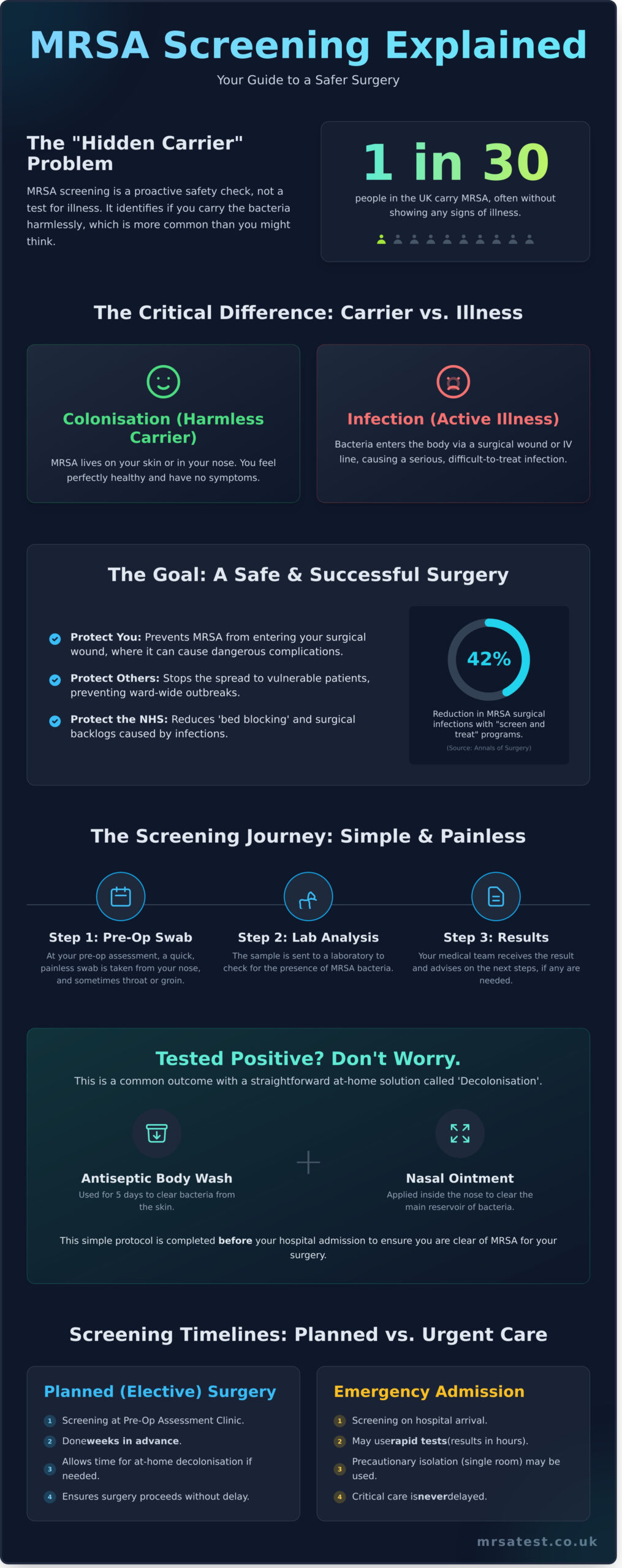
Did you know that according to NHS estimates, approximately 1 in 30 people in the UK carry MRSA bacteria on their skin or in their nose, often without showing any signs of illness? It’s completely natural to feel a sense of apprehension when told you need a pre-operative screening; the thought of a positive result delaying your surgery is a common and valid concern.
Understanding exactly why do hospitals screen for MRSA is the first step toward replacing that anxiety with confidence. This routine check is a critical safety measure designed to protect you from post-surgical infections and ensure your procedure is successful. In this guide, we’ll clearly explain the difference between carrying MRSA and having an active infection, detail how screening prevents life-threatening complications, and provide straightforward advice on what to expect if your result is positive, giving you the peace of mind you need before your hospital stay.
Key Takeaways
- Learn the crucial difference between carrying MRSA on your skin (colonisation) and having an active infection, and why this distinction is vital before surgery.
- Discover why do hospitals screen for mrsa to prevent surgical complications and what the straightforward “decolonisation” protocol involves if you test positive.
- Demystify the screening process by understanding the simple, step-by-step journey of your swabs from the pre-op clinic to the laboratory analysis.
- Understand how you can take control of your pre-operative journey and avoid last-minute stress by exploring private screening options ahead of your NHS appointment.
What is MRSA Screening and Why is it Standard Hospital Protocol?
MRSA screening is a simple, preventative measure used by UK hospitals to identify the presence of a specific antibiotic-resistant bacterium. It typically involves taking a quick and painless swab from the inside of your nose, and sometimes from your throat or groin. The sample is then sent to a laboratory to check for the presence of Methicillin-resistant Staphylococcus aureus (MRSA). This isn’t a test for an active infection; it’s a proactive safety check to find out if you are carrying the bacteria on your skin without any signs or symptoms.
The reason why do hospitals screen for mrsa is rooted in patient safety initiatives from the last two decades. Following a significant rise in hospital-acquired infections, NHS England made MRSA screening mandatory for all patients due to be admitted for elective surgery in 2009. This policy was a direct response to the challenge posed by MRSA and has been instrumental in reducing infection rates across the country. The primary goal is to identify carriers before they enter a high-risk environment, such as an operating theatre or a ward with vulnerable patients, where the bacteria could cause a serious infection.
This screening is necessary because of the ‘hidden carrier’ problem. It’s estimated that around 1 in 3 people carry Staphylococcus aureus bacteria on their skin or in their nose, usually without any harm. A small percentage of these individuals carry the specific MRSA strain, which has evolved to resist common antibiotics. These people are ‘colonised’ rather than infected; they feel perfectly well but can unknowingly pass the bacteria to others or develop an infection themselves if their skin is broken during surgery.
The Difference Between Elective and Emergency Screening
For patients scheduled for planned (elective) surgery, MRSA screening is a routine part of the pre-operative process. This is often done weeks in advance at a Pre-Operative Assessment Clinic (PAAC). This timeframe allows for decolonisation treatment, a simple body and nasal wash, to be completed at home if a patient tests positive, clearing the bacteria before their hospital admission.
In contrast, emergency admissions through A&E don’t allow for advance screening. In these urgent cases, hospitals may use rapid PCR tests that provide results in hours, or they may place the patient in a single room as a precaution. This approach ensures that critical care is never delayed while still managing the potential risk of transmission to other patients on the ward.
Hospital Safety as a Collective Responsibility
MRSA is often called a ‘superbug’ because it has developed resistance to methicillin and other common antibiotics, making infections difficult to treat. Because it can be carried unknowingly, one undiagnosed patient can inadvertently lead to a ward-wide outbreak, putting patients with weakened immune systems at severe risk. This has a significant knock-on effect on hospital resources, contributing to ‘bed blocking’ where patients cannot be discharged, and causing delays in the surgical backlogs that affect the entire NHS system.
Understanding the Risk: Colonisation vs. Active Infection
Receiving a positive MRSA result can be alarming, but it’s crucial to understand what it actually means. In most cases, it doesn’t mean you are sick. Instead, it indicates ‘colonisation,’ which is the medical term for carrying the bacteria on your skin or in your nose without any signs of illness. A significant portion of the population carries Staphylococcus aureus bacteria, and MRSA is simply a strain that has become resistant to certain antibiotics. The bacteria can live harmlessly on the skin for weeks, months, or even years.
The primary reason why do hospitals screen for mrsa is to identify this colonisation before it has a chance to become a dangerous, active infection. The body’s skin provides a highly effective barrier against bacteria. However, this barrier is compromised during medical procedures, most notably surgery. An incision, an IV line, or a catheter creates a direct pathway for colonised bacteria to enter the bloodstream or deeper tissues, where they can multiply and cause serious harm.
The vulnerability of surgical sites is a key focus. Once inside the body, MRSA can lead to a post-operative wound infection that is difficult to treat. The evidence supporting pre-operative screening is compelling. A major study published in the Annals of Surgery found that a comprehensive “screen and treat” programme reduced MRSA surgical site infections by 42%. Different healthcare systems adopt various MRSA screening strategies to mitigate this risk, but the goal remains the same: prevent a manageable risk from becoming a life-threatening infection.
Common Sites for MRSA Colonisation
MRSA bacteria prefer to live in warm, moist environments on the body. This is why hospital and at-home screening tests involve taking swabs from multiple locations to ensure an accurate and reliable result. The most common reservoirs include:
- The Nose (Nares): This is the primary site where Staphylococcus aureus, including MRSA, is found.
- Skin Folds: Areas like the armpits (axilla), groin, and underneath skin folds provide ideal conditions for the bacteria to thrive.
- The Throat or Perineum: In some cases, these areas may also be swabbed depending on the specific hospital protocol.
When MRSA Becomes Dangerous
An active MRSA infection occurs when the colonised bacteria breach the body’s defences. This is when the situation becomes dangerous. An infection at a surgical site can quickly progress from a localised problem to a systemic crisis. Knowing your status before a hospital admission allows for pre-emptive action. For those seeking clarity before a procedure, an at-home MRSA test offers a simple and confidential solution.
Initial symptoms of an active wound infection are often localised and include:
- Increasing redness, warmth, and swelling around the wound.
- Pus or other fluid draining from the incision.
- A persistent fever and feeling generally unwell.
If left untreated, the infection can spread into the bloodstream, leading to sepsis, a life-threatening condition. It can also cause severe complications like pneumonia or bone infections (osteomyelitis). Because MRSA is resistant to many first-line antibiotics, treating these systemic infections is complex and requires specialised care. This is precisely why do hospitals screen for mrsa; prevention is always safer and more effective than treatment.
The ongoing challenge posed by antibiotic resistance is a major focus for medical researchers worldwide. Scientists are constantly exploring new compounds that could form the basis of future treatments, with antimicrobial peptides being a particularly promising area of study. This vital work is supported by specialist suppliers providing laboratory-grade materials, and for researchers in Australia, Peptide Research AU is one such source for these compounds.
The Screening Process: Swabs, Labs, and Timelines
Understanding the MRSA screening process can help demystify what happens before a hospital admission. The procedure itself is simple, quick, and non-invasive, designed to provide crucial information with minimal discomfort. It’s a fundamental part of patient safety protocols and a key reason why do hospitals screen for mrsa: to identify colonised individuals before they enter a high-risk clinical environment.
The collection process involves taking samples from areas of the body where MRSA bacteria commonly live without causing harm. A healthcare professional, or you yourself with a home-testing kit, will use a sterile cotton swab to gently collect a sample from:
- The Nose: The swab is carefully rotated inside both nostrils, as this is the most frequent site for MRSA colonisation.
- The Groin: A swab is also taken from the skin in the groin area (perineum), another common site.
- The Throat or Wounds: Depending on your medical history, samples may also be taken from the throat or from any open wounds, sores, or catheter sites.
Once collected, these swabs are securely sealed and sent directly to a UKAS-accredited laboratory for analysis. Here, scientists use one of two primary methods to determine if MRSA is present.
Culture Testing: The Gold Standard
The traditional culture test is considered the most definitive method for MRSA detection. The sample from your swab is applied to a special nutrient-rich plate (agar) and incubated. If MRSA bacteria are present, they will multiply and grow into visible colonies. This process requires time, which is why results typically take between 48 and 72 hours. Its high accuracy and ability to identify specific bacterial strains make it invaluable for infection control.
Rapid PCR Testing: Speed for Urgent Cases
For more urgent situations, hospitals and private services use PCR (Polymerase Chain Reaction) testing. This advanced molecular technique doesn’t wait for bacteria to grow. Instead, it directly detects MRSA’s genetic material (DNA) from the swab sample. This allows for a much faster turnaround, with accurate results often available in under 24 hours. This speed is vital for emergency admissions or last-minute pre-operative checks where a delay is not possible. Learn more about our Rapid PCR MRSA kits for situations requiring this swift response.
The choice between these tests directly impacts timelines. For planned surgeries, the NHS typically performs a culture test during a pre-operative assessment a week or two beforehand. This buffer allows enough time for the 72-hour result and, if positive, for a five-day decolonisation treatment to be completed without postponing the procedure. This careful scheduling is precisely why do hospitals screen for mrsa well in advance of elective operations. It ensures patient safety protocols are met without causing unnecessary disruption to care.
What Happens if You Test Positive? The Decolonisation Protocol
Receiving a positive MRSA test result can be worrying, but it’s crucial to understand that this is a common and manageable situation. A positive result simply means the bacteria is present on your skin or in your nose; it doesn’t mean you have an active infection. For UK hospitals, this finding rarely leads to the cancellation of your surgery. Instead, it triggers a standard, effective safety procedure known as ‘decolonisation’.
The goal is to significantly reduce the amount of MRSA bacteria on your body before your operation, lowering the risk of it entering your bloodstream or surgical wound. You’ll typically be asked to complete a simple 5-day treatment course at home before you are admitted. This proactive treatment is a core reason why do hospitals screen for mrsa; it’s about prevention, not just reaction. After the course, some NHS trusts may require a re-test to confirm the bacteria has been suppressed to safe levels.
The Decolonisation Routine
Your pre-admission team will provide a decolonisation kit with clear instructions. The routine is straightforward and involves three key elements to be performed daily for five consecutive days:
- Antiseptic Body and Hair Wash: You’ll use a special antiseptic skin cleanser, often containing 4% Chlorhexidine gluconate. You use this in the shower once a day, washing your entire body from the neck down, paying special attention to areas like the armpits, groin, and any skin folds. On at least two of the five days, you’ll also use it to wash your hair, as MRSA can be present on the scalp.
- Antibiotic Nasal Ointment: The nose is the most common place for MRSA to live harmlessly. You’ll be given a topical antibiotic ointment, usually Mupirocin 2%, to apply inside your nostrils. Using a clean cotton bud or your little finger, you apply a small, match-head-sized amount to the inner surface of each nostril, two to three times a day.
- Environmental Hygiene: To prevent re-colonising yourself from your surroundings, it’s vital to change your towels, flannels, bedsheets, and nightwear every day during the 5-day treatment period. Wash these items on a hot wash (at least 60°C) to kill any bacteria.
While this routine addresses temporary bacterial colonisation, maintaining long-term scalp health is also important for overall well-being. For those with ongoing concerns about hair or scalp conditions, you can discover Terra Medical, a doctor-led clinic specializing in this area.
Impact on Your Surgery Date
Your surgical team will assess the urgency of your procedure. For emergency operations, treatment will proceed immediately alongside other infection control measures. For planned (elective) surgery, the team may prefer to wait for you to complete the 5-day decolonisation course. This short delay is a critical safety measure, and this principle of rigorous pre-operative screening is a global standard applied in many advanced procedures, such as the kind of FUE hair transplant Singapore clinics specialize in, to minimize infection risks.
When your surgery does go ahead, you may notice you are scheduled ‘first on the list’ for the day. This isn’t a coincidence. Placing MRSA-positive patients at the start of the day allows the operating theatre to undergo a full, enhanced deep clean immediately afterwards, ensuring the environment is completely safe for the next patient. This meticulous planning helps explain why do hospitals screen for mrsa as part of a wider infection control strategy.
Successfully completing the decolonisation protocol is highly effective. Clinical evidence, supported by guidance from the UK’s National Institute for Health and Care Excellence (NICE), shows that pre-operative decolonisation reduces the risk of a patient developing an MRSA surgical site infection by up to 60%. If you’re concerned about potential hospital delays or want to take control of the process, you can get tested in advance. Discover your status early with our confidential MRSA home testing kit.
Taking Control: The Benefits of Private MRSA Screening
While NHS pre-operative screening is a vital safety measure, the waiting period can be a source of significant anxiety for many patients. The uncertainty of a potential last-minute procedure cancellation leads many to seek a more proactive approach. Private MRSA screening offers a confidential and convenient way to gain clarity, putting you firmly in control of your surgical preparations and providing valuable peace of mind.
Imagine this scenario: it’s 5 PM on a Friday, and your surgery is scheduled for Monday morning. The phone rings. It’s the hospital pre-assessment nurse informing you that your routine MRSA swab has come back positive. Your operation is now postponed, pending a course of decolonisation treatment. This “Friday night phone call” is a stressful reality for thousands of patients in the UK each year. It creates immense emotional turmoil and disrupts carefully made plans for work, family, and recovery. Testing privately a week or two in advance eliminates this risk, transforming a last-minute crisis into a manageable task.
For elderly patients or individuals with mobility challenges, a trip to a GP surgery or hospital clinic for a swab can be an ordeal in itself. At-home testing kits remove this barrier completely. The entire process, from taking a simple swab to receiving confidential results, is managed from the comfort of your own home. This discreet service ensures that preparing for your procedure is as stress-free as possible, without the need to arrange transport or navigate a busy clinical environment. This is a key reason why do hospitals screen for mrsa in the first place-to protect vulnerable patients-and at-home testing extends that protection by making pre-screening more accessible.
Arriving at the hospital with your MRSA status already confirmed can significantly streamline your admission process. If your private test was negative, you can share this result with your surgical team, demonstrating your proactive approach to safety. If the result was positive, you will have likely already completed the decolonisation treatment prescribed by your GP. This shows the hospital team that the risk has been managed effectively, reducing the chance of any administrative delays on the day of your surgery and reinforcing the patient safety goals that drive hospital screening protocols.
Proactive Preparation for Peace of Mind
Knowing your MRSA status early provides the time to act calmly and effectively. A positive result allows you to complete the simple decolonisation process at home, well ahead of your surgery date. This proactive step is particularly crucial in the private healthcare sector, where a last-minute cancellation can have financial implications. By taking control, you minimise disruption and ensure you are fully prepared for your procedure. Browse our UKAS-accredited MRSA test kits to get started.
The mrsatest.co.uk Advantage
Our service is confidential, simple, and 100% UK-based. We partner exclusively with a leading UKAS-accredited laboratory to ensure your results are clinically accurate and reliable. You can choose between our standard Culture test or a Rapid PCR test for time-sensitive situations. Your secure, easy-to-understand results are delivered directly to your email, giving you the information you need, when you need it. Order your confidential MRSA test kit today.
Take Proactive Control of Your Pre-Surgical Health
Understanding why do hospitals screen for mrsa is the first step towards a safer medical procedure. It’s a critical safety protocol designed to distinguish between harmless colonisation and the risk of a dangerous post-operative infection. By identifying MRSA carriers before they enter a vulnerable surgical setting, healthcare providers can implement simple decolonisation treatments to protect patient health and ensure the best possible outcome.
Engaging with trusted healthcare professionals is key to this process. For general advice on pre-operative wellness and medication management, your local pharmacist is an invaluable and accessible resource. A community-centered practice like Sage Creek Pharmacy is a great example of the personalized support that can help patients feel prepared and confident.
Engaging with trusted healthcare professionals is key to this process. For general advice on pre-operative wellness and medication management, your local pharmacist is an invaluable and accessible resource. A community-centered practice like Sage Creek Pharmacy is a great example of the personalized support that can help patients feel prepared and confident.
You don’t have to wait for a hospital appointment to get clear answers. Secure your peace of mind with a private MRSA test kit from mrsatest.co.uk. Our 100% confidential at-home service delivers clinically accurate results from our UKAS-accredited partner laboratory, with a rapid 24-hour PCR option available. Taking this simple, proactive step empowers you with the knowledge needed for a smoother, safer hospital experience.
Frequently Asked Questions
Is MRSA screening mandatory for all hospital patients in the UK?
No, MRSA screening isn’t mandatory for every patient, but it is a routine and highly recommended procedure for specific groups under NHS guidelines. Screening is standard for most patients scheduled for planned surgery, particularly in high-risk fields like orthopaedics and heart surgery. It is also common for emergency admissions. This proactive approach is a key reason why hospitals screen for MRSA; it helps prevent infections and protect all patients in their care.
What happens if I test positive for MRSA before my surgery?
If you test positive for MRSA, your clinical team will prescribe a simple and effective decontamination treatment. This typically involves using a special antiseptic body wash and a nasal ointment for five days at home before your admission. This treatment is very effective at removing the bacteria from your skin and nose, significantly lowering the risk of a post-surgical infection. Your care team will provide all necessary products and clear instructions.
Can I refuse an MRSA swab test at the hospital?
Yes, you have the right to refuse any medical test, including an MRSA screening swab. However, it’s important to understand the potential risks of this decision. Without a test result, the hospital staff cannot take specific precautions to protect you or others if you are carrying the bacteria. Your surgical team will discuss the safety implications with you, as refusing the test may affect how your care is managed during your stay.
How long does an MRSA screen result take to come back?
The time it takes to get your MRSA screen result depends on the testing method the hospital uses. A standard laboratory culture test, where the sample is grown to detect bacteria, usually provides a result within 48 to 72 hours. Some NHS trusts use a faster molecular test known as a PCR test, which can deliver a result in just a few hours. Your pre-assessment nurse will inform you of the expected timeframe.
Does a positive MRSA test mean my surgery will be cancelled?
No, a positive MRSA test very rarely means your surgery will be cancelled. In most cases, your procedure will simply be postponed for a short time, usually about a week, to allow you to complete the 5-day decontamination treatment at home. This brief delay is a crucial safety measure that dramatically reduces your risk of developing an infection after your operation. The goal is to proceed with your surgery as safely as possible.
How often do I need to be screened if I am a frequent hospital visitor?
Screening frequency for patients with regular hospital admissions is determined by individual hospital policy. You will likely be screened before each new planned admission, even if you were tested recently. This is because it’s possible to become colonised with MRSA in the community between hospital stays. Repeating the screen ensures your clinical team has the most current information to protect you and other patients from infection.
Can I carry MRSA without having any symptoms?
Yes, you can absolutely carry MRSA on your skin or in your nose and feel perfectly healthy. This is known as being ‘colonised’, and it is quite common. The bacteria are harmless when on the surface of the skin. They only pose a risk if they get a chance to enter the body, for example, through a surgical incision or a wound. This is precisely why hospitals screen for MRSA before surgery, to remove the bacteria first.
Is the MRSA swab test painful or uncomfortable?
The MRSA swab test is a quick, straightforward, and painless procedure. A healthcare professional will use a soft swab, much like a cotton bud, to gently wipe the inside of your nostrils and sometimes the back of your throat or your groin area. The entire process takes less than a minute. Most people report feeling a slight tickling sensation, but it does not cause any pain or lasting discomfort.
