

Blog
What Is a Ganglion Cyst? A Complete Guide to Causes, Symptoms & Treatment

Jan
Discovering a new, firm lump on your wrist, hand, or finger can be concerning. The sudden appearance of any unexpected growth often leads to immediate questions: Is it serious? Why is it there? What should I do next? If you’ve found a smooth, round lump that may or may not be painful, it is very likely a common and benign condition known as a ganglion cyst. While their presence can be unsettling, it is important to know that these cysts are non-cancerous and are not a threat to your overall health.
This complete guide is designed to provide clear, factual answers to all your questions. We will explain exactly what a ganglion cyst is, explore the common causes and symptoms, and detail the full range of available treatment options. From the simple approach of watchful waiting to safe medical procedures for removal, you will gain a comprehensive understanding of your condition. Our goal is to empower you with the knowledge to identify your lump confidently, understand when to seek medical advice, and make an informed decision about your care.
What Exactly Is a Ganglion Cyst? The Basics Explained
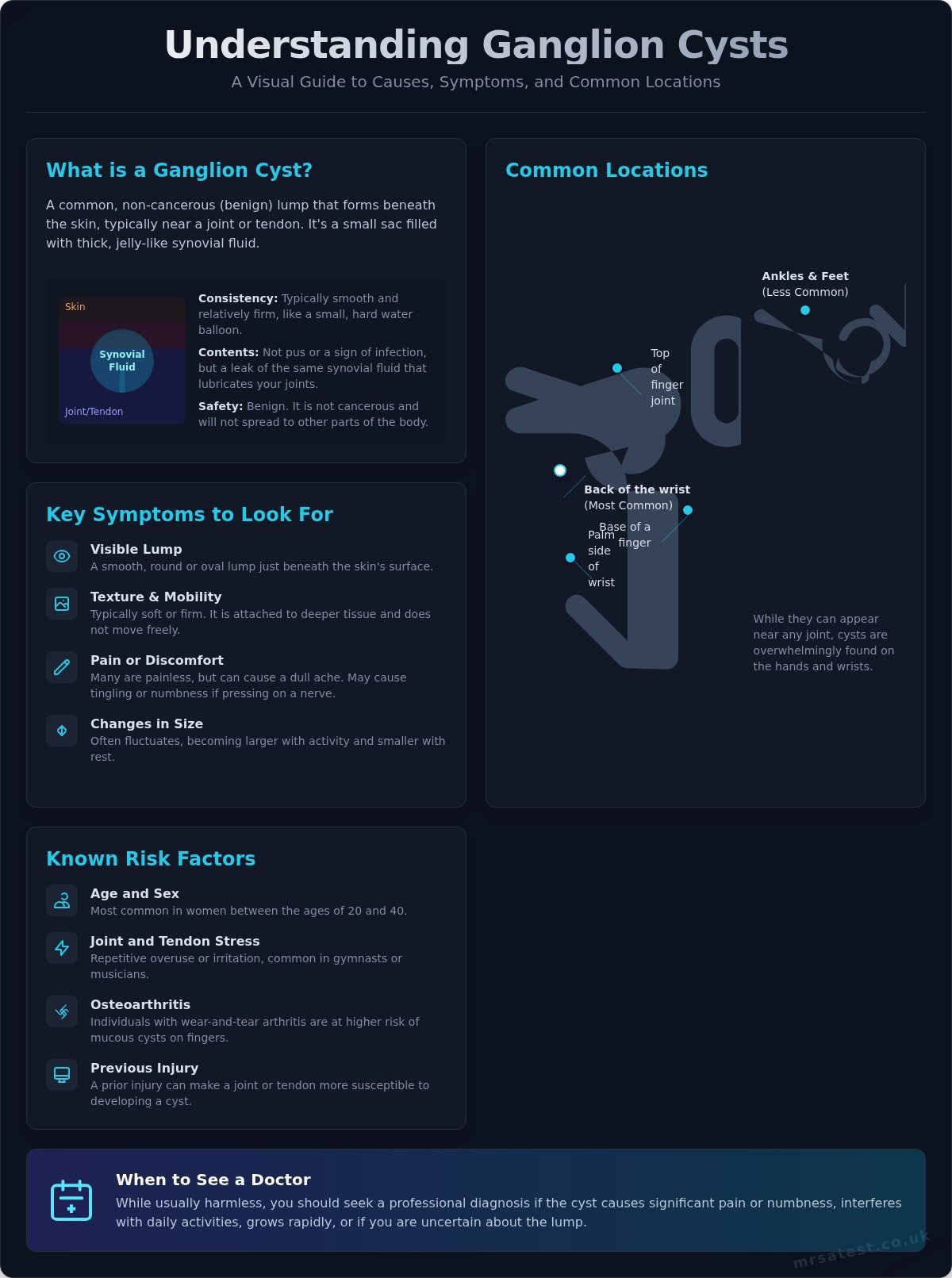
Discovering a new lump on your body can be concerning, but a ganglion cyst is a common and harmless occurrence. In simple terms, it is a non-cancerous (benign) lump that forms just beneath the skin. These cysts are essentially small sacs filled with a thick, jelly-like fluid. This fluid is synovial fluid, the same substance that lubricates your joints and tendons, allowing them to move smoothly. Ganglion cysts can vary significantly in size, from as small as a pea to larger, more noticeable lumps, and may change in size over time.
Common Locations for Ganglion Cysts
While a ganglion cyst can appear near any joint, they are most frequently found in specific areas. Understanding these common locations can help in preliminary identification:
- Back of the wrist: This is the most common site for a ganglion cyst to develop.
- Palm side of the wrist: They can also form on the underside of the wrist, often near the pulse point at the base of the thumb.
- Base of a finger: A small, firm cyst on the palm side at the base of a finger is often called a seed ganglion.
- Top of a finger joint: When located on the top of the end joint of a finger, it is referred to as a mucous cyst and may be associated with arthritis.
- Ankles and feet: Less commonly, these cysts can also appear on the top of the foot or ankle.
What’s Inside a Ganglion Cyst?
The substance inside a ganglion cyst is not pus or a sign of infection. It originates from a leak of synovial fluid from a nearby joint capsule or tendon sheath. This fluid, which is normally contained within our joints to reduce friction, escapes and collects in a sac-like structure. A Ganglion cyst is therefore filled with a thick, clear, viscous fluid that has a consistency similar to gel or jelly. This is why they typically feel smooth and relatively firm to the touch.
Are Ganglion Cysts Dangerous?
The most important point to understand is that ganglion cysts are benign, meaning they are not cancerous and will not spread to other parts of the body. In many cases, they are entirely asymptomatic and cause no problems. However, they can occasionally become a source of discomfort. If a cyst grows large enough to press on a nearby nerve, it can cause pain, tingling, or numbness in the surrounding area. Furthermore, a cyst located very close to a joint, such as the wrist, may sometimes interfere with the full range of movement.
Identifying the Symptoms and Understanding the Causes
A ganglion cyst typically presents as a noticeable lump, but understanding the full range of symptoms and potential causes is crucial for proper management. While often harmless, recognising the signs can help you determine when professional medical advice is necessary.
Key Symptoms to Look For
The most common and obvious symptom of a ganglion cyst is the appearance of the lump itself. However, other signs may accompany it. It is important to look for the following characteristics:
- A Visible Lump: The cyst appears as a smooth, round or oval lump just beneath the skin’s surface, most often on the wrists or hands.
- Texture and Mobility: The lump is typically soft or firm and is attached to a deeper joint or tendon sheath, meaning it does not move freely under the skin.
- Pain or Discomfort: While many cysts are painless, some can cause a dull ache, particularly with joint movement. If the cyst presses on a nearby nerve, you may experience tingling, numbness, or muscle weakness.
- Changes in Size: The cyst may fluctuate in size. It often becomes larger with increased activity of the affected joint and may shrink or even disappear with rest.
Why Do Ganglion Cysts Form? (Known Risk Factors)
The exact cause of these cysts remains unknown, but the leading theory suggests they occur when synovial fluid-the substance that lubricates your joints and tendons-leaks and collects in a sac. This leakage may be triggered by injury, trauma, or repetitive stress. Leading medical resources, such as the Cleveland Clinic on ganglion cysts, note that while the precise trigger is unknown, certain factors increase your likelihood of developing one.
Key risk factors include:
- Age and Sex: They are most common in women between the ages of 20 and 40.
- Joint and Tendon Stress: Repetitive overuse or irritation of a joint or tendon, common in gymnasts or musicians, can contribute to their formation.
- Osteoarthritis: Individuals with wear-and-tear arthritis in the finger joints are at higher risk of developing mucous cysts, a type of ganglion cyst near the nail bed.
- Previous Injury: A prior injury to a joint or tendon can make the area more susceptible to developing a cyst.
When to See a Doctor About Your Cyst
While many cysts do not require medical intervention, it is advisable to seek a professional diagnosis to rule out other conditions. You should schedule an appointment with your GP if you experience any of the following:
- The cyst causes significant or persistent pain, numbness, or tingling.
- It interferes with your ability to perform daily activities or limits joint movement.
- The lump grows rapidly, or the overlying skin becomes red and inflamed.
- You are uncertain about the diagnosis and would like professional reassurance.
How a Doctor Diagnoses a Ganglion Cyst
If you have discovered a lump you suspect is a ganglion cyst, the first step is to see your GP for a professional diagnosis. Fortunately, confirming the diagnosis is often a simple and straightforward process that can usually be completed during your appointment without the need for complex or invasive procedures.
The Physical Examination
Your doctor will begin with a physical examination of the lump and the surrounding area. They will likely ask you about your symptoms, such as whether the lump is painful, and when you first noticed it. During the exam, the doctor will:
- Press gently on the lump to assess its consistency (they are typically firm and smooth) and to check for any tenderness.
- Check if the lump is attached to deeper tissue or if it can be moved slightly under the skin.
- Perform a simple diagnostic test using a small light to see through the lump.
The ‘Flashlight Test’ (Transillumination)
A key diagnostic step is a simple procedure called transillumination. Your doctor will dim the lights and shine a small, bright light (like a pen torch) against the side of the lump. Because a ganglion cyst is filled with a clear, jelly-like fluid, the light will pass through it, causing it to glow. This effective, painless test helps confirm the lump is cystic rather than a solid mass, which would block the light. This clinical technique is a reliable way to differentiate between types of lumps, as supported by extensive NCBI ganglion cyst research.
Imaging Tests: When Are They Needed?
In most cases, a physical examination and transillumination are sufficient for a confident diagnosis. However, if there is any uncertainty or if the cyst is causing unusual symptoms, your GP may refer you for imaging tests to get a clearer picture and rule out other conditions.
- Ultrasound: This uses sound waves to create an image of the inside of your body. It is excellent for confirming whether a lump is solid or filled with fluid.
- X-rays: While an X-ray won’t show the cyst itself, it can be used to rule out other problems like arthritis or a bone tumour as the cause of your symptoms.
- MRI (Magnetic Resonance Imaging): An MRI provides highly detailed images of soft tissues and is typically reserved for complex cases, such as identifying a hidden (occult) ganglion cyst or planning for surgical removal.
Ganglion Cyst Treatment Options: From Watching to Removal
Once a ganglion cyst has been diagnosed, the appropriate course of action depends entirely on your symptoms. If the cyst is not causing pain or interfering with movement, treatment may not be necessary at all. The approach to management is typically tiered, starting with the least invasive options first.
Option 1: Observation (Watchful Waiting)
In many cases, the most effective initial approach is simply to monitor the cyst. A significant number of ganglion cysts resolve spontaneously without any medical intervention. If the lump causes minor discomfort during certain activities, a doctor may recommend temporary immobilisation with a wrist brace or splint to relieve pressure on the nerves and reduce irritation. This ‘watchful waiting’ is a safe, non-invasive first step for asymptomatic or mildly symptomatic cysts.
Myth Busting: The ‘Bible Bump’ and Why You Shouldn’t Pop a Cyst
Historically, these lumps were nicknamed ‘Bible bumps’ from a dangerous home remedy involving striking the cyst with a heavy book. This practice is strongly discouraged. Attempting to burst a cyst by force can cause significant damage to the surrounding nerves, tendons, and blood vessels. Similarly, puncturing the cyst at home with a needle creates a high risk of deep tissue infection and is unlikely to be successful. Always seek professional medical advice for treatment.
Option 2: Aspiration (Draining the Cyst)
Aspiration is a minimally invasive procedure performed by a clinician. It involves:
- Cleaning the skin over the cyst.
- Using a sterile needle and syringe to withdraw the thick, gelatinous fluid from the cyst sac, causing it to collapse.
- An anti-inflammatory steroid may be injected into the area to help reduce swelling.
While this procedure is straightforward and can provide immediate relief, the recurrence rate is high. As the underlying sac and stalk that produce the fluid are not removed, the ganglion cyst often refills over time.
Option 3: Surgical Removal (Excision)
For cysts that are persistently painful, limit joint movement, or are cosmetically concerning, surgical removal is the most effective treatment. Known as an excision, the procedure removes the entire cyst wall along with the stalk that connects it to the joint or tendon sheath. By removing the root of the problem, excision offers the lowest rate of recurrence. The surgery can be performed as a traditional open procedure or arthroscopically (keyhole surgery), depending on the cyst’s location.
Recovery, Recurrence, and Managing Infection Risks
Understanding the final stages of treatment-recovery and potential recurrence-is essential for managing your expectations. While most treatments for a ganglion cyst are straightforward, it is also vital to be aware of the associated risks, particularly the risk of infection, which can be effectively managed with professional medical care.
What to Expect After Treatment
Your recovery timeline will depend on the procedure you have. The process is typically simple, but knowing what to expect can ensure a smooth and safe healing period.
- Post-Aspiration: Recovery is very quick. You may experience minor tenderness or bruising at the needle site, but you can usually resume normal activities almost immediately. However, recurrence rates after aspiration can be over 50%, as the procedure only drains the fluid, leaving the cyst’s structure intact.
- Post-Surgery (Excision): Surgical removal is more invasive. You will likely have stitches and may need to wear a splint for a week or more to immobilise the joint and support healing. A full return to strenuous activities might take two to six weeks. While surgery has a much lower recurrence rate, it is not zero.
The Risk of Infection: A Crucial Consideration
Any procedure that breaks the skin, from a simple needle aspiration to open surgery, carries a risk of introducing bacteria and causing an infection. This is why attempting to “pop” or drain a cyst at home is extremely dangerous and can lead to a serious, painful infection requiring medical intervention.
In a clinical setting, your healthcare provider uses sterile techniques to minimise this risk. For planned surgical procedures, hospitals in the UK take further steps to ensure patient safety, including screening for harmful bacteria before the operation even begins.
Why Pre-Surgical Screening Matters
To prevent post-operative complications, hospitals routinely screen patients for bacteria like MRSA (Methicillin-resistant Staphylococcus aureus) before surgery. MRSA can be carried on the skin without causing harm but can lead to severe infections if it enters the body through a surgical wound. Identifying it beforehand allows medical teams to take preventative measures.
This simple screening step is a critical part of modern surgical safety, ensuring the operating environment is as safe as possible for your procedure. Learn why private pre-op screening is a crucial step for your health.
Making an Informed Decision About Your Ganglion Cyst
Ultimately, a ganglion cyst is a common and typically benign condition. We have seen that while many are asymptomatic and may resolve on their own, a proper diagnosis from a healthcare professional is crucial to rule out other issues and discuss a suitable management plan. Whether you choose to monitor the cyst, opt for aspiration, or consider surgical removal, being well-informed is your greatest asset.
If you and your doctor determine that surgery is the best course of action, ensuring your safety throughout the process is paramount. Pre-operative screening for infections like MRSA is a critical step in minimising the risk of complications. For a trusted and convenient solution, our 100% UK-based service offers confidential and discreet home testing, with all samples processed by our UKAS-accredited partner laboratories.
Considering surgery? Understand the importance of pre-operative screening.
Taking proactive measures is a powerful way to protect your health and approach your treatment with confidence.
Frequently Asked Questions About Ganglion Cysts
Can a ganglion cyst go away on its own?
Yes, it is common for a ganglion cyst to resolve without medical intervention. In many cases, the cyst may shrink and disappear over several months or years. This is known as spontaneous resolution. If the cyst is not causing pain or limiting joint movement, a period of observation, often called “watchful waiting,” is a standard approach recommended by healthcare professionals. If symptoms develop, you should consult your GP for advice.
What happens if a ganglion cyst is left untreated?
Leaving a ganglion cyst untreated typically poses no serious health risk as they are benign (non-cancerous). For many, the cyst remains stable in size and causes no symptoms. However, it may grow larger, which could lead to discomfort, aching, or nerve compression, causing tingling or weakness. If the cyst becomes painful or interferes with your daily activities, it is advisable to seek a medical evaluation to discuss potential treatment options.
Is ganglion cyst surgery painful and does it leave a scar?
Surgical removal of a ganglion cyst, known as an excision, is performed under local or general anaesthetic, meaning you will not feel pain during the procedure. Post-operative discomfort is expected but can be managed effectively with standard painkillers. The procedure will leave a small, permanent scar. Surgeons typically place the incision carefully along a natural skin crease to ensure the scar is as discreet as possible once it has fully healed.
How can I tell if my ganglion cyst has become infected?
While infection is uncommon, it requires prompt medical attention. Key signs of an infected cyst include significant and increasing pain, redness spreading across the skin over the lump, swelling, and the area feeling warm to the touch. You may also see pus draining from the site or develop a fever. If you notice any of these symptoms, you should contact your GP or visit an urgent care centre without delay.
Does hitting a ganglion cyst with a book actually work?
This is a historical “home remedy” that is strongly discouraged by all medical professionals. Striking a cyst with a heavy object can rupture the sac, but it does not remove the root and the cyst is likely to return. More importantly, this action carries a high risk of causing significant injury, including bone fractures, bruising, and damage to the surrounding tendons, nerves, and blood vessels. It is an unsafe and ineffective method.
Can ganglion cysts be a sign of cancer?
Ganglion cysts are benign and are not cancerous. It is exceptionally rare for a cancerous tumour to be mistaken for a ganglion cyst. However, it is essential that any new lump or swelling on your body is properly diagnosed by a healthcare professional. A GP can usually confirm a diagnosis with a simple physical examination, providing peace of mind and ruling out other, more serious conditions.
